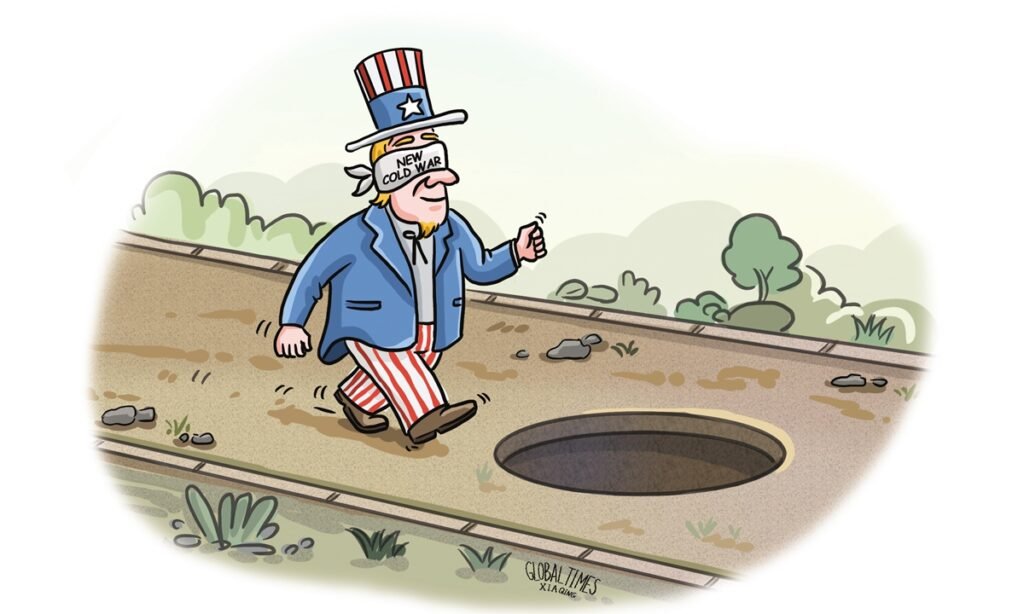
The U.S. Cold War Against China Is Self-Destructive

A couple of years ago, The Transnational Foundation for Peace and Future Research, TFF, in Sweden, of which I am the director, published ”Behind The Smokescreen. An Analysis of the West’s Destructive China Cold War Agenda And Why It Must Stop” (130 pages).

Among several perspectives of the U.S./Western accusation industry, we looked into the medialised stories about genocide in Xinjiang, forced labour, and Taiwan and nine mainstream media manipulation methods that aim to manufacture a systematically negative image of China in the Western mind.

We found that the Cold War happens by attempts to influence the ’free’ press – also the Western state press – through three main mechanisms: a) Fake or fabricated stories, b) Omission – for instance, of every positive aspect of China’s developments, and c) Source Ignorance: using the same few disinformative sources from the U.S. rippling through and being repeated ad nauseam and never checking the root empirical evidence or validity of the assertions. In short, FOSI.

Ultimately, this causes a decay of the crucial, critical role of mainstream media and their conversion towards tabloid banalising black-and-white worldviews – ”we good, them evil” – that promote confrontation and warfare operated by the Military-Industrial-Media-Academic Complex, MIMAC.

Tragically for democracy, mainstream media have become a leading promoting militarism, armament, and legitimising the Empire and its wars.

What are the elements of the Cold War in all this?

First and foremost, the Cold War is a psycho-political phenomenon. It dichotomises our incredibly complex world into two: good versus evil. It seeks to preserve ’our’ superiority and keep others submissive and weaker. It promises war if its deterrence fails. And it precludes a world of equals, cooperation and mutual learning. If you are Number 1 in a system, you do not learn and listen; you teach, bribe and issue orders.

Cold Wars may go well for the Cold Warrior when in ascendance. In the ”old” Cold War in Europe, two fundamentally Western systems – one based on Karl Marx, the other on Adam Smith, to put it crudely – competed while the US/NATO ascended after 1945. On all power scales, it was superior to the Soviet Union and its system. We know the end.

The winner then – foolishly – took it all: The US/NATO world did what it pleased within its exceptionalist ’international rules-based order,’ not the UN Charter and other parts of international law. Catchwords: out-of-NATO-area military actions in violation of NATO’s own Treaty – Yugoslavia – and regime change/resource/anti-terrorism wars on an assembly line basis; NATO’s expansion against all promises given to the Soviet Union – a reckless hubris-like taking advantage of Russia’s de facto lying down.
It all went so well and seemed so easy. Why listen to or empathise with others? Why focus on the changing world when ’we’ are the change-makers, God’s own country par excellence? If we can get away with it, we do it. However, prudence, statesmanship and long-range thinking would have compelled global impact analyses instead of narcissist imperial self-aggrandisement.

So well did it go that the West overlooked the Rest: China’s impressive socio-economic development based on an eclectic combination of Chinese concepts – that the West still don’t understand – and imported Western elements; the establishment and maturation of organisations like BRICS, Shanghai Cooperation Organisation, and African and other regional organisations.

The West also did not sense the actual prices of its militarism: It’s huge and growing burden on all civilian sectors, including technology and economy and – in the wake of the history of colonialism and imperialism – the Rest becoming more and more nationally and collectively self-reliant – a concept developed about 50 years ago and ridiculed by the West.

And the result? Well, this article is written the day after BRICS expanded with essential countries in Africa, the Middle East and South America – a huge step towards a multipolar and cooperative Rest saying: We can do without you, America and Europe! If you want to cooperate on new, reasonable terms, we are ready, but the days of your Western hegemony and universalisation of Western values are numbered.

Such is global macro history: Empires have come and gone, and that of the US/NATO is the last: Nobody is so naive as to believe that it has a God-given right to be the ruler of the whole world and force others to accept its values.

The enormous world order changes before our eyes were as predictable as inexorable. Only the ignorance – blinding intoxication – of power overlooks it. The West has run its race and become over-extended, insensitive to other cultures and ways of thinking, and unable to adapt to system changes but insists on steering unilaterally. It’s losing legitimacy in the eyes of others, relative economic and political strength and the creative ability to outline a better future world that the Rest feels attracted to: Classical decline indicators!

What I have said here is pure Gandhian thinking: You may harm others by using violence – physical, economic, military, structural, cultural and environmental violence – but, sooner rather than later, your violence boomerangs: corrupts, debases, brutalises and makes you more loathed than loved.

A critical mass will develop.

In a deeper socio-cultural sense, the Christian Occident has never appropriately problematised those many types of violence upon which it built its relations with The Rest.

The West’s Cold War on China is about so much more than the issues that dominate daily news – chips, trade, Taiwan and the topics of the permanent accusation industry.

It’s about profound tectonic changes in humanity’s way of developing – and about whether or not the West will join and contribute or become a de-developed periphery in the new world. And whether its Empire will go down with a whimper or a bang or adapt to macro history’s unavoidable changes.

We know very little about humanity’s future in the next 100 or so years. The safest philosophy will be for The Rest to, despite all, extend compassion and cooperation to the good forces of The West and abstain from tit-for-tat against its evil ones.

It is easy, fast and safe. Go here. Many thanks!

Peace & future researcher + ‌Art Photographer

Share

Leave a Reply

Your email address will not be published. Required fields are marked *

Related Posts

PressInfo # 141, December 21, 2001It’s time to prepare reconciliation between Albanians and Serbs PressInfo # 140, December 14, 2001Ibrahim Rugova’s decade-long leadership in Kosovo/a PressInfo # 139, 11. december, 2001En god nyhet: Jugoslaviens Sannings- och försoningskommission PressInfo # 139, 11. december, 2001Gode nyheder: Jugoslaviens Sandheds- og Forsoningskommission PressInfo # 139, December 11, 2001Good news: Yugoslavia’s Truth and Reconciliation Commission PressInfo # 138, November 8, 2001TFF co-founder PhD with thesis about young people with roots in other cultures PressInfo # 138, November 8, 2001TFF:s medstiftare doktor på avhandling om unga med ursprung i andra kulturer PressInfo # 137, October 17, 2001A new Marshall Plan: Advancing human security and controlling terrorism PressInfo # 136, October 15, 2001The UN and Annan really deserve it PressInfo # 135, October 10, 2001Preventing a terrorist mushroom cloud PressInfo # 134, 17 oktober, 2001Sverige og 11. september PressInfo # 134, October 9, 2001Sweden and September 11...
Peace is promoted by constructive proposals and dialogue Four preceding PressInfos have expressed concern over — and criticised — the ongoing, militarisation of the EU. Some will say: but there are no alternatives. We believe that there are always alternatives, that democracies are characterised by alternatives and choice, and that openly discussed alternatives will improve the quality and legitimacy of society’s decision–making. In addition, it is an intellectual and moral challenge to not only criticise but also be constructive. If we only tell people that we think they are wrong, they are not likely to listen. However, if we say: what are your views on this set of ideas and steps? — we may sometimes engage them in dialogue and sow a seed. Most people in power circles live their daily lives in in a time frame and a social space where certain ideas, viewpoints and concepts are just not...
Photos © TFF 2000 Read PressInfo 90 “Lift the Sanctions and Bring More Aid to Yugoslavia” See Pictures from Belgrade © TFF 2000 Please reprint, copy, archive, quote or re-post this item, but please retain the source.

Recent Articles

PressInfo # 141, December 21, 2001It’s time to prepare reconciliation between Albanians and Serbs PressInfo # 140, December 14, 2001Ibrahim Rugova’s decade-long leadership in Kosovo/a PressInfo # 139, 11. december, 2001En god nyhet: Jugoslaviens Sannings- och försoningskommission PressInfo # 139, 11. december, 2001Gode nyheder: Jugoslaviens Sandheds- og Forsoningskommission PressInfo # 139, December 11, 2001Good news: Yugoslavia’s Truth and Reconciliation Commission PressInfo # 138, November 8, 2001TFF co-founder PhD with thesis about young people with roots in other cultures PressInfo # 138, November 8, 2001TFF:s medstiftare doktor på avhandling om unga med ursprung i andra kulturer PressInfo # 137, October 17, 2001A new Marshall Plan: Advancing human security and controlling terrorism PressInfo # 136, October 15, 2001The UN and Annan really deserve it PressInfo # 135, October 10, 2001Preventing a terrorist mushroom cloud PressInfo # 134, 17 oktober, 2001Sverige og 11. september PressInfo # 134, October 9, 2001Sweden and September 11...
Peace is promoted by constructive proposals and dialogue Four preceding PressInfos have expressed concern over — and criticised — the ongoing, militarisation of the EU. Some will say: but there are no alternatives. We believe that there are always alternatives, that democracies are characterised by alternatives and choice, and that openly discussed alternatives will improve the quality and legitimacy of society’s decision–making. In addition, it is an intellectual and moral challenge to not only criticise but also be constructive. If we only tell people that we think they are wrong, they are not likely to listen. However, if we say: what are your views on this set of ideas and steps? — we may sometimes engage them in dialogue and sow a seed. Most people in power circles live their daily lives in in a time frame and a social space where certain ideas, viewpoints and concepts are just not...
Photos © TFF 2000 Read PressInfo 90 “Lift the Sanctions and Bring More Aid to Yugoslavia” See Pictures from Belgrade © TFF 2000 Please reprint, copy, archive, quote or re-post this item, but please retain the source.

TFF on Substack

Discover more from TFF Transnational Foundation & Jan Oberg.

Most Popular

PressInfo # 141, December 21, 2001It’s time to prepare reconciliation between Albanians and Serbs PressInfo # 140, December 14, 2001Ibrahim Rugova’s decade-long leadership in Kosovo/a PressInfo # 139, 11. december, 2001En god nyhet: Jugoslaviens Sannings- och försoningskommission PressInfo # 139, 11. december, 2001Gode nyheder: Jugoslaviens Sandheds- og Forsoningskommission PressInfo # 139, December 11, 2001Good news: Yugoslavia’s Truth and Reconciliation Commission PressInfo # 138, November 8, 2001TFF co-founder PhD with thesis about young people with roots in other cultures PressInfo # 138, November 8, 2001TFF:s medstiftare doktor på avhandling om unga med ursprung i andra kulturer PressInfo # 137, October 17, 2001A new Marshall Plan: Advancing human security and controlling terrorism PressInfo # 136, October 15, 2001The UN and Annan really deserve it PressInfo # 135, October 10, 2001Preventing a terrorist mushroom cloud PressInfo # 134, 17 oktober, 2001Sverige og 11. september PressInfo # 134, October 9, 2001Sweden and September 11...
Peace is promoted by constructive proposals and dialogue Four preceding PressInfos have expressed concern over — and criticised — the ongoing, militarisation of the EU. Some will say: but there are no alternatives. We believe that there are always alternatives, that democracies are characterised by alternatives and choice, and that openly discussed alternatives will improve the quality and legitimacy of society’s decision–making. In addition, it is an intellectual and moral challenge to not only criticise but also be constructive. If we only tell people that we think they are wrong, they are not likely to listen. However, if we say: what are your views on this set of ideas and steps? — we may sometimes engage them in dialogue and sow a seed. Most people in power circles live their daily lives in in a time frame and a social space where certain ideas, viewpoints and concepts are just not...
Photos © TFF 2000 Read PressInfo 90 “Lift the Sanctions and Bring More Aid to Yugoslavia” See Pictures from Belgrade © TFF 2000 Please reprint, copy, archive, quote or re-post this item, but please retain the source.
Read More
Imagen-thumbnail-The-Transnational-1
PressInfo # 141, December 21, 2001It’s time to prepare reconciliation between Albanians and Serbs PressInfo # 140, December 14, 2001Ibrahim Rugova’s decade-long leadership in Kosovo/a PressInfo # 139, 11. december, 2001En god nyhet: Jugoslaviens Sannings- och försoningskommission PressInfo # 139, 11. december, 2001Gode nyheder: Jugoslaviens Sandheds- og Forsoningskommission PressInfo # 139, December 11, 2001Good news: Yugoslavia’s Truth and Reconciliation Commission PressInfo # 138, November 8, 2001TFF co-founder PhD with thesis about young people with roots in other cultures PressInfo # 138, November 8, 2001TFF:s medstiftare doktor på avhandling om unga med ursprung i andra kulturer PressInfo # 137, October 17, 2001A new Marshall Plan: Advancing human security and controlling terrorism PressInfo # 136, October 15, 2001The UN and Annan really deserve it PressInfo # 135, October 10, 2001Preventing a terrorist mushroom cloud PressInfo # 134, 17 oktober, 2001Sverige og 11. september PressInfo # 134, October 9, 2001Sweden and September 11...
Imagen-thumbnail-The-Transnational-1
Peace is promoted by constructive proposals and dialogue Four preceding PressInfos have expressed concern over — and criticised — the ongoing, militarisation of the EU. Some will say: but there are no alternatives. We believe that there are always alternatives, that democracies are characterised by alternatives and choice, and that openly discussed alternatives will improve the quality and legitimacy of society’s decision–making. In addition, it is an intellectual and moral challenge to not only criticise but also be constructive. If we only tell people that we think they are wrong, they are not likely to listen. However, if we say: what are your views on this set of ideas and steps? — we may sometimes engage them in dialogue and sow a seed. Most people in power circles live their daily lives in in a time frame and a social space where certain ideas, viewpoints and concepts are just not...
Imagen-thumbnail-The-Transnational-1
Photos © TFF 2000 Read PressInfo 90 “Lift the Sanctions and Bring More Aid to Yugoslavia” See Pictures from Belgrade © TFF 2000 Please reprint, copy, archive, quote or re-post this item, but please retain the source.
Imagen-thumbnail-The-Transnational-1
Av FRANK SØHOLM GREVIL 16 augusti 2004  Vi er nu nået til tredje akt i det absurde teaterstykke, der i analogi med de store skueprocesser i Moskva 1936-38 er blevet døbt ‘Grevil-sagen’. Første akt bestod i min anonyme fremlæggelse af egenhændigt nedklassificerede rapporter i Berlingske Tidende i februar og marts. Andet akt udgjordes af min fremtræden med navn og billede i Information i april samt den efterfølgende mediestorm, som uden min direkte medvirken kostede en forsvarsminister taburetten samt en sigtelse for brud på tavshedspligten. Tredje akt bliver en retssag, hvor jeg står tiltalt for at have overtrådt straffelovens bestemmelser om uberettiget videregivelse eller udnyttelse af fortrolige oplysninger. Statsanklageren har ovenikøbet valgt at påberåbe sig særligt skærpende omstændigheder. Da jeg aldrig har modtaget betaling for at stille rapporterne til rådighed eller lade mig interviewe, må det skærpende bestå i, at “videregivelsen eller udnyttelsen er sket under sådanne omstændigheder, at det påfører...
Imagen-thumbnail-The-Transnational-1
Af Svenska Irakkommittén mot de Ekonomiska Sanktionerna (SIES) 13 september 2002 FN:s ekonomiska sanktioner mot Irak har nu pågått i tolv år och drabbat det irakiska folket med svåra lidanden. Enligt FN:s egna siffror har mer än 1,5 miljoner människor, varav ca 600 000 barn, dött som en direkt följd av sanktionerna. Dessutom har ett lågintensivt bombkrig mot landet pågått under dessa år. Av all denna förödelse- orsakad huvudsakligen av amerikansk och brittisk politik- har Saddam Husseins brutala och diktatoriska regim snarast stärkts än försvagats. Nu förbereder USA under president Bushs ledning ett storskaligt bombkrig mot Irak som kommer att innebära ett ännu större lidande för civilbefolkningen. Ett sådant krig kommer dessutom att ytterligare undergräva freden och säkerheten i världen. Att upprätta en demokratisk regim i Irak är det irakiska folkets angelägenhet och får enligt folkrätten inte ske med krigshandlingar utifrån. Folkrätten och FN:s stadgar måste respekteras. Vi vädjar till...