Look at and listen in to three spheres of contemporary Western society – politics, research and media: The word” peace” and related words, such as the UN Charter norm of “making peace by peaceful means”, nonviolence, negotiations – have disappeared. And with the words, the discourse and with the discourse, the interest, the education and expertise, the focus, the awareness and the strategies.
Let us start with the political sphere. In Scandinavia where I happen to live, today’s status is very different from the 1980s. There are no global disarmament policies or disarmament ministers; the UN’s basically non-armed peace-keeping is hardly ever mentioned; while Sweden has integrated with NATO and has soldiers under NATO command, it no longer contributes a single UN peacekeeper.
Ideas such as human security, common security and confidence-building measures with the presumed enemy are never mentioned in the political discourse. The Corona crisis has also shown that there never was any planning for human security.
When Denmark goes to war which, regrettably, it has done more or less constantly since 1999 – a trend toward rogue state status started by the Social Democrats – responsible politicians merely state that it will serve stability, security and peace, promote democracy or take down a dictator. There is no analytical work and no consulting with conflict and peace-making before the F16s take off – usually less than 24 hours after Washington has called.
In the research sphere, Scandinavia used to be a region with quite good critical and, to some extent, solution-oriented peace research institutes. SIPRI now calls itself” the independent resource on global security”. It’s Stockholm conferences that you may watch on various videos are filled with diplomats, security experts and other government representatives who do not focus on theories, concepts or development of them. Its funding includes a series of NATO/EU governments. In 2020 it worked closely with the Münich Conference.
The originally stipulated theory development and focus on making proposals for conflict-resolution has been watered down in the latest version of the statutes.
In Denmark, the well-respected Copenhagen Peace Research Institute (COPRI) directed at the time by Håkan Wiberg was closed down by the same government that made Denmark an occupying power 2003-2007 in Iraq – Denmark’s perhaps biggest foreign policy blunder since 1945. Instead, a series of military-oriented research centres have been established over the years – in addition to military research facilities such as the Defence Academy.
The Danish Institute of International Studies, DIIS, has substantial funding from the Ministry of Defence; its director is experienced from his deputy permanent secretary position at the Ministry of Defence and in the Danish delegation to NATO.
Some of the remaining university-based peace research departments in Scandinavia may study peace concepts or activism, a bit here and there, but the thrust is theories and policies of conflict, violence and war – and no alternatives to world militarism.
Mainstreaming has been on the research agenda for decades. Criticism of militarism, nuclear policies and interventionism is hard to find now, except in tiny local peace movement circles consisting of older age segments. In spite of their knowledge and life experience, they are never invited to give their views in the media. One such group that deserves international recognition is “Fredsvagten” – The Peace Guard – outside the Danish parliament building, Christiansborg. They have been standing there every day since 2001 when the US commenced its Global War on Terror – that is 7000 days now!
Third, the mainstream media does not require much space here. It is abundantly clear to me – having followed the international affairs coverage also in the mainstream press over four decades – that there is no fundamental questioning of Western interventionism, US foreign policies in particular, today. The New York Times is allegedly still the only newspaper that has apologised for its misleading coverage up to the intervention in Iraq – but then continued that type of coverage in the cases of Libya and Syria.
I could write a book about a) all the media work I did between the late 1970s and up to around 2005 after which no requests – and b) the attempts at manipulations I have experienced, including framings.
The last massive Syria media narrative had perhaps even less to do with reality than earlier conflicts.
In December 2016 I was in Eastern Aleppo when it was liberated from terrorist occupation, the only person from Scandinavia and one of only a handful of Westerners. Nevertheless, not one Western mainstream media of about a hundred approached wanted my texts or photos – all published instead on our foundation’s homepage.
Sweden has, since the days of Olof Palme’s murder – moved incrementally in the direction of NATO membership. There is a Host Nation Support Agreement and huge NATO exercises are regularly held on Swedien’s territory. Its mainstream media question neither this trend nor how this has happened over some 20 years with the deliberate strategy to minimise public debate.
Of course, Scandinavia is not the whole West, and some countries may be worse, some better. However, the media homogenisation is so uniform and systematic that it is natural to assume that there is a conductor deciding which tune to play and whose hand movements decide when to start and stop plaing.
For instance, since Aleppo 2016 when this basically Western regime-change policy had failed miserably, how much have the media told us about Syria?
• • •
Militarism as the new God
After these scattered observations, let me jump the causes – which I judge to be many and complex – and just say that what I call the Military-Industrial-Media-Academic Complex (MIMAC) is the dominant reason behind the fact that the peace discourse has disappeared.
It is a much wider and deeper notion than when President Eisenhower, in his farewell speech in 1961, talked about the MIC – the Military-Industrial Complex.
While so much bigger and resource consuming as well as globalised today compared with back then, this MIMAC has become the elephant in the centre of the room of Western civilisation which rather small vested elite interests have a common interest in maintaining with as little public debate as possible. It is also in their interest to secure that it should not be seen, interpreted and certainly not disarmed.
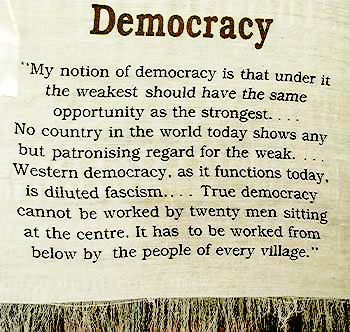
Of course, this militates against democracy as well as human welfare.
It may even have become a kind of religion-like mental construction or thought-structure. It can certainly be argued that the militarised governments based on MIMAC dynamics substitute a sense of authority that – earlier – was placed in the hands of God before the whole society secularised ad absurdum and subordinated values and ethics under the market mechanism and blind technological “progress” only at the end to find itself in a deep identity crisis.
It could also be that it satisfies the human need for protection – however, in this case in exchange for obedience and the non-questioning of this God-like MIMAC.
Like other faiths, the MIMAC has its priesthood, its followers – who are not supposed to question any of it – and its punishment of unbelievers.
Leading Buddhist teacher and thinker (and TFF Associate), David Loy, has written about this – about the militarized, corporate state as contemporary Western deity although he has not made use of the MIMAC concept.
Carrying this a bit further, one may add that since the birth of the nuclear weapon, man took over what had up till then been God’s prerogative – namely to decide whether humankind should, or should not, continue to exist. Thus, we did not need God; we took over God’s role. Remember Charlie Chaplin’s Hynkel/Hitler playing with the globus at his desk in “The Great Dictator” (1940)?
The MIMAC deity is, of course, invisible. It has an invisible hand that runs everything (like the invisible hand on the neo-liberal market) and people who believe in it feel they get protection. It no longer has to reason, argue or document any facts about the observable world; it is enough to state a) that there are “infidels” out there who are threatening us and b) that whatever it does serves “stability, security and peace” (NATO).
Philosophically, it rests purely on fear and faith – believe it or not, you may add.
It runs, of course, on constructed, outdated Them/Us paradigms: there is some Evil out there that must be combatted and killed (purification of the world, the extermination of the evil/infidels), carried through with the Sword – or to be brought over to us, become like us, feel like us and see the world like we do (mission with a Bible in hand).
In this perspective, arms trade is much more than the transfer of destructive capacity; it is rather a currency or exchange coins that symbolises and solidifies the MIMAC community among elite believers of the same faith. A bonding, or a pact.
The faith in militarism as the main tool to solve whichever problem – be it that of enemy threats, carrying through defence sector reforms or mould governments and societies to forward the message to yet others is boundless. The military and its bonding elites profess to be able to help bring about democracy in faraway lands and cultures, create the preconditions for (Western) understanding of gender equality and human rights and direct/protect refugees on the run from its own war zones.
And when the world talks about climate change and sustainability, militarism is responding by making its military bases and exercises “green” and environmentally friendly. Not even Greta Thunberg has had the civil courage to mention the huge role of the global military in the process of environmental destruction – not to speak of the Creation that would be totally destroyed by nuclear war.
While people engage in the environment and climate ‘change’ (a newspeak term preferred over all the others since’ change’ is positive…), they do not seem to care much about nuclear weapons as the by far largest and potentially most destructive threat to humanity’s survival.
Or, take a look at, first, the UN’s 8 old Millennium Goals – target date 2015. Not one of them had a focus on weapons, disarmament, warfare, arms trade and all that. No challenging of the military national security concept and not a word about nuclear weapons.
Go then to the UN’s 17 Sustainability goals – target date 2030. Goal number 16 has a headline with the word “peace” in it. Click that Goal 16, “Promote justice, peaceful and inclusive societies”, and you’ll see, it has nothing to do with the problems mentioned in the preceding para. Either.
So, not even the United Nations – whose Charter mentions the abolition of war in its Preamble, whose Article 1 puts forward the norm that “peace shall be brought about by peaceful means” and who has invented the idea of peacekeeping and – also – has defined, in its Chapter 7, how military force can be used to re-establish peace (but only as a last resort) – even that fine organisation has been prevented by the most militarist member states to include peace, disarmament, nuclear abolition, human and global security, etc. among the goals we must strive to achieve before 2030.
One may even ask: What is actually left that the military as part of the MIMAC can not be brought in to do? If given the appropriate resources paid by taxpayers’ money – a kind of collect in the church – virtually any sector of society can benefit from, or be taken over by, the MIMAC. To sell that, all you need is the NATO mantra which states that, no matter what the alliance actually does, it creates” stability, security and peace” – all of which are devoid of evidence from the moment those words come flying out of the mouth of, say, NATO’s S-G.
So, are we saying that militarism moulds civil society into a garrison state and that society operates like under top-down control from an authoritarian leader? No, far from it. You also do not see political leaders in uniforms or huge military parades in the capitals of the West. Why?
Contemporary militarism is something very different from the times of, say, Alfred Vagts who in 1937 published his classical book, A History of Militarism: Civil and Military. Today it is about two mutually bending longterm trends: the military operates more and more in a civilian manner inside society, and society becomes increasingly authoritarian in its structures and modes of operation. But while the military thinking has melted into society, civilian thinking – and means – have not melted into the defence and security sectors, at least not to the same extent. If they did and societies would go for civilian conflict-resolution, defensive defence, nonviolence and negotiations, the military would no longer be able to usurp civil society on which it depends for its survival.
To maintain MIMAC and continuously find new “threats” (like an addict searching all the time for the next heroin shot) – the focus ranges from North Korea, Iran, to the classical Soviet/Russian enemy (with 8% of 30 NATO members’ military expenditures and falling) and since Obama’s” pivot” – to China.
Call it North Koreaphobia, Iranophobia, Russophobia and Sinophobia. As TFF Associate in Beijing, Gordon Dumoulin recently argued, the latest US State Department report, The Elements of the China Challenge, reads quite a lot like the Ten Commandments of what the US/West must and must not do vis-a-vis China. It’s clearly faith- rather than fact-based.
• • •
Militarism as the largest single cause of Western decline
In summary, the peace discourse has been marginalised, indeed disappeared. The winner – militarism – has taken it all. For now and some time. But it is self-defeating. With it go hubris, over-extension, a center that will not hold and – most importantly – an inability to grasp (“group think”) that the rest of the world is changing rapidly.
The enemies are invented/imagined and, in reality, rather more projections of one’s own dark features upon ’the others’.
To uphold the MIMAC, the West has increasingly to distort reality and base itself on fake – production of enemies that are not, deceptive media narratives, the silent acceptance of its own politically and morally failed projects in one war zone after the other and the toll these wars take on the interventionist’s and warmaster’s own society – blowback in the larger sense of the term.
It also has to omit every mention of the positive sides of the designated enemy. There is nothing good to say about North Korea, Iran, Russia and China. Period. And only good things to talk about when it comes to ourselves – noble motives, superior civilisation and ”better” values.
Like in the Soviet Union towards the end, fewer and fewer will believe it. Legitimacy in the eyes of others will fade. The truth, to the extent that there is one, is that there is nobody who threatens the West. It is the West that is doing incredible harm to itself and undermines its economy, legitimacy, vision and democracy as well as its moral power.
The latter is, of course, undermined by the deceptive policies embedded in the short sentence uttered with pride by US Secretary of State, Mike Pompeo – “We lied, we cheated, we stole. We had entire training courses. It reminds you of the glory of the American experiment.”
So the Empire – the glory of the American experiment – is coming to an end. All empires do – and then it will fall. Militarism will be the largest single cause of that demise, Eisenhower’s warnings completely ignored and so too Luther King Jr.’s “America, you are too arrogant.”
• • •
Peace people combine passion with detachment
So if you are a peace researcher, peace activist or peace journalist, what do you do in the nearest times when peace is basically out of sight? I would try to suggest:
- Look at it in a macro perspective – a few years is nothing in world history although, of course, it may be in one’s own life depending on how far through it you have advanced.
- Do not give up or hibernate.
- Do for peace what you have always done, light a candle, don’t waste your time cursing the darkness. (It’s not peace to only criticize violence, wars and weapons).
- Do something else simultaneously and creatively, that recharges your batteries and gives you joy while we wait for more peaceful times.
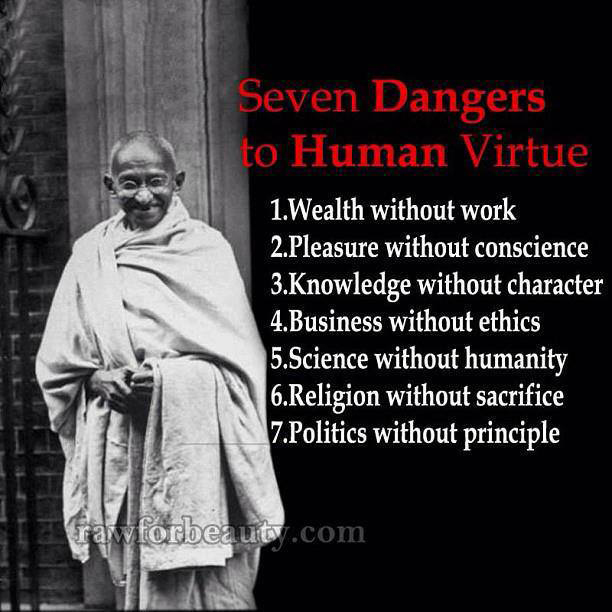
And, finally, remember Gandhi’s words in 1946: “A burning passion coupled with absolute detachment is the key to all success.” Gandhi (Harijan, 9-29-1946, p. 336). If you worked for peace to get famous or be awarded prizes (as the fruits, or rewards) then better you stop.
But if you work with the conviction that that is what you must do, can not not do, then you are like the artist who continues to work creatively because it is an inner urge, a passion, rather than in order to become rich and famous. (An they turn out, in hindsight if not while still alive, to be the greatest).
In short, don’t follow the past or the present – which admittedly looks a bit overclouded right now. Do not give in to the wish of those in power who rule more smoothly when you feel powerless and stop researching, criticising, imagining and struggling for the better future(s) to come.
Over the clouds, the sky is blue.
With another piece of Gandhi wisdom, be the change you want to see – that is, do your pro-peace work only with a view to the future, with passion in what you do and total detachment from the immediate fruits of it.
Peace is part of the good society. We do not know that the good society is impossible, so let’s try. If we don’t try, we can be sure that it will never emerge. In the longer perspective – logically – violence is other/self-destructive while non-violence is constructive.
If you think thoughts like these are important and perhaps even made you see things from a different perspective, please show it here – thanks.