
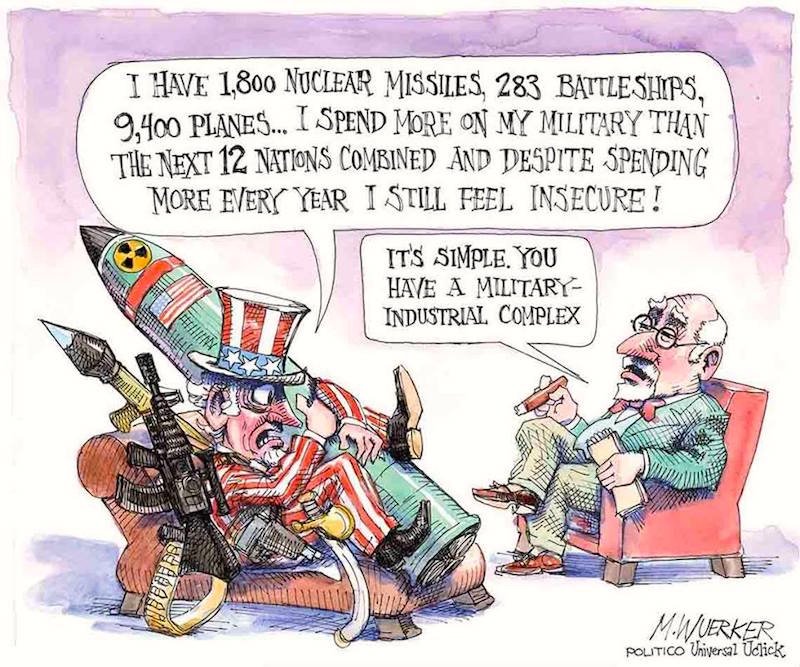
The militarization of everything

By William J. Astore

November 14, 2019

The expanding cultural authority of the armed forces is a problem for U.S. democracy, writes William J. Astore.

When Americans think of militarism, they may imagine jackbooted soldiers goose-stepping through the streets as flag-waving crowds exult; or, like our president, they may think of enormous parades featuring troops and missiles and tanks, with warplanes soaring overhead. Or nationalist dictators wearing military uniforms encrusted with medals, ribbons, and badges like so many barnacles on a sinking ship of state. (Was President Donald Trump only joking recently when he said he’d like to award himself a Medal of Honor?)

And what they may also think is: that’s not us. That’s not America. After all, Lady Liberty used to welcome newcomers with a torch, not an AR-15. We don’t wall ourselves in while bombing others in distant parts of the world, right?

Article posted on ConsortiumNews.com on October 31, 2019 (original article is posted on TomDispatch.com) here

But militarism is more than thuggish dictators, predatory weaponry, and steely-eyed troops. There are softer forms of it that are no less significant than the “hard” ones. In fact, in a self-avowed democracy like the United States, such softer forms are often more effective because they seem so much less insidious, so much less dangerous.

Even in the heartland of Trump’s famed base, most Americans continue to reject nakedly bellicose displays like phalanxes of tanks rolling down Pennsylvania Avenue. 

But who can object to celebrating “hometown heroes” in uniform, as happens regularly at sports events of every sort in 21st-century America? Or polite and smiling military recruiters in schools? Or gung-ho war movies like the latest version of “Midway,” timed for Veterans Day weekend 2019 and marking America’s 1942 naval victory over Japan, when we were not only the good guys but the underdogs?
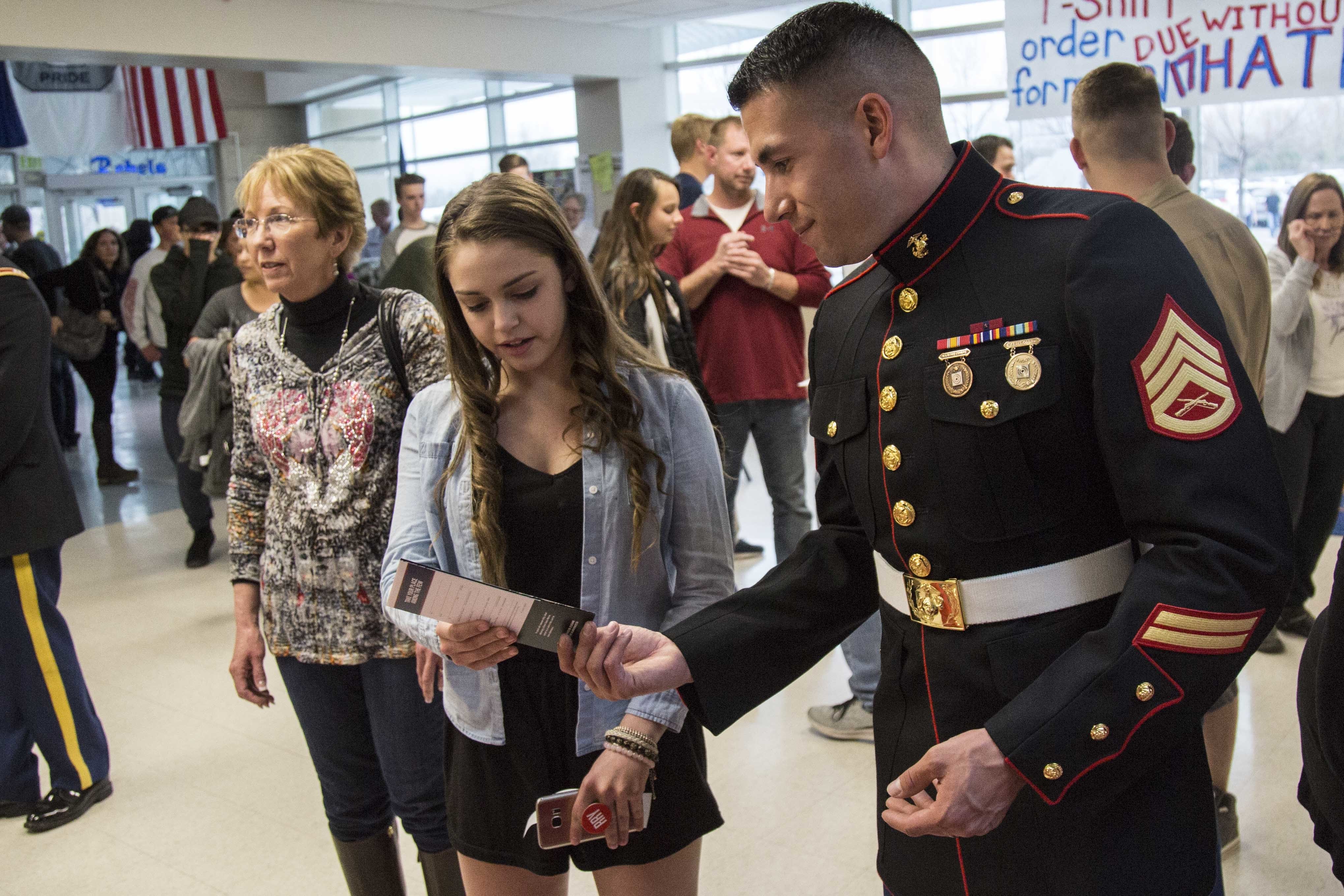
Recruiter with an attendee of the Military Exploration Workshop at Columbine High School in Littleton, Colorado, March 21, 2017. (DoD/Benjamin Pryer)

What do I mean by softer forms of militarism?

I’m a football fan, so one recent Sunday afternoon found me watching an NFL game on CBS. People deplore violence in such games, and rightly so, given the number of injuries among the players, notably concussions that debilitate lives. But what about violent commercials during the game? In that one afternoon, I noted repetitive commercials for “SEAL Team,” “SWAT,” and “FBI,” all CBS shows from this quietly militarized American moment of ours.

In other words, I was exposed to lots of guns, explosions, fisticuffs, and the like, but more than anything I was given glimpses of hard men (and a woman or two) in uniform who have the very answers we need and, like the Pentagon-supplied police in Ferguson, Missouri, in 2014, are armed to the teeth. (“Models with guns,” my wife calls them.) 

Got a situation in Nowhere-stan? Send in the Navy SEALs. Got a murderer on the loose? Send in the SWAT team. With their superior weaponry and can-do spirit, Special Forces of every sort are sure to win the day (except, of course, when they don’t, as in America’s current series of never-ending wars in distant lands).

And it hardly ends with those three shows. Consider, for example, this century’s update of “Magnum P.I.,” a CBS show featuring a kickass private investigator. In the original “Magnum P.I.” that I watched as a teenager, Tom Selleck played the character with an easy charm. Magnum’s military background in Vietnam was acknowledged but not hyped. Unsurprisingly, today’s Magnum is proudly billed as an ex-Navy SEAL.

Cop and military shows are nothing new on American TV, but never have I seen so many of them, new and old, and so well-armed. On CBS alone you can add to the mix “Hawaii Five-O” (yet more models with guns updated and up-armed from my youthful years), the three “NCIS” (Naval Criminal Investigative Service) shows, and “Blue Bloods” (ironically starring a more grizzled and less charming Tom Selleck) — and who knows what I haven’t noticed?

While today’s cop/military shows feature far more diversity with respect to gender, ethnicity, and race compared to hoary classics like “Dragnet,” they also feature far more gunplay and other forms of bloody violence.

Look, as a veteran, I have nothing against realistic shows on the military. Coming from a family of first responders — I count four firefighters and two police officers in my immediate family — I loved shows like “Adam-12” and “Emergency!” in my youth.

What I’m against is the strange militarization of everything, including, for instance, the idea, distinctly of our moment, that first responders need their very own version of the American flag to mark their service. Perhaps you’ve seen those thin blue line flags, sometimes augmented with a red line for firefighters.

As a military veteran, my gut tells me that there should only be one American flag and it should be good enough for all Americans. Think of the proliferation of flags as another soft type of up-armoring (this time of patriotism). 

Speaking of which, whatever happened to “Dragnet’s” Sergeant Joe Friday, on the beat, serving his fellow citizens, and pursuing law enforcement as a calling? He didn’t need a thin blue line battle flag. And in the rare times when he wielded a gun, it was .38 Special. Today’s version of Joe looks a lot more like G.I. Joe, decked out in body armor and carrying an assault rifle as he exits a tank-like vehicle, maybe even a surplus MRAP from America’s failed imperial wars.

U.S. Marines assist in the filming “SEAL Team” on Marine Corps Base Camp Pendleton, Calif., Jan. 14, 2019. Camp Pendleton has been used as a filming site by a number of shows and movies in order to replicate the realism of the military services. (U.S. Marine Corps/Joseph Prado)

Militarism in the USA

Besides TV shows, movies, and commercials, there are many signs of the increasing embrace of militarized values and attitudes in this country. The result: the acceptance of a military in places where it shouldn’t be, one that’s over-celebrated, over-hyped, and given far too much money and cultural authority, while becoming virtually immune to serious criticism.

Let me offer just nine signs of this that would have been so much less conceivable when I was a young boy watching reruns of “Dragnet”:

  1. Roughly two-thirds of the federal government’s discretionary budget for 2020 will, unbelievably enough, be devoted to the Pentagon and related military functions, with each year’s “defense” budget coming ever closer to a trillion dollars. Such colossal sums are rarely debated in Congress; indeed, they enjoy wide bipartisan support.
  2. The U.S. military remains the most trusted institution in our society, so say 74 percent of Americans surveyed in a Gallup poll. No other institution even comes close, certainly not the presidency (37 percent) or Congress (which recently rose to a monumental 25 percent on an impeachment high).
    Yet that same military has produced disasters or quagmires in Afghanistan, Iraq, Libya, Syria, Somalia, and elsewhere. Various “surges” have repeatedly failed.
    The Pentagon itself can’t even pass an audit. Why so much trust?
  3. A state of permanent war is considered America’s new normal. Wars are now automatically treated as multi-generational with little concern for how permawar might degrade our democracy.
    Anti-war protesters are rare enough to be lone voices crying in the wilderness. 
  4. America’s generals continue to be treated, without the slightest irony, as “the adults in the room.” Sages like former Secretary of Defense James Mattis (cited glowingly in the recent debate among 12 Democratic presidential hopefuls) will save America from unskilled and tempestuous politicians like one Donald J. Trump.
    In the 2016 presidential race, it seemed that neither candidate could run without being endorsed by a screaming general (Michael Flynn for Trump; John Allen for Clinton).
  5. General James Mattis on MSNBC. (Screen shot below) The media routinely embraces retired U.S. military officers and uses them as talking heads to explain and promote military action to the American people. Simultaneously, when the military goes to war, civilian journalists are “embedded” within those forces and so are dependent on them in every way. The result tends to be a cheerleading media that supports the military in the name of patriotism — as well as higher ratings and corporate profits.
  6. America’s foreign aid is increasingly military aid. Consider, for instance, the current controversy over the aid to Ukraine that Trump blocked before his infamous phone call, which was, of course, partially about weaponry. This should serve to remind us that the United States has become the world’s foremost merchant of death, selling far more weapons globally than any other country.
    Again, there is no real debate here about the morality of profiting from such massive sales, whether abroad ($55.4 billion in arms sales for this fiscal year alone, says the Defense Security Cooperation Agency) or at home (a staggering 150 million new guns produced in the USA since 1986, the vast majority remaining in American hands).
  7. In that context, consider the militarization of the weaponry in those very hands, from .50 caliber sniper rifles to various military-style assault rifles. Roughly 15 million AR-15s are currently owned by ordinary Americans. We’re talking about a gun designed for battlefield-style rapid shooting and maximum damage against humans.
    In the 1970s, when I was a teenager, the hunters in my family had bolt-action rifles for deer hunting, shotguns for birds, and pistols for home defense and plinking. No one had a military-style assault rifle because no one needed one or even wanted one. Now, worried suburbanites buy them, thinking they’re getting their “man card” back by toting such a weapon of mass destruction.
  8. Paradoxically, even as Americans slaughter each other and themselves in large numbers via mass shootings and suicides (nearly 40,000 gun deaths in 2017 alone), they largely ignore Washington’s overseas wars and the continued bombing of numerous countries. But ignorance is not bliss. By tacitly giving the military a blank check, issued in the name of securing the homeland, Americans embrace that military, however loosely, and its misuse of violence across significant parts of the planet.
    Should it be any surprise that a country that kills so wantonly overseas over such a prolonged period would also experience mass shootings and other forms of violence at home?
  9. Even as Americans “support our troops” and celebrate them as “heroes,” the military itself has taken on a new “warrior ethos” that would once — in the age of a draft army — have been contrary to this country’s citizen-soldier tradition, especially as articulated and exhibited by the “greatest generation” during World War II.
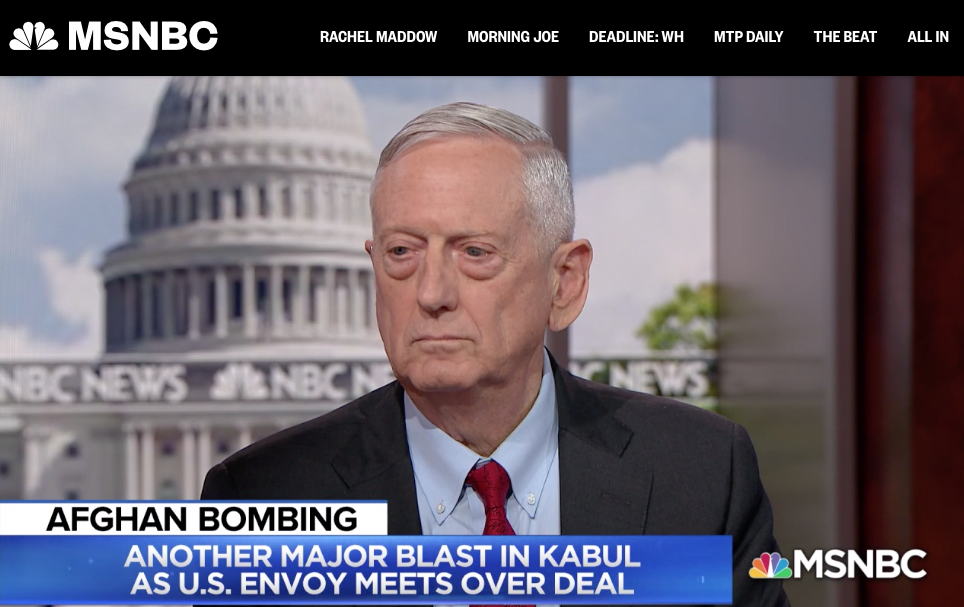
General James Mattis on MSNBC

What these nine items add up to is a paradigm shift as well as a change in the zeitgeist. The U.S. military is no longer a tool that a democracy funds and uses reluctantly.  It’s become an alleged force for good, a virtuous entity, a band of brothers (and sisters), America’s foremost missionaries overseas and most lovable and admired heroes at home. This embrace of the military is precisely what I would call soft militarism. Jackbooted troops may not be marching in our streets, but they increasingly seem to be marching unopposed through — and occupying — our minds.
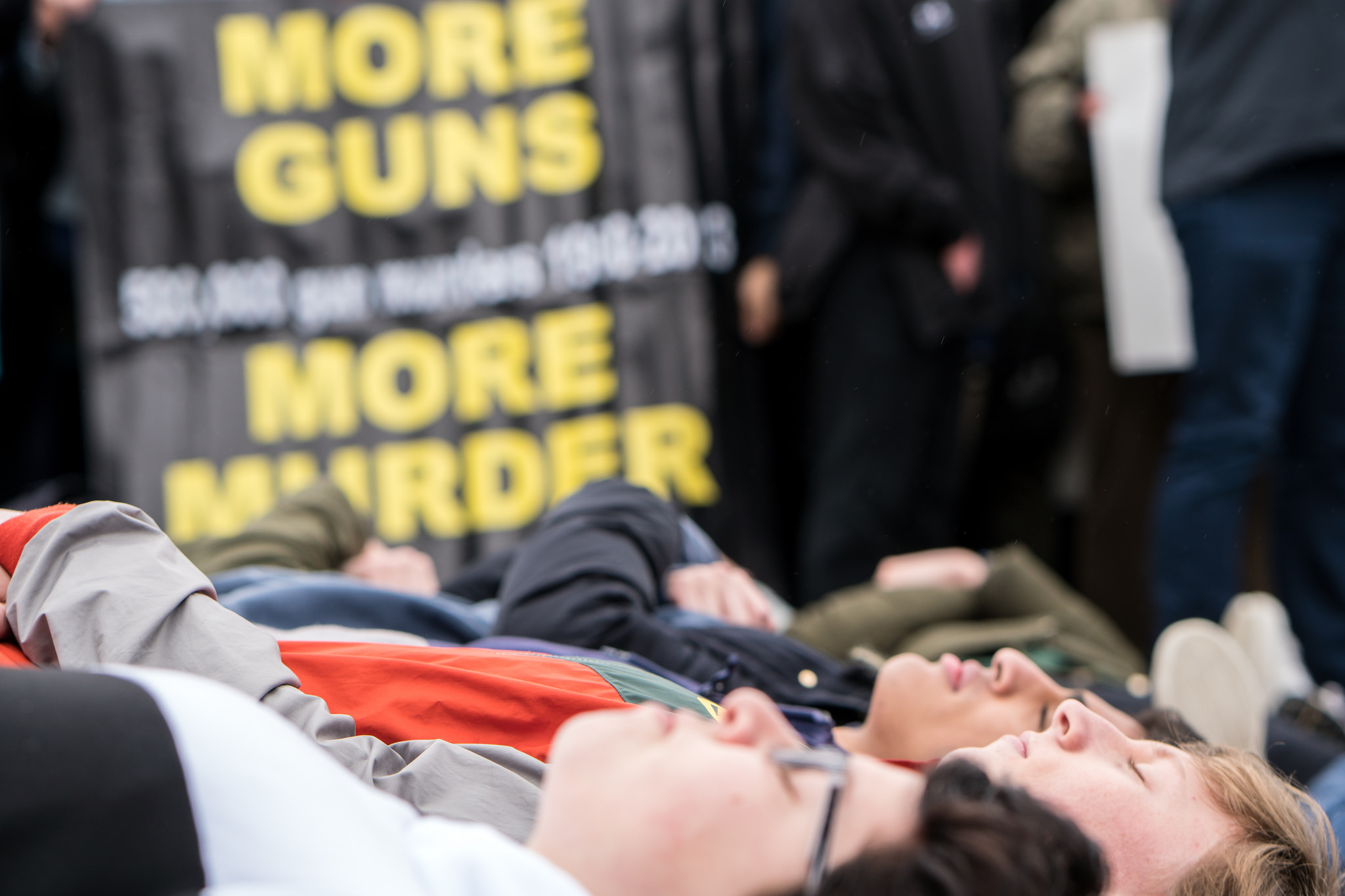
Die-in demonstration in February 2018 organized by Teens For Gun Reform in wake of the shooting at Marjory Stoneman Douglas High School in Parkland, Florida. (Lorie Shaull via Flickr)
Die-in demonstration in February 2018 organized by Teens For Gun Reform in wake of the shooting at Marjory Stoneman Douglas High School in Parkland, Florida. (Lorie Shaull via Flickr)

The Decay of Democracy

As Americans embrace the military, less violent policy options are downplayed or disregarded. Consider the State Department, America’s diplomatic corps, now a tiny, increasingly defunded branch of the Pentagon led by Mike Pompeo (celebrated by Trump as a tremendous leader because he did well at West Point). Consider Trump as well, who’s been labelled an isolationist, and his stunning inability to truly withdraw troops or end wars.

In Syria, U.S. troops were recently redeployed, not withdrawn, not from the region anyway, even as more troops are being sent to Saudi Arabia. In Afghanistan, Trump sent a few thousand more troops in 2017, his own modest version of a mini-surge and they’re still there, even as peace negotiations with the Taliban have been abandoned. That decision, in turn, led to a new surge (a “near-record high”) in U.S. bombing in that country in September, naturally in the name of advancing peace. The result: yet higher levels of civilian deaths.

How did the U.S. increasingly come to reject diplomacy and democracy for militarism and proto-autocracy? Partly, I think, because of the absence of a military draft. Precisely because military service is voluntary, it can be valorized. It can be elevated as a calling that’s uniquely heroic and sacrificial. Even though most troops are drawn from the working class and volunteer for diverse reasons, their motivations and their imperfections can be ignored as politicians praise them to the rooftops.

Related to this is the Rambo-like cult of the warrior and warrior ethos, now celebrated as something desirable in America. Such an ethos fits seamlessly with America’s generational wars. Unlike conflicted draftees, warriors exist solely to wage war. They are less likely to have the questioning attitude of the citizen-soldier. 

Don’t get me wrong: reviving the draft isn’t the solution; reviving democracy is. We need the active involvement of informed citizens, especially resistance to endless wars and budget-busting spending on American weapons of mass destruction. The true cost of our previously soft (now possibly hardening) militarism isn’t seen only in this country’s quickening march toward a militarized authoritarianism.

It can also be measured in the dead and wounded from our wars, including the dead, wounded, and displaced in distant lands. It can be seen as well in the rise of increasingly well-armed, self-avowed nationalists domestically who promise solutions via walls and weapons and “good guys” with guns. (“Shoot them in the legs,” Trump is alleged to have said about immigrants crossing America’s southern border illegally.)

Democracy shouldn’t be about celebrating overlords in uniform. A now-widely accepted belief is that America is more divided, more partisan than ever, approaching perhaps a new civil war, as echoed in the rhetoric of our current president. Small wonder that inflammatory rhetoric is thriving and the list of this country’s enemies lengthening when Americans themselves have so softly yet fervently embraced militarism.

With apologies to the great Roberta Flack, America is killing itself softly with war songs.

William J. Astore

William J. Astore is a retired lieutenant colonel (USAF) and professor of history who has written for TomDispatch.com, Truthout, History News Network (HNN), Alternet, Salon, Antiwar.com, and Huffington Post among other sites.  He is the author or co-author of three books and numerous articles focusing on military history as well as the history of science, technology, and religion.  He is a co-founder of The Contrary Perspective (TCP) and served as its editor and chief writer from 2013 to 2015.

No data was found

Share

Leave a Reply

Your email address will not be published. Required fields are marked *

Related Posts

OK, Trump did not get it. But he got a full endorsement of a possible future US regime change in Venezuela. And that is what Ms Machado has advocated. On October 10, 2025, the Norwegian Nobel Committee awarded its Peace Prize to Venezuelan opposition figure María Corina Machado. The citation praised her “tireless work promoting democratic rights.” But Ms Machado has openly called for U.S. military intervention in Venezuela, stating on CBS: “The only way to stop the suppression is by force—U.S. force.” She or her party has received funding from the National Endowment for Democracy (NED), a U.S. government-backed body known as a CIA front organisation and for supporting regime-change operations worldwide. And in 2018, she sent a letter to Israeli Prime Minister Benjamin Netanyahu, asking him to use “force and influence” to help dismantle Venezuela’s government—citing alleged ties to terrorism, Iran and narcotrafficking. This year’s NATO Norwegian prize...
PRESS RELEASE – 6 OCTOBER 2025 LAY DOWN YOUR ARMSPEACE PRIZE FOR 2025 is awarded Francesca Albanese The United Nations Special Rapporteur on the occupied Palestinian territories – as the person who, in accordance with Alfred Nobel’s will, has “done the most or the best work for fraternity between nations and for the abolition or reduction of standing armies as well as for the holding and promotion of peace congresses.” Francesca Albanese has forcefully and unwaveringly worked against Israel’s full-scale war on the occupied Palestinian territories, in particular Israel´s ongoing genocide against the Palestinian people. She has confronted Israel’s systematic war crimes and crimes against humanity in a truly global outreach. Further, she has brought governments, international organisations and people’s groups together to underline the responsibility of the world at large to act and to stop arming, enabling, and profiting from Israel’s ongoing criminal actions. But first of all, Albanese...
Drones over Nordic airports. No damage. No trace. No answers. Most assume Russia—but what if that’s not so? Why is there so much we are not told? This article explores the strategic ambiguity behind recent drone incursions and asks: Who else might benefit from sending drones into NATO airspace? From Ukraine’s surprising drone supremacy to Russia’s possible signalling, the silence itself may be the loudest message. These are the kinds of questions decent, intelligent investigative journalists and commentators could easily research. Why don’t they? Did you, dear reader, know or think of this? That the most powerful weapon in today’s conflicts might be the one that leaves no trace – and no answers. Just enough fear to justify the next move? Recently, drones have repeatedly appeared over Nordic airports and near some military facilities. They cause no damage – for which reason the designation “hybrid attack” is misleading but serves a purpose. These...

Recent Articles

Gandhi, Arun. Lord Richard Attenborough. Kasturba: a lifeNew Delhi: Penguin Books Ltd., 2000.315 pp, 295 Indian Rs, US $22.51 January 29, 2002 Arun Gandhi, grandson to Mohandas and Kasturba, has written a thorough account of Kasturba’s life. Arun begins with a description of Kasturba’s childhood in Porbandar in the late1800s, before she met Mohandas. By having chosen to embark on difficult research into his grandmother’s life, including her first years which are not well-documented, Arun ensures that the reader receives an intimate and life-long portrait of this amazing woman. Kasturba is presented as a lively woman &endash; obedient, yet with a mind of her own. As the relationship between Kasturba and Mohandas developed, Arun maintains that Kasturba’s influence over Mohandas in her own quiet way also grew, to which some of Mohandas’ writings also attest.  Arun paints a vivid picture of the beginnings of Mohandas’ non-violence movement in South Africa, a...
In response to an urgent Appeal from all the living Nobel Peace Prize Laureates, the General Assembly of the United Nations, on November 1998, unanimously declared the first decade of the twenty-first century to be The Decade for a Culture of Peace and Nonviolence. While people are naturally concerned about the amount of violence in our world and how it threatens our future, the Nobel Laureates are right to remind us of the potential of nonviolence and our calling to build a culture of peace and nonviolence.  The twentieth century is instructive in the way that the philosophy and practice of nonviolence have begun to flourish and in the way that nonviolent movements have had an exponential growth across the world. Mohandas Gandhi and Martin Luther King, Jr. are the most famous nonviolent leaders but many have built upon the paths they charted as in country after country, tyrannies and...
We know that medical personnel have failed to report to higher authorities wounds that were clearly caused by torture and that they have neglected to take steps to interrupt this torture. In addition, they have turned over prisoners’ medical records to interrogators who could use them to exploit the prisoners’ weaknesses or vulnerabilities. We have not yet learned the extent of medical involvement in delaying and possibly falsifying the death certificates of prisoners who have been killed by torturers. A May 22 article on Abu Ghraib in the New York Times states that “much of the evidence of abuse at the prison came from medical documents” and that records and statements “showed doctors and medics reporting to the area of the prison where the abuse occurred several times to stitch wounds, tend to collapsed prisoners or see patients with bruised or reddened genitals.” http://www.truthout.org/docs_04/080604J.shtml#16 According to the article, two doctors who...

TFF on Substack

Discover more from TFF Transnational Foundation & Jan Oberg.

Most Popular

Gandhi, Arun. Lord Richard Attenborough. Kasturba: a lifeNew Delhi: Penguin Books Ltd., 2000.315 pp, 295 Indian Rs, US $22.51 January 29, 2002 Arun Gandhi, grandson to Mohandas and Kasturba, has written a thorough account of Kasturba’s life. Arun begins with a description of Kasturba’s childhood in Porbandar in the late1800s, before she met Mohandas. By having chosen to embark on difficult research into his grandmother’s life, including her first years which are not well-documented, Arun ensures that the reader receives an intimate and life-long portrait of this amazing woman. Kasturba is presented as a lively woman &endash; obedient, yet with a mind of her own. As the relationship between Kasturba and Mohandas developed, Arun maintains that Kasturba’s influence over Mohandas in her own quiet way also grew, to which some of Mohandas’ writings also attest.  Arun paints a vivid picture of the beginnings of Mohandas’ non-violence movement in South Africa, a...
In response to an urgent Appeal from all the living Nobel Peace Prize Laureates, the General Assembly of the United Nations, on November 1998, unanimously declared the first decade of the twenty-first century to be The Decade for a Culture of Peace and Nonviolence. While people are naturally concerned about the amount of violence in our world and how it threatens our future, the Nobel Laureates are right to remind us of the potential of nonviolence and our calling to build a culture of peace and nonviolence.  The twentieth century is instructive in the way that the philosophy and practice of nonviolence have begun to flourish and in the way that nonviolent movements have had an exponential growth across the world. Mohandas Gandhi and Martin Luther King, Jr. are the most famous nonviolent leaders but many have built upon the paths they charted as in country after country, tyrannies and...
We know that medical personnel have failed to report to higher authorities wounds that were clearly caused by torture and that they have neglected to take steps to interrupt this torture. In addition, they have turned over prisoners’ medical records to interrogators who could use them to exploit the prisoners’ weaknesses or vulnerabilities. We have not yet learned the extent of medical involvement in delaying and possibly falsifying the death certificates of prisoners who have been killed by torturers. A May 22 article on Abu Ghraib in the New York Times states that “much of the evidence of abuse at the prison came from medical documents” and that records and statements “showed doctors and medics reporting to the area of the prison where the abuse occurred several times to stitch wounds, tend to collapsed prisoners or see patients with bruised or reddened genitals.” http://www.truthout.org/docs_04/080604J.shtml#16 According to the article, two doctors who...
Read More
Imagen-thumbnail-The-Transnational-1
Gandhi, Arun. Lord Richard Attenborough. Kasturba: a lifeNew Delhi: Penguin Books Ltd., 2000.315 pp, 295 Indian Rs, US $22.51 January 29, 2002 Arun Gandhi, grandson to Mohandas and Kasturba, has written a thorough account of Kasturba’s life. Arun begins with a description of Kasturba’s childhood in Porbandar in the late1800s, before she met Mohandas. By having chosen to embark on difficult research into his grandmother’s life, including her first years which are not well-documented, Arun ensures that the reader receives an intimate and life-long portrait of this amazing woman. Kasturba is presented as a lively woman &endash; obedient, yet with a mind of her own. As the relationship between Kasturba and Mohandas developed, Arun maintains that Kasturba’s influence over Mohandas in her own quiet way also grew, to which some of Mohandas’ writings also attest.  Arun paints a vivid picture of the beginnings of Mohandas’ non-violence movement in South Africa, a...
Imagen-thumbnail-The-Transnational-1
In response to an urgent Appeal from all the living Nobel Peace Prize Laureates, the General Assembly of the United Nations, on November 1998, unanimously declared the first decade of the twenty-first century to be The Decade for a Culture of Peace and Nonviolence. While people are naturally concerned about the amount of violence in our world and how it threatens our future, the Nobel Laureates are right to remind us of the potential of nonviolence and our calling to build a culture of peace and nonviolence.  The twentieth century is instructive in the way that the philosophy and practice of nonviolence have begun to flourish and in the way that nonviolent movements have had an exponential growth across the world. Mohandas Gandhi and Martin Luther King, Jr. are the most famous nonviolent leaders but many have built upon the paths they charted as in country after country, tyrannies and...
Imagen-thumbnail-The-Transnational-1
We know that medical personnel have failed to report to higher authorities wounds that were clearly caused by torture and that they have neglected to take steps to interrupt this torture. In addition, they have turned over prisoners’ medical records to interrogators who could use them to exploit the prisoners’ weaknesses or vulnerabilities. We have not yet learned the extent of medical involvement in delaying and possibly falsifying the death certificates of prisoners who have been killed by torturers. A May 22 article on Abu Ghraib in the New York Times states that “much of the evidence of abuse at the prison came from medical documents” and that records and statements “showed doctors and medics reporting to the area of the prison where the abuse occurred several times to stitch wounds, tend to collapsed prisoners or see patients with bruised or reddened genitals.” http://www.truthout.org/docs_04/080604J.shtml#16 According to the article, two doctors who...
Imagen-thumbnail-The-Transnational-1
Jan Øberg behandler i artiklen en lang række faktorer, som ligger til grund for den måde vores samfund er organiseret på – og derfor også for konflikter. Artiklen introducerer således sammenhængen mellem familien, foreninger, regeringer, NGO’ er, nation, stat, nationalstat og alliancer for på denne måde bedre at kunne forstå konflikter og i sidste ende blive klogere mht. at løse disse. Øberg, der er fortaler for global bevidsthed, hvilket skal ses i lyset af den øgede globalisering, skelner mellem kulturkamp og kulturdialog. Endelig behandles begrebet magt og magtesløshed: giver magt ret til at udøve magt – fordi man mener at have ret? Litteraturliste og arbejdsspørgsmål efter artiklen. Ordene vi bruger om verden I satellitperspektiv kan man godt tale om den menneskelige familie eller menneskeheden. Udtrykket understreger, at der eksisterer – eller burde eksistere – et fællesskab fordi vi alle er mennesker og sammen bebor denne klode og ingen anden. Og...
Imagen-thumbnail-The-Transnational-1
Kapitel 2: Forskellige sider af Europa og USA…fortsat 2.5 Militære relationer I forbifarten har vi allerede sagt nogle ting om USA’s militære situation. Kig lige en gang til på afsnit 2.3. Nu skal vi uddybe det militære forhold mellem USA og EU. Der er en række ligheder mellem visse europæiske landes og USA’s militær. Næsten alle er med på en eller anden måde i NATO, direkte som medlem – selv Island, der ikke har et forsvar – eller indirekte i Partnerskab for Fred. USA og Canada er med i OSCE (på dansk OSSE), Organisationen for Sikkerhed og Samarbejde i Europa, der tæller over 50 lande. USA samt England og Frankrig er kernevåbenstater og de har styrker til intervention langt borte fra hjemlandet, om end USA’s er tifold større. Alle har også en omfattende våbeneksport og bruger den som et middel til at tjene penge og få loyale venner på, det...
Imagen-thumbnail-The-Transnational-1
Background Christian Harleman and Jan Oberg conducted a fact-finding mission to Burundi between November 26 and December 6, 2003. (See websites about the country here). The first TFF mission took place in March 1999. Unfortunately, since then it has not been practically possible to implement the co-operation with Burundi’s Ministry of Education and Burundian NGOs that was planned at the time. The 2003 mission had three purposes. First, to do fact-finding in general about the situation and, in particular, the progress under the Arusha Peace Process. Second, to explore the possibilities for co-operation between the government and relevant NGOs on the one hand and TFF on the other, in order to develop and deepen the existing competence in fields such as conflict-understanding, reconciliation and peace-building. Finally, third, to find out whether it would be possible, in co-operation with the Swedish Rescue Services Agency (Statens Räddningsverk), to establish a health care unit that...