

The lost peace discourse and the arts as a possible way out?

“Crystal Opalescent”

The discourse about, or for, peace has mostly disappeared over the last 2-3 decades. It applies to research (and its non-governmental funding possibilities), to politics in general and to the media. 

In foreign and security politics, the intellectual level is now such that it does not even seem strange to decision-makers that they never obtain peace advice or consult peace experts. The fantasy-assumption is that if only there is enough military’ security’ means applied to enough societal problems, peace will automatically come about. 

I can’t remember having heard a parliamentarian or minister mention or conceptualise peace beyond the level of the state dinner speech – that is, devoid of theoretical and factual content as well as of meaning. 

Originally published as an editorial on the Transcend Media Service, TMS.

The mainstream media have no one who can focus on peace – not to mention, do peace journalism with professional conflict analysis. Military, political, psychological and economic warfare as well as interventions – usually in the fake-and-omission mode – dominate the reporting. 

Remarkably, that applies also to those who are firmly against these types of policies: the focus is critical but seldom constructive: What should and can be done? Think Chomsky.

Living in Sweden, I cannot remember the last 20 or so years to have seen a peace perspective applied to the world or a particular conflict by any mainstream media in the Nordic countries. There is simply no editors, reporters or journalists who are specialised in such a perspective. And “peace people” seem barred from those media.

So the peace discourse has vanished. Peace made invisible. Peace being treated as the big benign Godot in the middle of the room that everybody, knowingly or not, pretends will never come and is unrealistic – that is, irrelevant and much more unrealistic than the ongoing militarism, nuclearism, interventionism and ongoing destruction of that Nature on which we are all dependent and with which we must all have a partnership.

Those of us who have been engaged in international matters for about half a century are seen as survivors of a culture gone by – the culture, thinking, researching and action for peace. Welcome to the Museum of Peace and its niks…

In other words, in the corridors of today’s more or less kakistocratic (” a government that is ruled by the least suitable, able, or experienced people”) power circles, the word ‘peace’ will be met with silence, ridiculed, considered overly idealistic/unrealistic out of time and place.

Conclusion on those points: We should simply just continue in spite of all – lit the light in that darkness ’cause the times will change. If you work out of conviction, passion or talent – like, say, a composer – you don’t stop just because you don’t get attention. You continue because you are passionate about your values and goals and because – precisely in these times – you have a delightfully different story to tell: that peace is possible and by no measure unrealistic but requires different thinking, knowledge and policies. 

This leads me to continue saying that we must change this fact: 95% of the people in the West, devote 95% of their energies to the world as it is – criticising this or that, producing diagnoses and prognoses, predicting catastrophes, issuing warnings and fighting each other about the right interpretation or making up conspiracies and propaganda.

But such negative energy will get us exactly nowhere:

• When you fall ill, you don’t fancy a doctor who does only diagnosis and prognosis but hasn’t got a clue about your treatment, do you?

• The focus ought to be on the better futures that are possible – imagining them and finding ways to reach them – together. Dear Elise Boulding always rightly told us that what people cannot imagine they won’t work for.

• We know more than enough about today’s problems to now attend creatively to what could be instead of what is: that is, a little of wisdom built on top of knowledge – as E F” Small is Beautiful” Schumacher expressed it: We are now so knowledgeable that we cannot do without wisdom.

In short, positive energy put into visualising and “visionising”…

This leads me in this short article – as well as in my own life – to the question: What about art?

Can the arts become one of the building blocks of the necessary bridge between what is and what could be? Between criticism and constructivism? Between now/here and vision/strategy towards different future(s)? Between the blindness of the information avalanche and the seeing of a better future?

I believe it can – however with the qualification “in principle” or ”theoretically”.

Art is fundamentally about seeing something less visible or not readily visible. It’s about realising something that does not yet exist but comes bursting out of the imagination. It’s about doing old things in new ways or doing what has never been done before.

Art is based on an emotionally/intuitively expressive urge to say something – also beyond empirical reality – to make a wake-up call to fellow global citizens. It’s the thing the artist does because she or he can do nothing better than exactly that.

True art is existential – no matter today’s perverted commercial “art market” and “art industry” (and some who are inside that are indeed true artists anyhow, complicated and contradictory as it may seem).

If you can’t hear those defining qualities in, say, Beethoven’s symphonies or in Dylan’s poetry-music, if you cannot see it in Helen Frankenthaler’s paintings, sense it in Tolstoy’s writings, or in Boulding’s writings – and Gandhi’s and King’s too – there is nothing I can do to explain what I mean.

But there is still at least one problem on my mind: Why is so much of the arts also focused more – much more – on violence, war, evil, death, drama, killing, aggression and suffering?

Why is so little of it motivated by or conveying life-confirming stuff such as reconciliation, forgiveness, harmony, diversity, development, cooperation, joy, conviviality … and peace?

Why is so much of it on problems rather than solutions? On history/present more than on the future?

The classical discussion – are humans fundamentally good or evil? – can be extended to: Do humans pay attention mostly to good or to evil? To problems or solutions? And that is much more easy to answer.  

Perhaps you now think that I am exaggerating and that these matters can simply not be quantified. That’s a valid argument but I believe we should try to dialogue about it anyhow. 

Many of the great works in literature, films, music, and paintings build on themes of violence and destruction and take their inspiration in the dark sides of human and societal nature, behaviour and actions. They ask the question why the past and present world is evil – rather than stimulate our imagination to perceive the better world as it could be – to paraphrase George Bernhard Shaw.

I was reminded of that when recently I went to the leading photography festival in Sweden, if not in Scandinavia – the Landskrona Photo Festival –  which I always visit because I am also an art photographer.

Beyond any doubt, it shows high average quality, considerable diversity, many and highly topical themes – all the attributes defining fine curatorship.

So what was my problem?

Well, that at least 40% of the exhibited works focus on war, genocide, massacre, concentration camps, the suffering of particular groups of people, refugees and other ‘damned of the earth.’ And that much of the rest is either expressive of de-politicising identity issues or experimental photography, constructed, stage-set or hybrid, formalistic.

And it’s all pretty lifeless! No humour, satire, no attempt to depict beauty, conviviality, happiness. Or make the spectator think about peace and other positive values.

I mean, what is the point of displaying yet another series of (documentary) images of skeletons from various massacres in the narrow, dark prison cells of a Citadel?
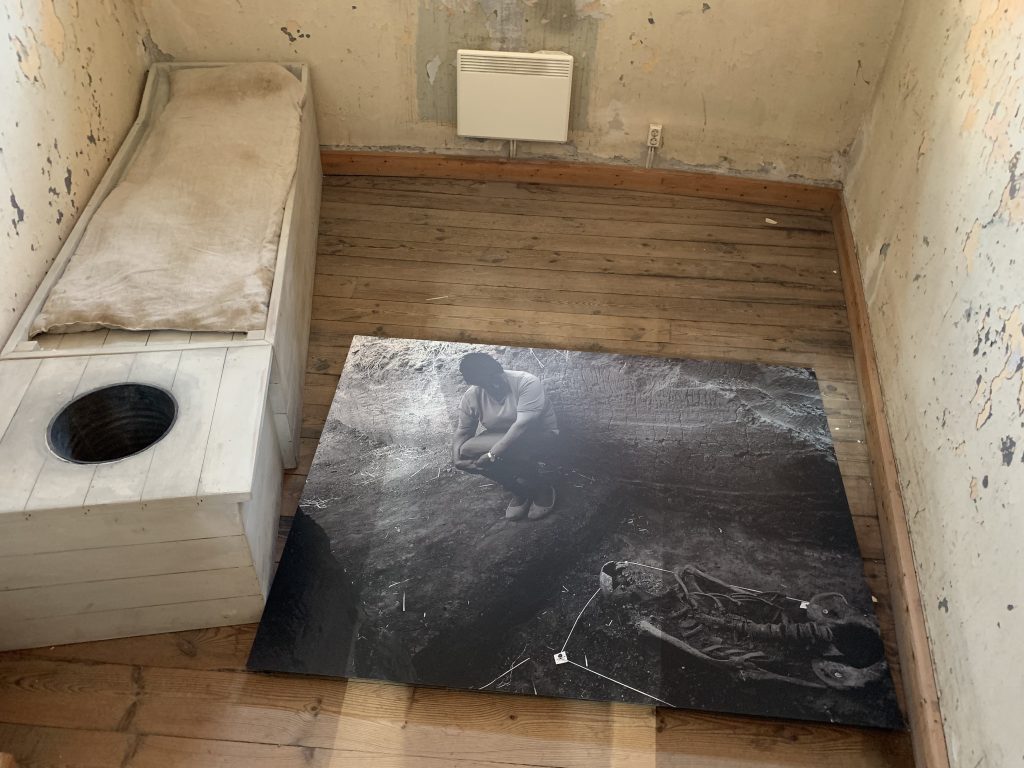
Is the assumption, perhaps, the – naive – one like the one surrounding Hiroshima and hibakusha films and photos, namely that by showing them the audience will be appalled and become more critical or warfare and other types of violence?

Is it part of the broader “violence industry” in which we also find the museums of wars and massacres and Holocaust?

Or is it that it hits us emotionally and get an “automatic” mileage, a little like if a photographer takes portraits of celebrities rather than non-celebrities, then she or he becomes famous more easily?

Why are there so many more images in this world of destruction than of construction, of violence than of peace? 

The very important World Press Photo contest is another – worse – example. Just look at the photos on the link. 

It’s filled with violence and suffering – and I am relatively sure that those who run these contests and festivals are not even aware of that bias or have discussed it. As if reality or the imagination or the creative impulse could not also be expressed through images of beauty and peace?

Perhaps we have come so far down the mental slippery slope that war and destruction is considered (un- or subconsciously) to be more ‘realistic’ and significant or ‘normal’ and everyday-like than peace, love, cooperation and beauty?

We live in an age influenced much more by images than by text and even sound – also because everybody has become a kind of photographer.

What the hundreds of images we more or less consciously perceive during a day through all sorts of media tell us about the world is extremely important in shaping our worldview. 
 
Well, you may say, it’s always been the case that the negative dominated and fascinated us, hasn’t it? Perhaps. 

But if so, let’s become a bit more peace-creative and re-balance it all! 

If you thought this was useful or even thought-provoking, we’d be grateful for your contribution to this unique homepage.

The author
Peace & future researcher + ‌Art Photographer

Share

Leave a Reply

Your email address will not be published. Required fields are marked *

Related Posts

PressInfo # 141, December 21, 2001It’s time to prepare reconciliation between Albanians and Serbs PressInfo # 140, December 14, 2001Ibrahim Rugova’s decade-long leadership in Kosovo/a PressInfo # 139, 11. december, 2001En god nyhet: Jugoslaviens Sannings- och försoningskommission PressInfo # 139, 11. december, 2001Gode nyheder: Jugoslaviens Sandheds- og Forsoningskommission PressInfo # 139, December 11, 2001Good news: Yugoslavia’s Truth and Reconciliation Commission PressInfo # 138, November 8, 2001TFF co-founder PhD with thesis about young people with roots in other cultures PressInfo # 138, November 8, 2001TFF:s medstiftare doktor på avhandling om unga med ursprung i andra kulturer PressInfo # 137, October 17, 2001A new Marshall Plan: Advancing human security and controlling terrorism PressInfo # 136, October 15, 2001The UN and Annan really deserve it PressInfo # 135, October 10, 2001Preventing a terrorist mushroom cloud PressInfo # 134, 17 oktober, 2001Sverige og 11. september PressInfo # 134, October 9, 2001Sweden and September 11...
Peace is promoted by constructive proposals and dialogue Four preceding PressInfos have expressed concern over — and criticised — the ongoing, militarisation of the EU. Some will say: but there are no alternatives. We believe that there are always alternatives, that democracies are characterised by alternatives and choice, and that openly discussed alternatives will improve the quality and legitimacy of society’s decision–making. In addition, it is an intellectual and moral challenge to not only criticise but also be constructive. If we only tell people that we think they are wrong, they are not likely to listen. However, if we say: what are your views on this set of ideas and steps? — we may sometimes engage them in dialogue and sow a seed. Most people in power circles live their daily lives in in a time frame and a social space where certain ideas, viewpoints and concepts are just not...
Photos © TFF 2000 Read PressInfo 90 “Lift the Sanctions and Bring More Aid to Yugoslavia” See Pictures from Belgrade © TFF 2000 Please reprint, copy, archive, quote or re-post this item, but please retain the source.

Recent Articles

PressInfo # 141, December 21, 2001It’s time to prepare reconciliation between Albanians and Serbs PressInfo # 140, December 14, 2001Ibrahim Rugova’s decade-long leadership in Kosovo/a PressInfo # 139, 11. december, 2001En god nyhet: Jugoslaviens Sannings- och försoningskommission PressInfo # 139, 11. december, 2001Gode nyheder: Jugoslaviens Sandheds- og Forsoningskommission PressInfo # 139, December 11, 2001Good news: Yugoslavia’s Truth and Reconciliation Commission PressInfo # 138, November 8, 2001TFF co-founder PhD with thesis about young people with roots in other cultures PressInfo # 138, November 8, 2001TFF:s medstiftare doktor på avhandling om unga med ursprung i andra kulturer PressInfo # 137, October 17, 2001A new Marshall Plan: Advancing human security and controlling terrorism PressInfo # 136, October 15, 2001The UN and Annan really deserve it PressInfo # 135, October 10, 2001Preventing a terrorist mushroom cloud PressInfo # 134, 17 oktober, 2001Sverige og 11. september PressInfo # 134, October 9, 2001Sweden and September 11...
Peace is promoted by constructive proposals and dialogue Four preceding PressInfos have expressed concern over — and criticised — the ongoing, militarisation of the EU. Some will say: but there are no alternatives. We believe that there are always alternatives, that democracies are characterised by alternatives and choice, and that openly discussed alternatives will improve the quality and legitimacy of society’s decision–making. In addition, it is an intellectual and moral challenge to not only criticise but also be constructive. If we only tell people that we think they are wrong, they are not likely to listen. However, if we say: what are your views on this set of ideas and steps? — we may sometimes engage them in dialogue and sow a seed. Most people in power circles live their daily lives in in a time frame and a social space where certain ideas, viewpoints and concepts are just not...
Photos © TFF 2000 Read PressInfo 90 “Lift the Sanctions and Bring More Aid to Yugoslavia” See Pictures from Belgrade © TFF 2000 Please reprint, copy, archive, quote or re-post this item, but please retain the source.

TFF on Substack

Discover more from TFF Transnational Foundation & Jan Oberg.

Most Popular

PressInfo # 141, December 21, 2001It’s time to prepare reconciliation between Albanians and Serbs PressInfo # 140, December 14, 2001Ibrahim Rugova’s decade-long leadership in Kosovo/a PressInfo # 139, 11. december, 2001En god nyhet: Jugoslaviens Sannings- och försoningskommission PressInfo # 139, 11. december, 2001Gode nyheder: Jugoslaviens Sandheds- og Forsoningskommission PressInfo # 139, December 11, 2001Good news: Yugoslavia’s Truth and Reconciliation Commission PressInfo # 138, November 8, 2001TFF co-founder PhD with thesis about young people with roots in other cultures PressInfo # 138, November 8, 2001TFF:s medstiftare doktor på avhandling om unga med ursprung i andra kulturer PressInfo # 137, October 17, 2001A new Marshall Plan: Advancing human security and controlling terrorism PressInfo # 136, October 15, 2001The UN and Annan really deserve it PressInfo # 135, October 10, 2001Preventing a terrorist mushroom cloud PressInfo # 134, 17 oktober, 2001Sverige og 11. september PressInfo # 134, October 9, 2001Sweden and September 11...
Peace is promoted by constructive proposals and dialogue Four preceding PressInfos have expressed concern over — and criticised — the ongoing, militarisation of the EU. Some will say: but there are no alternatives. We believe that there are always alternatives, that democracies are characterised by alternatives and choice, and that openly discussed alternatives will improve the quality and legitimacy of society’s decision–making. In addition, it is an intellectual and moral challenge to not only criticise but also be constructive. If we only tell people that we think they are wrong, they are not likely to listen. However, if we say: what are your views on this set of ideas and steps? — we may sometimes engage them in dialogue and sow a seed. Most people in power circles live their daily lives in in a time frame and a social space where certain ideas, viewpoints and concepts are just not...
Photos © TFF 2000 Read PressInfo 90 “Lift the Sanctions and Bring More Aid to Yugoslavia” See Pictures from Belgrade © TFF 2000 Please reprint, copy, archive, quote or re-post this item, but please retain the source.
Read More
Imagen-thumbnail-The-Transnational-1
PressInfo # 141, December 21, 2001It’s time to prepare reconciliation between Albanians and Serbs PressInfo # 140, December 14, 2001Ibrahim Rugova’s decade-long leadership in Kosovo/a PressInfo # 139, 11. december, 2001En god nyhet: Jugoslaviens Sannings- och försoningskommission PressInfo # 139, 11. december, 2001Gode nyheder: Jugoslaviens Sandheds- og Forsoningskommission PressInfo # 139, December 11, 2001Good news: Yugoslavia’s Truth and Reconciliation Commission PressInfo # 138, November 8, 2001TFF co-founder PhD with thesis about young people with roots in other cultures PressInfo # 138, November 8, 2001TFF:s medstiftare doktor på avhandling om unga med ursprung i andra kulturer PressInfo # 137, October 17, 2001A new Marshall Plan: Advancing human security and controlling terrorism PressInfo # 136, October 15, 2001The UN and Annan really deserve it PressInfo # 135, October 10, 2001Preventing a terrorist mushroom cloud PressInfo # 134, 17 oktober, 2001Sverige og 11. september PressInfo # 134, October 9, 2001Sweden and September 11...
Imagen-thumbnail-The-Transnational-1
Peace is promoted by constructive proposals and dialogue Four preceding PressInfos have expressed concern over — and criticised — the ongoing, militarisation of the EU. Some will say: but there are no alternatives. We believe that there are always alternatives, that democracies are characterised by alternatives and choice, and that openly discussed alternatives will improve the quality and legitimacy of society’s decision–making. In addition, it is an intellectual and moral challenge to not only criticise but also be constructive. If we only tell people that we think they are wrong, they are not likely to listen. However, if we say: what are your views on this set of ideas and steps? — we may sometimes engage them in dialogue and sow a seed. Most people in power circles live their daily lives in in a time frame and a social space where certain ideas, viewpoints and concepts are just not...
Imagen-thumbnail-The-Transnational-1
Photos © TFF 2000 Read PressInfo 90 “Lift the Sanctions and Bring More Aid to Yugoslavia” See Pictures from Belgrade © TFF 2000 Please reprint, copy, archive, quote or re-post this item, but please retain the source.
Imagen-thumbnail-The-Transnational-1
Av FRANK SØHOLM GREVIL 16 augusti 2004  Vi er nu nået til tredje akt i det absurde teaterstykke, der i analogi med de store skueprocesser i Moskva 1936-38 er blevet døbt ‘Grevil-sagen’. Første akt bestod i min anonyme fremlæggelse af egenhændigt nedklassificerede rapporter i Berlingske Tidende i februar og marts. Andet akt udgjordes af min fremtræden med navn og billede i Information i april samt den efterfølgende mediestorm, som uden min direkte medvirken kostede en forsvarsminister taburetten samt en sigtelse for brud på tavshedspligten. Tredje akt bliver en retssag, hvor jeg står tiltalt for at have overtrådt straffelovens bestemmelser om uberettiget videregivelse eller udnyttelse af fortrolige oplysninger. Statsanklageren har ovenikøbet valgt at påberåbe sig særligt skærpende omstændigheder. Da jeg aldrig har modtaget betaling for at stille rapporterne til rådighed eller lade mig interviewe, må det skærpende bestå i, at “videregivelsen eller udnyttelsen er sket under sådanne omstændigheder, at det påfører...
Imagen-thumbnail-The-Transnational-1
Af Svenska Irakkommittén mot de Ekonomiska Sanktionerna (SIES) 13 september 2002 FN:s ekonomiska sanktioner mot Irak har nu pågått i tolv år och drabbat det irakiska folket med svåra lidanden. Enligt FN:s egna siffror har mer än 1,5 miljoner människor, varav ca 600 000 barn, dött som en direkt följd av sanktionerna. Dessutom har ett lågintensivt bombkrig mot landet pågått under dessa år. Av all denna förödelse- orsakad huvudsakligen av amerikansk och brittisk politik- har Saddam Husseins brutala och diktatoriska regim snarast stärkts än försvagats. Nu förbereder USA under president Bushs ledning ett storskaligt bombkrig mot Irak som kommer att innebära ett ännu större lidande för civilbefolkningen. Ett sådant krig kommer dessutom att ytterligare undergräva freden och säkerheten i världen. Att upprätta en demokratisk regim i Irak är det irakiska folkets angelägenhet och får enligt folkrätten inte ske med krigshandlingar utifrån. Folkrätten och FN:s stadgar måste respekteras. Vi vädjar till...
