
The asymmetrical US-China ‘technology cold war’ – analysis

He Jun

April 11th, 2023

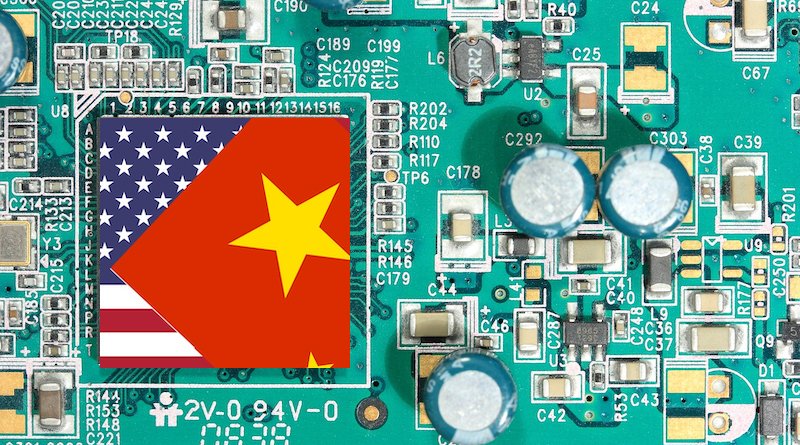
The policy of decoupling and containment towards China pushed by the United States is most aggressive in the technology field. Although the current state of U.S.-China relations has not yet reached the level of a cold war, researchers at ANBOUND believe that in the technology field, the competition between the two countries has become similar to a “technology cold war”. Due to the difference in the levels of technological and industrial development between the two, this is an asymmetric game, with the U.S. having a significant advantage.

Originally posted on Eurasia Review’s official website on March 30, 2023

The Institute of International Technology and Economy (IITE), a think tank of China’s State Council, has recently published an article titled “Systematic Trends of U.S. Technology Containment towards China”. This article shows the understanding, analysis, and judgment of Chinese official research institutions on the technological competition between the U.S. and China, but also to some extent reflects the possible directions and measures for China to deal with U.S. technology containment.

The article discusses the systematic development of U.S. technological containment against China, which has become clearer and more decisive under the Biden administration. This containment has three key aspects, namely political mobilization, strategic design, and organizational guarantees.

The strategy, according to the article, encompasses four pillars, i.e., investment in technology ecology, nurturing top STEM (science, technology, engineering, and mathematics) talent, protecting technological advantages, and integrating alliance partners. This approach covers unilateral, bilateral, and multilateral dimensions and targets specific technological domains.

The Biden administration has also set up various task forces in federal departments, including, and additional funds have been allocated through congressional legislation. For example, in August 2022, Biden signed the CHIPS and Science Act, which requires subsidized companies to “choose a side” and not participate in significant deals to expand semiconductor production capacity in China for ten years.

In addition, the IITE article also argues that with its systematic ability to contain China’s technology, the U.S. makes it difficult to depart from the strategic direction of containment. This will normalize technological containment and make U.S.-China scientific cooperation more difficult. The policy will become more precise with more legislation and administrative measures being taken to restrict China’s technological development, even increasingly polarized, as various interest groups push for stricter policies.

As a result, according to the article, the rational and friendly voice for U.S.-China relations in Washington is disappearing, making cooperation between the two countries in science and technology more difficult in the future.

Researchers at ANBOUND believe that from the analysis of the IITE article, some relatively clear conclusions can be drawn.

Firstly, China has come to accept that the U.S. is engaging in a long-term and systematic campaign of technological containment against it. With repeated efforts to suppress China’s technological advancements, the U.S.’s policy of containment is unlikely to change and will continue to intensify over time. This strategic adjustment towards China, combined with the prevailing attitude towards China in the American political ecology, suggests that the future of U.S.-China relations is unlikely to improve significantly for a considerable period.

As a result, researchers at ANBOUND predict that this situation may continue for 20 to 30 years, which will also mean that such a technological containment against China will last for decades.

Secondly, in the face of the systematic technological containment against China, China will take a comprehensive and strategic approach to respond. Although China recognizes the need for openness in technological and industrial development, it will pursue “independence and controllability” in multiple specific technological industries, promote “de-Americanization” in critical industries, technologies, as well as key areas, and strive for “domestic substitution” in some fields.

Furthermore, it may also prepare for extreme situations, such as facing comprehensive sanctions from the West, including technological and related industrial sanctions, in the event of a Taiwan Strait crisis in the future. We believe that relevant departments are actively considering means to respond to this possibility.

Thirdly, the “technology cold war” presents significant challenges for education, technology talent cultivation, and talent utilization in China. Advancements in breakthrough technologies or emerging technology fields depend on professional knowledge and on high-tech talents. Therefore, to achieve long-term technological competitiveness, China will need to invest significantly in building a world-class ecosystem for talent cultivation and development while promoting the coordinated growth of technology, education, and the economy.

To achieve these objectives, it must reform its technology talent training mechanism and education system. However, researchers at ANBOUND note that restrictions imposed by the U.S. are only external pressures. Many domestic education and talent mechanisms in China create internal pressure, further hindering the cultivation and utilization of innovative technology talent.

Fourthly, as the U.S. is pushing its allies to join in the technological blockade against China, China must respond to it by maintaining international scientific and technological exchanges, as well as with openness to the greatest extent possible.

In various areas such as market sharing, external cooperation, and personnel exchanges, China must increase its exchanges and cooperation with other countries and regions.

Breaking through this “technology cold war” network woven by the U.S. is the first step toward success for China.

Final analysis conclusion:

The “technology cold war” initiated by the U.S. based on geopolitical competition against China has taken shape and is continuously strengthening. Faced with such a long-term and systematic technological containment, China now considers a long-term strategy to respond to it. Its education, technology, and industrial sectors need to be prepared for this in the long run.

Please help TFF remain truly independent by contributing if you benefited from this article

[paypal-donation]

He Jun is a researcher at Anbound. Anbound Consulting (Anbound) is an independent Think Tank with the headquarter based in Beijing. Established in 1993, Anbound specializes in public policy research, and enjoys a professional reputation in the areas of strategic forecasting, policy solutions and risk analysis. Anbound’s research findings are widely recognized and create a deep interest within public media, academics and experts who are also providing consulting service to the State Council of China.

Share

Leave a Reply

Your email address will not be published. Required fields are marked *

Related Posts

Drones over Nordic airports. No damage. No trace. No answers. Most assume Russia—but what if that’s not so? Why is there so much we are not told? This article explores the strategic ambiguity behind recent drone incursions and asks: Who else might benefit from sending drones into NATO airspace? From Ukraine’s surprising drone supremacy to Russia’s possible signalling, the silence itself may be the loudest message. These are the kinds of questions decent, intelligent investigative journalists and commentators could easily research. Why don’t they? Did you, dear reader, know or think of this? That the most powerful weapon in today’s conflicts might be the one that leaves no trace – and no answers. Just enough fear to justify the next move? Recently, drones have repeatedly appeared over Nordic airports and near some military facilities. They cause no damage – for which reason the designation “hybrid attack” is misleading but serves a purpose. These...
Foreword The Board of The Transnational Foundation in Sweden has decided to publish an easy-to-read, scholarly anthology that addresses one of the most important – and potentially dangerous – issues of our time: Why are the political, economic, and medialised Western images of China so consistently negative – and what can you do to understand China better? These images may be expressions of a political will to present only various shades of grey and black with the aim of building a consciousness about China as an enemy and not a partner. They may also be seen as a sort of world-dominating ethos of ignorance based upon the assumption that “we’ve-got-nothing-to-learn-from-others,’ we are the teacher. Another possibility is that the West, deep down, feels that it is getting relatively weaker from a macro-historical perspective and comforts itself with denial and accusations against “the other” of being the reason for its manifest...
World BEYOND War,TFF Associate For years, World BEYOND War and other peace groups from around the world had been attending peace conferences in Cuba. When I visited Cuba this past January it was with a visa for that purpose. I published here the remarks I made at the conference. We shouted as loudly as we could about January’s conference in websites, social media, emails, and media interviews. The notion that there could be anything wrong with it — or that some institution could punish us for it — never entered our minds. Legally, you’re allowed to go to a peace conference in Cuba. Nobody has so much as hinted that I’ve done anything illegal. But on Thursday June 5th I got a bunch of letters in the mail telling me that on Monday June 9th the U.S. bank accounts of World BEYOND War and the private accounts of all of my family members...

Recent Articles

PressInfo # 141, December 21, 2001It’s time to prepare reconciliation between Albanians and Serbs PressInfo # 140, December 14, 2001Ibrahim Rugova’s decade-long leadership in Kosovo/a PressInfo # 139, 11. december, 2001En god nyhet: Jugoslaviens Sannings- och försoningskommission PressInfo # 139, 11. december, 2001Gode nyheder: Jugoslaviens Sandheds- og Forsoningskommission PressInfo # 139, December 11, 2001Good news: Yugoslavia’s Truth and Reconciliation Commission PressInfo # 138, November 8, 2001TFF co-founder PhD with thesis about young people with roots in other cultures PressInfo # 138, November 8, 2001TFF:s medstiftare doktor på avhandling om unga med ursprung i andra kulturer PressInfo # 137, October 17, 2001A new Marshall Plan: Advancing human security and controlling terrorism PressInfo # 136, October 15, 2001The UN and Annan really deserve it PressInfo # 135, October 10, 2001Preventing a terrorist mushroom cloud PressInfo # 134, 17 oktober, 2001Sverige og 11. september PressInfo # 134, October 9, 2001Sweden and September 11...
Peace is promoted by constructive proposals and dialogue Four preceding PressInfos have expressed concern over — and criticised — the ongoing, militarisation of the EU. Some will say: but there are no alternatives. We believe that there are always alternatives, that democracies are characterised by alternatives and choice, and that openly discussed alternatives will improve the quality and legitimacy of society’s decision–making. In addition, it is an intellectual and moral challenge to not only criticise but also be constructive. If we only tell people that we think they are wrong, they are not likely to listen. However, if we say: what are your views on this set of ideas and steps? — we may sometimes engage them in dialogue and sow a seed. Most people in power circles live their daily lives in in a time frame and a social space where certain ideas, viewpoints and concepts are just not...
Photos © TFF 2000 Read PressInfo 90 “Lift the Sanctions and Bring More Aid to Yugoslavia” See Pictures from Belgrade © TFF 2000 Please reprint, copy, archive, quote or re-post this item, but please retain the source.

TFF on Substack

Discover more from TFF Transnational Foundation & Jan Oberg.

Most Popular

PressInfo # 141, December 21, 2001It’s time to prepare reconciliation between Albanians and Serbs PressInfo # 140, December 14, 2001Ibrahim Rugova’s decade-long leadership in Kosovo/a PressInfo # 139, 11. december, 2001En god nyhet: Jugoslaviens Sannings- och försoningskommission PressInfo # 139, 11. december, 2001Gode nyheder: Jugoslaviens Sandheds- og Forsoningskommission PressInfo # 139, December 11, 2001Good news: Yugoslavia’s Truth and Reconciliation Commission PressInfo # 138, November 8, 2001TFF co-founder PhD with thesis about young people with roots in other cultures PressInfo # 138, November 8, 2001TFF:s medstiftare doktor på avhandling om unga med ursprung i andra kulturer PressInfo # 137, October 17, 2001A new Marshall Plan: Advancing human security and controlling terrorism PressInfo # 136, October 15, 2001The UN and Annan really deserve it PressInfo # 135, October 10, 2001Preventing a terrorist mushroom cloud PressInfo # 134, 17 oktober, 2001Sverige og 11. september PressInfo # 134, October 9, 2001Sweden and September 11...
Peace is promoted by constructive proposals and dialogue Four preceding PressInfos have expressed concern over — and criticised — the ongoing, militarisation of the EU. Some will say: but there are no alternatives. We believe that there are always alternatives, that democracies are characterised by alternatives and choice, and that openly discussed alternatives will improve the quality and legitimacy of society’s decision–making. In addition, it is an intellectual and moral challenge to not only criticise but also be constructive. If we only tell people that we think they are wrong, they are not likely to listen. However, if we say: what are your views on this set of ideas and steps? — we may sometimes engage them in dialogue and sow a seed. Most people in power circles live their daily lives in in a time frame and a social space where certain ideas, viewpoints and concepts are just not...
Photos © TFF 2000 Read PressInfo 90 “Lift the Sanctions and Bring More Aid to Yugoslavia” See Pictures from Belgrade © TFF 2000 Please reprint, copy, archive, quote or re-post this item, but please retain the source.
Read More
Imagen-thumbnail-The-Transnational-1
PressInfo # 141, December 21, 2001It’s time to prepare reconciliation between Albanians and Serbs PressInfo # 140, December 14, 2001Ibrahim Rugova’s decade-long leadership in Kosovo/a PressInfo # 139, 11. december, 2001En god nyhet: Jugoslaviens Sannings- och försoningskommission PressInfo # 139, 11. december, 2001Gode nyheder: Jugoslaviens Sandheds- og Forsoningskommission PressInfo # 139, December 11, 2001Good news: Yugoslavia’s Truth and Reconciliation Commission PressInfo # 138, November 8, 2001TFF co-founder PhD with thesis about young people with roots in other cultures PressInfo # 138, November 8, 2001TFF:s medstiftare doktor på avhandling om unga med ursprung i andra kulturer PressInfo # 137, October 17, 2001A new Marshall Plan: Advancing human security and controlling terrorism PressInfo # 136, October 15, 2001The UN and Annan really deserve it PressInfo # 135, October 10, 2001Preventing a terrorist mushroom cloud PressInfo # 134, 17 oktober, 2001Sverige og 11. september PressInfo # 134, October 9, 2001Sweden and September 11...
Imagen-thumbnail-The-Transnational-1
Peace is promoted by constructive proposals and dialogue Four preceding PressInfos have expressed concern over — and criticised — the ongoing, militarisation of the EU. Some will say: but there are no alternatives. We believe that there are always alternatives, that democracies are characterised by alternatives and choice, and that openly discussed alternatives will improve the quality and legitimacy of society’s decision–making. In addition, it is an intellectual and moral challenge to not only criticise but also be constructive. If we only tell people that we think they are wrong, they are not likely to listen. However, if we say: what are your views on this set of ideas and steps? — we may sometimes engage them in dialogue and sow a seed. Most people in power circles live their daily lives in in a time frame and a social space where certain ideas, viewpoints and concepts are just not...
Imagen-thumbnail-The-Transnational-1
Photos © TFF 2000 Read PressInfo 90 “Lift the Sanctions and Bring More Aid to Yugoslavia” See Pictures from Belgrade © TFF 2000 Please reprint, copy, archive, quote or re-post this item, but please retain the source.
Imagen-thumbnail-The-Transnational-1
Av FRANK SØHOLM GREVIL 16 augusti 2004  Vi er nu nået til tredje akt i det absurde teaterstykke, der i analogi med de store skueprocesser i Moskva 1936-38 er blevet døbt ‘Grevil-sagen’. Første akt bestod i min anonyme fremlæggelse af egenhændigt nedklassificerede rapporter i Berlingske Tidende i februar og marts. Andet akt udgjordes af min fremtræden med navn og billede i Information i april samt den efterfølgende mediestorm, som uden min direkte medvirken kostede en forsvarsminister taburetten samt en sigtelse for brud på tavshedspligten. Tredje akt bliver en retssag, hvor jeg står tiltalt for at have overtrådt straffelovens bestemmelser om uberettiget videregivelse eller udnyttelse af fortrolige oplysninger. Statsanklageren har ovenikøbet valgt at påberåbe sig særligt skærpende omstændigheder. Da jeg aldrig har modtaget betaling for at stille rapporterne til rådighed eller lade mig interviewe, må det skærpende bestå i, at “videregivelsen eller udnyttelsen er sket under sådanne omstændigheder, at det påfører...
Imagen-thumbnail-The-Transnational-1
Af Svenska Irakkommittén mot de Ekonomiska Sanktionerna (SIES) 13 september 2002 FN:s ekonomiska sanktioner mot Irak har nu pågått i tolv år och drabbat det irakiska folket med svåra lidanden. Enligt FN:s egna siffror har mer än 1,5 miljoner människor, varav ca 600 000 barn, dött som en direkt följd av sanktionerna. Dessutom har ett lågintensivt bombkrig mot landet pågått under dessa år. Av all denna förödelse- orsakad huvudsakligen av amerikansk och brittisk politik- har Saddam Husseins brutala och diktatoriska regim snarast stärkts än försvagats. Nu förbereder USA under president Bushs ledning ett storskaligt bombkrig mot Irak som kommer att innebära ett ännu större lidande för civilbefolkningen. Ett sådant krig kommer dessutom att ytterligare undergräva freden och säkerheten i världen. Att upprätta en demokratisk regim i Irak är det irakiska folkets angelägenhet och får enligt folkrätten inte ske med krigshandlingar utifrån. Folkrätten och FN:s stadgar måste respekteras. Vi vädjar till...