
TFF PressInfo # 391: Stockholm International Peace Research Institute, SIPRI, at 50. Now change name to SIMSI

/10/tff-pressinfo-390-ten-articles-on-the-new-cold-war/”>new Cold War are becoming ever more significant. And a good intellectual way to celebrate an important research institute’s 50th Anniversary, namely SIPRI – Stockholm International Peace Research Institute.

Now, what was this SIPRI supposed to be 50 years ago as the brainchild of, among others, brilliant visionary sociologist and social democratic politician Alva Myrdal who later became Sweden’s disarmament ambassador, wrote an impressive book on disarmament and security and received the Nobel Peace Prize in 1982?

If you go to its entry at Wikipedia, it is very clearly spelled out in 1966 (my italics):

“A Swedish Royal Commission chaired by Ambassador Alva Myrdal proposed in its 1966 report to establish an institute, later named the Stockholm International Peace Research Institute, SIPRI. The Institute’s research should seek to contribute to “the understanding of the preconditions for a stable peace and for peaceful solutions of international conflicts” and the Commission recommended that research be concentrated on armaments, their limitation and reduction, and arms control. The Commission also recommended that SIPRI work be of “an applied research character directed towards practical-political questions [which] should be carried on in a constant interchange with research of a more theoretical kind”.”

However, here is today’s research programs of SIPRI – also from Wikipedia:

• The SIPRI Yearbook
• Euro-Atlantic Security and Arms Control
• Armed Conflict and Conflict Management
• Non-Proliferation and Export Controls
• Chemical and Biological Warfare
• Military Expenditure and Arms Production
• Arms Transfers
• IT Projects: “Facts on International Relations and Security Trends” and “An Internet-Based Early Warning Indicators System for Preventive Policy”

The character of this program is pretty obvious:

SIPRI studies wars and arms and very little, if at all, peaceful solutions to international conflicts and the – theoretical – conditions of a stable peace.

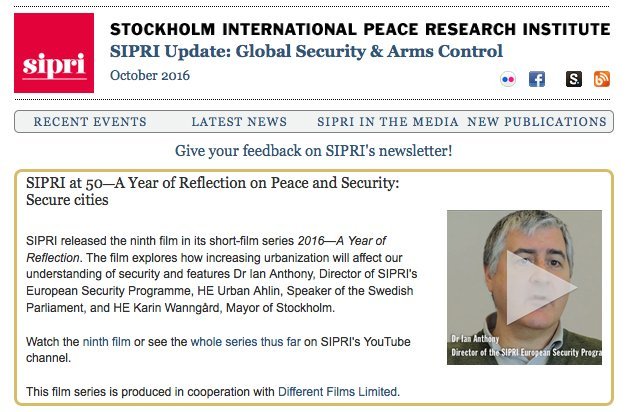
So here are some videos in which four members of the international Governing Board of SIPRI answer those questions.

Two of them are mainstream international relations scholars, one British, one Russian. One, the head of the Board, is a Swedish diplomat not known for his independent thinking – as also comes through here. He blames Russia for all Europe’s problems, for not accepting a rule-based international order and changing borders (as if it were the only one!) and believes that withdrawal from Crimea is the first step towards preventing a new cold war and that “the whole world has to say No to Georgia’s being divided by Russian aggression. See, now you understand it all much better!

The fourth is a German diplomat who is related to finance management and chairs the highly mainstream, militarist Munich Conference on Security Policy. He has recently argued, in diplomatic terms of course, that dictator al-Assad should have been removed earlier, that Russia should have been countered by a Western intervention in Syria and that we must save both “pax americana” and the liberal international order. See, a true peace-thinker!

None of the four board members have a background in academic peace research.

When I saw the videos I asked myself a couple of “anniversary” questions and here they are with my short answers:

Do they talk in reasonably sharp intellectual terms?
No! It’s mainly some small-talk political commentary with no originality or theory. No perspective of history or of what the future may bring.

Do they have any new and sparkling ideas about how to make peace?
No! Except what they in their narrow “school of thought” believe can be done by military means and by governments. None of them seem to have a concept of peace on which to base their words and more or less lofty personal wishes for the future: “I would like to see that..” which has also nothing to do with research.

Is this anything but traditional international relations, geopolitical-military or political science commentary in what they say?
No! They share a government perspectives, no civil society aspects, no linking to democracy or identification of things that should be researched more. No re-searching mind. All seem quite tired if not re-tired.

Does it have anything to do with peace research?
No! Words like conflict-resolution, nonviolence, peace-making, reconciliation, dialogue etc. don’t seem to be on their radar. The only thing in common seems to be the Russian, German and British voice advocating joint projects and a strengthening of the OSCE. The EU is mentioned once: that it should put peacekeeping troops on the ground in Aleppo (!). And the UN? The UN, the global movement for disarmament and security, the changing world order, development issues – not a word! Also not a word about peace education or the possible role of media in providing both war reports and peace stories.

My congratulations at the 50th Anniversary of SIPRI, this once so promising, innovative institution! I know it was promising because I interned at SIPRI on and off for weeks as a young student in the 1970s when it was at the Wennergren Center sky scraper – leadership sitting at the top floor, those doing newspaper clippings on the lower floors. I’ve written reviews of SIPRI’s amazing Yearbooks and many special studies, not the least in the Danish daily Politiken in the 1970s and 1980s.

I got the greatest respect for the meticulous data collecting – “bean counting” – from only open sources that SIPRI is still very good at. (But that isn’t peace research).

I vividly remember the seminars and the dynamic leadership of its scholar-director, amazing Frank Barnaby whose knowledge about nuclear weapons and nuclear policies and passion for nuclear abolition impressed everyone who met him and listened to his dark rusty voice. I silently wonder whether such a character would be invited to SIPRI today?

In all friendliness, I have a proposal to make for the next decades of this mainly government-financed and not exactly independent institute as it professes to be:

Since its work has so conspicuously little to do with peace thinking and re-search into the vast and fascinating field called world peace, perhaps it’s time to change name to Stockholm International Military Security Institute, SIMSI?

Peace & future researcher + ‌Art Photographer

Share

Leave a Reply

Your email address will not be published. Required fields are marked *

Related Posts

Peace is promoted by constructive proposals and dialogue Four preceding PressInfos have expressed concern over — and criticised — the ongoing, militarisation of the EU. Some will say: but there are no alternatives. We believe that there are always alternatives, that democracies are characterised by alternatives and choice, and that openly discussed alternatives will improve the quality and legitimacy of society’s decision–making. In addition, it is an intellectual and moral challenge to not only criticise but also be constructive. If we only tell people that we think they are wrong, they are not likely to listen. However, if we say: what are your views on this set of ideas and steps? — we may sometimes engage them in dialogue and sow a seed. Most people in power circles live their daily lives in in a time frame and a social space where certain ideas, viewpoints and concepts are just not...
Photos © TFF 2000 Read PressInfo 90 “Lift the Sanctions and Bring More Aid to Yugoslavia” See Pictures from Belgrade © TFF 2000 Please reprint, copy, archive, quote or re-post this item, but please retain the source.
Av FRANK SØHOLM GREVIL 16 augusti 2004  Vi er nu nået til tredje akt i det absurde teaterstykke, der i analogi med de store skueprocesser i Moskva 1936-38 er blevet døbt ‘Grevil-sagen’. Første akt bestod i min anonyme fremlæggelse af egenhændigt nedklassificerede rapporter i Berlingske Tidende i februar og marts. Andet akt udgjordes af min fremtræden med navn og billede i Information i april samt den efterfølgende mediestorm, som uden min direkte medvirken kostede en forsvarsminister taburetten samt en sigtelse for brud på tavshedspligten. Tredje akt bliver en retssag, hvor jeg står tiltalt for at have overtrådt straffelovens bestemmelser om uberettiget videregivelse eller udnyttelse af fortrolige oplysninger. Statsanklageren har ovenikøbet valgt at påberåbe sig særligt skærpende omstændigheder. Da jeg aldrig har modtaget betaling for at stille rapporterne til rådighed eller lade mig interviewe, må det skærpende bestå i, at “videregivelsen eller udnyttelsen er sket under sådanne omstændigheder, at det påfører...

Recent Articles

PressInfo # 141, December 21, 2001It’s time to prepare reconciliation between Albanians and Serbs PressInfo # 140, December 14, 2001Ibrahim Rugova’s decade-long leadership in Kosovo/a PressInfo # 139, 11. december, 2001En god nyhet: Jugoslaviens Sannings- och försoningskommission PressInfo # 139, 11. december, 2001Gode nyheder: Jugoslaviens Sandheds- og Forsoningskommission PressInfo # 139, December 11, 2001Good news: Yugoslavia’s Truth and Reconciliation Commission PressInfo # 138, November 8, 2001TFF co-founder PhD with thesis about young people with roots in other cultures PressInfo # 138, November 8, 2001TFF:s medstiftare doktor på avhandling om unga med ursprung i andra kulturer PressInfo # 137, October 17, 2001A new Marshall Plan: Advancing human security and controlling terrorism PressInfo # 136, October 15, 2001The UN and Annan really deserve it PressInfo # 135, October 10, 2001Preventing a terrorist mushroom cloud PressInfo # 134, 17 oktober, 2001Sverige og 11. september PressInfo # 134, October 9, 2001Sweden and September 11...
Peace is promoted by constructive proposals and dialogue Four preceding PressInfos have expressed concern over — and criticised — the ongoing, militarisation of the EU. Some will say: but there are no alternatives. We believe that there are always alternatives, that democracies are characterised by alternatives and choice, and that openly discussed alternatives will improve the quality and legitimacy of society’s decision–making. In addition, it is an intellectual and moral challenge to not only criticise but also be constructive. If we only tell people that we think they are wrong, they are not likely to listen. However, if we say: what are your views on this set of ideas and steps? — we may sometimes engage them in dialogue and sow a seed. Most people in power circles live their daily lives in in a time frame and a social space where certain ideas, viewpoints and concepts are just not...
Photos © TFF 2000 Read PressInfo 90 “Lift the Sanctions and Bring More Aid to Yugoslavia” See Pictures from Belgrade © TFF 2000 Please reprint, copy, archive, quote or re-post this item, but please retain the source.

TFF on Substack

Discover more from TFF Transnational Foundation & Jan Oberg.

Most Popular

PressInfo # 141, December 21, 2001It’s time to prepare reconciliation between Albanians and Serbs PressInfo # 140, December 14, 2001Ibrahim Rugova’s decade-long leadership in Kosovo/a PressInfo # 139, 11. december, 2001En god nyhet: Jugoslaviens Sannings- och försoningskommission PressInfo # 139, 11. december, 2001Gode nyheder: Jugoslaviens Sandheds- og Forsoningskommission PressInfo # 139, December 11, 2001Good news: Yugoslavia’s Truth and Reconciliation Commission PressInfo # 138, November 8, 2001TFF co-founder PhD with thesis about young people with roots in other cultures PressInfo # 138, November 8, 2001TFF:s medstiftare doktor på avhandling om unga med ursprung i andra kulturer PressInfo # 137, October 17, 2001A new Marshall Plan: Advancing human security and controlling terrorism PressInfo # 136, October 15, 2001The UN and Annan really deserve it PressInfo # 135, October 10, 2001Preventing a terrorist mushroom cloud PressInfo # 134, 17 oktober, 2001Sverige og 11. september PressInfo # 134, October 9, 2001Sweden and September 11...
Peace is promoted by constructive proposals and dialogue Four preceding PressInfos have expressed concern over — and criticised — the ongoing, militarisation of the EU. Some will say: but there are no alternatives. We believe that there are always alternatives, that democracies are characterised by alternatives and choice, and that openly discussed alternatives will improve the quality and legitimacy of society’s decision–making. In addition, it is an intellectual and moral challenge to not only criticise but also be constructive. If we only tell people that we think they are wrong, they are not likely to listen. However, if we say: what are your views on this set of ideas and steps? — we may sometimes engage them in dialogue and sow a seed. Most people in power circles live their daily lives in in a time frame and a social space where certain ideas, viewpoints and concepts are just not...
Photos © TFF 2000 Read PressInfo 90 “Lift the Sanctions and Bring More Aid to Yugoslavia” See Pictures from Belgrade © TFF 2000 Please reprint, copy, archive, quote or re-post this item, but please retain the source.
Read More
Imagen-thumbnail-The-Transnational-1
PressInfo # 141, December 21, 2001It’s time to prepare reconciliation between Albanians and Serbs PressInfo # 140, December 14, 2001Ibrahim Rugova’s decade-long leadership in Kosovo/a PressInfo # 139, 11. december, 2001En god nyhet: Jugoslaviens Sannings- och försoningskommission PressInfo # 139, 11. december, 2001Gode nyheder: Jugoslaviens Sandheds- og Forsoningskommission PressInfo # 139, December 11, 2001Good news: Yugoslavia’s Truth and Reconciliation Commission PressInfo # 138, November 8, 2001TFF co-founder PhD with thesis about young people with roots in other cultures PressInfo # 138, November 8, 2001TFF:s medstiftare doktor på avhandling om unga med ursprung i andra kulturer PressInfo # 137, October 17, 2001A new Marshall Plan: Advancing human security and controlling terrorism PressInfo # 136, October 15, 2001The UN and Annan really deserve it PressInfo # 135, October 10, 2001Preventing a terrorist mushroom cloud PressInfo # 134, 17 oktober, 2001Sverige og 11. september PressInfo # 134, October 9, 2001Sweden and September 11...
Imagen-thumbnail-The-Transnational-1
Peace is promoted by constructive proposals and dialogue Four preceding PressInfos have expressed concern over — and criticised — the ongoing, militarisation of the EU. Some will say: but there are no alternatives. We believe that there are always alternatives, that democracies are characterised by alternatives and choice, and that openly discussed alternatives will improve the quality and legitimacy of society’s decision–making. In addition, it is an intellectual and moral challenge to not only criticise but also be constructive. If we only tell people that we think they are wrong, they are not likely to listen. However, if we say: what are your views on this set of ideas and steps? — we may sometimes engage them in dialogue and sow a seed. Most people in power circles live their daily lives in in a time frame and a social space where certain ideas, viewpoints and concepts are just not...
Imagen-thumbnail-The-Transnational-1
Photos © TFF 2000 Read PressInfo 90 “Lift the Sanctions and Bring More Aid to Yugoslavia” See Pictures from Belgrade © TFF 2000 Please reprint, copy, archive, quote or re-post this item, but please retain the source.
Imagen-thumbnail-The-Transnational-1
Av FRANK SØHOLM GREVIL 16 augusti 2004  Vi er nu nået til tredje akt i det absurde teaterstykke, der i analogi med de store skueprocesser i Moskva 1936-38 er blevet døbt ‘Grevil-sagen’. Første akt bestod i min anonyme fremlæggelse af egenhændigt nedklassificerede rapporter i Berlingske Tidende i februar og marts. Andet akt udgjordes af min fremtræden med navn og billede i Information i april samt den efterfølgende mediestorm, som uden min direkte medvirken kostede en forsvarsminister taburetten samt en sigtelse for brud på tavshedspligten. Tredje akt bliver en retssag, hvor jeg står tiltalt for at have overtrådt straffelovens bestemmelser om uberettiget videregivelse eller udnyttelse af fortrolige oplysninger. Statsanklageren har ovenikøbet valgt at påberåbe sig særligt skærpende omstændigheder. Da jeg aldrig har modtaget betaling for at stille rapporterne til rådighed eller lade mig interviewe, må det skærpende bestå i, at “videregivelsen eller udnyttelsen er sket under sådanne omstændigheder, at det påfører...
Imagen-thumbnail-The-Transnational-1
Af Svenska Irakkommittén mot de Ekonomiska Sanktionerna (SIES) 13 september 2002 FN:s ekonomiska sanktioner mot Irak har nu pågått i tolv år och drabbat det irakiska folket med svåra lidanden. Enligt FN:s egna siffror har mer än 1,5 miljoner människor, varav ca 600 000 barn, dött som en direkt följd av sanktionerna. Dessutom har ett lågintensivt bombkrig mot landet pågått under dessa år. Av all denna förödelse- orsakad huvudsakligen av amerikansk och brittisk politik- har Saddam Husseins brutala och diktatoriska regim snarast stärkts än försvagats. Nu förbereder USA under president Bushs ledning ett storskaligt bombkrig mot Irak som kommer att innebära ett ännu större lidande för civilbefolkningen. Ett sådant krig kommer dessutom att ytterligare undergräva freden och säkerheten i världen. Att upprätta en demokratisk regim i Irak är det irakiska folkets angelägenhet och får enligt folkrätten inte ske med krigshandlingar utifrån. Folkrätten och FN:s stadgar måste respekteras. Vi vädjar till...