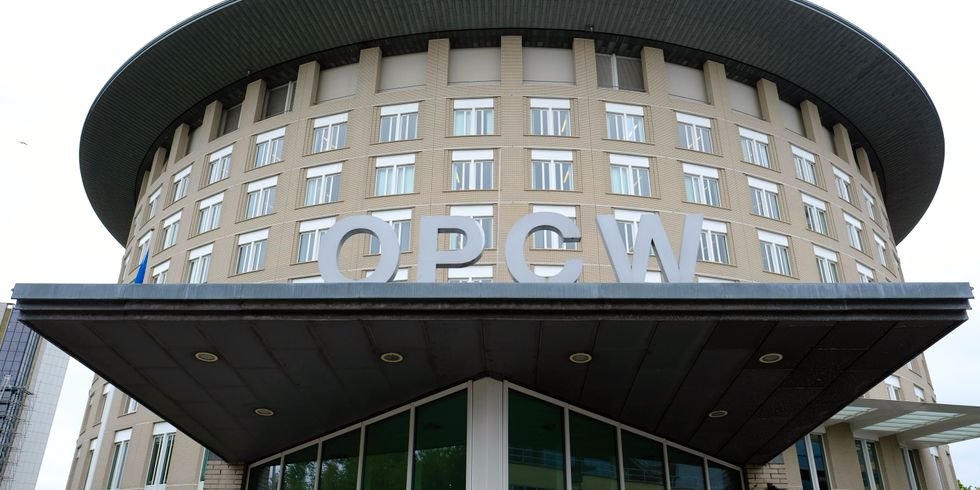

Statement of concern – concerning the OPCW – Organisation for the Prohibition of Chemical Weapons‘ – investigation of alleged chemical weapons use in Douma, Syria in early April 2018. Here NBC News’ coverage of the alleged attack and President Trump’s decision to strike in response to it.
We wish to express our deep concern over the protracted controversy and political fall-out surrounding the OPCW and its investigation of the alleged chemical weapons attack in Douma, Syria, on 7 April 2018.
Since the publication by the OPCW of its final report in March 2019, a series of worrying developments has raised serious and substantial concerns with respect to the conduct of that investigation. These developments include instances in which OPCW inspectors involved with the investigation have identified major procedural and scientific irregularities, the leaking of a significant quantity of corroborating documents, and damning statements provided to UN Security Council meetings. It is now well established that some senior inspectors involved with the investigation, one of whom played a central role, reject how the investigation derived its conclusions, and OPCW management now stands accused of accepting unsubstantiated or possibly manipulated findings with the most serious geo-political and security implications. Calls by some members of the Executive Council of the OPCW to allow all inspectors to be heard were blocked.
The inspectors’ concerns are shared by the first Director General of the OPCW, José Bustani, and a significant number of eminent individuals have called for transparency and accountability at the OPCW. Bustani himself was recently prevented by key members of the Security Council from participating in a hearing on the Syrian dossier. As Ambassador Bustani stated in a personal appeal to the Director General, if the Organization is confident in the conduct of its Douma investigation then it should have no difficulty addressing the inspectors’ concerns.
To date, unfortunately, the OPCW senior management has failed to respond to the allegations against it and, despite making statements to the contrary, we understand has never properly allowed the views or concerns of the members of the investigation team to be heard or even met with most of them. It has, instead, side-stepped the issue by launching an investigation into a leaked document related to the Douma case and by publicly condemning its most experienced inspectors for speaking out.
In a worrying recent development, a draft letter falsely alleged to have been sent by the Director General to one of the dissenting inspectors was leaked to an ‘open source’ investigation website in an apparent attempt to smear the former senior OPCW scientist. The ‘open source’ website then published the draft letter together with the identity of the inspector in question. Even more alarmingly, in a BBC4 radio series aired recently, an anonymous source, reportedly connected with the OPCW Douma investigation, gave an interview with the BBC in which he contributes to an attempt to discredit not only the two dissenting inspectors, but even Ambassador Bustani himself. Importantly, recent leaks in December 2020 have evidenced that a number of senior OPCW officials were supportive of one OPCW inspector who had spoken out with respect to malpractice.
The issue at hand threatens to severely damage the reputation and credibility of the OPCW and undermine its vital role in the pursuit of international peace and security. It is simply not tenable for a scientific organization such as the OPCW to refuse to respond openly to the criticisms and concerns of its own scientists whilst being associated with attempts to discredit and smear those scientists. Moreover, the on-going controversy regarding the Douma report also raises concerns with respect to the reliability of previous FFM reports, including the investigation of the alleged attack at Khan Shaykhun in 2017.
We believe that the interests of the OPCW are best served by the Director General providing a transparent and neutral forum in which the concerns of all the investigators can be heard as well as ensuring that a fully objective and scientific investigation is completed.
To that end, we call on the Director General of the OPCW to find the courage to address the problems within his organization relating to this investigation and ensure States Parties and the United Nations are informed accordingly. In this way we hope and believe that the credibility and integrity of the OPCW can be restored.
Signatories in Support of the Statement of Concern
José Bustani, Ambassador of Brazil, first Director General of the OPCW and former Ambassador to the United Kingdom and France.
Professor Noam Chomsky, Laureate Professor U. of Arizona and Institute Professor (em), MIT.
Andrew Cockburn, Washington editor, Harper’s Magazine.
Daniel Ellsberg, PERI Distinguished Research Fellow, UMass Amherst. Former Defense and State Department official. Former official of Defense Department (GS-18) and State Department (FSR-1).
Professor Richard Falk, Professor of International Law Emeritus, Princeton University.
Professor Dr. Ulrich Gottstein, on behalf of International Physicians for the Prevention of Nuclear War (IPPNW-Germany).
Katharine Gun, former GCHQ (UKGOV), whistleblower.
Denis J. Halliday, UN Assistant Secretary-General (1994-98).
Professor Pervez Houdbhoy, Quaid-e-Azam University and ex Pugwash.
Kristinn Hrafnnson, Editor in Chief, Wikileaks.
Dr. Sabine Krüger, Analytical Chemist, Former OPCW Inspector 1997-2009.
Ray McGovern, ex-CIA Presidential Briefer; co-founder, Veteran Intelligence Professionals for Sanity.
Elizabeth Murray, former Deputy National Intelligence Officer for the Near East, National Intelligence (rtd); member, Veteran Intelligence Professionals for Sanity and Sam Adams Associates for Integrity in Intelligence.
Professor Götz Neuneck, Pugwash Council and German Pugwash Chair.
Dirk van Niekerk, former OPCW Inspection Team Leader, Head of OPCW Special Mission to Iraq
John Pilger, Emmy and Bafta winning journalist and film maker.
Professor Theodore A. Postol, Professor Emeritus of Science, Technology, and National Security Policy, Massachusetts Institute of Technology.
Dr. Antonius Roof, former OPCW Inspection Team Leader and Head Industry Inspections.
Alan Steadman, Chemical Weapons Munitions Specialist, Former OPCW Inspection Team Leader and UNSCOM Inspector.
Jonathan Steele, journalist and author.
Roger Waters, Musician and Activist.
Lord West of Spithead, First Sea Lord and Chief of Naval Staff 2002-06.
Oliver Stone, Film Director, Producer and Writer.
Colonel (ret.) Lawrence B. Wilkerson, U.S. Army, Visiting Professor at William and Mary College and former chief of staff to United States Secretary of State Colin Powell.
Additional Background Information (provided by the Berlin Group)
The following points summarize key procedural and scientific flaws that have been identified and which are now in the public domain regarding the OPCW FFM Investigation of the Alleged Chemical Attack in Douma, April 7, 2018.
Procedural Irregularities
a) The Syria FFMs operate under bureaucratic, not scientific control. The Office of the Director-General (ODG), which has neither technical nor scientific expertise, controls the investigative and reporting aspects of the FFMs and, unlike the case of routine verification inspections, excludes scientific scrutiny and formal peer review by the technical departments, namely the Inspectorate and Verification Divisions.
This arrangement is inconsistent with sound scientific practices and creates the opportunity for undue political influence to be exerted on the Syria FFMs. Moreover, it allows the questionable practices of a handful of senior staff who exercise control over the FFMs to taint the reputation of the OPCW, most of whose staff work with professionalism and integrity.
b) The original interim report was secretly modified and issued for publication in June 2018 and only stopped when this act of deception was discovered by a member of Douma team. The modifications effectively drew unsupported conclusions that there was sufficient evidence at that time of a chlorine gas release and censored issues about chemistry, toxicology, ballistics and witness testimony that had been raised in the original interim report.
This attempt within the OPCW to secretly alter the original interim report and underhandedly publish a doctored version unknown to the inspectors is fraudulent and incompatible with the expected behaviour of a trusted international organization.
c) A US delegation, without any prior notice, was allowed to brief the investigation team just days before the interim report was published (two weeks after the duplicitous attempt to publish the doctored interim report had been thwarted) to promote their assessment that chemical weapons had been used by the Syrian government. The identities of the FFM team were disclosed to the US delegation. This is quite distinct from a member state offering data or intelligence to the OPCW to help the investigation, which States Parties are legitimately encouraged to do.
A State Party seeking to influence the inspectors in this manner, however, is not only a violation of Article VIII (paragraph 47) of the Chemical Weapons Convention “CWC” (which states ‘Each State Party shall respect the exclusively international character of the responsibilities of the Director-General, the inspectors and the other members of the staff and not seek to influence them in the discharge of their duties’) but also contravenes a regularly-cited dictum of the Director-General that the identities of inspectors must be protected to both maintain the integrity of the investigation and for their personal security.
d) After the FFM team had returned to The Hague most of the team who were on the ground in Syria were excluded from continuing the investigation. This exclusion became more pronounced after the release of the published interim report in July 2018 and through to the release of the final report in March 2019. According to a recently leaked letter from one dissenting inspector to the Director-General, there were never any discussions, meetings, or sharing of views or information between the on-site inspectors in Damascus and the team leader who had left Damascus before the investigation began but nonetheless played a leading role in writing the final report. The letter also claimed that within the team ‘there was an intolerance for views on alternative hypotheses.’
Preventing full and open discussion amongst inspectors who had actually been to Douma, and who had extensive experience, is not compatible with a scientific, objective and transparent investigation.
e) Throughout 2018 and 2019, senior OPCW management ignored and/or suppressed substantial concerns raised by members of the FFM investigation team. The OPCW does not have a whistleblower policy and has been criticized by auditors for this failure. In this context, two highly experienced inspectors and members of the Douma FFM made multiple attempts to raise their concerns internally. These attempts included requests to initiate an internal inquiry by the OPCW’s Office of Internal Oversight and repeated requests to meet with the Director-General of the OPCW. All were ignored.
It is not normal or justified for the inspectors’ concerns to be ignored in this way and this conduct is at odds with a well-functioning organization. Refusal to hear the concerns of two highly experienced inspectors is incompatible with a scientific, objective and transparent investigation.
f) In November 2020 a draft letter, falsely alleged to have been sent by the Director-General in response to a private letter from one inspector, Dr. Whelan, to Mr. Arias (mentioned in point d above) in which he outlined his concerns about the Douma investigation, was leaked to an ‘open source’ investigation website which then published the draft letter together with the identity of the inspector in question. The intention of the leak, and the associated article published by Bellingcat, was clearly to discredit the OPCW inspector and create the misleading impression that all concerns raised by him had been addressed. In fact, the draft letter was never sent by the Director-General and no detailed response was ever given to the issues raised by Whelan. Shortly after this occurrence, in December 2020, a BBC4 radio series aired in which an anonymous source, reportedly connected with the OPCW Douma investigation, contributed to an attempt to discredit the two dissenting inspectors and Ambassador Bustani himself.
These developments suggest that one or more individuals within the OPCW are involved with leaking disinformation and attempting to discredit the OPCW scientists who have raised concerns about the Douma investigation.
Scientific Flaws
Key scientific flaws were documented by the Courage Foundation panel in October 2019. Key issues are as follows:
a) Chemical Analysis:
The final report fails to provide key information regarding the analysis of environmental samples– the levels of chemicals detected, analysis of control samples, and consideration of benign sources of the chemicals found – necessary to substantiate its finding that chlorine gas was present or likely present at either of the two locations investigated.
Furthermore, the final report includes what appears to be fabricated evidence: Whilst acknowledging that the tell-tale chemicals supposedly indicating chlorine use can also be generated by contact of samples with sodium hypochlorite (the main ingredient of household bleaching agent (final report: para 8.13 & para 8.15), this is ruled out on the basis that “[a] t both locations, there were no visible signs of a bleach agent or discoloration due to contact with a bleach agent” (final report: para 8.16). It has been reported, however, (and has not been denied by the Organisation) that no such ‘negative’ observation was recorded during the on-site inspection and it is unclear on what basis this claim was inserted into the final report, particularly since open-source videos show evidence of bleach stains on some of the victims clothing.
As such, the Final Report fails to provide sufficient evidence to confirm chlorine gas was present at the alleged attack sites.
b) Regarding toxicological evidence, a toxicology assessment produced in consultation with NATO chemical weapon toxicology experts in June 2018 clearly concluded that both signs and symptoms reported, as well as the arrangement of the deceased at Location 2 (gathered in piles and indicating no attempt to escape), were inconsistent with chlorine gas at Location 2 being the cause of death. This conclusion, however, was obfuscated, without any explanation or justification, in the final OPCW FFM report. The final report mentions that toxicology experts were consulted in September and October 2018 but notably never details their assessment. Instead, the report states that ‘it is not currently possible to precisely link the cause of the signs and symptoms to a specific chemical’. As such, the report substitutes clear unequivocal opinions from toxicologists expert in chemical weapons poisoning for an unspecific statement which is not attributed to toxicologists that are reported to have been consulted in September and October. The original interim report also included an epidemiological assessment that in chlorine poisoning incidents most of those exposed manage to escape and reach health care facilities, so the case-fatality rate is typically low. This assessment was omitted from the published report.
As such, the final OPCW FFM report has omitted key evidence that ruled out chlorine as the cause of death, apparently justifying the omission because other experts were subsequently consulted (but whose professional opinions are not reported). Such cherry-picking of evidence is highly irregular possibly amounting to scientific fraud.
c) Regarding ballistics evidence pertaining to the two chlorine cylinders allegedly dropped from a helicopter, the final OPCW FFM report asserts that three independent external experts concluded that the damage to the cylinders and roofs were compatible with a fall from height. Moreover, they claim, without providing any technical explanation or evidence, that the cylinder at one location, after penetrating through the roof, took a sideways bounce onto a nearby bed, apparently in defiance of physical laws. These conclusions were inconsistent with earlier findings and observations of the FFM team, many of which were noted in the suppressed original interim report, as well as with those of an engineering assessment of the two cylinders. Moreover, the final report contains unresolved inconsistencies and insufficient explanatory material.
As such, the final report does not provide adequate evidence nor analysis to support a claim that the cylinders were dropped from a significant height.
d) Regarding witness testimonies, the reporting of witness statements and the lack of analysis or corroboration highlights the partiality of the final report. It is now known from the leaked original interim report that there were diametrically opposing narratives of what had happened depending on which country the interviews were conducted (a distinction that was blurred in the Final Report). Those interviewed in Country X (who were generally either members of the White Helmets, or were brought to the inspectors by the White Helmets, supported the narrative that there had been a chemical attack. On the other hand, those interviewed in Damascus (who were provided to the inspectors by the Syrian authorities) reported no evidence of a chemical attack. Whilst two clearly distinct and opposing narratives are described by witnesses, only the one supportive of the use of toxic weapons contributes to the conclusions in the final report.
As such, the final report fails to resolve sharply divergent witness testimonies and, furthermore, obfuscates testimonies that cast doubt on the occurrence of a chemical weapon attack.