
Richard Falk: A citizen pilgrim in search of justice and peace turns 90

TFF celebrates the world-renowned international law professor, activist, writer, TFF Associate and dear friend

At TFF, we are blessed by having a number of peace and future scholars, world-leading in their professions, who have followed world events over many decades and continue to be committed to world order change and public education.

I say “blessed” because I assume that the reader share my reverence for high age and the sharing of long life experience as well as the wisdom that may accompany it in the midst of the youth-worshipping which characterises the ageing and increasingly grumpy West itself – also sometimes called age discrimination.

Last month we celebrated Johan Galtung at 90. And today, Richard Falk at 90 – both world-renowned mega-productive scholars restlessly seeking ways to make the world a more peaceful place. And both TFF Associates, mentors and friends of the founders even before we set up TFF in 1985.

As a student of sociology, peace and world affairs in the 1970s, I had been drawn to Falk’s pioneering writings and textbooks – and the “relevantly utopian” World Order Models Project, WOMP, that he participated in. I then met him in Lisbon for that project’s meeting in 1980 and have benefited ever since from his academic/law perspectives, peace thinking as well as from his sophisticated, elegantly complex style of writing.
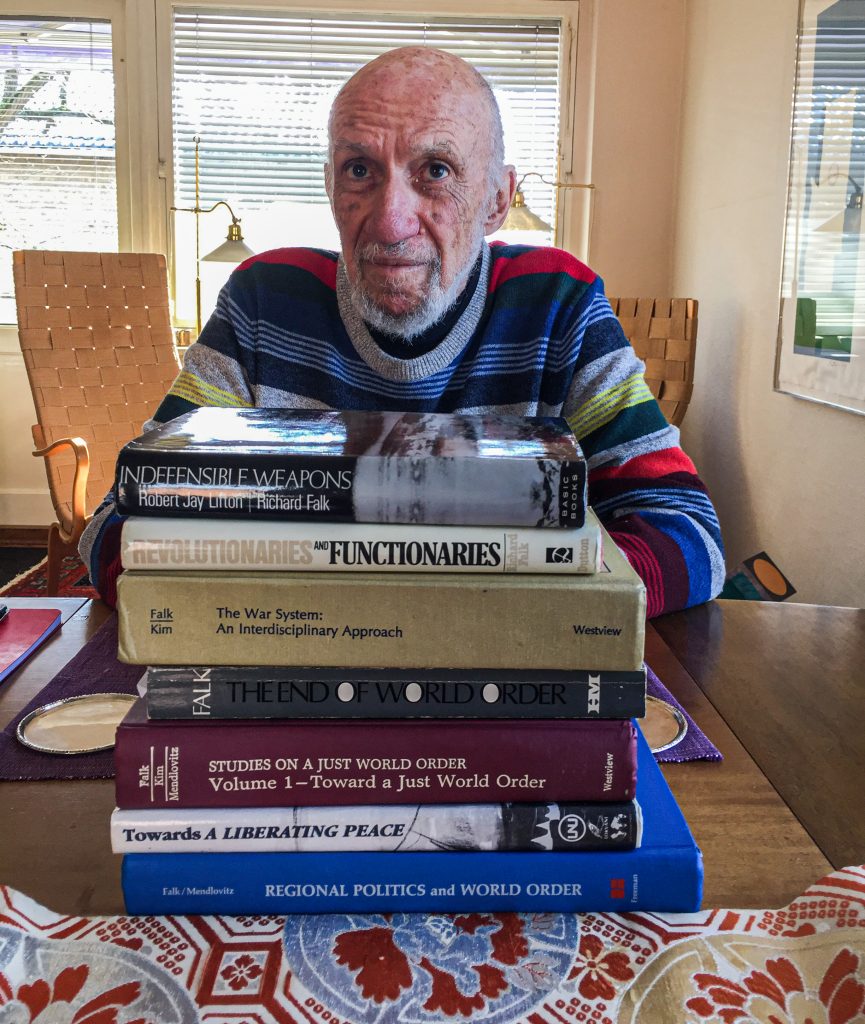
Richard Falk with some of his many books,
March 2018, at TFF’s headquarters

To write this heart- and brain-felt homage, I went back first to TFF Associate’s “Treasures” section 1998-2005 and found 43 articles by Richard. Then on to TFF’s homepage – 2006-2012 and found 46 articles by him. Continuing to TFF Associates’ blog 2012-2017, I find that we published no less than 243 articles by Richard during those five years. And finally to our present site, The Transnational from 2018 where there are some 50.

In sum, more than 380 pieces of theory, visions, commentaries, analyses and debate articles. Although this is only a fraction of his total production, I allow myself to interpret this publication result as a modest token of my deep gratitude and my joy of paying back a little of what he has so generously given TFF and me personally during all these years – not the least, I may add, by reading and editing all these articles before I posted them!

It isn’t easy, perhaps actually impossible, to pin down who Richard Falk is, incessantly writing and speaking around the world, over so many years. But it suffices here to just celebrate the incredible diversity. Richard’s lifelong engagement with the Palestinian people stands out – as do critical analyses of USand NATO militarism and interventionism; Middle Eastern developments and wars, of course; international law and the UN in particular – we share a big heart for its basic idea and role in the world – as well as nonviolence and peace and analysis of topical issues such as this from just a couple of days ago. . .

Richard Falk is Jewish and explains what this identity means to him and, in passing, why he cannot in spite of his critical attitude to Zionism be categorized as he has been, as a self-hating Jew. He speaks rather from an ecumenical perspective – of great significance for world peace thinking:

“In a more fundamental respect my own evolution has always been suspicious of those who give priority to tribalist or sectarian identities. In other words, it is fine to affirm being Jewish, but it should not take precedence over being human or being open and receptive to the insight and wisdom of other traditions. We have reached a point in the political and cultural evolution that our future flourishing as a species vitally depends upon the spread of a more ecumenical ethos. We have expressed this embrace of otherness in relation to food, with the rise of ‘fusion’ cuisines, and with regard to popular culture, particularly music, where all kinds of borrowing and synthesis are perceived as exciting, authentic, valuable.”

And…

“In my experience what is most appropriate in our historical circumstances is an ecumenical and inclusive spiritual identity, and associated ethical and political commitments. In effect, what would awaken the collective sensibilities of the peoples of the earth to the challenges confronting humanity is a movement of spiritual and ethical globalization that approaches the universal through an immersion in a variety of particularities.

In this sense, I want to say, yes I am Jewish, and proud of it, but I am equally indigenous, Sufi, Hindu, Buddhist, Muslim, and Christian to the extent that I allow myself to participate in their rituals, partake of their sacred texts, and seek and avail myself of the opportunity to sit at the feet of their masters. Many persons living deprived lives do not have or desire such ecumenical opportunities, and can best approach this universal ideal, by seeking out the inclusive potentialities of their own religious and cultural reality.”

Of course, like many other experts critical of Israel’s policies in general and policies vis-a-vis the Palestinians, he has been accused of anti-Semitism. In this short video from autumn 2019, you’ll see how he – careful with formulations around the complexity of the issue – explains how Zionism’s rejection/diversion of all criticism as anti-Semitism has more dimensions and purposes than we may have thought of. Indeed, this short sequence a pearl of pedagogics.

Richard’s style of writing has literary qualities way beyond the normal academic text – and without losing its precision and attempted rational reasoning. That may very well have to do with his reading of fiction and his own writing of poetry.

You’ll see in Memoir sketch – Championing lost causes how literary-philosophical classics such as Albert Camus influences his thinking, not only about external academic issues and the world but what it means to be an intellectual acting responsibly into that world and – even in dark times – avoid the traps of losing hope and being overtaken by fear.

In this article he pays tribute to one of his dearest friends, literature professor Edward Said (1935-2003) taking as his point of departure Said’s 1997 essay “On lost causes”, something which he elaborates further on in this 2014 article in The Nation about the future of Palestine.

It wasn’t before he turned 80 that Falk started his personal blog, Global Justice in the 21st Century which contains posts of a fascinating diversity and in a quantity that makes you wonder whether the man ever sleeps (he maintains that he does but gives the impression that to him sleep is an unfortunate, necessary waste of time; it’s a feeling we share).

Not to be missed, throughout this blog, he explores directly and indirectly what it means to be what he calls a citizens pilgrim. He defines that as an identity shaped through an appreciative reference to ‘the citizen pilgrim,’ that is, to the citizen whose conscience is directed at others without heeding boundaries of space or time, or such contingent features of identity as nationality, ethnicity, race, religion, gender, class. The citizen pilgrim has embarked upon what is essentially a spiritual journey or pilgrimage, seeking an inspirational future that seems neither feasible nor impossible. Such an inspirational dedication also minimizes the imaginative foreclosures of mortality, making the certainty of death a part of life, and accepting this destiny without seeking the comfort of metaphysical fictions, and thus not deeply disconcerted by ‘the dying of the light.’

As I’ve hinted above, parallel with his academic and political production, Richard has consistently grappled with what it means to be a responsible intellectual – over the moral aspects of his lifelong project and its meandering path. “Responsible scholarship in dark times” from 2007 is but one of many such thoughtful pieces – rare in the academic world – with the greatest relevance for today’s – no less dark – world in which true knowledge, not to mention wisdom, seems to have lost out to the fast market’s banality-driven timespan-contracting and impulsive clicking fad that gives priority to fast, smart opinions rather than the slower knowledge-building – in short, a new illiteracy.

The world as a whole and as we experience it today in a macro-historical perspective has not progressed to the better, towards what he has struggled and hoped for. But is he frustrated?

Richard Falk in Lund, Sweden, March 2018 – from an interview with the author

Anti-war and pro-peace

This little tribute to one of the most prolific and elegantly-reasoning social scientists of our time cannot be anything but kaleidoscopic. The reader is advised to explore the Falk universe and its enlightenment on their own, perhaps through some of the links provided in this article.

Of particular importance for our relations with him is, naturally, his deep belief in and advocacy of using all the civilian means at humanity’s disposal and only use violence as the last resort, completely in unison with the UN Charter’s Article 1 – the promotion of which is TFF’s mission.

An example. Already in September 2002 – about half a year before the U.S. invasion and destruction of Iraq with its allies under Goerge W. Bush, Falk pulled the entire project apart, intellectually, legally, politically and morally in this short article on TFF – “A roadmap to war: A flawed debate.”

Falk stated his factual and intuitive pre-war criticism succinctly as did other TFF Associates such as Hans von Sponeck, Johan Galtung, Brian Martin, David Krieger, Burns Weston, Birgitte Rahbek, Else Hammerich and myself to mention some of the more vocal anti-intervention voices at the time.

It’s noteworthy that all TFF Associates who advised strongly against that war before it started also predicted its catastrophic consequences it would have in Iraq as well as for the possibility of a new and more benign world order that had been made possible by the demise of the Soviet Union and the Warsaw Pact. But few politicians and media in the US and NATO countries had any wish or capacity to listen. Today the consequences of that insensitive and self-destructive militarism causes the decline of the US and NATO itself.

Falk’s devotion to Gandhi, to eclecticist nonviolent thinking and policies, can be enjoyed in this article on TFF’s homepage “Mahatma Gandhi and the revival of nonviolent politics at the end of the 20th century” – as early as 1998.

If a Nobel Peace Prize should, for the first time, be awarded to a peace and conflict scholar, Richard Falk would be on top of the shortlist. Fortunately, he is on the list of the Nobel Peace Prize Watch. Here you may read the motivation for his nomination, every year over the last 12.

However, like Johan Galtung and the other qualified people on that list, Falk is probably too central to the essential peace concerns as Alfred Nobel expressed them in his will to ever even be considered – not that I think it bothers him the slightest.

♫ ♫

My wife and co-founder Christina – and many other TFF Associates – join you today to say thank you, dear Richard, for your friendship, mentorship and TFF Associateship over more than 40 years.

As we look forward, we wish you and you wife Hilal Elver everything good in years to come, good health in particular so you can continue happily your citizen’s pilgrimage which will, beyond a doubt, continue to inspire way beyond your own time and space. And do continue your daily ping-pong matches too…
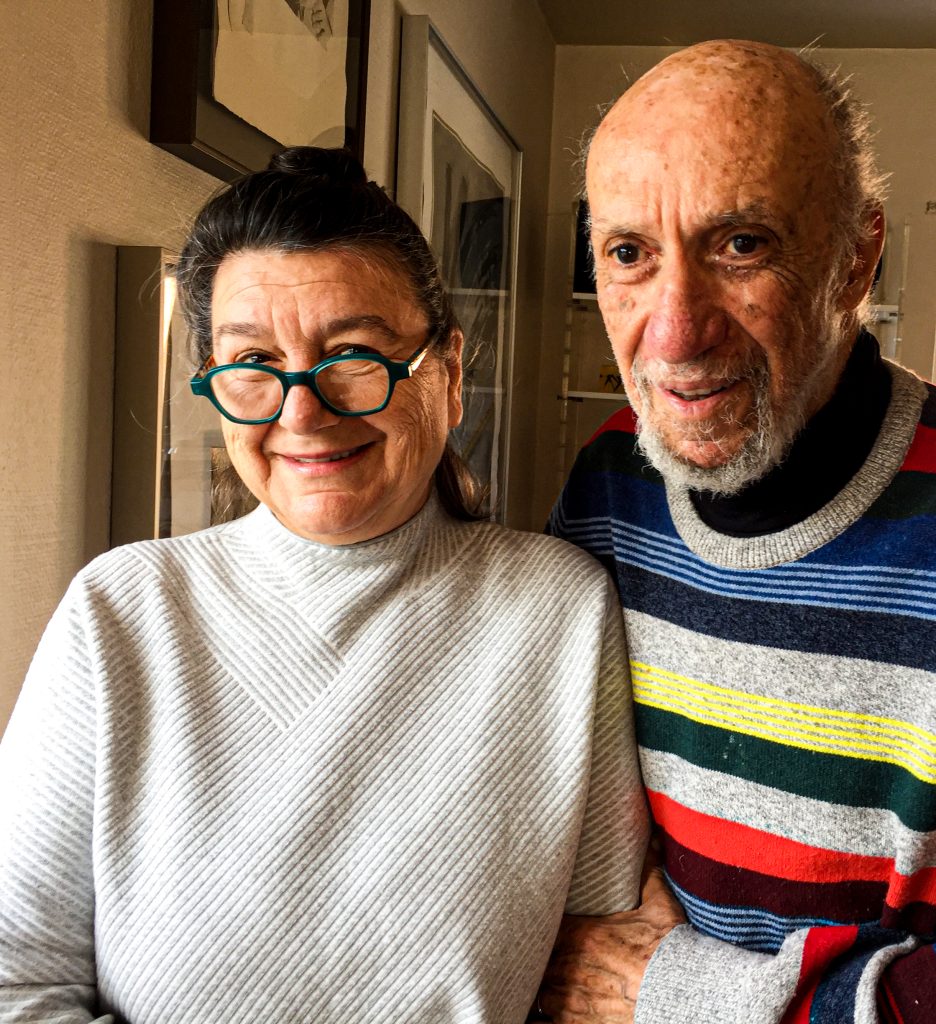
Hilal & Richard in the founders home, March 2018

You may congratulate Richard Falk in the comments section below or write him at either falk@global.ucsb.edu or rfalk@princeton.edu

Peace & future researcher + ‌Art Photographer

Share

Leave a Reply

Your email address will not be published. Required fields are marked *

Related Posts

PRESS RELEASE – 6 OCTOBER 2025 LAY DOWN YOUR ARMSPEACE PRIZE FOR 2025 is awarded Francesca Albanese The United Nations Special Rapporteur on the occupied Palestinian territories – as the person who, in accordance with Alfred Nobel’s will, has “done the most or the best work for fraternity between nations and for the abolition or reduction of standing armies as well as for the holding and promotion of peace congresses.” Francesca Albanese has forcefully and unwaveringly worked against Israel’s full-scale war on the occupied Palestinian territories, in particular Israel´s ongoing genocide against the Palestinian people. She has confronted Israel’s systematic war crimes and crimes against humanity in a truly global outreach. Further, she has brought governments, international organisations and people’s groups together to underline the responsibility of the world at large to act and to stop arming, enabling, and profiting from Israel’s ongoing criminal actions. But first of all, Albanese...
Officially, the drones were not identified. By simply thinking critically – which journalists and selected experts no longer do – there may be a good reason for that. And this article will never be mentioned in Denmark… Drones over Denmark. No damage. No trace. No answers. Yet the headlines scream “Russian threat,” and Prime Minister Mette Frederiksen speaks with a certainty that defies logic: “We don’t know they were Russian—but we know Russia is the biggest threat to Europe.” It could be nobody else – unless you make an interest analysis which I did two days ago. This is not security policy. It’s theatre. And the audience is being played. Let’s rewind. These drones—unphotographed, untracked, unclaimed—appear and vanish like ghosts. Airports shut down. Panic spreads. Military budgets swell. And the narrative hardens: Russia is behind it. But what if that’s not just wrong but deliberately misleading? Here’s a hypothesis for...
And why the world, especially the EU, must now declare itself independent of the United States. UN’s 80th anniversary This year, the United Nations celebrates the 80th anniversary of its founding. The UN was formed after the scourge of the Second World War, in which 70 to 85 million people were killed and many countries were destroyed. That war came on the heels of the First World War, which also killed between 15 and 22 million people. After the Second World War, especially after the use of nuclear weapons by the United States, which marked a turning point in the history of warfare that could result in the end of civilisation as we know it, humanity decided to move away from the era of empires and big power politics and usher in a new era of peace, freedom and cooperation. These were the principles enshrined in the UN Charter. The United States...

Recent Articles

Gandhi, Arun. Lord Richard Attenborough. Kasturba: a lifeNew Delhi: Penguin Books Ltd., 2000.315 pp, 295 Indian Rs, US $22.51 January 29, 2002 Arun Gandhi, grandson to Mohandas and Kasturba, has written a thorough account of Kasturba’s life. Arun begins with a description of Kasturba’s childhood in Porbandar in the late1800s, before she met Mohandas. By having chosen to embark on difficult research into his grandmother’s life, including her first years which are not well-documented, Arun ensures that the reader receives an intimate and life-long portrait of this amazing woman. Kasturba is presented as a lively woman &endash; obedient, yet with a mind of her own. As the relationship between Kasturba and Mohandas developed, Arun maintains that Kasturba’s influence over Mohandas in her own quiet way also grew, to which some of Mohandas’ writings also attest.  Arun paints a vivid picture of the beginnings of Mohandas’ non-violence movement in South Africa, a...
In response to an urgent Appeal from all the living Nobel Peace Prize Laureates, the General Assembly of the United Nations, on November 1998, unanimously declared the first decade of the twenty-first century to be The Decade for a Culture of Peace and Nonviolence. While people are naturally concerned about the amount of violence in our world and how it threatens our future, the Nobel Laureates are right to remind us of the potential of nonviolence and our calling to build a culture of peace and nonviolence.  The twentieth century is instructive in the way that the philosophy and practice of nonviolence have begun to flourish and in the way that nonviolent movements have had an exponential growth across the world. Mohandas Gandhi and Martin Luther King, Jr. are the most famous nonviolent leaders but many have built upon the paths they charted as in country after country, tyrannies and...
We know that medical personnel have failed to report to higher authorities wounds that were clearly caused by torture and that they have neglected to take steps to interrupt this torture. In addition, they have turned over prisoners’ medical records to interrogators who could use them to exploit the prisoners’ weaknesses or vulnerabilities. We have not yet learned the extent of medical involvement in delaying and possibly falsifying the death certificates of prisoners who have been killed by torturers. A May 22 article on Abu Ghraib in the New York Times states that “much of the evidence of abuse at the prison came from medical documents” and that records and statements “showed doctors and medics reporting to the area of the prison where the abuse occurred several times to stitch wounds, tend to collapsed prisoners or see patients with bruised or reddened genitals.” http://www.truthout.org/docs_04/080604J.shtml#16 According to the article, two doctors who...

TFF on Substack

Discover more from TFF Transnational Foundation & Jan Oberg.

Most Popular

Gandhi, Arun. Lord Richard Attenborough. Kasturba: a lifeNew Delhi: Penguin Books Ltd., 2000.315 pp, 295 Indian Rs, US $22.51 January 29, 2002 Arun Gandhi, grandson to Mohandas and Kasturba, has written a thorough account of Kasturba’s life. Arun begins with a description of Kasturba’s childhood in Porbandar in the late1800s, before she met Mohandas. By having chosen to embark on difficult research into his grandmother’s life, including her first years which are not well-documented, Arun ensures that the reader receives an intimate and life-long portrait of this amazing woman. Kasturba is presented as a lively woman &endash; obedient, yet with a mind of her own. As the relationship between Kasturba and Mohandas developed, Arun maintains that Kasturba’s influence over Mohandas in her own quiet way also grew, to which some of Mohandas’ writings also attest.  Arun paints a vivid picture of the beginnings of Mohandas’ non-violence movement in South Africa, a...
In response to an urgent Appeal from all the living Nobel Peace Prize Laureates, the General Assembly of the United Nations, on November 1998, unanimously declared the first decade of the twenty-first century to be The Decade for a Culture of Peace and Nonviolence. While people are naturally concerned about the amount of violence in our world and how it threatens our future, the Nobel Laureates are right to remind us of the potential of nonviolence and our calling to build a culture of peace and nonviolence.  The twentieth century is instructive in the way that the philosophy and practice of nonviolence have begun to flourish and in the way that nonviolent movements have had an exponential growth across the world. Mohandas Gandhi and Martin Luther King, Jr. are the most famous nonviolent leaders but many have built upon the paths they charted as in country after country, tyrannies and...
We know that medical personnel have failed to report to higher authorities wounds that were clearly caused by torture and that they have neglected to take steps to interrupt this torture. In addition, they have turned over prisoners’ medical records to interrogators who could use them to exploit the prisoners’ weaknesses or vulnerabilities. We have not yet learned the extent of medical involvement in delaying and possibly falsifying the death certificates of prisoners who have been killed by torturers. A May 22 article on Abu Ghraib in the New York Times states that “much of the evidence of abuse at the prison came from medical documents” and that records and statements “showed doctors and medics reporting to the area of the prison where the abuse occurred several times to stitch wounds, tend to collapsed prisoners or see patients with bruised or reddened genitals.” http://www.truthout.org/docs_04/080604J.shtml#16 According to the article, two doctors who...
Read More
Imagen-thumbnail-The-Transnational-1
Gandhi, Arun. Lord Richard Attenborough. Kasturba: a lifeNew Delhi: Penguin Books Ltd., 2000.315 pp, 295 Indian Rs, US $22.51 January 29, 2002 Arun Gandhi, grandson to Mohandas and Kasturba, has written a thorough account of Kasturba’s life. Arun begins with a description of Kasturba’s childhood in Porbandar in the late1800s, before she met Mohandas. By having chosen to embark on difficult research into his grandmother’s life, including her first years which are not well-documented, Arun ensures that the reader receives an intimate and life-long portrait of this amazing woman. Kasturba is presented as a lively woman &endash; obedient, yet with a mind of her own. As the relationship between Kasturba and Mohandas developed, Arun maintains that Kasturba’s influence over Mohandas in her own quiet way also grew, to which some of Mohandas’ writings also attest.  Arun paints a vivid picture of the beginnings of Mohandas’ non-violence movement in South Africa, a...
Imagen-thumbnail-The-Transnational-1
In response to an urgent Appeal from all the living Nobel Peace Prize Laureates, the General Assembly of the United Nations, on November 1998, unanimously declared the first decade of the twenty-first century to be The Decade for a Culture of Peace and Nonviolence. While people are naturally concerned about the amount of violence in our world and how it threatens our future, the Nobel Laureates are right to remind us of the potential of nonviolence and our calling to build a culture of peace and nonviolence.  The twentieth century is instructive in the way that the philosophy and practice of nonviolence have begun to flourish and in the way that nonviolent movements have had an exponential growth across the world. Mohandas Gandhi and Martin Luther King, Jr. are the most famous nonviolent leaders but many have built upon the paths they charted as in country after country, tyrannies and...
Imagen-thumbnail-The-Transnational-1
We know that medical personnel have failed to report to higher authorities wounds that were clearly caused by torture and that they have neglected to take steps to interrupt this torture. In addition, they have turned over prisoners’ medical records to interrogators who could use them to exploit the prisoners’ weaknesses or vulnerabilities. We have not yet learned the extent of medical involvement in delaying and possibly falsifying the death certificates of prisoners who have been killed by torturers. A May 22 article on Abu Ghraib in the New York Times states that “much of the evidence of abuse at the prison came from medical documents” and that records and statements “showed doctors and medics reporting to the area of the prison where the abuse occurred several times to stitch wounds, tend to collapsed prisoners or see patients with bruised or reddened genitals.” http://www.truthout.org/docs_04/080604J.shtml#16 According to the article, two doctors who...
Imagen-thumbnail-The-Transnational-1
Jan Øberg behandler i artiklen en lang række faktorer, som ligger til grund for den måde vores samfund er organiseret på – og derfor også for konflikter. Artiklen introducerer således sammenhængen mellem familien, foreninger, regeringer, NGO’ er, nation, stat, nationalstat og alliancer for på denne måde bedre at kunne forstå konflikter og i sidste ende blive klogere mht. at løse disse. Øberg, der er fortaler for global bevidsthed, hvilket skal ses i lyset af den øgede globalisering, skelner mellem kulturkamp og kulturdialog. Endelig behandles begrebet magt og magtesløshed: giver magt ret til at udøve magt – fordi man mener at have ret? Litteraturliste og arbejdsspørgsmål efter artiklen. Ordene vi bruger om verden I satellitperspektiv kan man godt tale om den menneskelige familie eller menneskeheden. Udtrykket understreger, at der eksisterer – eller burde eksistere – et fællesskab fordi vi alle er mennesker og sammen bebor denne klode og ingen anden. Og...
Imagen-thumbnail-The-Transnational-1
Kapitel 2: Forskellige sider af Europa og USA…fortsat 2.5 Militære relationer I forbifarten har vi allerede sagt nogle ting om USA’s militære situation. Kig lige en gang til på afsnit 2.3. Nu skal vi uddybe det militære forhold mellem USA og EU. Der er en række ligheder mellem visse europæiske landes og USA’s militær. Næsten alle er med på en eller anden måde i NATO, direkte som medlem – selv Island, der ikke har et forsvar – eller indirekte i Partnerskab for Fred. USA og Canada er med i OSCE (på dansk OSSE), Organisationen for Sikkerhed og Samarbejde i Europa, der tæller over 50 lande. USA samt England og Frankrig er kernevåbenstater og de har styrker til intervention langt borte fra hjemlandet, om end USA’s er tifold større. Alle har også en omfattende våbeneksport og bruger den som et middel til at tjene penge og få loyale venner på, det...
Imagen-thumbnail-The-Transnational-1
Background Christian Harleman and Jan Oberg conducted a fact-finding mission to Burundi between November 26 and December 6, 2003. (See websites about the country here). The first TFF mission took place in March 1999. Unfortunately, since then it has not been practically possible to implement the co-operation with Burundi’s Ministry of Education and Burundian NGOs that was planned at the time. The 2003 mission had three purposes. First, to do fact-finding in general about the situation and, in particular, the progress under the Arusha Peace Process. Second, to explore the possibilities for co-operation between the government and relevant NGOs on the one hand and TFF on the other, in order to develop and deepen the existing competence in fields such as conflict-understanding, reconciliation and peace-building. Finally, third, to find out whether it would be possible, in co-operation with the Swedish Rescue Services Agency (Statens Räddningsverk), to establish a health care unit that...