
June 15, 2020
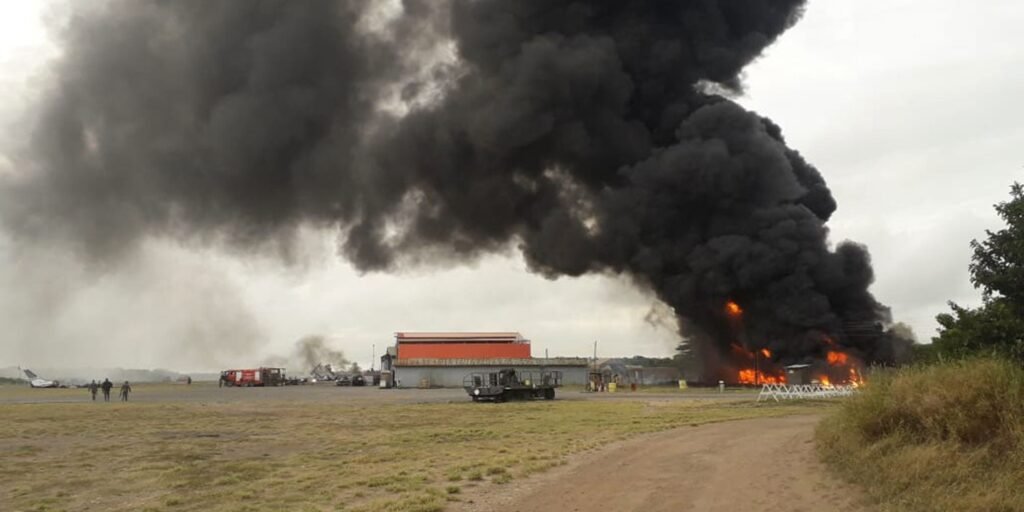
27 Feb 2020 –Last month, about a dozen al-Shabab fighters infiltrated the perimeter of a military base in Manda Bay, Kenya. One of them took aim with a rocket-propelled grenade, firing at a U.S. surveillance plane and touching off an hourslong firefight. When it was all over, the two American pilots of that plane and a U.S. soldier were dead, two other U.S. military personnel were wounded, six surveillance aircraft and helicopters were destroyed, and parts of the airfield were in flames.
Originally posted on Transcend Media Service on March 2, 2020
Where there are U.S. bases, there is the potential for such attacks, because bases are not just launching pads for offensive military operations, but targets for them too. Since 9/11, the U.S. military has built a sprawling network of outposts in more than a dozen African countries. The Intercept has obtained U.S. military documents and a set of accompanying maps that provide the locations of these African bases in 2019, including the one at Manda Bay. These formerly secret documents, created by the Pentagon’s Africa Command and obtained via the Freedom of Information Act, offer an exclusive window into the footprint of American military operations in Africa.
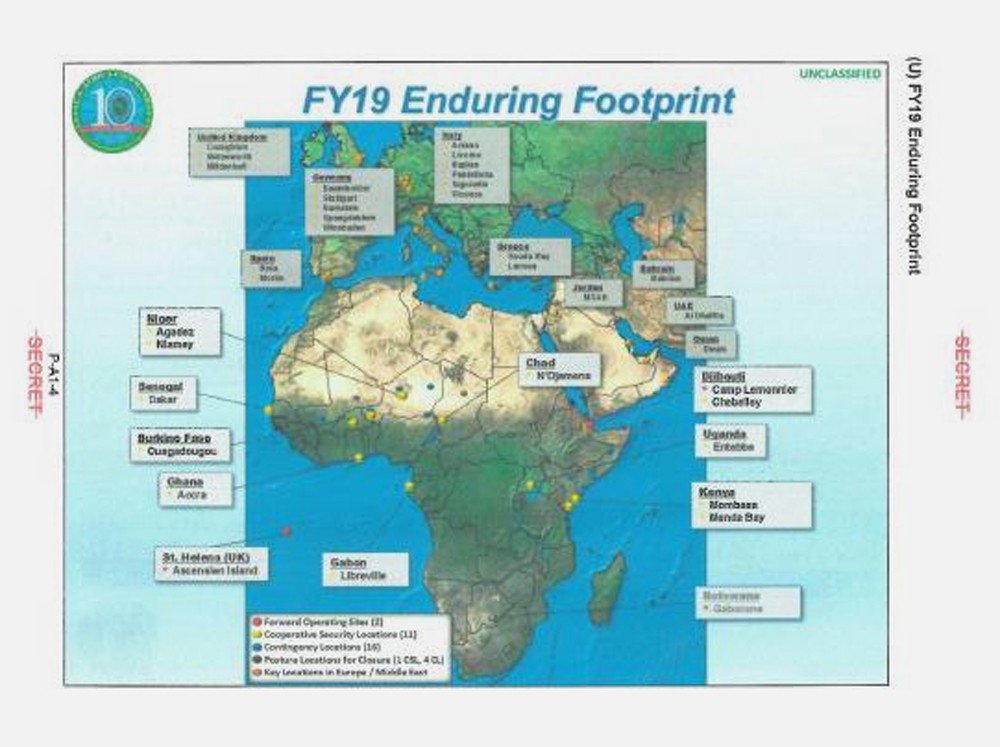
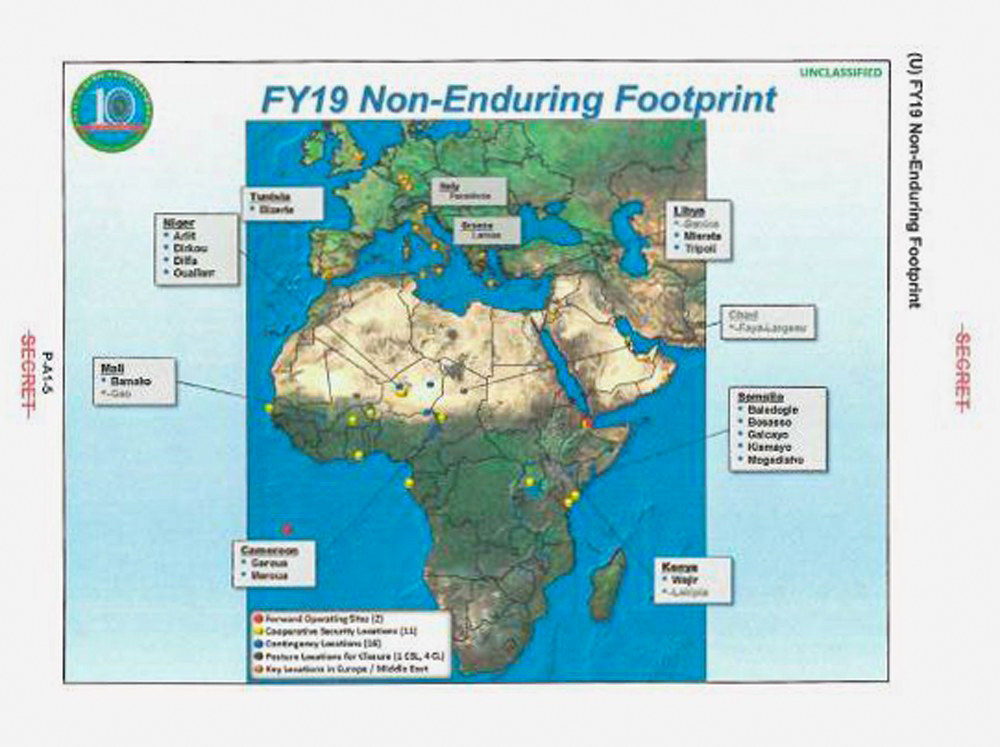
During testimony before the Senate Armed Services Committee late last month, Stephen Townsend, the commander of AFRICOM, echoed a line favored by his predecessors that AFRICOM maintains a “light and relatively low-cost footprint” on the continent. This “light” footprint consists of a constellation of more than two dozen outposts that stretch from one side of Africa to the other. The 2019 planning documents provide locations for 29 bases located in 15 different countries or territories, with the highest concentrations in the Sahelian states on the west side of the continent, as well as the Horn of Africa in the east. Since the plans were created, according to AFRICOM spokesperson John Manley, two bases have been shuttered, leaving the U.S. with an archipelago of 15 “enduring locations” and 12 less-permanent “contingency locations.” The documents note, however, that AFRICOM is actively seeking to enhance its presence and is primed for expansion in the future.
U.S. Africa Command’s “Enduring Footprint” and “Non-Enduring Footprint” in 2019:
| ENDURING FOOTPRINT 2019 | NON-ENDURING FOOTPRINT 2019 |
| Chebelley, Djibouti | Bizerte, Tunisia |
| Camp Lemonnier, Djibouti | Arlit, Niger |
| Entebbe, Uganda | Dirkou, Niger |
| Mombassa, Kenya | Diffa, Niger |
| Manda Bay, Kenya | Ouallam, Niger |
| Liberville, Gabon | Bamako, Mali |
| St. Helena, Ascension Island | Garoua, Cameroon |
| Accra, Ghana | Maroua, Cameroon |
| Ouagadougou, Burkina Faso | Misrata, Libya |
| Dakar, Senegal | Tripoli, Libya |
| Agadez, Niger | Baledogle, Somalia |
| Niamey, Niger | Bosasso, Somalia |
| N’Djamena, Chad | Galcayo, Somalia |
| Kismayo, Somalia | |
| Mogadishu, Somalia | |
| Wajir, Kenya |
Violent extremism and insecurity on the continent has increased exponentially during the very years that the U.S. has been building up its network of bases, providing billions of dollars in security assistance to local partners, conducting persistent counterterrorism operations that include commando raids, combat by U.S. Special Operations forces in at least 13 African countries between 2013 and 2017, and a record number of U.S. airstrikes in Somalia (just over one attack per week in 2019). There are now roughly 25 active militant Islamist groups operating in Africa, up from just five in 2010 — a jump of 400 percent — according to the Defense Department’s Africa Center for Strategic Studies. Militant Islamist activity also hit record levels in 2019. There were 3,471 reported violent events linked to these groups last year, a 1,105 percent increase since 2009. Reported fatalities resulting from African militant Islamist group activity also increased by 7 percent over last year, to an estimated 10,460 deaths. The situation has become so grim that U.S. military aims in West Africa have recently been scaled back from a strategy of degrading the strength and reach of terror groups to nothing more than “containment.”
The current archipelago of U.S. outposts in Africa represents a decrease of seven sites from the 34 bases detailed in a set of briefing documents by AFRICOM science adviser Peter Teil that were published by The Intercept in 2018. The new 2019 AFRICOM planning documents provide information on five bases slated for closure, including a longtime “enduring” site in Gaborone, Botswana, and four contingency locations, or CLs, in Faya Largeau, Chad; Lakipia, Kenya; Benina, Libya; and Gao, Mali. Shuttering the CLs, according to the documents, is part of an effort to “seek efficiencies by consolidating … functions at a reduced number of posture locations,” while the removal of Gabrone was chalked up to “a lack of DoD [Department of Defense] property or routine DoD presence” and the fact that “Botswana does not acknowledge or desire any formal DoD access at the international airport.”
Manley refused to say which two additional bases were dropped from the 2019 list. “The fluctuation in the number is not related to Misrata and Tripoli,” he told The Intercept in response to a question about whether the Libyan outposts were the others closed. But it is worth noting that since the 2019 base posture document was produced, the U.S. pulled its forces out of the North African nation. “Due to increased unrest in Libya, a contingent of U.S. forces supporting U.S. Africa Command temporarily relocated from the country in response to security conditions on the ground,” AFRICOM announced last April as the Libyan civil war flared up. Those troops have never returned, according to Manley, and a recent inspector general’s report states that they won’t be redeployed until there is a ceasefire in Libya’s civil war.
It’s also worth noting the documents state that U.S. Army Africa uses space at “host nation facilities” in Theis, Senegal, and Singo, Uganda, even though the bases are not listed on AFRICOM’s maps. While these “cooperative training locations” are not officially considered outposts by the command, they raise the question of whether 29 bases is actually a more accurate count. Whatever the real number of bases, the recent alteration of AFRICOM’s footprint in 2019 appears to be a strategic consolidation as the command fortifies its presence in some of the continent’s hottest hotspots. Of the 6,000 or more U.S. personnel deployed in Africa, about 1,200, according to Manley, are in West Africa, with a significant percentage in Niger, which has become the key American hub on that side of the continent. Around 500 Special Operations forces are reportedly deployed on the other side of the continent in Somalia, the site of America’s most intense and longest-running undeclared war in Africa.
While the five U.S. outposts in Somalia rank second only to the six in Niger when it comes to America’s footprint on the continent, AFRICOM is actively seeking to expand its presence in the Horn of Africa. “Additional posture and/or capacity is required in East Africa to more efficiently employ limited aviation resources in support of U.S. activities in southern Somalia,” according to the formerly secret files, which also mention the “potential establishment of one or more [contingency locations] in Somalia to support Somali National Security Force development.” The 2019 planning documents also state that five “contingency locations” were recommended to be upgraded to “semi-permanent” status: Baledogle, Kismayo, and Mogadishu in Somalia, and Arlit and Diffa in Niger.
What are the forces at these bases doing there? In Diffa, according to a recent inspector general’s report, a small unit of U.S. Special Forces has been providing advice and assistance to Niger’s 51st Special Intervention Battalion, which conducts operations in the Lake Chad region. Another Special Forces detachment has been engaged in train, advise, and assist activities with a local counterterrorism force in Arlit, Niger.
The presence of U.S. commandos at Diffa and Arlit first came to widespread notice in the wake of the October 2017 ambush by Islamic State militants in Tongo Tongo, Niger, that killed four U.S. soldiers. The U.S. base at Baledogle received attention last September when it was attacked by the Somali terrorist group, al-Shabab. Manda Bay, Kenya, where al-Shabab killed the American soldier and U.S. pilots, is still another “enduring” location from AFRICOM’s 2019 list. In the wake of the attack last month, its defenses were also hardened and its troop strength markedly increased.
“I think it’s self-obvious we were not as prepared there in Manda Bay as we needed to be,” AFRICOM’s Townsend told the Senate Armed Services Committee on January 30. “Al-Shabab managed to penetrate onto that airfield. A lot of people don’t know, but the base where our troops live is not where the airfield is. But they were able to get access to that airfield, kill three Americans and destroy six aircraft there. … There’s about 120 infantrymen there on the ground now who are securing that place, and they’ve been working hard since 6 January to put in the appropriate level of defenses. So I am confident that by the time they are done, Manda Bay will be much more properly defended.”
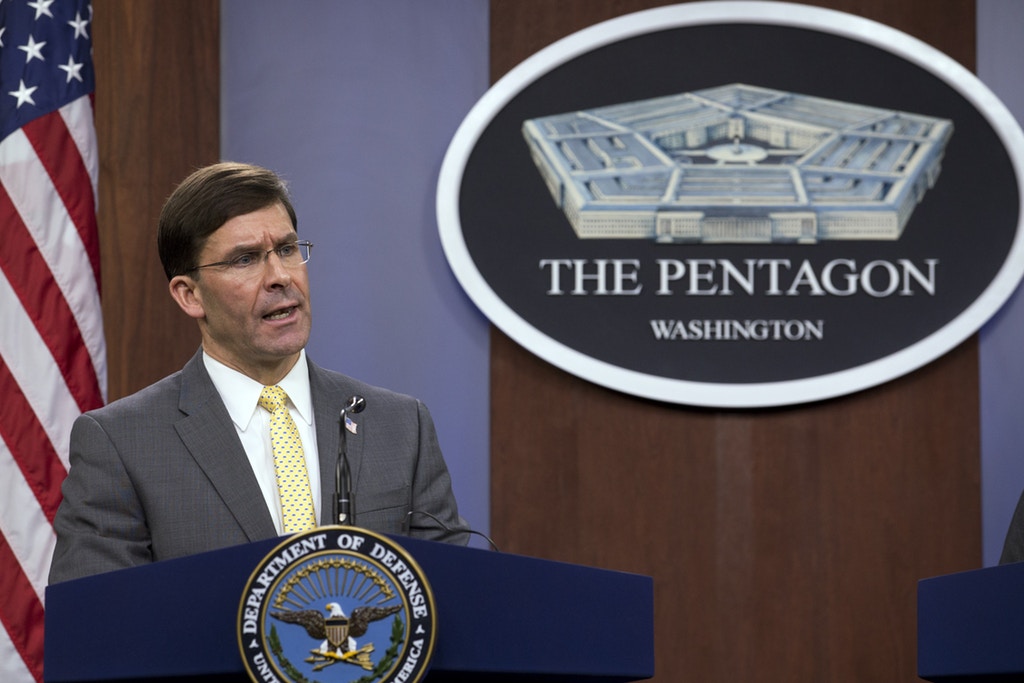
The attack in Kenya came at a time when Defense Secretary Mark Esper was already considering proposals for a major drawdown of U.S. forces on the other side of the continent, in West Africa, including the possible abandonment of a recently built $110 million drone base in Agadez, Niger. According to Manley, the Pentagon’s so-called Blank Slate Review process is still ongoing, and there has been no change to U.S. “force posture” in Africa as of yet. “I haven’t made any decisions yet on West Africa or East Africa,” Esper said recently, while at the same time calling on European nations to “step up in Africa.”
Talk of scaling back U.S. posture and presence in Africa has prompted fierce pushback in Congress. “These personnel and installations are critical in combatting the ever-increasing number of violent extremist groups throughout the region that pose an immediate threat to our partners and allies,” wrote U.S. Sens. Lindsey Graham, R-S.C., and Chris Coons, D-Del., in a January 15 letter to Esper. The senators argued that “any withdrawal or reduction would likely result in a surge in violent extremist attacks on the continent and beyond as well as increase the geopolitical influence of competitors like Russia and China.” James Inhofe, chair of the Senate Armed Services Committee echoed these concerns. “Today, more than a dozen terrorist groups with ties to Al Qaida and ISIS are operating across Africa,” he said late last month. “Many of these groups have ambition to attack Americans and our partners. Without sustained pressure, the threat posed by these groups will.”
But in the face of deteriorating security and gloomy Pentagon assessments, some experts question this rationale. “The current, overly militarized approach to fighting terrorism in Africa is not working,” said William Hartung, the director of the arms and security project at the Center for International Policy, or CIP. “As the U.S. military footprint and military activities have increased, terrorist violence has grown and terrorist groups have proliferated.”
His colleague, Temi Ibirogba, a program and research associate with the Africa Program at CIP, noted that the rise of violent extremism in Africa in the face of persistent U.S. military engagement since 9/11 should be cause for skepticism of the “more is better” strategy. “The U.S. military should be considering alternative approaches like better coordination with African regional and continental organizations and encouraging African governments to consider negotiations in certain cases,” she told The Intercept.
In recent years, the U.S. military has carried out no fewer than 36 named operations and activities in Africa, including at least eight “127-echo” programs, which are named for the budgetary authority that allows U.S. Special Operations forces to use host-nation military units as proxies in missions aimed at violent extremist organizations, or VEOs. Run by Joint Special Operations Command, the secretive organization that controls the Navy’s SEAL Team 6 and the Army’s Delta Force, or by theater special operations forces, these 80- to 120-person units, operating with the assistance of U.S. commandos, are primarily engaged in counterterrorism operations, especially ones aimed at high-value targets.
The 2019 AFRICOM planning document notes that U.S. forces will “continue to conduct counter-VEO-focused activities” from 16 separate bases. Even discounting the two counter-VEO bases in Libya that appear to have been closed since the map was created by AFRICOM, this leaves one each in Kenya, Mali, and Tunisia, as well as five in Somalia, four in Niger, and two in Cameroon at Garoua and Maroua. The site in Garoua is a drone base that was profiled by The Intercept in 2016. In 2017, the Intercept revealed that while the U.S. military fortified its base in Maroua, known as Camp Salak, the outpost also served as a scene of illegal imprisonment, torture, and even killings.
Facing a potential drawdown of forces, AFRICOM has been making the case that its bases and the missions run from them are integral to U.S. interests. “Strategic access to Africa, its airspace, and its surrounding waters is vital to U.S. national security,” Townsend told the Senate Armed Services Committee late last month. He and others have argued for what they contend is AFRICOM’s supposed bang for the buck. “What U.S. Africa Command accomplishes with relatively few people and few dollars, on a continent three-and-a-half times the size of the continental United States, is a bargain for the American taxpayer,” Manley told The Intercept.
But a recent inspector general’s report, examining U.S. counterterrorism efforts in Africa, raises serious questions about the utility of billions of tax dollars spent on U.S. bases, operations, and assistance to local partners. Even after a decade-plus spent fighting militants in Somalia, “the threat posed by al Shabaab and ISIS-Somalia in East Africa remains ‘high,’ despite continued U.S. airstrikes and training of Somali security forces,” the Defense Intelligence Agency told the Defense Department’s Inspector General. The DoDIG further noted that al-Shabab not only “remains a potent threat” due to its “ability to conduct high-profile attacks, recruit fighters, and finance ongoing operations,” but that the group “appears to be a growing threat to U.S. personnel and interests in the region.”
The DoDIG’s assessment of West Africa was even more dire. “VEO violence in West Africa grew rapidly over the past 2 years; in Burkina Faso, Mali, and Western Niger, VEO violence increased by 250 percent since 2018,” according to the report. AFRICOM told the DoDIG that security in West Africa continued to deteriorate during the final quarter of 2019 as terrorist groups “launched a growing number of offensive attacks against military facilities and troops … often resulting in large numbers of casualties” to U.S.-allied armed forces. “VEOs in West Africa are not degraded nor contained to the Sahel and Lake Chad region,” the command admitted.
Given the current state of affairs, the Center for International Policy’s Hartung believes that the United States needs to reevaluate its approach. “It’s time for an honest reassessment of U.S. anti-terror strategy in Africa, including greater transparency about the size and scope of U.S. military operations there,” he told The Intercept. “The underlying drivers of terrorism, including poverty, corruption, and repression, do not have military solutions.”
Please help TFF remain truly independent here if you benefited from this article
[paypal-donation]

Nick Turse is an investigative reporter, a fellow at the Type Media Center, the managing editor of TomDispatch.com, a contributing writer at The Intercept, and the co-founder of Dispatch Books. He is the author, most recently, of Next Time They’ll Come to Count the Dead: War and Survival in South Sudan as well as the New York Times bestseller Kill Anything That Moves: The Real American War in Vietnam,. He has reported from the Middle East, Southeast Asia, and Africa.
