
Peace journalism for the Koreas negotiations

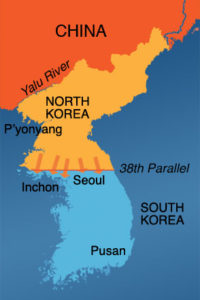
A map of the Korean Peninsula showing the 38th Parallel where the DMZ was established in 1953. (Wikipedia)

“Do not demonise North Korea. Demons do not negotiate. If there are no negotiations, there will be war.”
The words of Chung-in Moon to journalists who gathered for the Korea Press Foundation journalism conference in Seoul, last October, as diplomatic efforts were being stepped up for a second summit meeting between Kim Jong Un and President Donald Trump.

Moon is a sage old hand of arms control talks. A current member of the South Korean government’s advisory committee on diplomatic strategy, he previously served as Ambassador for International Security, combining these posts with his career in universities.

His advice was timely, given the findings of new research on Australian media and how they refer to the Democratic People’s Republic [i]. In coverage from two major newspapers and the public broadcaster, the ABC, North Korea was usually described as rogue, secretive, totalitarian or evil, with its leader “often referred to as a ruthless psychopath.”

Dominant metaphors tended to be conflictual, framing the country as “a military threat [and] unpredictable, irrational and ruthless.” As the researchers comment, the pattern is typical, and not just in Australia.

What would it take, to change the tenor of international coverage? Restraint, for one: CNN’s Seoul correspondent Paula Hancocks, who also spoke at the conference, recalled how she successfully argued against the network running a story on claims that Kim had removed one of his relatives, fallen from government favour, by feeding him to a pack of dogs. Editors in Atlanta had been keen on the story, which was being widely aired elsewhere, but Hancocks advised caution, given that no firm evidence was available to support it.

What can the Peace Journalism playbook contribute?

How can readers and audiences be prompted and equipped to consider and value nonviolent responses to the still-unresolved conflict on the Korean peninsula, with all its potential dangers? Look past slogans from both ‘sides’ to focus on the goals of the conflict parties, for one.

The Korean war of 1950-53 has never been declared officially over. The Koreas are separated by a so-called Demilitarised Zone (DMZ) which marks the ceasefire line. Given this, Moon said, it was vital to realise that the North saw no reason to consider itself “a defeated nation. [So, they would think] don’t treat us as if we have to surrender to the United States.”

Reporters should therefore regard with scepticism calls by hawkish voices on the American side for “complete and verifiable disarmament” before concessions such as the lifting of sanctions (which, indeed, collapsed the second Trump summit, when made under the apparent influence of National Security Adviser John Bolton). Approaches that provide for such steps to proceed in parallel should be seen as more realistic.

Another distinction in the Peace Journalism model originally proposed by Johan Galtung is to focus on “people as peacemakers”, not just leaders. A couple of months before leaving for Seoul, I listened to a talk, at Sydney’s Exodus Foundation, by the veteran nuclear disarmament campaigner, Joseph Gerson, who was visiting Australia from the US. Because the North Korea talks were an initiative of the Trump White House, he explained, Democrats were instinctively sceptical, if not downright hostile. A typical line was: “this is all a sham, Trump gave up too much, we should still be exerting maximum pressure.”

Instead, he called on the official agenda for the process to be “attacked from the Left: demand the formation of negotiating teams” to hammer out a sequence of real progress towards denuclearisation, and the “easing of the trade and medicine embargo.” This would also meet one of Galtung’s key recommendations for reporting peace plans, which I presented at the Seoul conference: ask “is the peace plan a process, or only an outcome?”

Beyond the day’s headline, what happens next?

If non-elite voices deserve greater prominence on the American side, the same is true on the Korean peninsula. Korea Peace Now: Women Mobilizing to End War, was an intervention by the Nobel Women’s Initiative and Women Cross the DMZ. Taking the form of a letter to Presidents Trump and Kim, they called for normalization of relations by “establishing reciprocal liaison offices, lifting sanctions that harm vulnerable individuals, and facilitating people-to-people engagement.”

One of the chief gains from the first Trump-Kim summit in 2018 was a “freeze for a freeze”: no further nuclear weapons testing by Pyongyang, in exchange for a halt to joint military exercises between the US and South Korea. Peace campaigners are calling for the latter to be made permanent.

Over recent years, the pristine environment of Jeju Island has been violated by the establishment of a new naval base, which hosted an “international fleet review” last October. The local Association of Gangjeong villagers, who opposed the development, called on third countries not to send warships to take part. If more media were prepared to listen seriously to such voices, then a more nuanced picture, exposing more of the realistic prospects for peacemaking, could emerge.

As Annabel McGoldrick and I argue in Peace Journalism, our book [ii] distilling many of the discussions we conducted with editors and reporters around the world, presenting inputs to news from unconventional sources requires journalism to construct a “framework of understanding” to establish their relevance to the story.

Today’s journalists must do this anyway, it could be argued, to justify their existence as professional communicators.

Another contributor to the Seoul conference was Thomas Rosenstiel, Executive Director of the American Press Institute. Publics now require “news fluency”, he said, to enable them to differentiate journalism they can rely on. Editors and reporters can help by explaining “how and why this was a story.” If the message from journalism to readers and audiences in the 20th Century was “trust me”, its equivalent for the 21st, in a world of unprecedented media plenitude, was inverted.

Now, the message was coming from readers and audiences, demanding greater transparency as a corollary of that trust: “show me.”

Part of the remedy, for the demonising coverage exposed by the findings on Australian media, would, the researchers say, be to feature “more stories illustrating individual and community life. This would give North Koreans a human face.” Getting the requisite access for such stories is difficult, they concede. However, a notable example screened this year on Australian television, which points the way.

The Foreign Correspondent strand on ABC Television took us into the heart of a unique US-North Korean cooperative venture, between clinics in the country for patients with multidrug-resistant tuberculosis – a deadly disease that strikes half a million people a year worldwide – and volunteers from the Eugene Bell Foundation, who work with them.

Titled ‘Out of Breath’, it’s a moving and memorable film, deserving to be more widely viewed – which it can be, on the program’s website [iii]. “I will never forget the first tuberculosis centre I visited,” the film-maker, Hein S Seok, has written[iv]. “As soon as we stopped, the North Korean medical team rushed over with huge smiles. I realised I was witnessing a reunion of old friends who had been working towards the same goal for decades… I discarded any assumptions I might have had about the North Korean people.”

As long-form journalism (the film runs at 28 minutes), it’s in a genre that lends itself most readily to the PJ approach. But there are clear opportunities now for editors and reporters engaged in all forms of journalism to peer beyond the clichés, engage with the goals and agendas of the parties to an unresolved and potentially dangerous conflict, and make room for peace to enter the debate. [v]

Notes

[i] Bronwen Dalton (2019) ‘Hermit kingdom, nuclear nation: if the media keep calling North Korea names, it will only prolong conflict’, The Conversation, February 28.

[iii] https://www.abc.net.au/foreign/out-of-breath/10825830

[iv] Hein S. Seok (2019) ‘Amid international tensions, the battle to treat “contagious cancer” in North Korea’. ABC News, February 19.

Associate Professor Jake Lynch chairs the Department of Peace and Conflict Studies at the University of Sydney. And a TFF Associate.
His debut novel, Blood on the Stone: An Oxford Detective Story of the 17th Century, is published by Unbound Books. Jake has spent 20 years developing and researching Peace Journalism, in theory and practice. He is the author of seven books and over 50 refereed articles and book chapters. His work in this field was recognised with the award of the 2017 Luxembourg Peace Prize, by the Schengen Peace Foundation. He served for two years as Secretary General of the International Peace Research Association, having organised its biennial global conference in Sydney, in 2010.
Before taking up an academic post, Jake enjoyed a 17-year career in journalism, with spells as a Political Correspondent in Westminster, for Sky News, and the Sydney Correspondent for the Independent newspaper, culminating in a role as an on-screen presenter for BBC World Television News. Lynch is a member of the TRANSCEND Network for Peace Development Environment and advisor for TRANSCEND Media Service.
He is the co-author, with Annabel McGoldrick, of the book Peace Journalism (Hawthorn Press, 2005), and Debates in Peace Journalism, Sydney University Press and TRANSCEND University Press. He also co-authored with Johan Galtung and Annabel McGoldrick ‘Reporting Conflict: An Introduction to Peace Journalism,’ which TMS editor Antonio C. S. Rosa translated to Portuguese.
His most recent book of scholarly research is, A Global Standard for Reporting Conflict (Taylor & Francis, 2014).
Share

Leave a Reply

Your email address will not be published. Required fields are marked *

Related Posts

PRESS RELEASE – 6 OCTOBER 2025 LAY DOWN YOUR ARMSPEACE PRIZE FOR 2025 is awarded Francesca Albanese The United Nations Special Rapporteur on the occupied Palestinian territories – as the person who, in accordance with Alfred Nobel’s will, has “done the most or the best work for fraternity between nations and for the abolition or reduction of standing armies as well as for the holding and promotion of peace congresses.” Francesca Albanese has forcefully and unwaveringly worked against Israel’s full-scale war on the occupied Palestinian territories, in particular Israel´s ongoing genocide against the Palestinian people. She has confronted Israel’s systematic war crimes and crimes against humanity in a truly global outreach. Further, she has brought governments, international organisations and people’s groups together to underline the responsibility of the world at large to act and to stop arming, enabling, and profiting from Israel’s ongoing criminal actions. But first of all, Albanese...
Officially, the drones were not identified. By simply thinking critically – which journalists and selected experts no longer do – there may be a good reason for that. And this article will never be mentioned in Denmark… Drones over Denmark. No damage. No trace. No answers. Yet the headlines scream “Russian threat,” and Prime Minister Mette Frederiksen speaks with a certainty that defies logic: “We don’t know they were Russian—but we know Russia is the biggest threat to Europe.” It could be nobody else – unless you make an interest analysis which I did two days ago. This is not security policy. It’s theatre. And the audience is being played. Let’s rewind. These drones—unphotographed, untracked, unclaimed—appear and vanish like ghosts. Airports shut down. Panic spreads. Military budgets swell. And the narrative hardens: Russia is behind it. But what if that’s not just wrong but deliberately misleading? Here’s a hypothesis for...
And why the world, especially the EU, must now declare itself independent of the United States. UN’s 80th anniversary This year, the United Nations celebrates the 80th anniversary of its founding. The UN was formed after the scourge of the Second World War, in which 70 to 85 million people were killed and many countries were destroyed. That war came on the heels of the First World War, which also killed between 15 and 22 million people. After the Second World War, especially after the use of nuclear weapons by the United States, which marked a turning point in the history of warfare that could result in the end of civilisation as we know it, humanity decided to move away from the era of empires and big power politics and usher in a new era of peace, freedom and cooperation. These were the principles enshrined in the UN Charter. The United States...

Recent Articles

Gandhi, Arun. Lord Richard Attenborough. Kasturba: a lifeNew Delhi: Penguin Books Ltd., 2000.315 pp, 295 Indian Rs, US $22.51 January 29, 2002 Arun Gandhi, grandson to Mohandas and Kasturba, has written a thorough account of Kasturba’s life. Arun begins with a description of Kasturba’s childhood in Porbandar in the late1800s, before she met Mohandas. By having chosen to embark on difficult research into his grandmother’s life, including her first years which are not well-documented, Arun ensures that the reader receives an intimate and life-long portrait of this amazing woman. Kasturba is presented as a lively woman &endash; obedient, yet with a mind of her own. As the relationship between Kasturba and Mohandas developed, Arun maintains that Kasturba’s influence over Mohandas in her own quiet way also grew, to which some of Mohandas’ writings also attest.  Arun paints a vivid picture of the beginnings of Mohandas’ non-violence movement in South Africa, a...
In response to an urgent Appeal from all the living Nobel Peace Prize Laureates, the General Assembly of the United Nations, on November 1998, unanimously declared the first decade of the twenty-first century to be The Decade for a Culture of Peace and Nonviolence. While people are naturally concerned about the amount of violence in our world and how it threatens our future, the Nobel Laureates are right to remind us of the potential of nonviolence and our calling to build a culture of peace and nonviolence.  The twentieth century is instructive in the way that the philosophy and practice of nonviolence have begun to flourish and in the way that nonviolent movements have had an exponential growth across the world. Mohandas Gandhi and Martin Luther King, Jr. are the most famous nonviolent leaders but many have built upon the paths they charted as in country after country, tyrannies and...
We know that medical personnel have failed to report to higher authorities wounds that were clearly caused by torture and that they have neglected to take steps to interrupt this torture. In addition, they have turned over prisoners’ medical records to interrogators who could use them to exploit the prisoners’ weaknesses or vulnerabilities. We have not yet learned the extent of medical involvement in delaying and possibly falsifying the death certificates of prisoners who have been killed by torturers. A May 22 article on Abu Ghraib in the New York Times states that “much of the evidence of abuse at the prison came from medical documents” and that records and statements “showed doctors and medics reporting to the area of the prison where the abuse occurred several times to stitch wounds, tend to collapsed prisoners or see patients with bruised or reddened genitals.” http://www.truthout.org/docs_04/080604J.shtml#16 According to the article, two doctors who...

TFF on Substack

Discover more from TFF Transnational Foundation & Jan Oberg.

Most Popular

Gandhi, Arun. Lord Richard Attenborough. Kasturba: a lifeNew Delhi: Penguin Books Ltd., 2000.315 pp, 295 Indian Rs, US $22.51 January 29, 2002 Arun Gandhi, grandson to Mohandas and Kasturba, has written a thorough account of Kasturba’s life. Arun begins with a description of Kasturba’s childhood in Porbandar in the late1800s, before she met Mohandas. By having chosen to embark on difficult research into his grandmother’s life, including her first years which are not well-documented, Arun ensures that the reader receives an intimate and life-long portrait of this amazing woman. Kasturba is presented as a lively woman &endash; obedient, yet with a mind of her own. As the relationship between Kasturba and Mohandas developed, Arun maintains that Kasturba’s influence over Mohandas in her own quiet way also grew, to which some of Mohandas’ writings also attest.  Arun paints a vivid picture of the beginnings of Mohandas’ non-violence movement in South Africa, a...
In response to an urgent Appeal from all the living Nobel Peace Prize Laureates, the General Assembly of the United Nations, on November 1998, unanimously declared the first decade of the twenty-first century to be The Decade for a Culture of Peace and Nonviolence. While people are naturally concerned about the amount of violence in our world and how it threatens our future, the Nobel Laureates are right to remind us of the potential of nonviolence and our calling to build a culture of peace and nonviolence.  The twentieth century is instructive in the way that the philosophy and practice of nonviolence have begun to flourish and in the way that nonviolent movements have had an exponential growth across the world. Mohandas Gandhi and Martin Luther King, Jr. are the most famous nonviolent leaders but many have built upon the paths they charted as in country after country, tyrannies and...
We know that medical personnel have failed to report to higher authorities wounds that were clearly caused by torture and that they have neglected to take steps to interrupt this torture. In addition, they have turned over prisoners’ medical records to interrogators who could use them to exploit the prisoners’ weaknesses or vulnerabilities. We have not yet learned the extent of medical involvement in delaying and possibly falsifying the death certificates of prisoners who have been killed by torturers. A May 22 article on Abu Ghraib in the New York Times states that “much of the evidence of abuse at the prison came from medical documents” and that records and statements “showed doctors and medics reporting to the area of the prison where the abuse occurred several times to stitch wounds, tend to collapsed prisoners or see patients with bruised or reddened genitals.” http://www.truthout.org/docs_04/080604J.shtml#16 According to the article, two doctors who...
Read More
Imagen-thumbnail-The-Transnational-1
Gandhi, Arun. Lord Richard Attenborough. Kasturba: a lifeNew Delhi: Penguin Books Ltd., 2000.315 pp, 295 Indian Rs, US $22.51 January 29, 2002 Arun Gandhi, grandson to Mohandas and Kasturba, has written a thorough account of Kasturba’s life. Arun begins with a description of Kasturba’s childhood in Porbandar in the late1800s, before she met Mohandas. By having chosen to embark on difficult research into his grandmother’s life, including her first years which are not well-documented, Arun ensures that the reader receives an intimate and life-long portrait of this amazing woman. Kasturba is presented as a lively woman &endash; obedient, yet with a mind of her own. As the relationship between Kasturba and Mohandas developed, Arun maintains that Kasturba’s influence over Mohandas in her own quiet way also grew, to which some of Mohandas’ writings also attest.  Arun paints a vivid picture of the beginnings of Mohandas’ non-violence movement in South Africa, a...
Imagen-thumbnail-The-Transnational-1
In response to an urgent Appeal from all the living Nobel Peace Prize Laureates, the General Assembly of the United Nations, on November 1998, unanimously declared the first decade of the twenty-first century to be The Decade for a Culture of Peace and Nonviolence. While people are naturally concerned about the amount of violence in our world and how it threatens our future, the Nobel Laureates are right to remind us of the potential of nonviolence and our calling to build a culture of peace and nonviolence.  The twentieth century is instructive in the way that the philosophy and practice of nonviolence have begun to flourish and in the way that nonviolent movements have had an exponential growth across the world. Mohandas Gandhi and Martin Luther King, Jr. are the most famous nonviolent leaders but many have built upon the paths they charted as in country after country, tyrannies and...
Imagen-thumbnail-The-Transnational-1
We know that medical personnel have failed to report to higher authorities wounds that were clearly caused by torture and that they have neglected to take steps to interrupt this torture. In addition, they have turned over prisoners’ medical records to interrogators who could use them to exploit the prisoners’ weaknesses or vulnerabilities. We have not yet learned the extent of medical involvement in delaying and possibly falsifying the death certificates of prisoners who have been killed by torturers. A May 22 article on Abu Ghraib in the New York Times states that “much of the evidence of abuse at the prison came from medical documents” and that records and statements “showed doctors and medics reporting to the area of the prison where the abuse occurred several times to stitch wounds, tend to collapsed prisoners or see patients with bruised or reddened genitals.” http://www.truthout.org/docs_04/080604J.shtml#16 According to the article, two doctors who...
Imagen-thumbnail-The-Transnational-1
Jan Øberg behandler i artiklen en lang række faktorer, som ligger til grund for den måde vores samfund er organiseret på – og derfor også for konflikter. Artiklen introducerer således sammenhængen mellem familien, foreninger, regeringer, NGO’ er, nation, stat, nationalstat og alliancer for på denne måde bedre at kunne forstå konflikter og i sidste ende blive klogere mht. at løse disse. Øberg, der er fortaler for global bevidsthed, hvilket skal ses i lyset af den øgede globalisering, skelner mellem kulturkamp og kulturdialog. Endelig behandles begrebet magt og magtesløshed: giver magt ret til at udøve magt – fordi man mener at have ret? Litteraturliste og arbejdsspørgsmål efter artiklen. Ordene vi bruger om verden I satellitperspektiv kan man godt tale om den menneskelige familie eller menneskeheden. Udtrykket understreger, at der eksisterer – eller burde eksistere – et fællesskab fordi vi alle er mennesker og sammen bebor denne klode og ingen anden. Og...
Imagen-thumbnail-The-Transnational-1
Kapitel 2: Forskellige sider af Europa og USA…fortsat 2.5 Militære relationer I forbifarten har vi allerede sagt nogle ting om USA’s militære situation. Kig lige en gang til på afsnit 2.3. Nu skal vi uddybe det militære forhold mellem USA og EU. Der er en række ligheder mellem visse europæiske landes og USA’s militær. Næsten alle er med på en eller anden måde i NATO, direkte som medlem – selv Island, der ikke har et forsvar – eller indirekte i Partnerskab for Fred. USA og Canada er med i OSCE (på dansk OSSE), Organisationen for Sikkerhed og Samarbejde i Europa, der tæller over 50 lande. USA samt England og Frankrig er kernevåbenstater og de har styrker til intervention langt borte fra hjemlandet, om end USA’s er tifold større. Alle har også en omfattende våbeneksport og bruger den som et middel til at tjene penge og få loyale venner på, det...
Imagen-thumbnail-The-Transnational-1
Background Christian Harleman and Jan Oberg conducted a fact-finding mission to Burundi between November 26 and December 6, 2003. (See websites about the country here). The first TFF mission took place in March 1999. Unfortunately, since then it has not been practically possible to implement the co-operation with Burundi’s Ministry of Education and Burundian NGOs that was planned at the time. The 2003 mission had three purposes. First, to do fact-finding in general about the situation and, in particular, the progress under the Arusha Peace Process. Second, to explore the possibilities for co-operation between the government and relevant NGOs on the one hand and TFF on the other, in order to develop and deepen the existing competence in fields such as conflict-understanding, reconciliation and peace-building. Finally, third, to find out whether it would be possible, in co-operation with the Swedish Rescue Services Agency (Statens Räddningsverk), to establish a health care unit that...
