
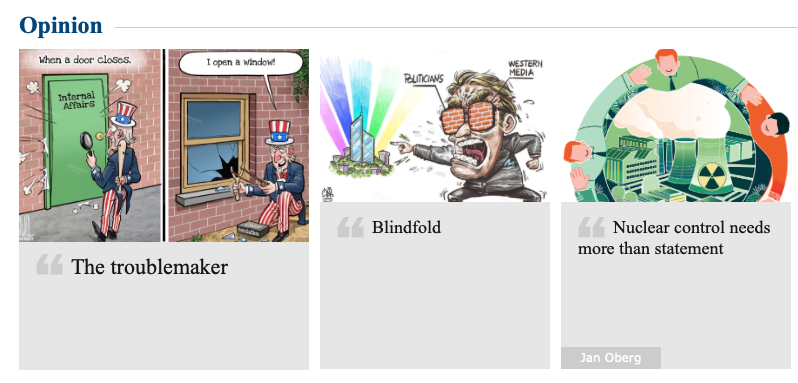
Nuclear weapons abolition requires more than the five nuclear-weapon states’ recent joint statement
, as Op-Ed for China Daily *

One description of the contemporary world is more accurate and ominous than any other, namely that we live in the nuclear age or the age of nuclearism, i.e. the weapons plus the thinking and power structures that surround these doomsday weapons.

In 1946, Albert Einstein stated that “the unleashed power of the atom has changed everything save our modes of thinking and we thus drift toward unparalleled catastrophe.”

Even limited use of nuclear weapons would lead to a global human and environmental catastrophe. It is enigmatic that everybody talks about the much slower climate change, while the numerous destructive links between militarism and environmental destruction are hardly ever made even by leading experts, politicians or civil society leaders.

Therefore, it must be welcomed that the five nuclear weapons states of the UN Security Council have issued a joint statement. They know there is a vast elephant there in the middle of the global room. They want the rest of the world to see that they care: They won’t use these weapons, they won’t start a nuclear arms race against each other, they want to intensify negotiations in good faith to rid the world of nuclear weapons. They know that a nuclear war cannot be won and must never be fought. They want nuclear weapons to be only for deterrence. And they will seek to prevent further proliferation of nukes.

Given the history of nuclear weapons and the intended road to their abolition since 1945, these assertions, however, fail to convince in substantial terms. Let me give a few reasons.

First and foremost – nuclear deterrence: No weapon in this world can serve deterrence if each party knows that all the others will never use their nukes. If A knows that B will under no circumstance ever use his, it is risk-free for A to start using them because A knows that he will not be hit by B’s retaliatory second strike. All deterrence rests on the idea that they shall be used if a particular situation occurs. So, to put it crudely, all nuclear weapons are there to be used – if!

And that’s why abolition is the only effective way to live in security and peace.

Secondly, nuclear defensiveness: To use a weapon only defensively must, by definition, mean that it is used on one’s immediate land and sea territory, thus having short range and limited destruction capacity. None of it applies to nuclear weapons: No country or people would accept the use of nuclear weapons on their own territory against an attacker. In short, nuclear weapons are, by definition, offensive – and offensive worldwide.

Three, disarmament negotiations: With a few exceptions such as the Intermediate-Range Nuclear Force, INF, Treaty of 1987 in Europe, arms control and disarmament negotiation have not led to reductions in arsenals considered essential by the parties. Neither has a lid been put on the ever-increasing sophistication of these weapons and their carriers – missiles, planes and submarines. If negotiations led to disarmament, there would be no nukes left today.

The joint statement correctly points out that the Non-Proliferation Treaty, NPT, of 1970 is important, but these weapons’ centrality and firing power has increased manifold since it was signed in 1968. One must ask with what rights and according to which part of international law the nuclear-weapons countries uphold the idea that they – no one else – have the God-like right, sense of responsibility or wisdom to possess nuclear weapons.

Fourth, nuclear weapons are illegal: The advisory of the International Court of Justice in 1996 was quite clear. And very important, since January 2021, the world finally has The Treaty On The Prohibition Of Nuclear Weapons – the first legally binding international agreement aiming at their total elimination. It’s signed by 86 countries but not by the nuclear ’haves.’ The joint statement doesn’t mention it.

Fifth, nuclear weapons are incompatible with human rights and democracy. Humanity has a right to peace, to live without the daily Damocles Sword that it can be exterminated this afternoon. No nuclear state has held a referendum on nuclear weapons, but opinion polls indicate that the vast majority of their citizens do not want these weapons at all.

Sixth, the risk of human and technical error: Many studies show that leaders such as Richard Nixon made decisions while drinking alcohol; other studies show that officers in nuclear command centres have been sleeping, drunk, or taking drugs. Nuclear accidents have happened, weapons have been lost and never found, nuclear submarines from NATO members have collided. And nuclear weapons have caused conventional conflicts such as the decades-long harassment of Iran for not having them and no one talking about Israel’s. And the US occupied Iraq with the nuclear pretext.

Seventh, nuclearism challenges ethics: Before nuclear weapons entered the world in July 1945, it was only God or Nature that could decide humanity’s being or extermination. In the nuclear age, humans have taken upon them the role of God. We need a debate about whether any government, civilian or military leader should have a right to make such a decision.

The joint statement seems to prove Einstein right: We have still not understood the need for new thinking necessitated by these weapons.

In particular, the US signature on that document is fake because the US’ official nuclear doctrine is the only one that reserves the right to be the first to use nukes, to use them against a conventional attack, including a significant cyber-attack and, additionally, has deliberately lowered the so-called nuclear threshold.

What would – perhaps – work instead?

One, respect for international law and the spirit and letter of the UN Charter. Two, peoples’ pressure from below worldwide. Three, signing right away the new Abolition Treaty – the first nuclear state doing that will be loved by humanity. Four, alternative – innovative – defence thinking would make nuclear weapons superfluous. Five, GRIT – Graduated Reciprocation in Tension-Reduction – a brilliant idea suggested by Charles Osgood in 1962: Take the first small step unilaterally and thereby invite/put moral pressure on others to take the next, leading to a downward spiral.

It’s time human civilisation does what it has earlier done in the name of civilisation namely abolishing/condemning slavery, cannibalism, absolute monarchy, genocide, child labour, rape, etc. We must abolish nuclear weapons before they abolish us. And it is imminently possible. [END]

*) China Daily published the article in a shortened and “polished” version on January 14, 2022. See it here.
Oberg is a monthly contributor of opinion pieces to this flagship Chinese media. It has more than 52 million clicks online daily and about 40 million followers on social media – according to the latest (2016) data. It serves more than 330 million readers all over the world and is a default choice for people who read about China in English.

If you appreciate this type of analysis and valus concerning nuclar weapons in our world, please let us see it here. Thanks a lot!

Note added on January 18, 2022

See what SIPRI has to say about the increase in and ongoing modernisation of nuclear weapons by the nuclear-haves in total defiance of the Abolition Treaty:

“The entry into force of the Treaty on the Prohibition of Nuclear Weapons in early 2021 highlights the growing divide between the nuclear-armed states, which are all investing in the long-term future of their nuclear forces, and other countries that are impatient to see progress on nuclear disarmament promised by the Nuclear Non-Proliferation Treaty,” said Matt Korda, Associate Researcher with SIPRI’s Nuclear Disarmament, Arms Control and Non-proliferation Programme and Research Associate with the FAS Nuclear Information Project.

Peace & future researcher + ‌Art Photographer

Share

Leave a Reply

Your email address will not be published. Required fields are marked *

Related Posts

PressInfo # 141, December 21, 2001It’s time to prepare reconciliation between Albanians and Serbs PressInfo # 140, December 14, 2001Ibrahim Rugova’s decade-long leadership in Kosovo/a PressInfo # 139, 11. december, 2001En god nyhet: Jugoslaviens Sannings- och försoningskommission PressInfo # 139, 11. december, 2001Gode nyheder: Jugoslaviens Sandheds- og Forsoningskommission PressInfo # 139, December 11, 2001Good news: Yugoslavia’s Truth and Reconciliation Commission PressInfo # 138, November 8, 2001TFF co-founder PhD with thesis about young people with roots in other cultures PressInfo # 138, November 8, 2001TFF:s medstiftare doktor på avhandling om unga med ursprung i andra kulturer PressInfo # 137, October 17, 2001A new Marshall Plan: Advancing human security and controlling terrorism PressInfo # 136, October 15, 2001The UN and Annan really deserve it PressInfo # 135, October 10, 2001Preventing a terrorist mushroom cloud PressInfo # 134, 17 oktober, 2001Sverige og 11. september PressInfo # 134, October 9, 2001Sweden and September 11...
Peace is promoted by constructive proposals and dialogue Four preceding PressInfos have expressed concern over — and criticised — the ongoing, militarisation of the EU. Some will say: but there are no alternatives. We believe that there are always alternatives, that democracies are characterised by alternatives and choice, and that openly discussed alternatives will improve the quality and legitimacy of society’s decision–making. In addition, it is an intellectual and moral challenge to not only criticise but also be constructive. If we only tell people that we think they are wrong, they are not likely to listen. However, if we say: what are your views on this set of ideas and steps? — we may sometimes engage them in dialogue and sow a seed. Most people in power circles live their daily lives in in a time frame and a social space where certain ideas, viewpoints and concepts are just not...
Photos © TFF 2000 Read PressInfo 90 “Lift the Sanctions and Bring More Aid to Yugoslavia” See Pictures from Belgrade © TFF 2000 Please reprint, copy, archive, quote or re-post this item, but please retain the source.

Recent Articles

PressInfo # 141, December 21, 2001It’s time to prepare reconciliation between Albanians and Serbs PressInfo # 140, December 14, 2001Ibrahim Rugova’s decade-long leadership in Kosovo/a PressInfo # 139, 11. december, 2001En god nyhet: Jugoslaviens Sannings- och försoningskommission PressInfo # 139, 11. december, 2001Gode nyheder: Jugoslaviens Sandheds- og Forsoningskommission PressInfo # 139, December 11, 2001Good news: Yugoslavia’s Truth and Reconciliation Commission PressInfo # 138, November 8, 2001TFF co-founder PhD with thesis about young people with roots in other cultures PressInfo # 138, November 8, 2001TFF:s medstiftare doktor på avhandling om unga med ursprung i andra kulturer PressInfo # 137, October 17, 2001A new Marshall Plan: Advancing human security and controlling terrorism PressInfo # 136, October 15, 2001The UN and Annan really deserve it PressInfo # 135, October 10, 2001Preventing a terrorist mushroom cloud PressInfo # 134, 17 oktober, 2001Sverige og 11. september PressInfo # 134, October 9, 2001Sweden and September 11...
Peace is promoted by constructive proposals and dialogue Four preceding PressInfos have expressed concern over — and criticised — the ongoing, militarisation of the EU. Some will say: but there are no alternatives. We believe that there are always alternatives, that democracies are characterised by alternatives and choice, and that openly discussed alternatives will improve the quality and legitimacy of society’s decision–making. In addition, it is an intellectual and moral challenge to not only criticise but also be constructive. If we only tell people that we think they are wrong, they are not likely to listen. However, if we say: what are your views on this set of ideas and steps? — we may sometimes engage them in dialogue and sow a seed. Most people in power circles live their daily lives in in a time frame and a social space where certain ideas, viewpoints and concepts are just not...
Photos © TFF 2000 Read PressInfo 90 “Lift the Sanctions and Bring More Aid to Yugoslavia” See Pictures from Belgrade © TFF 2000 Please reprint, copy, archive, quote or re-post this item, but please retain the source.

TFF on Substack

Discover more from TFF Transnational Foundation & Jan Oberg.

Most Popular

PressInfo # 141, December 21, 2001It’s time to prepare reconciliation between Albanians and Serbs PressInfo # 140, December 14, 2001Ibrahim Rugova’s decade-long leadership in Kosovo/a PressInfo # 139, 11. december, 2001En god nyhet: Jugoslaviens Sannings- och försoningskommission PressInfo # 139, 11. december, 2001Gode nyheder: Jugoslaviens Sandheds- og Forsoningskommission PressInfo # 139, December 11, 2001Good news: Yugoslavia’s Truth and Reconciliation Commission PressInfo # 138, November 8, 2001TFF co-founder PhD with thesis about young people with roots in other cultures PressInfo # 138, November 8, 2001TFF:s medstiftare doktor på avhandling om unga med ursprung i andra kulturer PressInfo # 137, October 17, 2001A new Marshall Plan: Advancing human security and controlling terrorism PressInfo # 136, October 15, 2001The UN and Annan really deserve it PressInfo # 135, October 10, 2001Preventing a terrorist mushroom cloud PressInfo # 134, 17 oktober, 2001Sverige og 11. september PressInfo # 134, October 9, 2001Sweden and September 11...
Peace is promoted by constructive proposals and dialogue Four preceding PressInfos have expressed concern over — and criticised — the ongoing, militarisation of the EU. Some will say: but there are no alternatives. We believe that there are always alternatives, that democracies are characterised by alternatives and choice, and that openly discussed alternatives will improve the quality and legitimacy of society’s decision–making. In addition, it is an intellectual and moral challenge to not only criticise but also be constructive. If we only tell people that we think they are wrong, they are not likely to listen. However, if we say: what are your views on this set of ideas and steps? — we may sometimes engage them in dialogue and sow a seed. Most people in power circles live their daily lives in in a time frame and a social space where certain ideas, viewpoints and concepts are just not...
Photos © TFF 2000 Read PressInfo 90 “Lift the Sanctions and Bring More Aid to Yugoslavia” See Pictures from Belgrade © TFF 2000 Please reprint, copy, archive, quote or re-post this item, but please retain the source.
Read More
Imagen-thumbnail-The-Transnational-1
PressInfo # 141, December 21, 2001It’s time to prepare reconciliation between Albanians and Serbs PressInfo # 140, December 14, 2001Ibrahim Rugova’s decade-long leadership in Kosovo/a PressInfo # 139, 11. december, 2001En god nyhet: Jugoslaviens Sannings- och försoningskommission PressInfo # 139, 11. december, 2001Gode nyheder: Jugoslaviens Sandheds- og Forsoningskommission PressInfo # 139, December 11, 2001Good news: Yugoslavia’s Truth and Reconciliation Commission PressInfo # 138, November 8, 2001TFF co-founder PhD with thesis about young people with roots in other cultures PressInfo # 138, November 8, 2001TFF:s medstiftare doktor på avhandling om unga med ursprung i andra kulturer PressInfo # 137, October 17, 2001A new Marshall Plan: Advancing human security and controlling terrorism PressInfo # 136, October 15, 2001The UN and Annan really deserve it PressInfo # 135, October 10, 2001Preventing a terrorist mushroom cloud PressInfo # 134, 17 oktober, 2001Sverige og 11. september PressInfo # 134, October 9, 2001Sweden and September 11...
Imagen-thumbnail-The-Transnational-1
Peace is promoted by constructive proposals and dialogue Four preceding PressInfos have expressed concern over — and criticised — the ongoing, militarisation of the EU. Some will say: but there are no alternatives. We believe that there are always alternatives, that democracies are characterised by alternatives and choice, and that openly discussed alternatives will improve the quality and legitimacy of society’s decision–making. In addition, it is an intellectual and moral challenge to not only criticise but also be constructive. If we only tell people that we think they are wrong, they are not likely to listen. However, if we say: what are your views on this set of ideas and steps? — we may sometimes engage them in dialogue and sow a seed. Most people in power circles live their daily lives in in a time frame and a social space where certain ideas, viewpoints and concepts are just not...
Imagen-thumbnail-The-Transnational-1
Photos © TFF 2000 Read PressInfo 90 “Lift the Sanctions and Bring More Aid to Yugoslavia” See Pictures from Belgrade © TFF 2000 Please reprint, copy, archive, quote or re-post this item, but please retain the source.
Imagen-thumbnail-The-Transnational-1
Av FRANK SØHOLM GREVIL 16 augusti 2004  Vi er nu nået til tredje akt i det absurde teaterstykke, der i analogi med de store skueprocesser i Moskva 1936-38 er blevet døbt ‘Grevil-sagen’. Første akt bestod i min anonyme fremlæggelse af egenhændigt nedklassificerede rapporter i Berlingske Tidende i februar og marts. Andet akt udgjordes af min fremtræden med navn og billede i Information i april samt den efterfølgende mediestorm, som uden min direkte medvirken kostede en forsvarsminister taburetten samt en sigtelse for brud på tavshedspligten. Tredje akt bliver en retssag, hvor jeg står tiltalt for at have overtrådt straffelovens bestemmelser om uberettiget videregivelse eller udnyttelse af fortrolige oplysninger. Statsanklageren har ovenikøbet valgt at påberåbe sig særligt skærpende omstændigheder. Da jeg aldrig har modtaget betaling for at stille rapporterne til rådighed eller lade mig interviewe, må det skærpende bestå i, at “videregivelsen eller udnyttelsen er sket under sådanne omstændigheder, at det påfører...
Imagen-thumbnail-The-Transnational-1
Af Svenska Irakkommittén mot de Ekonomiska Sanktionerna (SIES) 13 september 2002 FN:s ekonomiska sanktioner mot Irak har nu pågått i tolv år och drabbat det irakiska folket med svåra lidanden. Enligt FN:s egna siffror har mer än 1,5 miljoner människor, varav ca 600 000 barn, dött som en direkt följd av sanktionerna. Dessutom har ett lågintensivt bombkrig mot landet pågått under dessa år. Av all denna förödelse- orsakad huvudsakligen av amerikansk och brittisk politik- har Saddam Husseins brutala och diktatoriska regim snarast stärkts än försvagats. Nu förbereder USA under president Bushs ledning ett storskaligt bombkrig mot Irak som kommer att innebära ett ännu större lidande för civilbefolkningen. Ett sådant krig kommer dessutom att ytterligare undergräva freden och säkerheten i världen. Att upprätta en demokratisk regim i Irak är det irakiska folkets angelägenhet och får enligt folkrätten inte ske med krigshandlingar utifrån. Folkrätten och FN:s stadgar måste respekteras. Vi vädjar till...