
Neutrality or Non-Alignment? The purposefully forgotten but crucial difference.

J. Natasha Gooneratne*

August 10, 2023

This article explores the discourse of the Ukraine crisis from the perspective of the Non-Aligned Movement (NAM), recalling some of the movement’s focal pillars that find their roots in the cultural and historical makeup of its member states. It looks at recent efforts of NAM members within the context of peace talks and bilateral relations and further presents a reflection on why NAM members are better equipped to create progressive conditions within that space.

Lastly, it explores why such efforts are often misconstrued by Western governments and media.

A few weeks ago, 7 African leaders (heads of state of South Africa, Senegal, Zambia, Comoros and Egypt, alongside top officials from the Republic of Congo and Uganda) travelled to Russia and Ukraine, in what can thus far be described as the largest collective push toward brokering even a semblance of peace talks in over 16 months.

In a comparative perspective, the African peace mission is the opposite of NATO interactions.

Others have done their part, notably Türkiye, brokering the now defunct Black Sea Grain Export deal. This, while juggling tragic natural disasters, a US official’s distasteful hint at possible support toward regime change, a presidential election, its consequential run-off and a worsening economic situation. Although important to note that for now, Türkiye’s balanced stance within NATO appears void in light of investigative journalist Seymour Hersh’s revelation on negotiations between Ankara and Washington.

Other players still have contributed important trajectories in the domain of the last 16 months, that have perhaps re-shaped some of the more cliched POVs of world affairs. China, for instance, has emerged this year as a credible and serious mediator in conflict resolution, not only with Ukraine-Russia but with Iran and Saudi Arabia too. Even the most ascetic of its usual critics conceded to that point, with French President Macron noting that his Chinese counterpart had used ‘important words’ on the Ukraine crisis, and expressed his belief that China could play a major role in finding a path to peace.

This view stands in contrast to German Foreign Minister Annalena Baerbock’s perception of China’s stance, levelling directives that Beijing must take a clearer stance in the war and saying that “neutrality means taking the side of the aggressor, and that is why our guiding principle is to make it clear that we are on the side of the victim”.

In a similar vein, the NY Times reported that President Biden was seeking more allies against, what it called ‘increasingly aggressive governments’ in Moscow and Beijing. Indian Prime Minister Modi’s visit to the US was depicted in the international press as Washington’s ‘pomp-filled’ wooing and pageantry in the possible hopes that India would reconsider its non-aligned stance against Russia, and, perhaps more interestingly, against China. Liberal US media outlets, including the New York Times, are clearly unable to fathom why India, which it described as sharing certain enmity for China, would not subscribe fully to Washington’s strategy and perspective for dealing with the Chinese.

This assessment is important because, since World War II, it has often been the West’s rule, and not its exception, to reduce non-aligned policies of Global South states in their bilateral and multilateral relations with states that the West at varying times considers ‘the aggressors’.

This rule often permeates into diplomatic language, as has perhaps been the case with the United States’ rhetoric on the Indo-Pacific Strategy and more recently with the QUAD. Emphasis is often placed on ‘shared values’ between partners and allies, drawing invisible but palpable lines for non-partners. Lines that justify semantics like that of President Biden’s labelling of President Xi Jing Ping a ‘dictator’ recently, at the end of what had otherwise been seen as a promising visit of Secretary Blinken to China.

Despite the German Foreign Minister, Washington and a smattering of Western press – for Global South states, the familiar writing has always been on the wall: Pick a side – ours or the aggressor’s! It’s a passive-aggressive ultimatum that you’re either with us or against us.

And before we can even begin to deconstruct this coerced polarization of camps that has become part and parcel of the North’s relations with the South, it is perhaps more important to disentangle the purposeful and erred linguistic substitution of ‘neutrality’ with the accurate designation of ‘non-alignment’, and the differentiation of the two.

The Non-Aligned Movement (NAM), with its deep roots in the decolonization struggle, understood the implications of them-us narratives, and whose purpose they served. Most NAM member-states fell, of course, within the category of “them” during colonization (and some may argue,they still do).

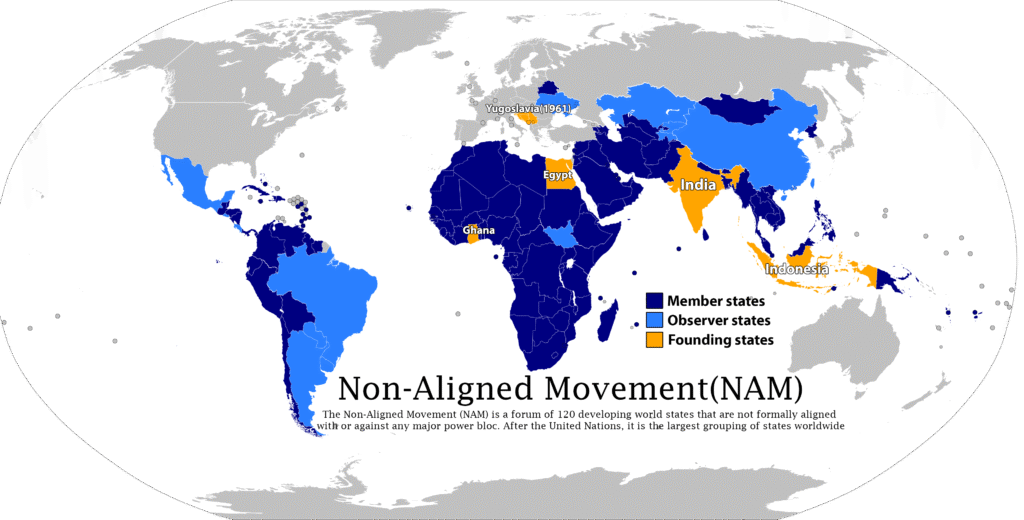
For NAM members, however, it is the promotion of mutual interests and cooperation that takes precedence over side-picking. It’s friendly relations over cliquey differentiations, and mutual respect over the need to paint international-order positions and policies in easy black or white. For those who followed the struggle of the decolonization movement and founding of the NAM, the current context of world affairs within the discourse of Russia should come as no real surprise: all 7 peace-mission African states are members of the Non-Aligned Movement, as is India.

China, with its observer status within the NAM, has strong links with the movement, with the NAM’s founding pillars being almost identical to the 5 principles of peaceful coexistence (1954) contained in the Panchsheel, a codification of the Chinese government’s foreign relations principles also today.

Even Türkiye, with its historical reservations during the formation of the NAM, has expressed its solidarity with the movement’s work; Türkiye’s foreign minister in 2021 reiterated the validity of the NAM’s work in a multipolar world where he said that challenges were becoming more complex; his words were like a precursor to the reality awaiting the world in 2022 with both the Ukraine crisis and the global economic crisis that would follow.

Among the 10 Principles of the Bandung Founding Conference (1955) was the movement’s pacta sunt servanda pledge toward settlement of international disputes by peaceful means, in conformity with the UN Charter, a pledge that, as illustrated by the African peace mission or via India-China diplomatic relations, members inculcate.

The movement has consistently stressed that it aims to promote peaceful coexistence between nations, regardless of their political, social or economic systems. NAM members have special capacities precisely because of this enshrined principle of friendly relations with all states and not just with those that share similar values.

If third-world approaches to international law liken the West’s hegemony within the international system to an understanding of ‘the white man’s burden’, then the opposite can be true of what the NAM can accomplish. For if the former is based on a perceived moral obligation to civilize, then the states being looked at will always be seen as requiring civilizing; they are “aggressors” or “dictators” always ‘developing’ – yet never arriving to or meeting the invisible measure set for it by that hegemony.

Through the lens of the NAM, states are seen as equals, not greater or lesser, but burdened with their gaps and shortcomings within differing contexts. Contexts that can only be genuinely addressed and understood from within. This is possibly what makes NAM states the most suitable mediators for this present time, with an approach that could allow both Russia and Ukraine to be at the table without consideration of a conflict of interest, or hidden agendas.

Where neutrality takes a back seat and no side, non-alignment actively strives for friendly relations and peace.

During the Cold War, non-aligned policies succeeded in making the world a far less aggressive place than it potentially had the capacity to become, but that story often goes untold, in the face of a narrative of two superpowers with their finger on the MAD trigger.

Perhaps this time around, the viewpoints of the 7 African leaders, or perhaps even the nuances of China-India relations, may be given more amplification – in the media yes, but also in the understanding of the public, alongside the consideration of how multilateral forums such as the NAM differ radically in their diplomatic relations and perception of other nations from those of the Western world.

If a peace mission is genuinely what the international so-called community is seeking, instead of more destruction now and in the future, it is imperative to recognise the radical difference that mediators – in spite of their experience of being labelled, name-called and othered – can make. It’s therefore time to stop twisting their arms and enable their genuinely different but competent mediation as a road toward sustainable conflict resolution and peace.

About the Author

J. Natasha Gooneratne – holds a double Masters in International Law & Human Rights from the United Nations-mandated University for Peace in Costa Rica, and in Political Science with a major in Global Governance from Ateneo de Manila University in the Philippines.

She has worked as a specialist in public diplomacy for Sri Lanka and the US governments and has been responsible for creating initiatives toward building South-South cooperation between Global South states.

She is the Founder and convener of Perspective South an international platform for public accessibility to geopolitics, international law terminology, and perspectives of the Global South.

She works part-time as a post-grad lecturer in International Law.

In the past, she has operated as a fixer and researcher for the NY Times, Swedish Public Media (SVT) and the Finnish Broadcasting Company (YLE). She is currently based in Colombo.

More about Gooneratne and her work on Linkedin and Perspective South on Instagram.

No data was found

Share

Leave a Reply

Your email address will not be published. Required fields are marked *

Related Posts

America’s Strategic Assault on Art, Academia, and the Imagination That Sustains Peace The United States once stood as a beacon of cultural audacity—a place where dissent could be beautiful, and beauty and innovation could challenge the present order of things. Its museums, universities, and artists helped inspire a worldwide imagination rooted in creative freedom and innovation. But today, under the Trump regime’s second term, those dynamic qualities are being systematically dismantled. Just read this. As Trump goes after the arts, many museums remain silent | CNN As CNN reports, the administration has launched an aggressive campaign to “eradicate improper ideology” from federally funded museums. Exhibitions involving race, gender, and identity are being censored or cancelled. Amy Sherald’s reimagining of the Statue of Liberty as a Black, trans woman was pulled from the Smithsonian after curators objected to its symbolism. Sherald warned that “history shows us what happens when governments demand loyalty...
“The future belongs to those who imagine it — not those who declare it doomed.” Silence is unusual for us. But even a foundation devoted to peace and ideas needs a pit stop now and then — a moment to refuel, re‑engineer, and prepare for the road ahead. Because the road ahead matters. On January 1, 2026, TFF turns 40. Four decades of independent research, education, and advocacy for the UN Charter norm that “peace shall be established by peaceful means.” And we are not celebrating with nostalgia — we are rebuilding for the future: We are bringing in new Associates, engaging in conferences across continents, and preparing to do what so few dare: offer solutions instead of despair. Because let’s be honest: describing the world as doomed is easy. It is also lazy, unprofessional, and unethical. Imagine a doctor telling a patient: “You’re dying, I can’t see what can...
Professor, Dr, TFF Board member The second of three TFF Appeals This is an example – for your inspiration – of how you can address your head of state, prime minister and other relevant ministers. To urge them to take action and not just use words.Instead of just sending it by email, which may not be read, it makes a stronger impression if you send it by snail mail – and millions do it too. It is urgently important that every citizen does something to stop the genocide on the Palestinian people now. Everybody can write a letter, short or long, and protest the lack of action. See also ideas to what you may constructively suggest in TFF’s first Appeal here. I address you deliberately in the way you prefer—in the feminine form. I write to you professor to professor, woman to woman, mother to mother, grandmother to grandmother. I...

Recent Articles

We know that medical personnel have failed to report to higher authorities wounds that were clearly caused by torture and that they have neglected to take steps to interrupt this torture. In addition, they have turned over prisoners’ medical records to interrogators who could use them to exploit the prisoners’ weaknesses or vulnerabilities. We have not yet learned the extent of medical involvement in delaying and possibly falsifying the death certificates of prisoners who have been killed by torturers. A May 22 article on Abu Ghraib in the New York Times states that “much of the evidence of abuse at the prison came from medical documents” and that records and statements “showed doctors and medics reporting to the area of the prison where the abuse occurred several times to stitch wounds, tend to collapsed prisoners or see patients with bruised or reddened genitals.” http://www.truthout.org/docs_04/080604J.shtml#16 According to the article, two doctors who...
Jan Øberg behandler i artiklen en lang række faktorer, som ligger til grund for den måde vores samfund er organiseret på – og derfor også for konflikter. Artiklen introducerer således sammenhængen mellem familien, foreninger, regeringer, NGO’ er, nation, stat, nationalstat og alliancer for på denne måde bedre at kunne forstå konflikter og i sidste ende blive klogere mht. at løse disse. Øberg, der er fortaler for global bevidsthed, hvilket skal ses i lyset af den øgede globalisering, skelner mellem kulturkamp og kulturdialog. Endelig behandles begrebet magt og magtesløshed: giver magt ret til at udøve magt – fordi man mener at have ret? Litteraturliste og arbejdsspørgsmål efter artiklen. Ordene vi bruger om verden I satellitperspektiv kan man godt tale om den menneskelige familie eller menneskeheden. Udtrykket understreger, at der eksisterer – eller burde eksistere – et fællesskab fordi vi alle er mennesker og sammen bebor denne klode og ingen anden. Og...
Kapitel 2: Forskellige sider af Europa og USA…fortsat 2.5 Militære relationer I forbifarten har vi allerede sagt nogle ting om USA’s militære situation. Kig lige en gang til på afsnit 2.3. Nu skal vi uddybe det militære forhold mellem USA og EU. Der er en række ligheder mellem visse europæiske landes og USA’s militær. Næsten alle er med på en eller anden måde i NATO, direkte som medlem – selv Island, der ikke har et forsvar – eller indirekte i Partnerskab for Fred. USA og Canada er med i OSCE (på dansk OSSE), Organisationen for Sikkerhed og Samarbejde i Europa, der tæller over 50 lande. USA samt England og Frankrig er kernevåbenstater og de har styrker til intervention langt borte fra hjemlandet, om end USA’s er tifold større. Alle har også en omfattende våbeneksport og bruger den som et middel til at tjene penge og få loyale venner på, det...

TFF on Substack

Discover more from TFF Transnational Foundation & Jan Oberg.

Most Popular

We know that medical personnel have failed to report to higher authorities wounds that were clearly caused by torture and that they have neglected to take steps to interrupt this torture. In addition, they have turned over prisoners’ medical records to interrogators who could use them to exploit the prisoners’ weaknesses or vulnerabilities. We have not yet learned the extent of medical involvement in delaying and possibly falsifying the death certificates of prisoners who have been killed by torturers. A May 22 article on Abu Ghraib in the New York Times states that “much of the evidence of abuse at the prison came from medical documents” and that records and statements “showed doctors and medics reporting to the area of the prison where the abuse occurred several times to stitch wounds, tend to collapsed prisoners or see patients with bruised or reddened genitals.” http://www.truthout.org/docs_04/080604J.shtml#16 According to the article, two doctors who...
Jan Øberg behandler i artiklen en lang række faktorer, som ligger til grund for den måde vores samfund er organiseret på – og derfor også for konflikter. Artiklen introducerer således sammenhængen mellem familien, foreninger, regeringer, NGO’ er, nation, stat, nationalstat og alliancer for på denne måde bedre at kunne forstå konflikter og i sidste ende blive klogere mht. at løse disse. Øberg, der er fortaler for global bevidsthed, hvilket skal ses i lyset af den øgede globalisering, skelner mellem kulturkamp og kulturdialog. Endelig behandles begrebet magt og magtesløshed: giver magt ret til at udøve magt – fordi man mener at have ret? Litteraturliste og arbejdsspørgsmål efter artiklen. Ordene vi bruger om verden I satellitperspektiv kan man godt tale om den menneskelige familie eller menneskeheden. Udtrykket understreger, at der eksisterer – eller burde eksistere – et fællesskab fordi vi alle er mennesker og sammen bebor denne klode og ingen anden. Og...
Kapitel 2: Forskellige sider af Europa og USA…fortsat 2.5 Militære relationer I forbifarten har vi allerede sagt nogle ting om USA’s militære situation. Kig lige en gang til på afsnit 2.3. Nu skal vi uddybe det militære forhold mellem USA og EU. Der er en række ligheder mellem visse europæiske landes og USA’s militær. Næsten alle er med på en eller anden måde i NATO, direkte som medlem – selv Island, der ikke har et forsvar – eller indirekte i Partnerskab for Fred. USA og Canada er med i OSCE (på dansk OSSE), Organisationen for Sikkerhed og Samarbejde i Europa, der tæller over 50 lande. USA samt England og Frankrig er kernevåbenstater og de har styrker til intervention langt borte fra hjemlandet, om end USA’s er tifold større. Alle har også en omfattende våbeneksport og bruger den som et middel til at tjene penge og få loyale venner på, det...
Read More
Imagen-thumbnail-The-Transnational-1
We know that medical personnel have failed to report to higher authorities wounds that were clearly caused by torture and that they have neglected to take steps to interrupt this torture. In addition, they have turned over prisoners’ medical records to interrogators who could use them to exploit the prisoners’ weaknesses or vulnerabilities. We have not yet learned the extent of medical involvement in delaying and possibly falsifying the death certificates of prisoners who have been killed by torturers. A May 22 article on Abu Ghraib in the New York Times states that “much of the evidence of abuse at the prison came from medical documents” and that records and statements “showed doctors and medics reporting to the area of the prison where the abuse occurred several times to stitch wounds, tend to collapsed prisoners or see patients with bruised or reddened genitals.” http://www.truthout.org/docs_04/080604J.shtml#16 According to the article, two doctors who...
Imagen-thumbnail-The-Transnational-1
Jan Øberg behandler i artiklen en lang række faktorer, som ligger til grund for den måde vores samfund er organiseret på – og derfor også for konflikter. Artiklen introducerer således sammenhængen mellem familien, foreninger, regeringer, NGO’ er, nation, stat, nationalstat og alliancer for på denne måde bedre at kunne forstå konflikter og i sidste ende blive klogere mht. at løse disse. Øberg, der er fortaler for global bevidsthed, hvilket skal ses i lyset af den øgede globalisering, skelner mellem kulturkamp og kulturdialog. Endelig behandles begrebet magt og magtesløshed: giver magt ret til at udøve magt – fordi man mener at have ret? Litteraturliste og arbejdsspørgsmål efter artiklen. Ordene vi bruger om verden I satellitperspektiv kan man godt tale om den menneskelige familie eller menneskeheden. Udtrykket understreger, at der eksisterer – eller burde eksistere – et fællesskab fordi vi alle er mennesker og sammen bebor denne klode og ingen anden. Og...
Imagen-thumbnail-The-Transnational-1
Kapitel 2: Forskellige sider af Europa og USA…fortsat 2.5 Militære relationer I forbifarten har vi allerede sagt nogle ting om USA’s militære situation. Kig lige en gang til på afsnit 2.3. Nu skal vi uddybe det militære forhold mellem USA og EU. Der er en række ligheder mellem visse europæiske landes og USA’s militær. Næsten alle er med på en eller anden måde i NATO, direkte som medlem – selv Island, der ikke har et forsvar – eller indirekte i Partnerskab for Fred. USA og Canada er med i OSCE (på dansk OSSE), Organisationen for Sikkerhed og Samarbejde i Europa, der tæller over 50 lande. USA samt England og Frankrig er kernevåbenstater og de har styrker til intervention langt borte fra hjemlandet, om end USA’s er tifold større. Alle har også en omfattende våbeneksport og bruger den som et middel til at tjene penge og få loyale venner på, det...
Imagen-thumbnail-The-Transnational-1
Background Christian Harleman and Jan Oberg conducted a fact-finding mission to Burundi between November 26 and December 6, 2003. (See websites about the country here). The first TFF mission took place in March 1999. Unfortunately, since then it has not been practically possible to implement the co-operation with Burundi’s Ministry of Education and Burundian NGOs that was planned at the time. The 2003 mission had three purposes. First, to do fact-finding in general about the situation and, in particular, the progress under the Arusha Peace Process. Second, to explore the possibilities for co-operation between the government and relevant NGOs on the one hand and TFF on the other, in order to develop and deepen the existing competence in fields such as conflict-understanding, reconciliation and peace-building. Finally, third, to find out whether it would be possible, in co-operation with the Swedish Rescue Services Agency (Statens Räddningsverk), to establish a health care unit that...
Imagen-thumbnail-The-Transnational-1
Former UN Under-Secretary-General with special responsibility for peacekeeping operations TFF associate August 20, 2003 YRINGHAM, Mass.- Ralph Bunche was born in Detroit 100 years ago today (August 7, 2003). His passionate determination to get results did not extend to seeking credit for them, so his work is better remembered than he is. Of all his many accomplishments – civil rights pioneer, Nobel Peace Prize laureate, chief drafter of two chapters of the United Nations charter, negotiator of the armistices that ended the first Arab-Israeli war – Bunche said he was proudest of developing what came to be known as peacekeeping. Setting up the United Nations Truce Supervision Organization in Palestine in 1948, Bunche formulated the principles that have governed peacekeeping operations ever since. In the 1956 Suez crisis, working with Secretary General Dag Hammarskjold and Lester Pearson of Canada, he organized the first peacekeeping force, the United Nations Emergency Force...
– nästan 11 månader Till Sofia nästan 11 månader # 1  Till Sofias huvudsida Till alla Privata Foto-Serier