
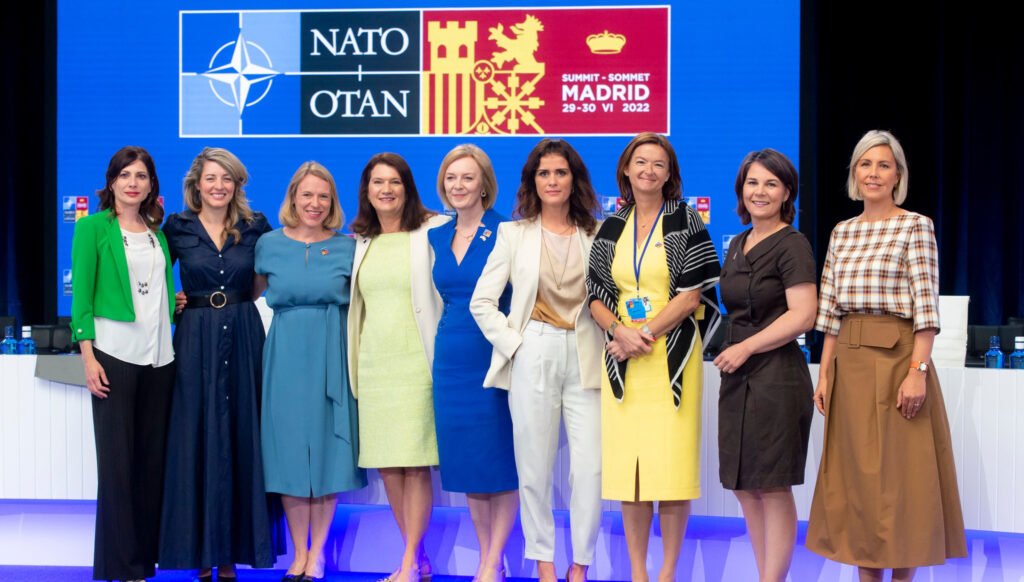
Photo: NATO
Joan Roelofs*
July 25, 2024
Why has NATO been so generally accepted in Europe by almost all the major political parties and especially puzzling, the social democratic ones? Its economic costs, illegal aggressive wars, environmental damage, and the risks of nuclear annihilation would seem to make it a prime platform item. Well-informed political activists are unlikely to believe that an invasion of Switzerland or Denmark is imminent. There are significant anti-NATO movements, such as No to War No to NATO, but so far they haven’t been able to turn the tide.
Some reasons are fairly obvious. The US military connections to European defense and foreign ministries began during World War II. These strong ties have continued, now with an emphasis on NATO’s newly acquired feminist face, the Women, Peace, and Security agenda.
The photo above, taken at the 2022 NATO summit in Madrid, depicts women Foreign Affairs and Defense ministers, from Canada, Norway, Sweden, United Kingdom, Iceland, Slovenia, Germany, and Belgium.
Published by Counterpunch on July 24, 2024
Promotion long and wide has been carried out by overtly pro-NATO lobbies such as the Atlantic Council and national think tanks, for example, the Council on Foreign Relations (US), the British Royal Institute of International Affairs, and their counterparts in many nations. There is also a Youth Atlantic Treaty Association, a network of national organizations of young professionals, university students and researchers.
The secretive Bilderberg group harnesses the political, economic, academic and journalism elites of NATO nations. Operation Gladio, Operation Paperclip and others have sustained firm links with military and intelligence agencies. There has also been covert and overt interventions in political parties and nongovernmental organizations, such as the CIA funding of Christian Democratic party in 1948 to defeat the Communist Party and meddling in the British Labour Party to minimize the influence of the Committee on Nuclear Disarmament. These have also cleared the path for NATO. Eastern Europe was even more easily penetrated by NATO, after the devastation of its economic, cultural, and scientific institutions.
There have been constant protests against NATO bases, yet their less vocal sympathizers appreciate the economic benefit. At first, in war-torn Europe both the liberated and the occupied nations saw little economic activity. Now the European economy is increasingly militarized, having outsourced much of its civilian industry and facing declines in its tourist industry due to pandemics, protests by local residents, and environmental costs.
According to the Stockholm International Peace Research Institute (SIPRI) Fact Sheet of 2024, weapons production has greatly accelerated in many European countries, even though NATO and national militaries also equip themselves royally with US products. Sales to the Middle East and other violence inflicted areas are good business.
Now workers, many unionized and some even socialists and communists, have secure jobs in war industries and in the burgeoning military-civilian industries. As the Erikssons have documented:
The defence industry is undergoing rapid change, particularly regarding the development of dual-use technology and transfer of technology between military and civilian domains. . . The blurring of the military-civilian divide is particularly noticeable with the rapid development of Artificial Intelligence (AI), digitalization, satellite technology, integrated quantum, photonics, high-capacity wireless communications, and “big data” networking through 5 G – developments which have been referred to as “the fourth industrial revolution. . .”
Just as its military bases need everything, NATO institutes, operations, conferences, war games, and its supersized headquarters in Brussels equip and maintain from every kind of business. Much information is available on the NATO website; it also has a presence on YouTube, LinkedIn, Facebook, Instagram and X (Twitter).
The NATO Support and Procurement Agency contracts database for 2023 lists only orders valued above €80,000. It includes “consumables” from a firm in Luxembourg, transport of tents and conference center equipment from Belgium, winter clothing from France, “civil and mechanical” from Albania, medical equipment from Sweden, waterproof bags from Great Britain, and spare parts from vendors in many countries. Undoubtedly, even smaller businesses supply a wide range, and, as in the US, provide economic survival for owners, workers, and communities (see The Trillion Dollar Silencer). A listing of bids above €800,000 includes medical treatment structures from a firm in Italy, training services (Netherlands and Spain), and military cots and mosquito nets (Italy and Turkey). Although the largest in both lists are expenditures for weapons, firms that are often the economic lifeblood—rather the deathblood—of their communities, the smaller (but not piddling) purchases can influence many citizens and their elected representatives.
NATO training and research operations involve civilian universities, which increasingly have military departments, as well as national military academies. There are even public high school training programs, e.g., in Sweden, Germany, and France (Defence Cadets). In addition, the US Department of Defense has direct contracts with universities and scientific institutes worldwide, especially for weapons development, nanotechnology, and biotechnology.
NATO also has several layers of its own training entities. One is the Partnership Training and Education Centres, in 34 member and partner (i.e., not full member) countries. Some examples are Switzerland, Geneva Centre for Security Policy; Israel, IDF Military Medical Academy; Serbia, Chemical, Biological, Radiological and Nuclear Training Centre; Mongolia, Peace Support Operations Centre; Colombia, International Demining Centre; Italy, The International Institute of Humanitarian Law; and United Kingdom, United Kingdom Defence Academy.
Another NATO network is the 28 Centres of Excellence which are “international military organizations that train and educate leaders and specialists from NATO member and partner countries.” They are funded nationally and accredited by NATO. Some of these are Civil-Military Cooperation, one of two in the Netherlands; Crisis Management and Disaster Response, Bulgaria; Modelling and Simulation, one of several in Italy; Strategic Communications, Latvia; Climate Change and Security, Canada; and Maritime Security, Turkey. The latter is described as:
[P]roviding expertise both as a centre for academic research and as a (multinational) hub for practical training in the field of maritime security, along with relevant domains (maritime trade, energy security, maritime environment, maritime resources, public health, maritime transport-logistic). The Centre strives to achieve the necessary collaboration among stakeholders from government, industry, academia and the private sector.
NATO’s enormous Civil Diplomacy department works through all print and electronic media. Its Press Tours enable reporters to “sail aboard the aircraft carrier USS George H.W. Bush on the Adriatic Sea” and “mingle with counter-terrorism experts in a metro station in Rome, Italy.” The department also welcomes grant applications from think tanks, universities, NGOs, and other civil society organizations “ranging from out-of-the box, non-traditional ideas to more institutional formats. Particular focus should be placed on outreach to youth audiences, female audiences and key opinion formers, including those who have not connected with NATO before.”
As Merje Kuus notes:
In addition to NATO’s own public diplomacy division, the alliance’s message is produced and projected through a host of NGOs that collaborate with NATO but are not affiliated with it. Funded through national foreign and defense ministries, NATO’s Public Diplomacy Division, and private companies, they organize a wide range of activities designed to popularize NATO within and beyond its member states.
NATO’s less obvious influence may derive from its accelerated penetration of civilian institutions: education, entertainment, teenage “influencers,” festivals, nongovernmental organizations, even progressive and human rights movements. NATO portrays itself as simply the prime association of democratic nations, which was apparently very persuasive in Eastern European regimes trying to divest themselves of the “totalitarian” label.
A notable example is its Women, Peace and Security Agenda. Journalist Lily Lynch reports:
In January 2018, Nato secretary-general Jens Stoltenberg held an unprecedented press conference with Angelina Jolie. While InStyle reported that Jolie “was dressed in a black off-the-shoulder sheath dress, a matching capelet and classic pumps (also black)”, there was a deeper purpose to this meeting: sexual violence in war. The pair had just co-authored a piece for the Guardian entitled “Why NATO must defend women’s rights”. The timing was significant. At the height of the #MeToo movement, the most powerful military alliance in the world had become a feminist ally. “Ending gender-based violence is a vital issue of peace and security as well as of social justice,” they wrote. “NATO can be a leader in this effort.”
A study by Katharine AM Wright, exploring the legitimacy given to NATO by the surprising participation of women’s rights groups in its activities, found some activists who argued that it enabled feminists to “advise” NATO, “to get it to hear things that they don’t usually hear,” and to “speak truth to power.”
As climate change is among NATO’s catalog of serious threats to security, environmentalists speak at NATO conferences and vice versa, serve on advisory boards, and formally interact in many ways. For example, the 2020 meeting of the Brussels Dialogue on Climate Diplomacy and the Environment & Development Resource Centre was hosted by the Policy Planning Unit in the Office of the NATO Secretary-General.
In addition to the more traditional Youth Atlantic Treaty Association, NATO has more recently created youth activities that are more cuddly. Its 2022 “Protect the Future campaign” recruited:
12 young online creators [teenage “influencers”] from Germany, Hungary, Latvia, Spain, the United Kingdom and the United States. To discover more about the Alliance’s work, the creators met with the Secretary General in May; travelled to the Madrid Summit in June; visited the US aircraft carrier USS George H.W. Bush in October; and went on an AWACS training mission in November.
The outcome, NATO reported, was 300,000 social media engagements that reached more than 9 million young people.
In another wing of this campaign, “young artists from across the Alliance took part in an open competition to help create NATO’s first-ever graphic novel, ‘Protect the Future.’ Six young artists were selected to work with professionals to produce the book.” For the multitude, a Youth Summit was held that included 35,000 people from 99 countries.
At the [2023] NATO Gaming Tournament in Warsaw, Poland, thousands of gamers from across the Alliance and around the world gathered to play online games and chat with experts from NATO Headquarters. The vibe in the room is casual and relaxed. Young gamers from Warsaw mingle with artists, soldiers and NATO experts. In one corner, troops from NATO’s multinational battlegroup in Poland play vintage console games, including Street Fighter and Super Mario. In another area, gamers mash buttons on old arcade games like Pac-Man.
The arts are not neglected. NATO sponsors exhibits, murals, and competitions:
Are you an artist under 35? Do you have a creative mind and want your artwork to be displayed at a permanent location in Washington D.C. where NATO will mark the 75th anniversary of the Alliance? Submit your work to the NATO mural competition – an opportunity to showcase your talent and artistic vision of the future. The winner will get to work with a local street artist to feature their mural permanently on a wall in the city.
The NATO mural competition will give young talents a chance to produce a signature image for NATO’s anniversary as part of its “Protect the Future” campaign.
In our era of network governance it is not surprising that NATO has close connections with the European Union (including its Organization for Security and Co-operation in Europe and European Defense Agency), the United Nations, the Council of Europe, and many other intergovernmental organizations. These in turn are interwoven with international (e.g., World Economic Forum, Amnesty International) and thousands of national nongovernmental organizations (e.g., Council on Foreign Relations), foundations, and business corporations. Zbigniew Brzezinski noted in The Grand Chessboard:
As the imitation of American ways gradually pervades the world, it creates a more congenial setting for the exercise of the indirect and seemingly consensual American hegemony. And as in the case of the domestic American system, that hegemony involves a complex structure of interlocking institutions and procedures, designed to generate consensus and obscure asymmetries in power and influence. (p.27)
The staffs of intergovernmental organizations are required to be politically neutral. However, there is also pressure on progressive or left wing nongovernmental organizations to avoid confrontation or strong dissent with conference participants or any member of the “partnership.”
The very size of this monumental hive of associations, including representatives, staffs, task forces of university and other experts, NGOs, and contractors may in itself affect the complexion of European political parties. Although I have found no evidence so far, perhaps there has been a “brain drain” of progressive activists into the more promising, interesting, and often paid work of these institutions, compared with the scant rewards of local political parties. It could be yet another factor in the passive or active support for NATO in Europe. Might there be scholars, journalists, or activists exploring this possibility?
Unless otherwise indicated, all quotations are from the NATO website.
* The Author
Joan Roelofs is Professor Emerita of Political Science, Keene State College, New Hampshire. She has been an anti-war activist since she protested the Korean War. She is the author of The Trillion Dollar Silencer: Why There Is So Little Anti-War Protest in the United States (Clarity Press, 2022), Foundations and Public Policy: The Mask of Pluralism (SUNY Press, 2003), and Greening Cities (Rowman and Littlefield, 1996). She is the translator of Victor Considerant’s Principles of Socialism (Maisonneuve Press, 2006), and with Shawn P. Wilbur, of Charles Fourier’s anti-war fantasy, The World War of Small Pastries (Autonomedia, 2015). Web site: www.joanroelofs.wordpress.com
