
NATO Expansion: The Budapest Blow Up 1994

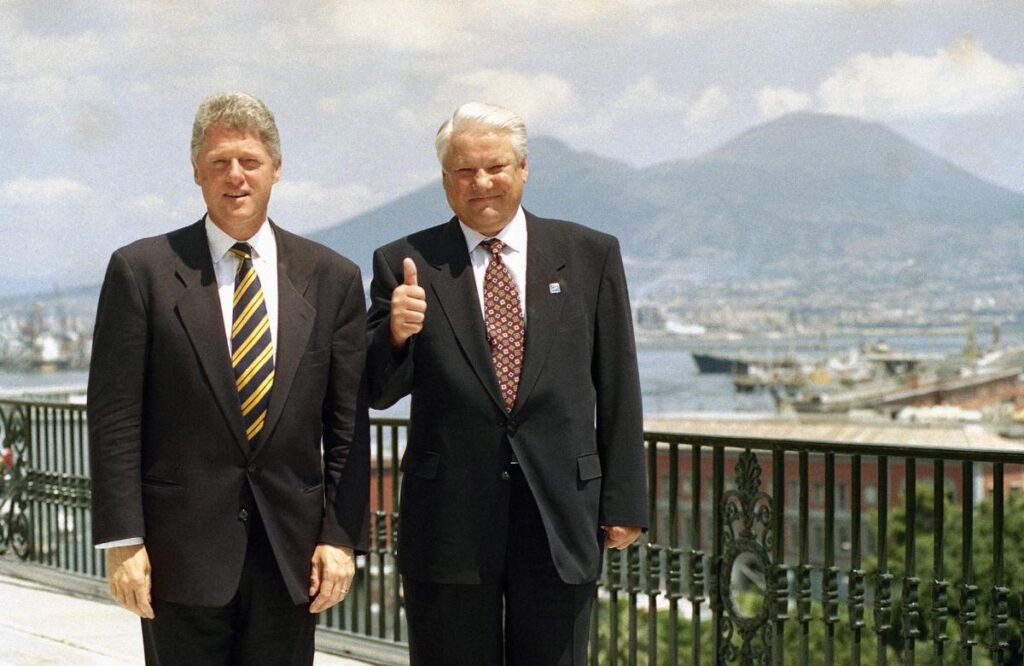
Clinton and Yeltsin in Naples, July 10, 1994.  Dormant Vesuvius is in the background.  (Eruption wouldn’t happen until Budapest).  Source:  Inosmi.ru

Declassified documents show security assurances against NATO expansion to Soviet leaders from Baker, Bush, Genscher, Kohl, Gates, Mitterrand, Thatcher, Hurd, Major, and Woerner

Slavic Studies Panel Addresses “Who Promised What to Whom on NATO Expansion?”

By Svetlana Savranskaya and Tom Blanton (Compiled and edited)

January 7, 2022

Washington, D.C., November 24, 2021 – The biggest train wreck on the track to NATO expansion in the 1990s – Boris Yeltsin’s “cold peace” blow up at Bill Clinton in Budapest in December 1994 – was the result of “combustible” domestic politics in both the U.S. and Russia, and contradictions in the Clinton attempt to have his cake both ways, expanding NATO and partnering with Russia at the same time, according to newly declassified U.S. documents published today by the National Security Archive.

The Yeltsin eruption on December 5, 1994, made the top of the front page of the New York Times the next day, with the Russian president’s accusation (in front of Clinton and other heads of state gathered for a summit of the Conference on Security and Cooperation in Europe, CSCE) that the “domineering” U.S. was “trying to split [the] continent again” through NATO expansion.

Originally published by the National Security Archive at Georg Washington University

The angry tone of Yeltsin’s speech echoed years later in his successor Vladimir Putin’s famous 2007 speech at the Munich security conference, though by then the list of Russian grievances went well beyond NATO expansion to such unilateral U.S. actions as withdrawal from the Anti-Ballistic Missile Treaty and the invasion of Iraq.

The new documents, the result of a Freedom of Information Act lawsuit by the National Security Archive, include a series of revelatory “Bill-Boris” letters in the summer and fall of 1994, and the previously secret memcon of the presidents’ one-on-one at the Washington summit in September 1994.

Clinton kept assuring Yeltsin any NATO enlargement would be slow, with no surprises, building a Europe that was inclusive, not exclusive, and in “partnership” with Russia. In a phone call on July 5, 1994, Clinton told Yeltsin “I would like us to focus on the Partnership for Peace program” not NATO.

At the same time, however, “policy entrepreneurs” in Washington were revving up the bureaucratic process for more rapid NATO enlargement than expected either by Moscow or the Pentagon,[1] which was committed to the Partnership for Peace as the main venue for security integration of Europe, not least because it could include Russia and Ukraine.[2]

The new documents include insightful cables from U.S. Ambassador to Moscow Thomas Pickering, explaining Yeltsin’s new hard-line at Budapest as the result of multiple factors. Not least, Pickering pointed to “strong domestic opposition across the [Russian] political spectrum to early NATO expansion,” criticism of Yeltsin and his foreign minister, Andrei Kozyrev, as too “compliant to the West,” and the growing conviction in Moscow that U.S. domestic politics – the pro-expansion Republicans’ sweep of the Congressional mid-term elections in November 1994 – would tilt U.S. policy away from taking Russia’s concerns into account.

Pickering was perhaps too diplomatic because there was plenty of blame to go around on the U.S. side. Clinton wrote in his memoir, “Budapest was embarrassing, a rare moment when people on both sides dropped the ball….”[3] Actually, the drops were almost all in Washington. White House schedulers led by chief of staff Leon Panetta tried to prevent Clinton from even going to Budapest by constraining his window there to eight hours, which meant no time for a one-on-one with Yeltsin. 

Clinton himself thought he was doing Yeltsin a big favor by even coming and expected good press from the substantial reduction in nuclear arsenals that would result from the signing of the Budapest memorandum on security assurances for Ukraine (violated by Russia in 2014).

National Security Adviser Tony Lake gave Clinton a prepared text that “was all yin and no yang – sure to please the Central Europeans and enthusiasts for enlargement, but equally sure to drive the Russians nuts….” The author of that phrase, Deputy Secretary of State Strobe Talbott, wasn’t even in Budapest, paying attention to the Haiti crisis instead (“never again” he later wrote, would he miss a Yeltsin meeting).[4]

The new documents include a previously secret National Security Council memo from Senior Director for Russia Nicholas Burns to Talbott, so sensitive that Burns had it delivered by courier, describing Clinton’s reaction to Budapest as “really pissed off” and reporting “the President did not want to be used any more as a prop by Yeltsin.”

At the same time, Burns stressed, “we need to separate our understandable anger on the tone of the debate with [sic] Russia’s substantive concerns which we must take seriously.” Similarly, the Pickering cables recommended using Vice President Al Gore’s previously scheduled December trip to Moscow for meetings with Prime Minister Victor Chernomyrdin to also meet with Yeltsin, calm down the discussion, and get back on a “workable track.”

Mending fences would include Gore’s description to Yeltsin of the parallel NATO and U.S.-Russia tracks as spaceships docking simultaneously and very carefully,[5] and Gore and then Clinton assuring the Russians (but not in writing, as Kozyrev kept asking for) that no NATO action on new members would happen before the 1995 Duma elections or the 1996 presidential elections in Russia.

The final assurance was Clinton’s agreement (despite Russia’s brutal Chechen war and multiple domestic pressures) to come to Moscow in May 1995 for the 50th anniversary celebrations of the victory over Hitler. In Moscow, Yeltsin berated Clinton about NATO expansion, seeing “nothing but humiliation” for Russia: “For me to agree to the borders of NATO expanding towards those of Russia – that would constitute a betrayal on my part of the Russian people.”

But Yeltsin also saw Clinton would do whatever he could to ensure Yeltsin’s re-election in 1996, and that mattered the most to him. Only after that Moscow summit would Yeltsin order Kozyrev to sign Russia up for the Partnership for Peace.

The new documents only reached the public domain as the result of a Freedom of Information lawsuit by the National Security Archive against the State Department, seeking the retired files of Strobe Talbott. Thanks to excellent representation by noted FOIA attorney David Sobel, State set up a schedule of regular releases to the Archive over the past three years.

The full corpus of thousands of pages covering the entire 1990s will appear next year in the award-winning series published by ProQuest, the Digital National Security Archive, which won Choice Magazine’s designation as an “Outstanding Academic Title 2018.”

The Archive also benefited from State’s assignment of veteran reviewer Geoffrey Chapman to the task of assessing the Talbott documents for declassification. Chapman ranks among the most thorough, expert, and professional declassifiers in the U.S. government.

For the notes in this article and 18 documents, please consult the original here.

Originally published by the National Security Archive at George Washington University

Please help TFF remain truly independent by contributing if you benefited from this article

[paypal-donation]

Note
For more links concerning the Ukraine conflict, please see Better World Link – which is a very useful link resource on numerous other issues too.

Share

Leave a Reply

Your email address will not be published. Required fields are marked *

Related Posts

America’s Strategic Assault on Art, Academia, and the Imagination That Sustains Peace The United States once stood as a beacon of cultural audacity—a place where dissent could be beautiful, and beauty and innovation could challenge the present order of things. Its museums, universities, and artists helped inspire a worldwide imagination rooted in creative freedom and innovation. But today, under the Trump regime’s second term, those dynamic qualities are being systematically dismantled. Just read this. As Trump goes after the arts, many museums remain silent | CNN As CNN reports, the administration has launched an aggressive campaign to “eradicate improper ideology” from federally funded museums. Exhibitions involving race, gender, and identity are being censored or cancelled. Amy Sherald’s reimagining of the Statue of Liberty as a Black, trans woman was pulled from the Smithsonian after curators objected to its symbolism. Sherald warned that “history shows us what happens when governments demand loyalty...
Launched on November 17, 2024Updated with new materials regularly TFF Board members Thore Vest. Everywhere, the delegation was met with a sincere wish to develop knowledge, dialogue, cooperative projects, and initiatives based on citizens’ diplomacy – in general, but with the West in particular. For more, see “Report from the Nordic delegation to China’s Xinjiang Province, September 7-15, 2024.” While the delegation was in Xinjiang, various ideas were already being discussed from the local to the top level, i.e., with the governor and party leaders of Xinjiang. The two TFF Associates suggested that TFF set up a special section – in addition to its “China and Silk” – where various quality materials about Xinjiang would regularly be published to promote public education about Xinjiang, particularly its contemporary development – worldwide but in the West in particular. This is now a reality – as can be seen below – but it...
Foreword The Board of The Transnational Foundation in Sweden has decided to publish an easy-to-read, scholarly anthology that addresses one of the most important – and potentially dangerous – issues of our time: Why are the political, economic, and medialised Western images of China so consistently negative – and what can you do to understand China better? These images may be expressions of a political will to present only various shades of grey and black with the aim of building a consciousness about China as an enemy and not a partner. They may also be seen as a sort of world-dominating ethos of ignorance based upon the assumption that “we’ve-got-nothing-to-learn-from-others,’ we are the teacher. Another possibility is that the West, deep down, feels that it is getting relatively weaker from a macro-historical perspective and comforts itself with denial and accusations against “the other” of being the reason for its manifest...

Recent Articles

PressInfo # 141, December 21, 2001It’s time to prepare reconciliation between Albanians and Serbs PressInfo # 140, December 14, 2001Ibrahim Rugova’s decade-long leadership in Kosovo/a PressInfo # 139, 11. december, 2001En god nyhet: Jugoslaviens Sannings- och försoningskommission PressInfo # 139, 11. december, 2001Gode nyheder: Jugoslaviens Sandheds- og Forsoningskommission PressInfo # 139, December 11, 2001Good news: Yugoslavia’s Truth and Reconciliation Commission PressInfo # 138, November 8, 2001TFF co-founder PhD with thesis about young people with roots in other cultures PressInfo # 138, November 8, 2001TFF:s medstiftare doktor på avhandling om unga med ursprung i andra kulturer PressInfo # 137, October 17, 2001A new Marshall Plan: Advancing human security and controlling terrorism PressInfo # 136, October 15, 2001The UN and Annan really deserve it PressInfo # 135, October 10, 2001Preventing a terrorist mushroom cloud PressInfo # 134, 17 oktober, 2001Sverige og 11. september PressInfo # 134, October 9, 2001Sweden and September 11...
Peace is promoted by constructive proposals and dialogue Four preceding PressInfos have expressed concern over — and criticised — the ongoing, militarisation of the EU. Some will say: but there are no alternatives. We believe that there are always alternatives, that democracies are characterised by alternatives and choice, and that openly discussed alternatives will improve the quality and legitimacy of society’s decision–making. In addition, it is an intellectual and moral challenge to not only criticise but also be constructive. If we only tell people that we think they are wrong, they are not likely to listen. However, if we say: what are your views on this set of ideas and steps? — we may sometimes engage them in dialogue and sow a seed. Most people in power circles live their daily lives in in a time frame and a social space where certain ideas, viewpoints and concepts are just not...
Photos © TFF 2000 Read PressInfo 90 “Lift the Sanctions and Bring More Aid to Yugoslavia” See Pictures from Belgrade © TFF 2000 Please reprint, copy, archive, quote or re-post this item, but please retain the source.

TFF on Substack

Discover more from TFF Transnational Foundation & Jan Oberg.

Most Popular

PressInfo # 141, December 21, 2001It’s time to prepare reconciliation between Albanians and Serbs PressInfo # 140, December 14, 2001Ibrahim Rugova’s decade-long leadership in Kosovo/a PressInfo # 139, 11. december, 2001En god nyhet: Jugoslaviens Sannings- och försoningskommission PressInfo # 139, 11. december, 2001Gode nyheder: Jugoslaviens Sandheds- og Forsoningskommission PressInfo # 139, December 11, 2001Good news: Yugoslavia’s Truth and Reconciliation Commission PressInfo # 138, November 8, 2001TFF co-founder PhD with thesis about young people with roots in other cultures PressInfo # 138, November 8, 2001TFF:s medstiftare doktor på avhandling om unga med ursprung i andra kulturer PressInfo # 137, October 17, 2001A new Marshall Plan: Advancing human security and controlling terrorism PressInfo # 136, October 15, 2001The UN and Annan really deserve it PressInfo # 135, October 10, 2001Preventing a terrorist mushroom cloud PressInfo # 134, 17 oktober, 2001Sverige og 11. september PressInfo # 134, October 9, 2001Sweden and September 11...
Peace is promoted by constructive proposals and dialogue Four preceding PressInfos have expressed concern over — and criticised — the ongoing, militarisation of the EU. Some will say: but there are no alternatives. We believe that there are always alternatives, that democracies are characterised by alternatives and choice, and that openly discussed alternatives will improve the quality and legitimacy of society’s decision–making. In addition, it is an intellectual and moral challenge to not only criticise but also be constructive. If we only tell people that we think they are wrong, they are not likely to listen. However, if we say: what are your views on this set of ideas and steps? — we may sometimes engage them in dialogue and sow a seed. Most people in power circles live their daily lives in in a time frame and a social space where certain ideas, viewpoints and concepts are just not...
Photos © TFF 2000 Read PressInfo 90 “Lift the Sanctions and Bring More Aid to Yugoslavia” See Pictures from Belgrade © TFF 2000 Please reprint, copy, archive, quote or re-post this item, but please retain the source.
Read More
Imagen-thumbnail-The-Transnational-1
PressInfo # 141, December 21, 2001It’s time to prepare reconciliation between Albanians and Serbs PressInfo # 140, December 14, 2001Ibrahim Rugova’s decade-long leadership in Kosovo/a PressInfo # 139, 11. december, 2001En god nyhet: Jugoslaviens Sannings- och försoningskommission PressInfo # 139, 11. december, 2001Gode nyheder: Jugoslaviens Sandheds- og Forsoningskommission PressInfo # 139, December 11, 2001Good news: Yugoslavia’s Truth and Reconciliation Commission PressInfo # 138, November 8, 2001TFF co-founder PhD with thesis about young people with roots in other cultures PressInfo # 138, November 8, 2001TFF:s medstiftare doktor på avhandling om unga med ursprung i andra kulturer PressInfo # 137, October 17, 2001A new Marshall Plan: Advancing human security and controlling terrorism PressInfo # 136, October 15, 2001The UN and Annan really deserve it PressInfo # 135, October 10, 2001Preventing a terrorist mushroom cloud PressInfo # 134, 17 oktober, 2001Sverige og 11. september PressInfo # 134, October 9, 2001Sweden and September 11...
Imagen-thumbnail-The-Transnational-1
Peace is promoted by constructive proposals and dialogue Four preceding PressInfos have expressed concern over — and criticised — the ongoing, militarisation of the EU. Some will say: but there are no alternatives. We believe that there are always alternatives, that democracies are characterised by alternatives and choice, and that openly discussed alternatives will improve the quality and legitimacy of society’s decision–making. In addition, it is an intellectual and moral challenge to not only criticise but also be constructive. If we only tell people that we think they are wrong, they are not likely to listen. However, if we say: what are your views on this set of ideas and steps? — we may sometimes engage them in dialogue and sow a seed. Most people in power circles live their daily lives in in a time frame and a social space where certain ideas, viewpoints and concepts are just not...
Imagen-thumbnail-The-Transnational-1
Photos © TFF 2000 Read PressInfo 90 “Lift the Sanctions and Bring More Aid to Yugoslavia” See Pictures from Belgrade © TFF 2000 Please reprint, copy, archive, quote or re-post this item, but please retain the source.
Imagen-thumbnail-The-Transnational-1
Av FRANK SØHOLM GREVIL 16 augusti 2004  Vi er nu nået til tredje akt i det absurde teaterstykke, der i analogi med de store skueprocesser i Moskva 1936-38 er blevet døbt ‘Grevil-sagen’. Første akt bestod i min anonyme fremlæggelse af egenhændigt nedklassificerede rapporter i Berlingske Tidende i februar og marts. Andet akt udgjordes af min fremtræden med navn og billede i Information i april samt den efterfølgende mediestorm, som uden min direkte medvirken kostede en forsvarsminister taburetten samt en sigtelse for brud på tavshedspligten. Tredje akt bliver en retssag, hvor jeg står tiltalt for at have overtrådt straffelovens bestemmelser om uberettiget videregivelse eller udnyttelse af fortrolige oplysninger. Statsanklageren har ovenikøbet valgt at påberåbe sig særligt skærpende omstændigheder. Da jeg aldrig har modtaget betaling for at stille rapporterne til rådighed eller lade mig interviewe, må det skærpende bestå i, at “videregivelsen eller udnyttelsen er sket under sådanne omstændigheder, at det påfører...
Imagen-thumbnail-The-Transnational-1
Af Svenska Irakkommittén mot de Ekonomiska Sanktionerna (SIES) 13 september 2002 FN:s ekonomiska sanktioner mot Irak har nu pågått i tolv år och drabbat det irakiska folket med svåra lidanden. Enligt FN:s egna siffror har mer än 1,5 miljoner människor, varav ca 600 000 barn, dött som en direkt följd av sanktionerna. Dessutom har ett lågintensivt bombkrig mot landet pågått under dessa år. Av all denna förödelse- orsakad huvudsakligen av amerikansk och brittisk politik- har Saddam Husseins brutala och diktatoriska regim snarast stärkts än försvagats. Nu förbereder USA under president Bushs ledning ett storskaligt bombkrig mot Irak som kommer att innebära ett ännu större lidande för civilbefolkningen. Ett sådant krig kommer dessutom att ytterligare undergräva freden och säkerheten i världen. Att upprätta en demokratisk regim i Irak är det irakiska folkets angelägenhet och får enligt folkrätten inte ske med krigshandlingar utifrån. Folkrätten och FN:s stadgar måste respekteras. Vi vädjar till...