Andi Olluri
April 12, 2023
A recent Pentagon conference on psychological warfare noted that the forces of indoctrination “cannot wait until a crisis begins”. A high-ranking chief at the Department of Defence suggested a model for propaganda, in no way new: “Look at marketing … What makes people drink Coke, what makes people drink Pepsi?” In short, public “marketing”. “I think”, the chief lauded, that “the private sector has used the information domain through marketing to the Nth degree … And I think we, as a department and in the national security enterprise, need to be able to pull some of those lessons”. (1)
In fact, the “lessons” of effective indoctrination and public persuasion have been perfected in the domain of US government propaganda in conjunction with a servile ‘free’ press. A natural prediction of this is that in discussions of war, peace, diplomacy, violence and so on, essentially any fact that is unfit for US and Western goals will be either ignored, distorted or falsified, and Western geopolitical ambitions will be revered to the point of almost being beyond what words can describe. In the case of Western imperialism in today’s Asia, this is precisely verified.
I. Aggression in fact and fiction
The Biden administration declared early in 2022 that official American policy in Asia and the Pacific sought domination and control over “every corner of the region,” while deploring Chinese “coercion and aggression” which “spans the globe” – a statement which is too ludicrous to comment, and was in fact ignored by the media, though presumably not for that reason. (2)
The military branch is usually quite honest about intentions: “This grand strategy uses”, quite effectively, “security and financial institutions to both bound and reshape China’s power within the system to bolster US” imperial power (US Air Force’s journal). (3) Putting all euphemisms aside, the West must ensure that “all nations can benefit” – that is, all nations that obediently serve the US – “from resource-rich” assets in Southeast Asia, as the Chief of naval operations, Michael Gilday, put it. (4) Surely, actions confirm the urgency among elites of achieving this.
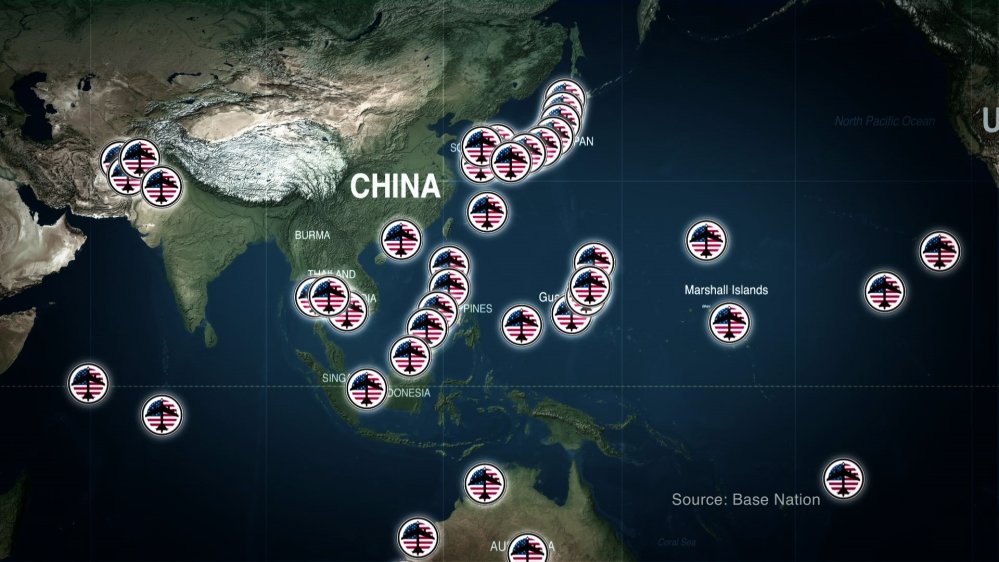
Thus, the US has stationed about 375 000 troops in the Indo-Pacific, of which 80 000 are in South Korea and Japan – while conducting constant offensive large-scale military operations aimed at China through what is an offensive “global NATO” in Asia, to use the phrase of Liz Truss. (5)
Throughout 2021, US and European “warships and planes carried out over 2 000 close spying operations aimed at China”, including at the “coastal area of the Chinese mainland”. Although lavishly funded Western news agencies mystically found a minimal opportunity to report on these incidents, the reader of the Asian press could have learned that Western “strikes groups” in “the South China Sea” nearly doubled their activity since 2020 – repeatedly to the protest of the Chinese and in fact most of Asia, though to the enthusiastic celebration of the Western liberal and humane press. (6)
This is virtually a continuation of the policy of the Trump administration, from which Biden is scarcely different – insofar as not being more hawkish, which the One-party-two-factions military oligarchy in Washington ensures. Therefore, the US government declared in mid-2020 that the West must mobilize against the “Marxist-Leninist regime” and its “desire for global hegemony of Chinese communism”, which threatens “freedom everywhere”.
Finally, we became aware of the “threat they pose to our very way of life”. The “ambitions for ideological control” of “Josef Stalin’s successor” (Xi Jinping) are “not limited to his own people”, and violent Chinese global control “is well underway”. (7)
Predictably enough, this was met not with a horse laugh but rather with a deluge of awe. However, liberal critics had their reservations: this policy “is meaningful only if it is accompanied by a firm commitment by the Trump administration to a robust and coordinated policy” (NYT). “China’s strategy also aims to encircle the West” (naturally, no map depicting stationed military forces was presented in the article), and so the West must strike back “in the decisive battle”, “hopefully led once again by the United States” and its “enlightened leadership”, to quote the former director of US national intelligence, Dan Coats. (8)
However, not everyone were satisfied, since confrontation with China had to be conducted with “unalterable counterforce at every point”, as NYT columnists demanded. (9) Crucially, the Trump administration escalated the provocations against China – both maritime and by air – setting new records of daily US military operations and aircraft spying raids against China, and stationing tens of thousands of US military personnel in the Asian region.
Nothing comparable is done by Chinese vessels and aircraft off the coast of Miami, London, Normandy and so on. It is simply taken for granted that we have the right to do anything we feel like, and that this has to be received with stoic equanimity by those who we deem as the Enemy. (10)
Needless to say, the European satellites – convinced that the Boss will share a piece of the cake – have happily joined in on the one-sided military confrontation off the shores of China.
Thus, the main Asian diplomatic journal, East Asia Forum, noted:
Since 2016, France has mobilized support for a European presence with annually rotating forces which have expanded with participation from a growing number of countries […] The German frigate Bayern was deployed in the Indo-Pacific from August 2021 to February 2022 to conduct operations […] and exercise with the navies of Australia, Singapore, Japan and the United States. Germany’s contribution was considered a key decision in forging French-German unity on building a permanent and effective European military presence in the Indo-Pacific. The United Kingdom has also delivered significant contributions to Indo-Pacific defense, decoupling a carrier strike group in 2021 and two warships permanently in 2022. (11)
The ‘free’ press insists on the Chinese leader being “the modern-day emperor he has now become”, and China now “hunkering down” in a position of hostility towards the West – that’s from the liberal Harvard specialist David Ignatius at Washington Post, who concedes that the Chinese perceive “bullying” from “America” with their massive military buildup along China’s borders, aiming to “win the 21st century”.
In short, to “make it harder for Beijing to maintain growth”, as the technical Asian press openly points out. However, he neatly left the last parts out, naturally. (12)
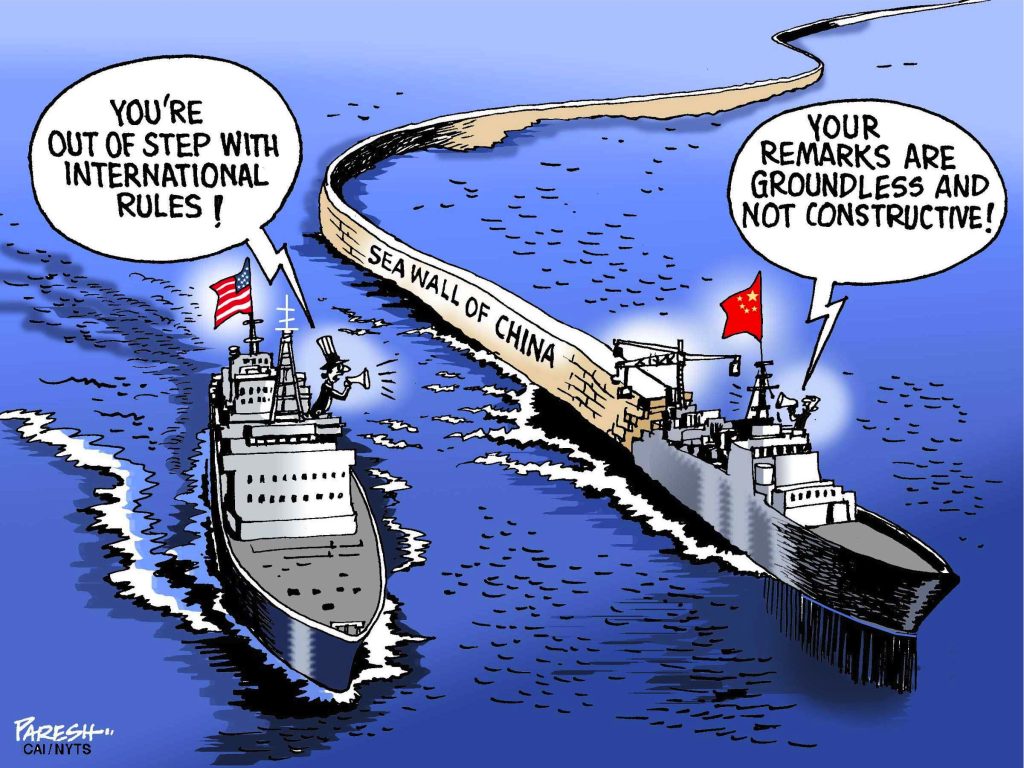
Group: ViewsAsia Credit: PARESH Source: The Khaleej Times – Dubai, UA.
Provider: CartoonArts International / The New York Times Syndicate
In fact, they are “driven by the leader’s vision of an ascendant and uncompromising China”, unwilling to give the West any chance of respite from its overwhelming confrontational stance – unquestionably “a combative approach”, informed WSJ, the Wall Street Journal. (13) Incidentally, on that same day, international wire services (Agence France-Press) published an official declaration by Xi Jinping, who noted that the US and China have to “find ways to get along” through diplomacy, and invited Washington to increased “cooperation”. China is “willing to work with the U.S. to give mutual respect, coexist peacefully” and “find ways to get along”.
That went unreported in the major press, though the vast Western readership of for example, The Hindu had access to the statements. (14)
The very fact that the Western powers are openly and explicitly provoking China with massive military infrastructure in order to stifle its progress through a military coalition of powerful Western and Asian countries, constantly building new military bases in the South China Sea, is unmentionable in the ‘free’ press.
However, as one moves away from the typical propaganda channels and closer to the military strategists, official diplomatic documents and so on, one can discern the obvious.
Thus, a study conducted by the US Air Force observed that “There is an abundance of evidence that documents China’s discontent with US SRO”, military reconnaissance operations off China’s coast, and that the country is “extremely prickly about sovereignty-related issues”. The study points out that “China’s sensitivity in this area is further aggravated by ‘ever-present aerial reconnaissance aircraft off the coast’”, conceding that such actions “compels Beijing to ‘defend their sovereignty’”, including “with military means”.
And consider this report published in perhaps the most respected international Asian daily, The South China Morning Post, SCMP:
As one senior naval officer put it, [constant American and European military operations in the South China Sea] are “an in your face, rub your nose in it operation that lets people know who is the boss”. The Donald Trump administration increased the tempo of US military activities in the South China Sea … The situation became so fraught that Beijing feared an attack against its installations. Yet President Joe Biden’s administration has continued fervently down this path and even worsened the situation … The US now undertakes an average of four [military ship] missions a day over the South China Sea. That is about 1 500 a year.
That is done in combination with large-scale offensive attack exercises by NATO and its regional “partners” against China, rarely causing any raised eyebrows at home. (15)
Notice that it is not perceived as relevant to stop these military campaigns or reflect on any question that could arise regarding the justice and legitimacy of such calculated provocations, which once again illustrates the shared consensus in an obedient culture. Rather, we must learn “the hard lessons about hard power” in order to not “succumb to the utopian path of disarmament”, and we must not “allow the fear of escalation to dominate our decisions”, as Mike Gallagher noted in a WSJ piece.

Speaking of which, the same WSJ warned us the next day that the West now faces an “uncompromising China that challenges us” and has “championed a combative approach in dealing with the West”. You will notice that this was printed as a news article, not an opinion piece, thus exposing the paper’s actual role as a servile tool of state propaganda. (16)
Another window of opportunity for diplomacy opened itself in mid-November of 2022, when the Chinese president noted that the West and China “should respect each other, coexist in peace, pursue win-win cooperation” and avoid “a collision”.
We do not know whether this was seriously meant, principally because the call was rejected by the West, which responded by saying that it will “continue to compete vigorously” – “compete”, meaning militarize and massively provoke near the shores of China. As we shall discover, this sort of response to diplomacy is becoming a standard operating procedure. (17)
II. The concocted nuclear peril, and the predictable response
Using the Chinese “threat” to keep the domestic population in line, the military sector now has free access to unlimited welfare funding to high-tech industry, known in Newspeak as “defense spending”. “The imperative to innovate is back”, as military journals celebrate. (18) Consider in this context the concern over alleged mindless Chinese “nuclear militarism”, a topic of extreme furore and concern in both Western press and government agitprop (essentially the same thing).
The media has been saturated with headlines pointing out all kinds of threats to nuclear non-proliferation and expansion. As with every depoliticized and indoctrinated culture, the usual suspects are always fit for attack. In our case: North Korea, Iran, and, crucially, China.
Thus, the US Nuclear Posture Review warns of the “PRC” and its ever-increasing ability to conduct “nuclear coercion”, repeated by US Pentagon and State Department officials, who regularly decry “China’s nuclear modernization and its rapid expansion”. That is a staple in government propaganda, and hence the ‘free’ press, which refuses to expose it as the obvious fraud that they, in fact, know it to be.
The best grasping at the straw to illustrate the global intent of the “rogue regime brandishing nuclear weapons and threatening its neighbors” (WSJ editorial) was in the summer of 2021, in which the Washington Post claimed that “China is building more than 100 new missile silos” to be armed with nuclear warheads. That number later increased, though that cannot be said about the presentation of evidence. (19)
The entire thing was quickly exposed as a falsification, as these “turn out to be wind turbines” (e.g. TFI Global and Council on Pacific Affairs). However, that lie was simply too useful to let go of, and the actual facts of the matter are yet more or less literally unreported in the West, and the ploy has now been forgotten after having properly served its propaganda function. (20)
The intelligentsia made sure to not miss this splendid opportunity of showing complete loyalty to the state disinformation system. Former CIA agent and Atlantic Council propagandist Matthew Kroenig warned that America “should continue with bipartisan plans to modernize U.S. nuclear weapons. In addition, the Pentagon has to be able to “meet its deterrence requirements with existing stockpile numbers”, and beyond.
The CIA’s and State Department’s favoured China analysts declared that “China is now shifting to war-fighting mode.” “Beijing’s refusal to talk and its insistence on secrecy about its arsenal means Washington has no choice but to believe but to believe Beijing intends to build a bigger nuclear force than Americas” (Gordon Chang) – that is, to build 14-20 times that of their existing amount of nuclear weapons. (21) The falsifications continued well after the entire episode had been exposed, with media pretending not to know, while describing the “explosive growth” of Chinese nuclear arms as “breathtaking, and frankly, the word ‘breathtaking’ may not be enough” (as The Sun’s US edition formulated it). (22)
The unmentioned Western nuclear weapons expansion programs
Incidentally, had the ‘free’ press actually been concerned about an “explosive growth” of nuclear arms, they would certainly have had no difficulty finding and reporting material documenting such “breathtaking” developments. Just prior to the carefully orchestrated furore about Chinese windmills purported to be “nuclear silos”, the UK openly declared that it would “expand” its “nuclear warhead stockpile by over 40%”, closer to 300 warheads in total.
This fact, too, was totally useless for the purposes of ideological warfare and was, therefore, quickly forgotten in the ever-expanding Memory Hole. (23) However, this is marginal compared to the nuclear escalation that puts other countries’ combined such in the shade: the dramatic American nuclear expansion programme – which, of course, is also the one never mentioned in the ‘free’ press.
It consists of new nuclear missiles, strategic bombers (the newly revealed B-21), submarines and so on, which in total will cost $1,7 trillion, according to Congressional numbers – all in all, an impressive escalation. (24)
Biden’s Nuclear Posture Review calls for “Modernizing U.S. nuclear forces”, and a readiness for a first nuclear strike, which is in order with the earlier policy of being the only country to have used the nuclear bomb on a population.
The Union of Concerned Scientists deemed the Review to be “a terrifying document” that “not only keeps the world on a path of increasing nuclear risk, in many ways it increases that risk”. That is somewhat of an understatement. (25)
Not everyone agrees, however. Nuclear weapons producers and retired military generals inform us that nuclear bombs must serve “as a mainstay of deterrence”, and defence “is based on our demonstrated capabilities and the willpower to use nuclear weapons.” A No-First-Use policy of nuclear bombs must, therefore, be regarded as “narcissistic, self-indulgent, dangerous and destabilizing” (Claude Robert, retired general and board member of Maxar Technologies). (26)
You will notice, for sure, that the entire publication about the alleged threat posed to us by China from which we have to defend ourselves is complete hypocrisy. Apparently, the West is not obliged to adhere to non-proliferation. That is reserved for our adversary – a bizarre thought, given that China has about the same number of nuclear weapons as countries such as France, Israel or the UK.
The US, on the other hand, has 14 times the number of nukes China has, is spending close to two trillion dollars on nuclear weapons modernization, and is carrying out massive provocations off the Chinese border. Though this militarism and nuclear arms proliferation is off the agenda, for reasons obvious enough, the mainstream ‘free’ media raise no critical question if at all they bother about the larger picture.
No sane person would like China, or any other nation for that matter, to have a nuclear arsenal, let alone for them to expand it. Therefore the first thing one who is seriously concerned about Chinese nuclear armament would do, naturally, is to not act in such a way which is known to advance it.
In fact, there is a perfectly simple and effective way to stop China from arming itself, and everyone in the government must know it: It is for the West to stop carrying out massive military provocations against the Chinese.

Thus, in Senate hearings, military experts note that US nuclear bombs and military infrastructure established in southern Asia “pose threats to China’s ability to retain an assured retaliation capability” and to its ability “to deter” a “first strike by the United States.”
“So what accounts for this pattern of change and continuity in China’s strategic posture?” the Senate asked – “Several external drivers play important roles. Foremost among them are developments by the United States (and its allies)”, deploying their military forces in China’s backyard, and massively increasing their already overwhelming nuclear capacities. (27)
In the technical and diplomatic literature, it is conceded all the time that “China” is merely sending “a response to the gratuitous, unrestrained nuclear policies” of the US and its allies. “Massively outgunned, China is acting rationally and predictably … By modernizing its nuclear force, the United States is giving China every reason to expand its own.” (Foreign Affairs). (28)
Or to quote military analysts in Forbes: the (exaggerated) Chinese modernization of its military and nuclear forces “is a rational response to decades of American provocations. And if those provocations don’t end, rivals such as China are sure to develop even more capable nukes”.
“China” does this, notes one the leading arms-control experts, Jeffrey Lewis, “because they want to be able to have a secure second-strike capability” were the US to attack – as it regularly simulates in military exercises off China’s borders, together with a hostile alliance of nuclear-armed nations. And so the technical military analyses go, all in virtually the same tune and all equally unreported to the general public. (29)
With the US knowingly acting precisely to increase the Chinese nuclear threat against itself, we can discard the alleged concern and fear over Chinese nuclear arms. The trivial truism that the US is knowingly and actively driving the Chinese to the path of militarisation, is far beyond what can be perceived in the ‘free’ press.
Although the person who fanatically reads the entire press can learn about these facts, one will likely not read a word about the very plausible reality that US policy is, in fact, designed to induce this Chinese response as a cover for further aggressive military escalation and renewal. Though all of this is unheard of among the current jingoist blast, favoured by hawks and doves alike.
Reaching a frenzy pitch in the fall and winter of 2022, a media barrage sought to inform us that, on nuclear talks, there is “zero give on Beijing’s side”, noting “the fact that Xi” will not “negotiate on any of the contentious issues … because of his long record of deception,” to quote Washington Post’s Josh Rogin.
A few days earlier, the same Post warned in an editorial that “the United states faces” a menace “who might prove far less willing to sign up for new treaty limits” – that is, “China, which has refused to engage in negotiations about its nuclear forces.” (30)
Obviously, the West has to respond accordingly, and so it “is time for diplomatic rock ‘n’ roll. Let’s prevent whining from isolationists”, to quote the advice given in the Wall Street Journal by John Bolton. (31)
The record of diplomatic proposals is clear and easy to discover had there been an interest to do so. But the actual facts are, however, entirely unacceptable to Western government propaganda and are therefore simply not facts: namely, that China, on multiple occasions, has signalled its willingness to establish a nuclear weapons settlement.
Let us pick just a few examples.
China’s willingness to establish a nuclear weapons settlement
In 2020 and 2021, there were concerns over how to “bring the Chinese to the negotiating table” to be held between the US and Russia in the START talks in early 2021, as then US top arms negotiator, Marshall Billingslea, put it. (32) Shortly after this announcement, the Chinese leadership would “be happy to” participate in reaching a settlement on the nuclear issue, actually “happy to participate the next day”. (33)
But, on one condition: that the US dramatically reduces its nuclear arsenal – a perfectly sensible condition, given the astronomical discrepancy between the arsenals of China and the US. It is not as if the US ignored the proposal. It did responded – by totally rejecting the diplomatic proposal, boasting that it would outspend China “into oblivion”: “We know how to win these [arms] races and we know how to spend the adversary into oblivion”, as Billingslea triumphed. (34)
Last year, in November 2021, Xi Jinping stated that “China supports ASEAN’s [southeast Asia’s intergovernmental body] efforts to build a Nuclear-Weapon-Free Zone, and is prepared to sign the Protocol to the Treaty on the Southeast Asia Nuclear Weapon-Free Zone as early as possible.”
“Beijing’s demand for a nuclear-free Southeast Asia comes as the US and UK empower their ally Australia with nuclear-armed submarines”, as the Asian press noted. (35)
But none of this can be reported in the West, since it would give the game away, and would render unusable the inversion of fact suggesting that the West is helplessly trying to reach a settlement, facing “Chinese unwillingness to join any arms-control regime in the foreseeable future” (Global Asia). That is not allowed to happen, since the cover for aggression against China would be exposed for what it really is. (36)
One could extend the discussion beyond merely the questions of militarism and diplomacy in Western conduct towards China, though very little unexpected is to be discovered. It was once observed by leaders of the early modern PR and propaganda industry that “it is as impossible to imagine a genuine democracy without the science of persuasion”, namely propaganda, “as it is to think of a totalitarian state without coercion”.
This is verified on a permanent basis.
In short, the behaviour of the intellectual classes in their analysis of Western imperial policy in Asia is yet another illustration of how close we have come to realising “the ideal of a propaganda-managed democracy”. (37)
Notes and references
- Lauren Williams, “Ukraine, Irregular War-Changes are Reshaping Pentagon’s Info-Ops Strategy”, Defence One, November 21 2022.
- The White House, “Indo-Pacific Strategy”, White House, February 2022, p. 2.
- Matthew Smalls, “The Challenge of a Rising China to US National Security”, Journal of Indo-Pacific Affairs (Air University), June 17 2021.
- Dewey Sim, “South China Sea, US will ensure ‘all nations can benefit’ from resource-rich international waters, top navy admiral says”, South China Morning Post, July 28 2021. See also Journal of Indo-Pacific Affairs, June 2021, p. 362-373. <