At 86, Robert S. McNamara has written yet another book filled with wisdom and vision, Wilson’s Ghost, co-authored by James G. Blight. It is subtitled Reducing the risk of conflict, killing, and catastrophe in the 21st century. It’s a unique and moving reading experience. McNamara has almost forty years in public service; he served as Secretary of Defence to Presidents Kennedy and Johnson from 1961 to 1968.
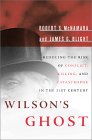
Robert S. McNamara & James G. Blight
Through this work he offers personal lessons learned from both the Vietnam War and the Cuban Missile Crisis while he uses the framework of President Woodrow Wilson’s ideas to produce what I judge to be the most compelling realistic blueprint for a new American foreign and security policy.
The personalities in the Bush administration would be wise to study McNamara’s morally and intellectually powerful and consistent exposé. I fear they won’t. Wilson’s Ghost is a book way beyond their frame of reference. But we should be grateful that there is a voice like McNamara’s, who both in 1995 and 1999 published books on the tragedy and lessons of Vietnam and has had the moral courage to go back, listen, be self-critical and participate in seminars of empathy and reconciliation. Can we see any of the Bush family, Bill Clinton or their secretaries and advisers going back in the future to Iraq, Yugoslavia, Afghanistan to discuss the tragedies and how to move toward reconciliation?
Here is how McNamara’s and Blight’s seminal book unfolds in basically four sections.
Listen to McNamara speaking about Wilson’s Ghost (26 minutes)Other books by McNamara et. al.
Argument Without End: In Search of Answers to the Vietnam Tragedy
Robert S. Ncnamara, James G. Blight, Robert K. Brigham, Biersteker
In Retrospect: The Tragedy and Lessons of Vietnam
Robert McNamara and Brian Vandemark
McNamara’s credo: a moral policy
In the first part of the book, McNamara’s states his credo. In the 20th century, approximately 160 million human beings were killed. It must be our moral priority in the 21st to reduce the killing. “We hold up the Wilson tragedy as a historical mirror in order to illuminate our own security risks, and as a stimulus to finding ways to lower those risks.”
Contrary to Wilson’s belief, the First World War turned out not to be “the war to end all war.” In Versailles, Wilson hoped to achieve two goals, namely lay the groundwork for a nonpunitive peace devoted to reconciliation between Germany and her European enemies and, second, to create a multilateral framework within which to handle conflicts, namely the League of Nations. But he failed in both respects. Germany felt grossly humiliated and the League was rendered nearly irrelevant by America’s absence from it. Wilson himself suffered a stroke in 1919.
We have, say the authors, to deal with the two fundamental messages of the last 100 years:
a) The Moral Imperative. We must avoid the mass killing of the past.
b) The Multilateral Imperative. The U.S. must provide leadership to achieve the objective of reduced carnage, but never – – never – – apply its economic, political, or military power unilaterally except in defence of its own territory.
These two imperatives make up the core of their “radical program.”
The authors then summarise the lessons to be learned from Wilson’s failure, thus:
– On morality versus moralism: Choose life, they say with reference to Albert Schweitzer. And do not allow attempts to implement a morality-based foreign policy to be frustrated by moralistic self-righteousness.
– On multilateralism: In the absence of a firm commitment to multilateral decision making, preferably institutionalised in credible international and regional organisations, sustainable peace is illusory.
– On preventing versus risking great power conflicts: Empathise with your adversary; if you don’t you risk the kind of miscalculation, misperception, and misjudgement that, among Great Powers, can lead to catastrophic war.
– On reducing versus encouraging communal killing: The redrawing of national borders, particularly secession and the creation of new states, is likely to be dangerous and destabilising, and should therefore be attempted only as a last resort, and then only if new borders do not threaten the neighbours of the states involved.
Thus, for America to lead, and deserve to be a leader, McNamara suggests that its moral goal should be to establish a foreign and defence policy, together with others, that will prevent the mass killing we saw in the 20th century. Never again 160 million dead! Listen, they say, to Kant and to Hans Küng, listen to the great religions which share a common belief in the Golden Rule. Christianity says, “All things whatsoever you would that men should do to you, you do even to them”. Buddhism says, “Hurt not others in ways that you yourself would find hurtful.” And Islam says, “No one of you is a believer until he desires for his brother that which he desires for himself.”
In short, policies must now be based on one basic value: Settle disputes within and among nations without resort to violence.
McNamara and Blight rely on Reinhold Niebuhr’s discussion from 1944 of evil and good – – with remarkable relevance for the situation we are in after September 11. What is evil in the international sphere, he said, is “the assertion of some self-interest without regard to the whole, whether the whole be conceived as the immediate community, or the total community of mankind.” In contrast to the children of darkness, the children of light “seek to bring self-interest under the discipline of a more universal law and in harmony with a more universal good.”
We must prevent Great Power conflict
The betrayal felt by Germany fuelled the rise of the Nazis. It ensured that the 20th century would be “soaked in blood.” “Wilson’ ghost,” McNamara and Blight write, “has already appeared in the 21st century, as Russia and China have become increasingly suspicious of the United States and the West for having betrayed them, reneging (as the Russians believe) on commitments not to expand the NATO alliance on Russia’s western borders; and (as the Chinese believe) on commitments to avoid supporting independence for Taiwan.”
The authors do not claim that Russia or China are right. Their psychologically well-taken point is that we must apply “realistic empathy” and bring them both “in from the cold”. McNamara reminds us of how little empathy was applied in the past vis-a-vis Russia and Vietnam.
And then comes a particularly important argument: “Inadvertent conflict is not “accidental” conflict. Rather, it is conflict that occurs due to the unintended consequences of actions taken by many actors, over an extended period, at the outset of which none of the actors will have anticipated a crisis leading to heightened risk of war between two or more of them.” In fact, the authors emphasise, some of the most important actions leading to conflict are taken years, decades or centuries before shooting begins. History – – incommensurable interpretations of the “same” history – – must also be taken into account as a potentially explosive factor in a process leading to increased risk of conflict.
McNamara knows. In August 1937, he was in Shanghai and witnessed Japan’s unprovoked bombing of that city which, according to China, cost 20 million lives. In 1996, the U.S. and Japan renewed their Security-Alliance. What would we think if we were the Chinese? The West promised Gorbachev not to expand NATO, but we broke that promise and NATO is “metastasing” to contain Russia once and for all. Has the West given enough help, the right help and help in time to Russia? Hardly! Yeltsin talked about a “cold peace” in 1994 and it is here now, claim the authors. There are many other examples and we must recognise, they say, that others see a U.S. Arrogance, a U.S. Betrayal, a U.S. Threat and a U.S. Flashpoint. It does not mean that they necessarily agree with the Russians and the Chinese but:
“This is the absolutely central proposition, the beginning of wisdom for preventing Great Power conflict in the 21st century: If Russia feels severely threatened by NATO expansion on its western border, and if China feels similarly threatened by what it believes to be growing U.S. support for Taiwan’s independence and for Japan’s rearming, then the U.S. and its allies, including Japan, should feel similarly threatened.”
Reducing communal killing
Wilson put forward his 14 points appearing to promise national self-determination to virtually everyone who claimed it. It was, McNamara and Blight judge, a recipe for disaster. In this part of the book, the authors deal with Rwanda, Somalia, and the Balkans (Kosovo in particular). Their point of departure is a discussion of Niebuhr’s famous question: How much evil must we do in order to do good?
Hardly surprising, the lessons from Vietnam are again in focus: “The tragedy of Vietnam was, in many ways, a tragedy of American unilateralism.” Today we must learn that “in no case should the United States decide unilaterally to intervene. U.S. leaders are not omniscient, even though they sometimes act as if they are. Wisdom and local knowledge are essential for successful intervention, and others with similar concerns may well have more of it than the Americans…we should practise the democratic principle we preach by subjecting our beliefs and inclinations to critical reviews by like-minded allies with similar values and interests.”
Following this principle will have a series of legal, institutional and perceptual advantages. If the U.S. consults with others and listens with empathy, it will make fewer mistakes. Doing so, it would also “combat the perception throughout the world that it has become a ‘rogue superpower’.” To put it crudely, the only way the U.S. can be an accepted and appreciated leader is by practising multilateralism and empathy and applying a complex analyses of long-range consequences of its past and present policies.
This part of the book, one may argue, says far too little about conflict-resolution, violence-prevention and overall North-South issues in comparison to outlining when and how to intervene militarily. That’s a pity, because McNamara’s approach is fully compatible with modern theories and methods of conflict-resolution – – as well as with the U.N. Charter that states that everything should be tried by civilian means before military force is employed as absolutely last resort.
The authors take much-needed issue with one of the most “moralistic” trends of our time – – the absolutist human rights movement that argues that it is a duty to intervene: “The human rights-based argument for American unilateral last resort is seductive, but we are not convinced by it. Many who hold this position argue that U.S. unilateralism is not like the unilateralism of other countries, countries with imperial pasts and perhaps ongoing imperial ambitions. They imply that the United States will take better care of those in whose affairs it might choose to intervene. But while this argument may well appeal to European or American advocates, we cannot conceive it being made by Cubans, Filipinos, Grenadans, Panamanians, Vietnamese, Dominicans, Mexicans, or others who have felt the sting of that they regard as U.S. imperialism.”
Did we, via our bombing, make life better for the Kosovars? The answer may well be no, they say and remind us of Carl Kaysen’s moral point: “You can’t justify killing for something you aren’t willing to die for.” The West may have fine values, but if it is not willing to sacrifice anything to promote them, what are they really worth?
So, Wilson’s Ghost is one long, convincing argument for non-intervention and thereby – – implicitly, at least – – for non-violent conflict-resolution. And few, if any, can speak from the vantage point of personal experience of wars and major world crises since 1937.
Abolish nuclear weapons once and for all
We have still not understood what the use of nuclear weapons would mean for the world in terms of destruction, including perhaps 300 million dead. We have not understood that first-use policies are destabilising and threatening and that the post-Cold War nuclear situation is more dangerous than before.
We have still not understood that no political objective would ever justify their use. Here is another example of the remarkable clarity of this book:
“This is, we believe, the correct way to consider the problem (of nuclear weapons): begin at the end, at the possible catastrophe; ask whether anything – – anything at all – – could justify such an outcome; if the answer is no, then you have your marching orders: the capacity to destroy nations must be eliminated. Since the possible outcome is absolute, action to prevent it must be absolute.”
They continue to argue that, while the Cold War is gone, deterrence is not – – and that it is morally unacceptable, militarily unnecessary, and extremely dangerous. Winning a nuclear war is an illusory dream; building a ballistic missile defence against it is yet another example of “American exceptionalism” and will be understood by others as another instance of the U.S. acting as a rogue superpower. For, it can only be done at the expense of the security of the world community.
Modelled on the Canberra Commission, the authors then outline a highly realistic program towards a nuclear-free world. We must overcome the fear, they say, that such a process and such a world would be more dangerous than the present. And, yes, there are risks such as cheating, breakout and of others using the opportunity to acquire nuclear capacity.
Again, however, they advise us to look at the whole picture, and empathise with others. Nuclear states would be able to put their energies to more constructive matters and the relationship between the present nuclear haves and the have-nots would change fundamentally: “It is easy to see why we must keep our eyes firmly on zero as the required number of nuclear weapons. For a world that will consent to relinquishing its nuclear weapons, and its right to make them, is a world in which many countries are made to feel more secure without them than they feel at present with them.”
Will these thoughts get through?
Wilson’s Ghost is a beautiful and pedagogical book written with compassion and persuasion like few. Towards the end, McNamara and Blight summarise it all, by arguing that we have a responsibility to redeem, in some measure, the lives of those who died violently in the 20th century. To do that we have to feel, think and act along these lines:
On Great Power conflict: Empathy now!
On communal killing: Resolve conflicts without violence now!
On nuclear weapons: Radical reductions – – and ultimate elimination – – beginning now!
This is, of course, not the only book of wisdom, vision and clarity. There are so many American scholars, columnists, peace researchers and international policy experts who have outlined safe alternatives to the present self-righteous, unilateralist, missionary polity of the Bush administration. And we know that a non-imperialist United States would be a much more beautiful and admired society.
The questions you ask yourself when putting down a book like Wilson’s Ghost, and all the other, equally superb, analyses are these: Why do the gates of formal powers seem wide open to destructive theories and methods? Why are the gates slammed in the faces of those who argue in favour of empathy, reconciliation, historical humility, non-violence, compassion and co-existence?
Why do I, why do you, accept that this is the way it is – – and what can we do to force open these doors before catastrophe descends upon us all? For, after all, democratic leadership is about open doors and listening, rather than about intellectual fences and omnipotent group think, isn’t it?
Robert S. McNamara & James G. Blight
Robert S. NcNamara and James G. Blight
Wilson’s Ghost.
Reducing the Risk of Conflict, Killing, and Catastrophe in the 21st Century
BBS Public Affairs, New York, 2001, 270 pp; US$ 24,00
Listen to McNamara speaking about Wilson’s Ghost (26 minutes)Other books by McNamara et. al.
Argument Without End: In Search of Answers to the Vietnam Tragedy
Robert S. Ncnamara, James G. Blight, Robert K. Brigham, Biersteker
In Retrospect: The Tragedy and Lessons of Vietnam
Robert McNamara and Brian Vandemark