
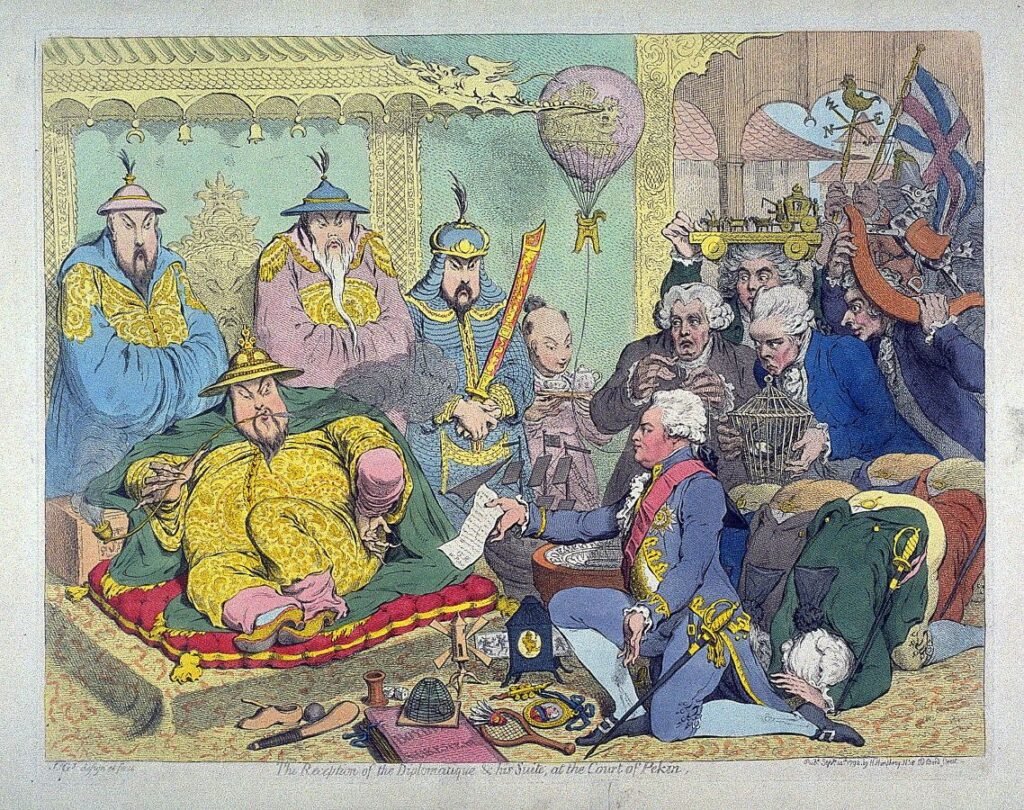

Lord Macartney, China, and the convenient lies of history

James Carter

February 25, 2020

In popular understanding, the Qianlong Emperor’s rejection of Lord Macartney and King George III was an act of hubris, a failure to recognize the military might of Britain and the West, the last prideful act of a waning empire before a “century of humiliation.” But what if our understanding is all wrong?

Originally posted on SupChina on September 9, 2020

“Our Celestial Empire possesses all things in prolific abundance and lacks no product within its borders. There was therefore no need to import the manufactures of outside barbarians in exchange for our own produce.”

This was the Qianlong Emperor’s response, in part, to British Lord Macartney in September 1793. For a century, the British, like other seafaring Europeans, had been restricted by the “Canton System” that permitted commerce only at the port of Guangzhou (Canton), through official government monopolies, and during a certain season. Industrialists in northern England wanted more access to Chinese markets; it was Macartney’s job to get it.

The details of Macartney’s mission are well known, told recently, and beautifully, by Stephen R. Platt in his 2018 book Imperial TwilightMacartney and his entourage of more than 400 left England in September 1792, sailing HMS Lion and Hindostan southwest from England toward South America, where they caught prevailing winds that took them back east, around the Cape of Good Hope, then through the Indian Ocean to Southeast Asia. They first made landfall in China in June, and then proceeded up the coast to Tianjin. There, they left their oceangoing vessels to make the rest of the journey on smaller boats, by river and canal, and then overland.

Arriving in the heat of summer, Macartney met the emperor north of the Great Wall at the Qing Summer Palace at Rehe (today in Hebei province). Their arrival on September 8, after almost a year of travel, could well define “anticlimactic.” As Platt describes it, Macartney and his retinue expected a personal greeting from the emperor’s personal representative, but when they reached their destination, “The British traveling party arranged itself in formation in front of the building, waiting ceremoniously…An hour passed that way. Then another hour and still he did not come.”

“After six hours of standing in formation with no sign of the imperial minister, they finally lost heart and went inside for their dinner.”

Nearly a week would pass before the audience with the emperor himself. The intervening days were spent negotiating the details of Macartney’s reception — would he perform the kowtow before Qianlong, as other embassies were expected to? There was disagreement and misunderstanding on this point, but a compromise was reached, allowing Macartney to bow his head and bend a knee, as he would to his own king.

Protocols settled, Macartney, wearing a velvet purple suit, entered the imperial presence on September 14, 1793, and presented George III’s letter outlining his demands for redefining the Qing-British relationship to Qianlong.

It is sometimes assumed that Macartney was uniquely breaking through Chinese isolation, but Macartney was not even the only ambassador from abroad that day. Representatives from western Asia and India were in attendance as well, making their own greetings to the emperor (Macartney made sure to record that they all eagerly performed the kowtow, and also that their dress was much plainer than his own).

The message delivered, Macartney’s embassy packed up and made its way south. Not until it reached Beijing, en route to their vessels awaiting off Tianjin, did Macartney receive Qianlong’s famous reply — quoted at the start of this article — that his empire had no use for anything Britain was offering. The response has become a shibboleth of Western understanding of China’s history. Taught in classes and cited by pundits, “no need to import the manufactures of foreign barbarians” confirms China’s hubris and foolishness at this pivotal moment between the prosperous High Qing and the “century of humiliation” around the corner. It shows China’s failure to recognize the rise of the West and its blindness to the military might they would soon face. Qianlong’s rejection of something as vital as “free trade and diplomatic equality” over refusal to comply with a ceremony demonstrates just how incompatible “traditional” Chinese culture and values were with those of Europe.

But what if this is all wrong?

The story of Qianlong’s reception to Macartney’s Mission has been subject to a great deal of revision by historians, starting especially with James L. Hevia’s 1993 Cherishing Men From Afar. (You can also get a thorough account in Mark Elliott’s 2007 biography, Emperor Qianlong: Son of Heaven, Man of the World.) Oxford historian Henrietta Harrison also makes the claim that Qianlong’s letter to George III has long been gravely misrepresented. In an important 2017 article in the American Historical Review(AHR), she notes that many of these fundamental assumptions about Macartney’s mission seem not to be true.

For one thing, the archival record makes it clear that rather than clinging to hoary ceremonials, Qianlong cared little about the kowtow. The consensus at the Qing court held that the English envoy could not be expected to kowtow. The obsession with the ritual came not from Qianlong, but from Macartney, who blamed Qianlong’s rejection on the perceived slight. This makes sense. Breaches of protocol took on outsized importance during an era of revolutionary fervor like the 1790s were in the Atlantic world. New states challenged the existing order and the behavior of envoys toward sovereigns was a fundamental way of establishing hierarchy.

But if Qianlong was not offended by a breach of etiquette, why did he turn George III down?

It took a few days after the audience for George’s missive to be translated, and once it was, Qianlong saw that he was being asked to reduce tariffs, cede to Britain two territorial bases (colonies?) in China, and receive an ambassador at the capital, circumventing the established Qing hierarchy. These were significant concessions, and rejecting them was hardly the action of a deluded autocrat.

Moreover, the record shows that Qianlong was aware that his refusal to comply might provoke serious consequences. Harrison quotes the emperor’s instructions to his ministers, advising them to prepare their coastal defenses and take care not to provoke the British warships because “England is stronger and fiercer than the other countries in the Western Ocean. Since things have not gone according to their wishes, it may cause them to stir up trouble.” Far from dismissing the English as insignificant, Qianlong feared what they represented.

Although the outcome of the embassy is not changed by these insights, the portrait of Qianlong is. Instead of rejecting modern commerce and science because he was beholden to ancient ways and arbitrary rituals, Qianlong was a practical ruler weighing the best interests of his empire against the demands of a powerful new rival. He is certainly no “oriental despot” opposing Enlightenment values.

So why the misunderstanding?

In her AHR article, Harrison advances several primary reasons. Central to all of them is that Qianlong’s letter itself was largely forgotten until the turn of the 20th century.

Let’s start with the archives themselves. Archives are not neutral repositories of knowledge. They are incomplete, inconsistent, and organized in certain ways rather than others. Use of the archives  is shaped by the priorities of the people who create and enable access to them. In this case, the immense scope of the Qing archives was made accessible to scholars through published collections of documents printed right around the turn of the 20th century. These collections included Qianlong’s letter, which had not been reprinted for 100 years, but was now available to scholars, in Chinese and in English.

Now removed from its context — context that included letters about the need for coastal defense and the unimportance of the kowtow — Qianlong’s letter fit two narratives, one Chinese and one Western.

The Chinese narrative was tied to the rise of Han nationalism against the Manchu rulers. Needing a scapegoat for Qing China’s humiliation at the hands of foreign powers, these nationalists used Qianlong’s letter to present him as the embodiment of shortsighted and xenophobic Manchu mismanagement that had led the Chinese nation to ruin. Just what revolutionaries seeking to discredit–and overthrow–the dynasty wanted.

The European, especially British, narrative used the absurdity of the Qianlong emperor’s attitude to justify colonialism. By 1900, it was widely “known” that Qianlong had rejected Britain’s demands largely because of the refusal to kowtow. The translation of Qianlong’s letter just confirmed that Britain was reasonable to continue working toward “Enlightened” policies in the face of entrenched tradition.

The view of an outmoded and overconfident Qing refusing to understand that their world was changing became conventional wisdom in the West largely because of the work of John King Fairbank, virtually the founder of American China studies and longtime professor at Harvard. Fairbank broke out of the mold of his mentors who relied on Western sources to tell the story of China’s history and was insistent on consulting Chinese archival sources. But as a trailblazer, his view of the archives was shaped by a generation of archivists wrapped up in post-Qing modernization, presenting a view of Qianlong that was, at best, shortsighted.

Writing in the 1950s, Fairbank’s great challenge was to explain the rise of Communism in China. How could a nation that had struggled so long suddenly be a force shaking the world? Qianlong’s letter fit the explanation: Under the Qing, China had been arrogant and ignorant, refusing to adapt to changing times. It had “no need for the manufactures of foreign barbarians.” With the Qing gone, China had charted a new path.

So let’s look back on the past with two takeaways. First, it was never the case that Qing China rejected all foreign contact and had to be pried open by enlightened Englishmen wanting only equality and openness. And second, remember that history is never a self-evident truth, but something that is always understood in the context of the present, mediated through the sources at hand. Let us be ever mindful of the biases we bring to our accounting of the past.

Please help TFF remain truly independent and highly productive by contributing if you benefited from this article

[paypal-donation]

James Carter is Professor of History and part of the Nealis Program in Asian Studies at Saint Joseph’s University in Philadelphia. He is the author of three books on China’s modern history, most recently Champions Day: The End of Old Shanghai.

Share

Leave a Reply

Your email address will not be published. Required fields are marked *

Related Posts

list=PLgfli1PY64h3bpPsycG1E1PquoujN9wIIu0026ab_channel=NeutralityStudies”,”type”:”video”,”providerNameSlug”:”youtube”,”responsive”:true,”className”:”wp-embed-aspect-16-9 wp-has-aspect-ratio”} –>
Foreword The Board of The Transnational Foundation in Sweden has decided to publish an easy-to-read, scholarly anthology that addresses one of the most important – and potentially dangerous – issues of our time: Why are the political, economic, and medialised Western images of China so consistently negative – and what can you do to understand China better? These images may be expressions of a political will to present only various shades of grey and black with the aim of building a consciousness about China as an enemy and not a partner. They may also be seen as a sort of world-dominating ethos of ignorance based upon the assumption that “we’ve-got-nothing-to-learn-from-others,’ we are the teacher. Another possibility is that the West, deep down, feels that it is getting relatively weaker from a macro-historical perspective and comforts itself with denial and accusations against “the other” of being the reason for its manifest...
We’ve seen it repeatedly: You invent a pretext based on deliberate lies, fake news, exaggerations or a false flag operation which serves to construct a story that country or leader X is a threat to “us” which legitimates that we do a ‘preemptive’ strike against that – obviously invented – threat to eliminate it. Mainstream media’s task is to propagate the ploy, not to ask questions or reveal the lie. Take Serbia’s ‘genocide’ in Kosovo, Afghanistan’s responsibility for 9/11, Saddam’s possession of nukes in Iraq, Assad’s use of chemical weapons against the Syrians, Gaddafi’s ‘mass murder’ in Bengazi, Russia’s planning to occupy and administer not only Ukraine but also a series of European countries thereafter, Hamas’ attack on Israel – that Israel knew everything about before it happened – and now you have the blatant lie about Iran’s being just about to become a nuclear weapons power. Basic facts about...

Recent Articles

PressInfo # 141, December 21, 2001It’s time to prepare reconciliation between Albanians and Serbs PressInfo # 140, December 14, 2001Ibrahim Rugova’s decade-long leadership in Kosovo/a PressInfo # 139, 11. december, 2001En god nyhet: Jugoslaviens Sannings- och försoningskommission PressInfo # 139, 11. december, 2001Gode nyheder: Jugoslaviens Sandheds- og Forsoningskommission PressInfo # 139, December 11, 2001Good news: Yugoslavia’s Truth and Reconciliation Commission PressInfo # 138, November 8, 2001TFF co-founder PhD with thesis about young people with roots in other cultures PressInfo # 138, November 8, 2001TFF:s medstiftare doktor på avhandling om unga med ursprung i andra kulturer PressInfo # 137, October 17, 2001A new Marshall Plan: Advancing human security and controlling terrorism PressInfo # 136, October 15, 2001The UN and Annan really deserve it PressInfo # 135, October 10, 2001Preventing a terrorist mushroom cloud PressInfo # 134, 17 oktober, 2001Sverige og 11. september PressInfo # 134, October 9, 2001Sweden and September 11...
Peace is promoted by constructive proposals and dialogue Four preceding PressInfos have expressed concern over — and criticised — the ongoing, militarisation of the EU. Some will say: but there are no alternatives. We believe that there are always alternatives, that democracies are characterised by alternatives and choice, and that openly discussed alternatives will improve the quality and legitimacy of society’s decision–making. In addition, it is an intellectual and moral challenge to not only criticise but also be constructive. If we only tell people that we think they are wrong, they are not likely to listen. However, if we say: what are your views on this set of ideas and steps? — we may sometimes engage them in dialogue and sow a seed. Most people in power circles live their daily lives in in a time frame and a social space where certain ideas, viewpoints and concepts are just not...
Photos © TFF 2000 Read PressInfo 90 “Lift the Sanctions and Bring More Aid to Yugoslavia” See Pictures from Belgrade © TFF 2000 Please reprint, copy, archive, quote or re-post this item, but please retain the source.

TFF on Substack

Discover more from TFF Transnational Foundation & Jan Oberg.

Most Popular

PressInfo # 141, December 21, 2001It’s time to prepare reconciliation between Albanians and Serbs PressInfo # 140, December 14, 2001Ibrahim Rugova’s decade-long leadership in Kosovo/a PressInfo # 139, 11. december, 2001En god nyhet: Jugoslaviens Sannings- och försoningskommission PressInfo # 139, 11. december, 2001Gode nyheder: Jugoslaviens Sandheds- og Forsoningskommission PressInfo # 139, December 11, 2001Good news: Yugoslavia’s Truth and Reconciliation Commission PressInfo # 138, November 8, 2001TFF co-founder PhD with thesis about young people with roots in other cultures PressInfo # 138, November 8, 2001TFF:s medstiftare doktor på avhandling om unga med ursprung i andra kulturer PressInfo # 137, October 17, 2001A new Marshall Plan: Advancing human security and controlling terrorism PressInfo # 136, October 15, 2001The UN and Annan really deserve it PressInfo # 135, October 10, 2001Preventing a terrorist mushroom cloud PressInfo # 134, 17 oktober, 2001Sverige og 11. september PressInfo # 134, October 9, 2001Sweden and September 11...
Peace is promoted by constructive proposals and dialogue Four preceding PressInfos have expressed concern over — and criticised — the ongoing, militarisation of the EU. Some will say: but there are no alternatives. We believe that there are always alternatives, that democracies are characterised by alternatives and choice, and that openly discussed alternatives will improve the quality and legitimacy of society’s decision–making. In addition, it is an intellectual and moral challenge to not only criticise but also be constructive. If we only tell people that we think they are wrong, they are not likely to listen. However, if we say: what are your views on this set of ideas and steps? — we may sometimes engage them in dialogue and sow a seed. Most people in power circles live their daily lives in in a time frame and a social space where certain ideas, viewpoints and concepts are just not...
Photos © TFF 2000 Read PressInfo 90 “Lift the Sanctions and Bring More Aid to Yugoslavia” See Pictures from Belgrade © TFF 2000 Please reprint, copy, archive, quote or re-post this item, but please retain the source.
Read More
Imagen-thumbnail-The-Transnational-1
PressInfo # 141, December 21, 2001It’s time to prepare reconciliation between Albanians and Serbs PressInfo # 140, December 14, 2001Ibrahim Rugova’s decade-long leadership in Kosovo/a PressInfo # 139, 11. december, 2001En god nyhet: Jugoslaviens Sannings- och försoningskommission PressInfo # 139, 11. december, 2001Gode nyheder: Jugoslaviens Sandheds- og Forsoningskommission PressInfo # 139, December 11, 2001Good news: Yugoslavia’s Truth and Reconciliation Commission PressInfo # 138, November 8, 2001TFF co-founder PhD with thesis about young people with roots in other cultures PressInfo # 138, November 8, 2001TFF:s medstiftare doktor på avhandling om unga med ursprung i andra kulturer PressInfo # 137, October 17, 2001A new Marshall Plan: Advancing human security and controlling terrorism PressInfo # 136, October 15, 2001The UN and Annan really deserve it PressInfo # 135, October 10, 2001Preventing a terrorist mushroom cloud PressInfo # 134, 17 oktober, 2001Sverige og 11. september PressInfo # 134, October 9, 2001Sweden and September 11...
Imagen-thumbnail-The-Transnational-1
Peace is promoted by constructive proposals and dialogue Four preceding PressInfos have expressed concern over — and criticised — the ongoing, militarisation of the EU. Some will say: but there are no alternatives. We believe that there are always alternatives, that democracies are characterised by alternatives and choice, and that openly discussed alternatives will improve the quality and legitimacy of society’s decision–making. In addition, it is an intellectual and moral challenge to not only criticise but also be constructive. If we only tell people that we think they are wrong, they are not likely to listen. However, if we say: what are your views on this set of ideas and steps? — we may sometimes engage them in dialogue and sow a seed. Most people in power circles live their daily lives in in a time frame and a social space where certain ideas, viewpoints and concepts are just not...
Imagen-thumbnail-The-Transnational-1
Photos © TFF 2000 Read PressInfo 90 “Lift the Sanctions and Bring More Aid to Yugoslavia” See Pictures from Belgrade © TFF 2000 Please reprint, copy, archive, quote or re-post this item, but please retain the source.
Imagen-thumbnail-The-Transnational-1
Av FRANK SØHOLM GREVIL 16 augusti 2004  Vi er nu nået til tredje akt i det absurde teaterstykke, der i analogi med de store skueprocesser i Moskva 1936-38 er blevet døbt ‘Grevil-sagen’. Første akt bestod i min anonyme fremlæggelse af egenhændigt nedklassificerede rapporter i Berlingske Tidende i februar og marts. Andet akt udgjordes af min fremtræden med navn og billede i Information i april samt den efterfølgende mediestorm, som uden min direkte medvirken kostede en forsvarsminister taburetten samt en sigtelse for brud på tavshedspligten. Tredje akt bliver en retssag, hvor jeg står tiltalt for at have overtrådt straffelovens bestemmelser om uberettiget videregivelse eller udnyttelse af fortrolige oplysninger. Statsanklageren har ovenikøbet valgt at påberåbe sig særligt skærpende omstændigheder. Da jeg aldrig har modtaget betaling for at stille rapporterne til rådighed eller lade mig interviewe, må det skærpende bestå i, at “videregivelsen eller udnyttelsen er sket under sådanne omstændigheder, at det påfører...
Imagen-thumbnail-The-Transnational-1
Af Svenska Irakkommittén mot de Ekonomiska Sanktionerna (SIES) 13 september 2002 FN:s ekonomiska sanktioner mot Irak har nu pågått i tolv år och drabbat det irakiska folket med svåra lidanden. Enligt FN:s egna siffror har mer än 1,5 miljoner människor, varav ca 600 000 barn, dött som en direkt följd av sanktionerna. Dessutom har ett lågintensivt bombkrig mot landet pågått under dessa år. Av all denna förödelse- orsakad huvudsakligen av amerikansk och brittisk politik- har Saddam Husseins brutala och diktatoriska regim snarast stärkts än försvagats. Nu förbereder USA under president Bushs ledning ett storskaligt bombkrig mot Irak som kommer att innebära ett ännu större lidande för civilbefolkningen. Ett sådant krig kommer dessutom att ytterligare undergräva freden och säkerheten i världen. Att upprätta en demokratisk regim i Irak är det irakiska folkets angelägenhet och får enligt folkrätten inte ske med krigshandlingar utifrån. Folkrätten och FN:s stadgar måste respekteras. Vi vädjar till...