
Li Xing: Why the global democratic alliance is nothing more than a Western fantasy

Illustration: Craig Stephens

Li Xing

19 January 2023

– The West likes to argue that market capitalism and political liberalism go hand in hand; in reality, the former has proved far more powerful than the latter

– Having made countries around the world economically interdependent, the West should not expect them to jeopardise their global links by taking political sides

US President Joe Biden has framed the Ukraine war as a battle between “democracy and autocracy”, while also claiming that “the West is now stronger, more united than it has ever been”.

During a recent visit to Taiwan, former Danish leader and Nato secretary general Anders Fogh Rasmussen said that, when combined, the world’s democracies represent 60 per cent of the global economy, providing an overwhelming deterrence to Beijing’s ambitions regarding Taiwan.

The irony is that, if we applied this logic to the Ukraine war, the US and Europe would have already won. In reality, the question is why there is no global democratic alliance on the war, with two of the world’s largest democracies, India and Indonesia, preferring not to take sides or calling for negotiations.

Contrary to Biden and Rasmussen’s postulations, the Ukraine war is widening the global disparity between attitudes to the US, China and Russia. Cambridge University recently released a report that merges data from 30 global surveys spanning 137 countries.

Originally published by South China Morning Post January 12, 2023

It found that, “Among the 1.2 billion people who inhabit the world’s liberal democracies, three-quarters (75 per cent) now hold a negative view of China, and 87 per cent a negative view of Russia. However, for the 6.3 billion people who live in the rest of the world, the picture is reversed. In these societies, 70 per cent feel positively towards China, and 66 per cent positively towards Russia.”

Why is the world so divided over such a simple issue of political correctness in Russia’s invasion of a sovereign state? The answer lies in the contradiction between the West’s two inherent identities which tends to generate double standards when dealing with global affairs.
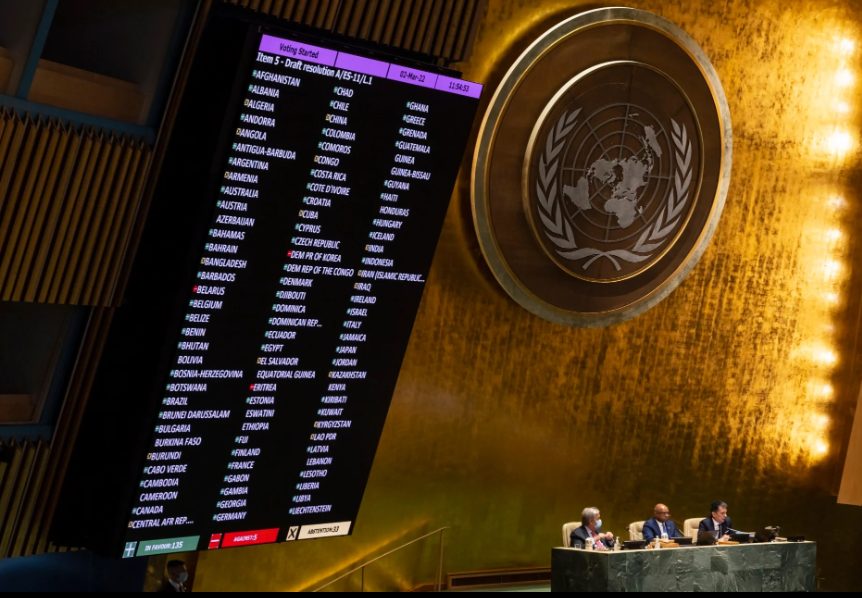
A screen shows results from a vote on a resolution condemning Russia’s invasion of Ukraine, during an emergency session of the United Nations General Assembly in New York, on March 2, 2022. Photo: EPA-EFE

These two identities are “market capitalism” and “political liberalism”. The former refers to the capitalist mode of production, characterised by private ownership, capital accumulation, profit pursuit, surplus value and the like.

The latter is a system of norms and values based on individual civil rights, democracy, secularism, rule of law, and political, economic and religious freedom. Proponents of liberalism argue that the world would be peaceful if every country became a democracy, because “democratic states rarely, if ever, go to war with one another”.

Western ideologists believe there is a positive interconnection between these two systems: the success of the former will lead to the latter, while the achievement of the latter will further facilitate the former.

The West’s victory in the Cold War is heralded as a mark of the global triumph of these two systems. Regarding the first, the victory indicates that Western market capitalism is ubiquitous and powerful.

Economic growth in the form of wealth-seeking and self-enrichment is regarded as a common desire among all people. “High living standards” and “material well-being” are seen not merely as Western values but universal ones.
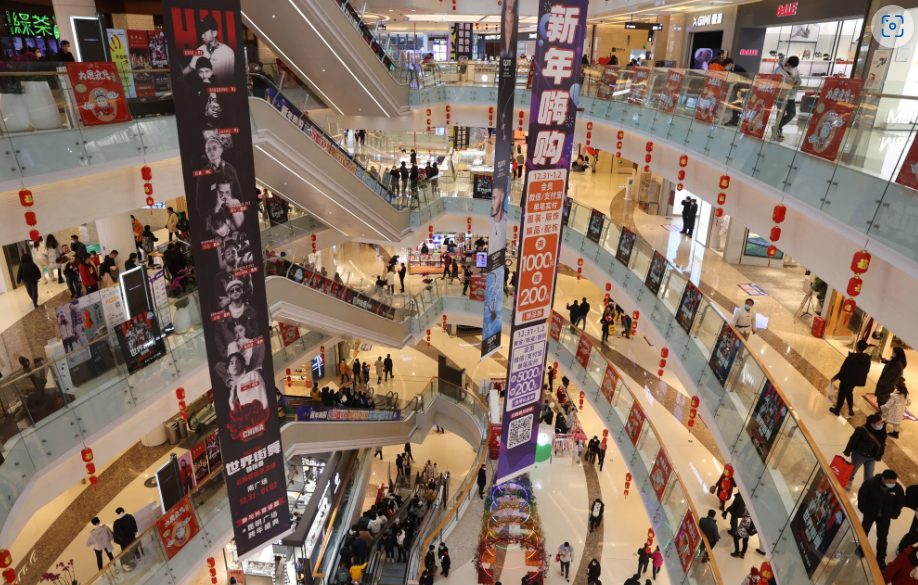
A shopping centre in Kunming, in southwest China’s Yunnan province, on January 1. There is widespread anxiety in the West that an illiberal China is becoming one of the world’s dominant powers. Photo: Xinhua

Since the end of the Cold War, West-driven globalisation has made market capitalism a truly global system, with every individual and state operating according to its dominant mode of functioning. Globalisation has resulted in a complex world structure characterised by interconnection, interdependence and inter-embedded systems.

It has also led to the fragmentation and decentralisation of production chains, as well as the worldwide dispersion and integration of the different segments of these chains. The rise of China’s pivotal position in global manufacturing supply chains, and Russia’s position in the global energy supply chain, are the outcomes of globalisation and global capitalism.

Regarding the second system, the outcome of the Cold War proves Francis Fukuyama’s “end of history” thesis, marking “the end point of mankind’s ideological evolution and the universalisation of Western liberal democracy as the final form of human government”. Liberalism has gone beyond the form of an ideology to become a tool used by the West to maintain and reinforce its status as the global hegemon.

Now, the underlying assumptions of the West’s dual identities are being challenged both by and by the ongoing Russia-Ukraine war. Today, there is widespread anxiety in the West that an illiberal China is becoming one of the world’s dominant powers. The West suffers from “China syndrome”, a set of psychological symptoms characterised by fear, hysteria and demonisation.

This is because China’s economic success and its global rise do not conform to the interaction between the two identities. China is able not only to challenge them, but to offer alternatives with “Chinese characteristics”, making it a “systemic rival”.

When viewing the coverage of the Ukraine war, it becomes clear that major Western media outlets acknowledge the fact that the world is divided over the war, and so is Europe. Some EU countries have only implemented selective sanctions against Russia, while others have resisted joining the sanctions, especially those that are dependent on Russia’s energy supply.

Yes, sanctions hurt Russia, but they also contribute to disruptions in global supply chains, higher global commodity prices and a slowdown in global economic growth. As market capitalism’s law of value becomes the survival mechanism of every society, few countries would risk the loss of the Chinese market and the negative impact of sanctioning Russia for the sake of “defending democracy against autocracy”.

Having lived in the West for decades, I have come to the conclusion that there is nothing wrong with Western identities as such. The problem lies in the contradiction between them, so that whenever a choice has to be made between them, the law of value always takes priority, while liberal values are optional.

Many double-standard policies of the West are a result of this contradiction, which is why the world is divided today.

Originally published by South China Morning Post January 12, 2023

About the author
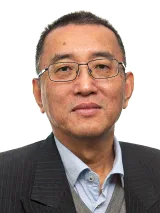
Professor Li Xing is the director of the Research Centre on Development and International Relations, Department of Politics and Society, at Aalborg University, Denmark.

Please help TFF remain truly independent by contributing if you benefited from this article

[paypal-donation]

Share

Leave a Reply

Your email address will not be published. Required fields are marked *

Related Posts

Contrary to what we stated when publishing this Call, the UN General Assembly (GA) opened on September 9, 2025, in New York, not in Geneva, as we initially wrote. However, due to the host role-violating US ban on visas to Palestinians, the Special GA Segment on Palestine will be held in the UN Geneva from September 22. And it builds up to something historic. Anyhow, here is what we believe you must advocate or do to help stop the Israeli genocide. It’s called people’s power or citizens’ diplomacy. SHARE! The first of three appeals from TFF. The second is here, and the third here. Across the world, people are witnessing the systematic destruction of Palestinian lives, homes, and communities. The scale and intensity of Israel’s military operations — especially in Gaza — have led leading legal bodies, including the International Court of Justice, to warn of a plausible genocide. The...
Professor Zhang Weiwei is a highly respected Chinese intellectual and professor at Fudan University in Shanghai. He is the director of its China Institute and also runs a series of conversations with many different people around the world. Here is what came out of their meetings there and in Skopje, Macedonia in October 2024: & As you can see, also at the end of the second one, we both enjoy win-win exchanges like these about world order issues. Zhang Weiwei is known for using videos and social media to reach a large audience in China and worldwide. We suggest you see many more of Zhang Weiwei’s conversations – like recently with Professor Jeffrey Sachs – on the Thinkers’ Forum on YouTube. PSTFF posts hundreds of videos, its own and those of others, in our Video Collections on TFF Substack – including those that appear on YouTube. However, TFF has been cancelled by Google-owned...
Launched on November 17, 2024Updated with new materials regularly TFF Board members Thore Vest. Everywhere, the delegation was met with a sincere wish to develop knowledge, dialogue, cooperative projects, and initiatives based on citizens’ diplomacy – in general, but with the West in particular. For more, see “Report from the Nordic delegation to China’s Xinjiang Province, September 7-15, 2024.” While the delegation was in Xinjiang, various ideas were already being discussed from the local to the top level, i.e., with the governor and party leaders of Xinjiang. The two TFF Associates suggested that TFF set up a special section – in addition to its “China and Silk” – where various quality materials about Xinjiang would regularly be published to promote public education about Xinjiang, particularly its contemporary development – worldwide but in the West in particular. This is now a reality – as can be seen below – but it...

Recent Articles

PressInfo # 141, December 21, 2001It’s time to prepare reconciliation between Albanians and Serbs PressInfo # 140, December 14, 2001Ibrahim Rugova’s decade-long leadership in Kosovo/a PressInfo # 139, 11. december, 2001En god nyhet: Jugoslaviens Sannings- och försoningskommission PressInfo # 139, 11. december, 2001Gode nyheder: Jugoslaviens Sandheds- og Forsoningskommission PressInfo # 139, December 11, 2001Good news: Yugoslavia’s Truth and Reconciliation Commission PressInfo # 138, November 8, 2001TFF co-founder PhD with thesis about young people with roots in other cultures PressInfo # 138, November 8, 2001TFF:s medstiftare doktor på avhandling om unga med ursprung i andra kulturer PressInfo # 137, October 17, 2001A new Marshall Plan: Advancing human security and controlling terrorism PressInfo # 136, October 15, 2001The UN and Annan really deserve it PressInfo # 135, October 10, 2001Preventing a terrorist mushroom cloud PressInfo # 134, 17 oktober, 2001Sverige og 11. september PressInfo # 134, October 9, 2001Sweden and September 11...
Peace is promoted by constructive proposals and dialogue Four preceding PressInfos have expressed concern over — and criticised — the ongoing, militarisation of the EU. Some will say: but there are no alternatives. We believe that there are always alternatives, that democracies are characterised by alternatives and choice, and that openly discussed alternatives will improve the quality and legitimacy of society’s decision–making. In addition, it is an intellectual and moral challenge to not only criticise but also be constructive. If we only tell people that we think they are wrong, they are not likely to listen. However, if we say: what are your views on this set of ideas and steps? — we may sometimes engage them in dialogue and sow a seed. Most people in power circles live their daily lives in in a time frame and a social space where certain ideas, viewpoints and concepts are just not...
Photos © TFF 2000 Read PressInfo 90 “Lift the Sanctions and Bring More Aid to Yugoslavia” See Pictures from Belgrade © TFF 2000 Please reprint, copy, archive, quote or re-post this item, but please retain the source.

TFF on Substack

Discover more from TFF Transnational Foundation & Jan Oberg.

Most Popular

PressInfo # 141, December 21, 2001It’s time to prepare reconciliation between Albanians and Serbs PressInfo # 140, December 14, 2001Ibrahim Rugova’s decade-long leadership in Kosovo/a PressInfo # 139, 11. december, 2001En god nyhet: Jugoslaviens Sannings- och försoningskommission PressInfo # 139, 11. december, 2001Gode nyheder: Jugoslaviens Sandheds- og Forsoningskommission PressInfo # 139, December 11, 2001Good news: Yugoslavia’s Truth and Reconciliation Commission PressInfo # 138, November 8, 2001TFF co-founder PhD with thesis about young people with roots in other cultures PressInfo # 138, November 8, 2001TFF:s medstiftare doktor på avhandling om unga med ursprung i andra kulturer PressInfo # 137, October 17, 2001A new Marshall Plan: Advancing human security and controlling terrorism PressInfo # 136, October 15, 2001The UN and Annan really deserve it PressInfo # 135, October 10, 2001Preventing a terrorist mushroom cloud PressInfo # 134, 17 oktober, 2001Sverige og 11. september PressInfo # 134, October 9, 2001Sweden and September 11...
Peace is promoted by constructive proposals and dialogue Four preceding PressInfos have expressed concern over — and criticised — the ongoing, militarisation of the EU. Some will say: but there are no alternatives. We believe that there are always alternatives, that democracies are characterised by alternatives and choice, and that openly discussed alternatives will improve the quality and legitimacy of society’s decision–making. In addition, it is an intellectual and moral challenge to not only criticise but also be constructive. If we only tell people that we think they are wrong, they are not likely to listen. However, if we say: what are your views on this set of ideas and steps? — we may sometimes engage them in dialogue and sow a seed. Most people in power circles live their daily lives in in a time frame and a social space where certain ideas, viewpoints and concepts are just not...
Photos © TFF 2000 Read PressInfo 90 “Lift the Sanctions and Bring More Aid to Yugoslavia” See Pictures from Belgrade © TFF 2000 Please reprint, copy, archive, quote or re-post this item, but please retain the source.
Read More
Imagen-thumbnail-The-Transnational-1
PressInfo # 141, December 21, 2001It’s time to prepare reconciliation between Albanians and Serbs PressInfo # 140, December 14, 2001Ibrahim Rugova’s decade-long leadership in Kosovo/a PressInfo # 139, 11. december, 2001En god nyhet: Jugoslaviens Sannings- och försoningskommission PressInfo # 139, 11. december, 2001Gode nyheder: Jugoslaviens Sandheds- og Forsoningskommission PressInfo # 139, December 11, 2001Good news: Yugoslavia’s Truth and Reconciliation Commission PressInfo # 138, November 8, 2001TFF co-founder PhD with thesis about young people with roots in other cultures PressInfo # 138, November 8, 2001TFF:s medstiftare doktor på avhandling om unga med ursprung i andra kulturer PressInfo # 137, October 17, 2001A new Marshall Plan: Advancing human security and controlling terrorism PressInfo # 136, October 15, 2001The UN and Annan really deserve it PressInfo # 135, October 10, 2001Preventing a terrorist mushroom cloud PressInfo # 134, 17 oktober, 2001Sverige og 11. september PressInfo # 134, October 9, 2001Sweden and September 11...
Imagen-thumbnail-The-Transnational-1
Peace is promoted by constructive proposals and dialogue Four preceding PressInfos have expressed concern over — and criticised — the ongoing, militarisation of the EU. Some will say: but there are no alternatives. We believe that there are always alternatives, that democracies are characterised by alternatives and choice, and that openly discussed alternatives will improve the quality and legitimacy of society’s decision–making. In addition, it is an intellectual and moral challenge to not only criticise but also be constructive. If we only tell people that we think they are wrong, they are not likely to listen. However, if we say: what are your views on this set of ideas and steps? — we may sometimes engage them in dialogue and sow a seed. Most people in power circles live their daily lives in in a time frame and a social space where certain ideas, viewpoints and concepts are just not...
Imagen-thumbnail-The-Transnational-1
Photos © TFF 2000 Read PressInfo 90 “Lift the Sanctions and Bring More Aid to Yugoslavia” See Pictures from Belgrade © TFF 2000 Please reprint, copy, archive, quote or re-post this item, but please retain the source.
Imagen-thumbnail-The-Transnational-1
Av FRANK SØHOLM GREVIL 16 augusti 2004  Vi er nu nået til tredje akt i det absurde teaterstykke, der i analogi med de store skueprocesser i Moskva 1936-38 er blevet døbt ‘Grevil-sagen’. Første akt bestod i min anonyme fremlæggelse af egenhændigt nedklassificerede rapporter i Berlingske Tidende i februar og marts. Andet akt udgjordes af min fremtræden med navn og billede i Information i april samt den efterfølgende mediestorm, som uden min direkte medvirken kostede en forsvarsminister taburetten samt en sigtelse for brud på tavshedspligten. Tredje akt bliver en retssag, hvor jeg står tiltalt for at have overtrådt straffelovens bestemmelser om uberettiget videregivelse eller udnyttelse af fortrolige oplysninger. Statsanklageren har ovenikøbet valgt at påberåbe sig særligt skærpende omstændigheder. Da jeg aldrig har modtaget betaling for at stille rapporterne til rådighed eller lade mig interviewe, må det skærpende bestå i, at “videregivelsen eller udnyttelsen er sket under sådanne omstændigheder, at det påfører...
Imagen-thumbnail-The-Transnational-1
Af Svenska Irakkommittén mot de Ekonomiska Sanktionerna (SIES) 13 september 2002 FN:s ekonomiska sanktioner mot Irak har nu pågått i tolv år och drabbat det irakiska folket med svåra lidanden. Enligt FN:s egna siffror har mer än 1,5 miljoner människor, varav ca 600 000 barn, dött som en direkt följd av sanktionerna. Dessutom har ett lågintensivt bombkrig mot landet pågått under dessa år. Av all denna förödelse- orsakad huvudsakligen av amerikansk och brittisk politik- har Saddam Husseins brutala och diktatoriska regim snarast stärkts än försvagats. Nu förbereder USA under president Bushs ledning ett storskaligt bombkrig mot Irak som kommer att innebära ett ännu större lidande för civilbefolkningen. Ett sådant krig kommer dessutom att ytterligare undergräva freden och säkerheten i världen. Att upprätta en demokratisk regim i Irak är det irakiska folkets angelägenhet och får enligt folkrätten inte ske med krigshandlingar utifrån. Folkrätten och FN:s stadgar måste respekteras. Vi vädjar till...