
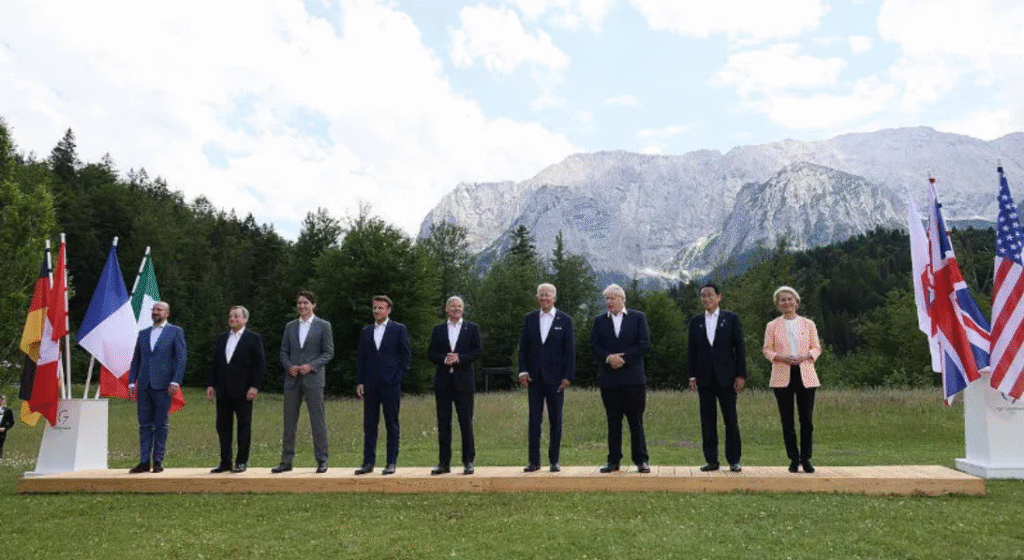
Kishore Mahbubani: The G-7, G-20 paradox

Image: Wikimedia Commons

By P&I Guest Writers

August 24, 2022

The G-7 countries are democratic domestically but are dictatorial globally. By contrast, the G-20 group, which has many autocratic regimes, represents a more democratic forum for governance.

The G-7 is dictatorial, while the G-20 is democratic.

This statement is obviously paradoxical. The G-7 countries are very proud of their liberal democratic societies. And they should be. However, while they are democratic domestically, they are dictatorial globally. By contrast, the G-20 group, which has many autocratic regimes, is more representative of the world’s population.

The spiritual essence of democracy is conveyed in the phrase: a government of the people, by the people, for the people. In short, it must represent a hundred per cent of the people. The G-7 represent just 10 per cent of the world’s population.

Yet, they make decisions and take actions that disrupt the lives of billions of people, including the world’s poor, without factoring in their interests and concerns. This is what dictators do.

Originally published at John Menadue’s “Pearls & Irritations” on August 4, 2022

The G-7 countries were right in imposing sanctions on Russia after its illegal invasion of Ukraine in February this year. But in designing the sanctions, the G-7 countries protected the interests of their own population, which makes up a minority of the world’s population. Indeed, the G-7 countries, especially the European countries, could have hastened the war’s end by boldly cutting off all the gas supplies from Russia immediately.

They didn’t do so because they didn’t want their own people to make any sacrifices. However, both the illegal Russian invasion and the subsequent sanctions led to massive increases in fuel and food prices, disrupting the lives of hundreds of millions, if not billions, of people, who had to make serious sacrifices.

Since the G-7 countries didn’t want to impose sacrifices on their own people, it was strange that they complained when China, India and other developing countries stepped up their purchases of Russian oil at a discount.

This led to two sharp responses from the Indian Foreign Minister S. Jaishankar. His two sharp responses resonated around the world. In response to criticisms about increased Indian oil purchases from Russia, he said: “India’s total purchases of oil from Russia in a month is probably less than what Europe does in an afternoon.” He also said, equally bitingly: “Europe has to grow out of the mindset that Europe’s problems are the world’s problems but the world’s problems are not Europe’s problems.”

Substitute G-7 for Europe and you get the essence of the problem with the G-7.

It takes care of the interests of the most privileged 10 per cent of the world’s population. It ignores the interests of the remaining 90 per cent. This is why the G-20 represents a more democratic forum governance. As Martin Wolf of the Financial Times wisely said: “The G-20 contains 63 per cent of the world’s people and 87 per cent of its output (at market prices). It contains the world’s most powerful countries and ones from every continent. It is our best chance for global economic governance.”

Even though the G-20 is a more democratic representation of the world’s population, some Western leaders are now suggesting that they should boycott the next G-20 leaders’ meeting, which will take place in Bali from Nov 15 to 16 2022, if Russian President Vladimir Putin is invited to attend. Any such Western boycott of the Bali Summit would be unwise. Indeed, it would damage the standing of the Western countries in the eyes of the majority of the world’s population in several ways.

Firstly, it will show the West acting in an “undemocratic” way by ignoring the wishes of the majority of the G-20 countries which want the meeting to continue, especially since the world is suffering from major global problems today. Secondly, if Mr Putin attends the G-20 meeting in Bali, he will hear the disapproving voices of both the West and the Rest on the invasion of Ukraine. He will also hear strong pleas to end the war as it is disrupting the lives of so many around the world.

Professor Barry R. Posen of MIT has argued persuasively in Foreign Affairs that the most likely result of the war in Ukraine is protracted conflict with painful losses on both sides. It’s thus in everyone’s best interests to “seek a diplomatic end to the war now”. His reasoning is sound. We’re more likely to get a diplomatic solution if Mr Putin hears clearly from his peers, both in the West and the Rest.

Finally, in ethical terms, the constituency we should care about the most is that of the very poor. On July 7, the United Nations Development Programme reported that an estimated 71 million people have fallen into poverty because of the skyrocketing food and fuel prices caused by the war in Ukraine, and that 750,000 people are at immediate risk of starvation. Given these dire challenges for the poor, it would be criminal to sabotage the November meeting of the G-20 leaders.

The West should also remember one important historical fact before taking action to undermine the Bali meeting. At the height of the Global Financial Crisis, when the Western countries were feeling threatened by an economic implosion, they convened the G-20 London Summit on April 2, 2009, to launch a global stimulus package to rescue the world economy.

All the G-20 countries – including the developing countries – participated in this US$1.1 trillion (S$1.53 trillion) rescue package, which was instrumental in turning things around for the embattled Western countries. The Rest didn’t hesitate to help the West in its hour of need. Perhaps the West should now consider repaying this debt by stepping up at the forthcoming Bali meeting to help the Rest.

Ultimately, to put it very simply, all eight billion people on Planet Earth are now on the same boat. We will sink or sail together. Let’s use the forthcoming G-20 meeting in Bali wisely to steer this common boat of ours.

Originally published at John Menadue’s “Pearls & Irritations” on August 4, 2022

About the author

Kishore Mahbubani is a veteran diplomat and a distinguished fellow at the Asia Research Institute at the National University of Singapore.

Source: The Straits Times © SPH Media Limited.

Please help TFF remain truly independent by contributing if you benefited from this article

[paypal-donation]

No data was found

Share

Leave a Reply

Your email address will not be published. Required fields are marked *

Related Posts

America’s Strategic Assault on Art, Academia, and the Imagination That Sustains Peace The United States once stood as a beacon of cultural audacity—a place where dissent could be beautiful, and beauty and innovation could challenge the present order of things. Its museums, universities, and artists helped inspire a worldwide imagination rooted in creative freedom and innovation. But today, under the Trump regime’s second term, those dynamic qualities are being systematically dismantled. Just read this. As Trump goes after the arts, many museums remain silent | CNN As CNN reports, the administration has launched an aggressive campaign to “eradicate improper ideology” from federally funded museums. Exhibitions involving race, gender, and identity are being censored or cancelled. Amy Sherald’s reimagining of the Statue of Liberty as a Black, trans woman was pulled from the Smithsonian after curators objected to its symbolism. Sherald warned that “history shows us what happens when governments demand loyalty...
TFF Associate and former Board member On 28 August 2025, France, Germany, and the United Kingdom (the EU Troika) decided to trigger the so-called “snapback mechanism” and reimpose stringent sanctions on Iran after 30 days for its alleged violation of the terms of the Iran nuclear deal, known as the Joint Comprehensive Plan of Action (JCPOA), if Iran did not give in to their demands within 30 days. In the lawless world in which we are living at the moment, discussing the principles of international law is futile and irrelevant. We have reverted to the age of imperial dictatorship and big power dominance. This state of affairs is dangerous for the whole world, especially the Global South, which is at the mercy of the dictates of the superpowers. However, a return to the rivalry between powerful empires outside the scope of international law, which led to the two world wars,...
Editorial for Transcend Media Service, TMS, and published in an edited Q & A version by the China Social Science Network-China Social Science News. See also this follow-up, “Condemn all UN member states: They spend 100 times more on militarism than on the entire UN system.” The UN has been extremely important over the last 80 years in terms of, for instance, global dialogue, multi-dimensional development, international law, peace-keeping, normativity, violence condemnation, and ethics. It has been the place to hold member states accountable. The UN Charter is the most Gandhian document ever signed by the world’s governments. If the great majority of member states lived up to their obligations in accordance with the UN Charter and including the resolutions they have signed up to, the world would be a much more peaceful, just, democratic, and lawful place. Regrettably, there are several reasons why the world is not in accordance with those fine Charter norms and provisions:a) The majority...

Recent Articles

– nästan 11 månader Till Sofia nästan 11 månader # 1  Till Sofias huvudsida Till alla Privata Foto-Serier
Till Sofias huvudsida
OK, Trump did not get it. But he got a full endorsement of a possible future US regime change in Venezuela. And that is what Ms Machado has advocated. On October 10, 2025, the Norwegian Nobel Committee awarded its Peace Prize to Venezuelan opposition figure María Corina Machado. The citation praised her “tireless work promoting democratic rights.” But Ms Machado has openly called for U.S. military intervention in Venezuela, stating on CBS: “The only way to stop the suppression is by force—U.S. force.” She or her party has received funding from the National Endowment for Democracy (NED), a U.S. government-backed body known as a CIA front organisation and for supporting regime-change operations worldwide. And in 2018, she sent a letter to Israeli Prime Minister Benjamin Netanyahu, asking him to use “force and influence” to help dismantle Venezuela’s government—citing alleged ties to terrorism, Iran and narcotrafficking. This year’s NATO Norwegian prize...

TFF on Substack

Discover more from TFF Transnational Foundation & Jan Oberg.

Most Popular

– nästan 11 månader Till Sofia nästan 11 månader # 1  Till Sofias huvudsida Till alla Privata Foto-Serier
Till Sofias huvudsida
OK, Trump did not get it. But he got a full endorsement of a possible future US regime change in Venezuela. And that is what Ms Machado has advocated. On October 10, 2025, the Norwegian Nobel Committee awarded its Peace Prize to Venezuelan opposition figure María Corina Machado. The citation praised her “tireless work promoting democratic rights.” But Ms Machado has openly called for U.S. military intervention in Venezuela, stating on CBS: “The only way to stop the suppression is by force—U.S. force.” She or her party has received funding from the National Endowment for Democracy (NED), a U.S. government-backed body known as a CIA front organisation and for supporting regime-change operations worldwide. And in 2018, she sent a letter to Israeli Prime Minister Benjamin Netanyahu, asking him to use “force and influence” to help dismantle Venezuela’s government—citing alleged ties to terrorism, Iran and narcotrafficking. This year’s NATO Norwegian prize...
Read More
– nästan 11 månader Till Sofia nästan 11 månader # 1  Till Sofias huvudsida Till alla Privata Foto-Serier
Till Sofias huvudsida
BlackNobel
OK, Trump did not get it. But he got a full endorsement of a possible future US regime change in Venezuela. And that is what Ms Machado has advocated. On October 10, 2025, the Norwegian Nobel Committee awarded its Peace Prize to Venezuelan opposition figure María Corina Machado. The citation praised her “tireless work promoting democratic rights.” But Ms Machado has openly called for U.S. military intervention in Venezuela, stating on CBS: “The only way to stop the suppression is by force—U.S. force.” She or her party has received funding from the National Endowment for Democracy (NED), a U.S. government-backed body known as a CIA front organisation and for supporting regime-change operations worldwide. And in 2018, she sent a letter to Israeli Prime Minister Benjamin Netanyahu, asking him to use “force and influence” to help dismantle Venezuela’s government—citing alleged ties to terrorism, Iran and narcotrafficking. This year’s NATO Norwegian prize...
Screenshot-2025-10-08-163458
PRESS RELEASE – 6 OCTOBER 2025 LAY DOWN YOUR ARMSPEACE PRIZE FOR 2025 is awarded Francesca Albanese The United Nations Special Rapporteur on the occupied Palestinian territories – as the person who, in accordance with Alfred Nobel’s will, has “done the most or the best work for fraternity between nations and for the abolition or reduction of standing armies as well as for the holding and promotion of peace congresses.” Francesca Albanese has forcefully and unwaveringly worked against Israel’s full-scale war on the occupied Palestinian territories, in particular Israel´s ongoing genocide against the Palestinian people. She has confronted Israel’s systematic war crimes and crimes against humanity in a truly global outreach. Further, she has brought governments, international organisations and people’s groups together to underline the responsibility of the world at large to act and to stop arming, enabling, and profiting from Israel’s ongoing criminal actions. But first of all, Albanese...
Copilot_20251003_003414
Officially, the drones were not identified. By simply thinking critically – which journalists and selected experts no longer do – there may be a good reason for that. And this article will never be mentioned in Denmark… Drones over Denmark. No damage. No trace. No answers. Yet the headlines scream “Russian threat,” and Prime Minister Mette Frederiksen speaks with a certainty that defies logic: “We don’t know they were Russian—but we know Russia is the biggest threat to Europe.” It could be nobody else – unless you make an interest analysis which I did two days ago. This is not security policy. It’s theatre. And the audience is being played. Let’s rewind. These drones—unphotographed, untracked, unclaimed—appear and vanish like ghosts. Airports shut down. Panic spreads. Military budgets swell. And the narrative hardens: Russia is behind it. But what if that’s not just wrong but deliberately misleading? Here’s a hypothesis for...
Screenshot-2025-09-30-231913-1
And why the world, especially the EU, must now declare itself independent of the United States. UN’s 80th anniversary This year, the United Nations celebrates the 80th anniversary of its founding. The UN was formed after the scourge of the Second World War, in which 70 to 85 million people were killed and many countries were destroyed. That war came on the heels of the First World War, which also killed between 15 and 22 million people. After the Second World War, especially after the use of nuclear weapons by the United States, which marked a turning point in the history of warfare that could result in the end of civilisation as we know it, humanity decided to move away from the era of empires and big power politics and usher in a new era of peace, freedom and cooperation. These were the principles enshrined in the UN Charter. The United States...