
Keeping the Empire Running: Britain’s Global Military Footprint

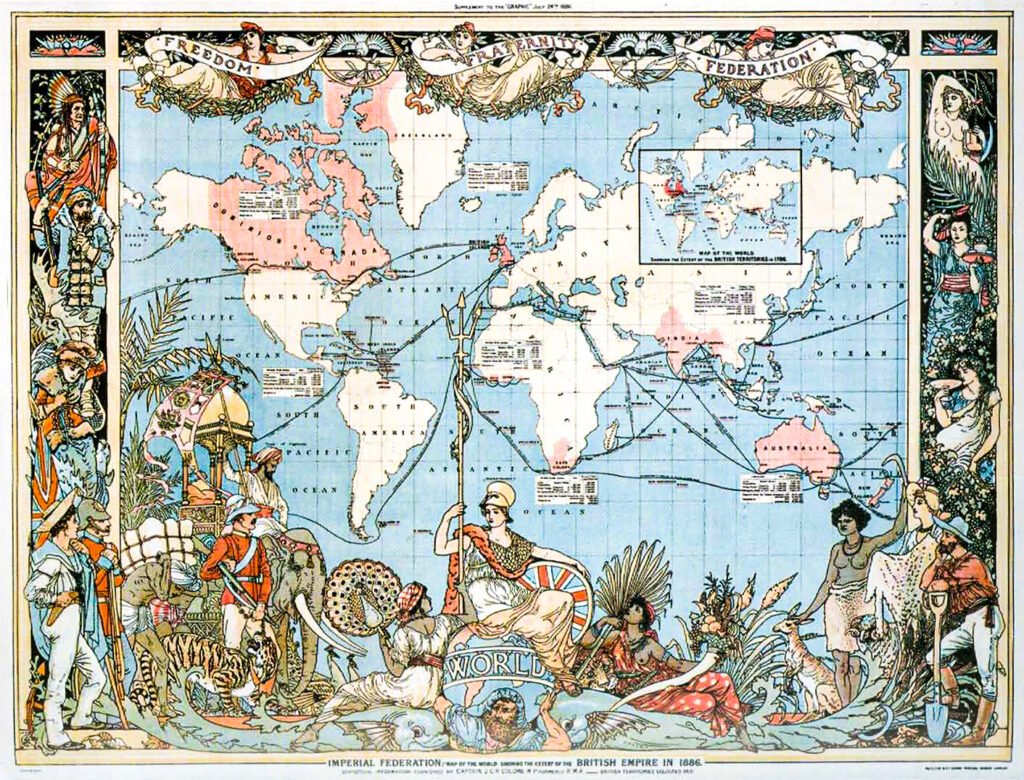
The British Empire in 1886

Britain leaves the EU on December 31, 2020. We mark this historical event by looking at its global, imperial military footprint and the mind-boggling waste of scarce resources its prime minister is proud of standing behind in times that are already extremely hard for the citizens.

Binoy Kampmark

December 29, 2020

A few nostalgic types still believe that the Union Jack continues to flutter to sighs and reverence over outposts of the world, from the tropics to the desert. They would be right, if only to a point. Britain, it turns out, has a rather expansive global reach when it comes to bases, military installations and testing sites. While not having the obese heft and lumbering brawn of the United States, it makes a good go of it. Globally, the UK military has a presence in 145 sites in 42 countries.

Originally posted by Off Guardian on November 29, 2020

Such figures tally with Ian Cobain’s prickly observation in The History Thieves: that the British were the only people “perpetually at war.”

Phil Miller’s rich overview of Britain’s military footprint for Declassified UK shows it to be heavy.

The size of the global military presence is far larger than previously thought and is likely to mean that the UK has the second largest military network in the world, after the United States.”

The UK military, for instance, has a presence in five countries in the Asia-Pacific: naval facilities in Singapore; garrisons in Brunei, drone testing facilities in Australia; three facilities in Nepal; a quick reaction force in Afghanistan. Cyprus remains a favourite with 17 military installations. In Africa, British personnel can be found in Kenya, Somalia, Djibouti, Malawi, Sierra Leone, Nigeria and Mali. Then come the ever dubious ties to Arab monarchies.

The nature of having such bases is to be kind to your host, despite him being theocratic, barking mad, or an old fashioned despot with fetishes. Despite the often silly pronouncements by British policymakers that they take issue with authoritarians, exceptions numerous in number abound.

The UK has never had a problem with authoritarians it can work with or despots it can coddle. A closer look at such relations usually reveal the same ingredients: capital, commerce, perceptions of military necessity. The approach to Oman, a state marked by absolute rule, is a case in point.
Since 1798, Britain has had a hand in ensuring the success, and the survivability, of the House of Al Said. On September 12, UK Defence Secretary Ben Wallace announced that a further £23.8 million would go to enhancing the British Joint Logistics Support Base at Duqm port, thereby tripling “the size of the existing UK base and help facilitate Royal Navy deployments to the Indian Ocean”. The Ministry of Defence also went so far as to describe a “renewal” of a “hugely valuable relationship,” despite the signing of a new Joint Defence Agreement in February 2019.

The agreement had been one of the swan song acts of the ailing Sultan Qaboos bin Said, whose passing this year was genuinely mourned in British political circles. Prime Minister Boris Johnson called him “an exceptionally wise and respected leader who will be missed enormously.” Papers of record wrote in praise of a reformer and a developer. “The longest serving Arab ruler,” observed a sycophantic column in The Guardian“Qaboos was an absolute monarch, albeit a relatively benevolent and popular one.”

The same Sultan, it should be said, had little fondness for freedom of expression, assembly and association, encouraged the arrests and harassment of government critics and condoned sex discrimination. But he was of the “one of us” labels: trained at the Royal Military Academy Sandhurst, an unwavering Anglophile, installed on the throne by Britain in the 1970 palace coup during the all but forgotten Dhofar Rebellion.

“Strategically,” Cobain reminds us“the Dhofar war was one of the most important conflicts of the 20th century, as the victors could expect to control the Strait of Hormuz and the flow of oil.” The British made sure their man won.

Public mention of greater British military involvement in foreign theatres can be found, though they rarely make front page acts. The business of projecting such power, especially in the Britannic model, should be careful, considered, even gnomic. Britain, for instance, is rallying to the US-led call to contain the Yellow Peril in the Asia Pacific, a nice reminder to Beijing that old imperial misdeeds should never be a bar to repetition.

The head of the British Army, General Sir Mark Carleton-Smith, spoke in September about there being “a market for a more persistent presence from the British Army (in Asia). It’s an area that saw a much more consistent Army presence in the Eighties, but with 9/11 we naturally receded from it.” The time had come “to redress that imbalance”.

The UK Chief of Defence Staff, General Sir Nick Carter, prefers to be more enigmatic about the “future of Global Britain.” To deal with an “ever more complex and dynamic strategic context,” he suggests the “Integrated Operating Concept”. Britain had to:

… “compete below the threshold of war in order to deter war, and to prevent one’s adversaries from achieving their objectives in fait accompli strategies.”

Gone are the old thuggeries of imperial snatch and grab; evident are matters of flexibility in terms of competition. “Competing involves a campaign posture that includes continuous operating on our terms and in places of our choosing.”

This entails a thought process involving “several dimensions to escalate and deescalate up and down multiple ladders – as if it were a spider’s web.” The general attempts to illustrate this gibberish with the following example:

One might actively constrain in the cyber domain to protect critical national infrastructure in the maritime Domain.”

In 2017, there were already more than just murmurings from Johnson, then Foreign Secretary, and Defence Secretary Michael Fallon, that a greater British presence in the Asia-Pacific was warranted. Fallon was keen to stress the reasons for deeper involvement, listing them to a group of Australian journalists.

The tensions have been rising in the region, not just from the tests by North Korea but also escalating tension in the South China Sea with the building program that’s gone there on the islands and the need to keep those routes open.”

With such chatter about the China threat you could be forgiven for believing that British presence in the Asia-Pacific was minimal. But that would ignore, for instance, the naval logistics base at Singapore’s Sembawang Wharf, permanently staffed by eight British military personnel with an eye on the busy Malacca Strait. A more substantial presence can also be found in the Sultanate of Brunei, comprising an infantry battalion of Gurkhas and an Army Air Corps Flight of Bell 212 helicopters.

The MOD is particularly keen on the surroundings, as they offer “tropical climate and terrain … well suited to jungle training”.

Over the next four years, the UK military can expect to get an extra £16.5 billion – a 10% increase in funding and a fond salute to militarists. “I have decided that the era of cutting our defence budget must end, and ends now,” declared Johnson“Our plans will safeguard hundreds of thousands of jobs in the defence industry, protecting livelihoods across the UK and keeping the British people safe.”

The prime minister was hoping to make that announcement accompanied by the “Integrated Defence and Security Review” long championed by his now-departed chief special adviser, Dominic Cummings. Cummings might have been ejected from the gladiatorial arena of Downing Street politics, but the ideas in the Review are unlikely to buck old imperial trends. At the very least, there will be a promise of more military bases to reflect a posture General Carter describes rather obscurely as “engaged and forward deployed”.

Please help TFF remain truly independent and highly productive by contributing if you benefited from this article

[paypal-donation]

Dr Binoy Kampmark was a Commonwealth Scholar at Selwyn College, Cambridge. He writes extensively for various publications, including CounterPunch, Dissident Voice, and Eureka Street. He is currently lecturing at the School of Global, Urban and Social Studies at RMIT University.

Share

Leave a Reply

Your email address will not be published. Required fields are marked *

Related Posts

Officially, the drones were not identified. By simply thinking critically – which journalists and selected experts no longer do – there may be a good reason for that. And this article will never be mentioned in Denmark… Drones over Denmark. No damage. No trace. No answers. Yet the headlines scream “Russian threat,” and Prime Minister Mette Frederiksen speaks with a certainty that defies logic: “We don’t know they were Russian—but we know Russia is the biggest threat to Europe.” It could be nobody else – unless you make an interest analysis which I did two days ago. This is not security policy. It’s theatre. And the audience is being played. Let’s rewind. These drones—unphotographed, untracked, unclaimed—appear and vanish like ghosts. Airports shut down. Panic spreads. Military budgets swell. And the narrative hardens: Russia is behind it. But what if that’s not just wrong but deliberately misleading? Here’s a hypothesis for...
Drones over Nordic airports. No damage. No trace. No answers. Most assume Russia—but what if that’s not so? Why is there so much we are not told? This article explores the strategic ambiguity behind recent drone incursions and asks: Who else might benefit from sending drones into NATO airspace? From Ukraine’s surprising drone supremacy to Russia’s possible signalling, the silence itself may be the loudest message. These are the kinds of questions decent, intelligent investigative journalists and commentators could easily research. Why don’t they? Did you, dear reader, know or think of this? That the most powerful weapon in today’s conflicts might be the one that leaves no trace – and no answers. Just enough fear to justify the next move? Recently, drones have repeatedly appeared over Nordic airports and near some military facilities. They cause no damage – for which reason the designation “hybrid attack” is misleading but serves a purpose. These...
By World BEYOND War A new report by the global peace group World BEYOND War finds that military bases used by foreign militaries are growing in number, as are public protests and advocacy against those bases. Of 1,247 foreign military bases in the world, 877 of them, by latest count, are U.S. bases outside of the United States. Eighteen other nations, combined, have 370 bases outside their borders. The full report is available at https://worldbeyondwar.org/basesreport2025 While U.S. bases are in 95 foreign countries all over the globe and virtually encircling the borders of Russia and China, the nation with the second-most foreign bases, Türkiye, has them all near Türkiye, with the exception of one base in Somalia, and the majority of them in Syria and Iraq where Türkiye has been waging wars. During U.S. wars in Iraq and Afghanistan, the United States added, and later closed, hundreds of bases. Türkiye and...

Recent Articles

PressInfo # 141, December 21, 2001It’s time to prepare reconciliation between Albanians and Serbs PressInfo # 140, December 14, 2001Ibrahim Rugova’s decade-long leadership in Kosovo/a PressInfo # 139, 11. december, 2001En god nyhet: Jugoslaviens Sannings- och försoningskommission PressInfo # 139, 11. december, 2001Gode nyheder: Jugoslaviens Sandheds- og Forsoningskommission PressInfo # 139, December 11, 2001Good news: Yugoslavia’s Truth and Reconciliation Commission PressInfo # 138, November 8, 2001TFF co-founder PhD with thesis about young people with roots in other cultures PressInfo # 138, November 8, 2001TFF:s medstiftare doktor på avhandling om unga med ursprung i andra kulturer PressInfo # 137, October 17, 2001A new Marshall Plan: Advancing human security and controlling terrorism PressInfo # 136, October 15, 2001The UN and Annan really deserve it PressInfo # 135, October 10, 2001Preventing a terrorist mushroom cloud PressInfo # 134, 17 oktober, 2001Sverige og 11. september PressInfo # 134, October 9, 2001Sweden and September 11...
Peace is promoted by constructive proposals and dialogue Four preceding PressInfos have expressed concern over — and criticised — the ongoing, militarisation of the EU. Some will say: but there are no alternatives. We believe that there are always alternatives, that democracies are characterised by alternatives and choice, and that openly discussed alternatives will improve the quality and legitimacy of society’s decision–making. In addition, it is an intellectual and moral challenge to not only criticise but also be constructive. If we only tell people that we think they are wrong, they are not likely to listen. However, if we say: what are your views on this set of ideas and steps? — we may sometimes engage them in dialogue and sow a seed. Most people in power circles live their daily lives in in a time frame and a social space where certain ideas, viewpoints and concepts are just not...
Photos © TFF 2000 Read PressInfo 90 “Lift the Sanctions and Bring More Aid to Yugoslavia” See Pictures from Belgrade © TFF 2000 Please reprint, copy, archive, quote or re-post this item, but please retain the source.

TFF on Substack

Discover more from TFF Transnational Foundation & Jan Oberg.

Most Popular

PressInfo # 141, December 21, 2001It’s time to prepare reconciliation between Albanians and Serbs PressInfo # 140, December 14, 2001Ibrahim Rugova’s decade-long leadership in Kosovo/a PressInfo # 139, 11. december, 2001En god nyhet: Jugoslaviens Sannings- och försoningskommission PressInfo # 139, 11. december, 2001Gode nyheder: Jugoslaviens Sandheds- og Forsoningskommission PressInfo # 139, December 11, 2001Good news: Yugoslavia’s Truth and Reconciliation Commission PressInfo # 138, November 8, 2001TFF co-founder PhD with thesis about young people with roots in other cultures PressInfo # 138, November 8, 2001TFF:s medstiftare doktor på avhandling om unga med ursprung i andra kulturer PressInfo # 137, October 17, 2001A new Marshall Plan: Advancing human security and controlling terrorism PressInfo # 136, October 15, 2001The UN and Annan really deserve it PressInfo # 135, October 10, 2001Preventing a terrorist mushroom cloud PressInfo # 134, 17 oktober, 2001Sverige og 11. september PressInfo # 134, October 9, 2001Sweden and September 11...
Peace is promoted by constructive proposals and dialogue Four preceding PressInfos have expressed concern over — and criticised — the ongoing, militarisation of the EU. Some will say: but there are no alternatives. We believe that there are always alternatives, that democracies are characterised by alternatives and choice, and that openly discussed alternatives will improve the quality and legitimacy of society’s decision–making. In addition, it is an intellectual and moral challenge to not only criticise but also be constructive. If we only tell people that we think they are wrong, they are not likely to listen. However, if we say: what are your views on this set of ideas and steps? — we may sometimes engage them in dialogue and sow a seed. Most people in power circles live their daily lives in in a time frame and a social space where certain ideas, viewpoints and concepts are just not...
Photos © TFF 2000 Read PressInfo 90 “Lift the Sanctions and Bring More Aid to Yugoslavia” See Pictures from Belgrade © TFF 2000 Please reprint, copy, archive, quote or re-post this item, but please retain the source.
Read More
Imagen-thumbnail-The-Transnational-1
PressInfo # 141, December 21, 2001It’s time to prepare reconciliation between Albanians and Serbs PressInfo # 140, December 14, 2001Ibrahim Rugova’s decade-long leadership in Kosovo/a PressInfo # 139, 11. december, 2001En god nyhet: Jugoslaviens Sannings- och försoningskommission PressInfo # 139, 11. december, 2001Gode nyheder: Jugoslaviens Sandheds- og Forsoningskommission PressInfo # 139, December 11, 2001Good news: Yugoslavia’s Truth and Reconciliation Commission PressInfo # 138, November 8, 2001TFF co-founder PhD with thesis about young people with roots in other cultures PressInfo # 138, November 8, 2001TFF:s medstiftare doktor på avhandling om unga med ursprung i andra kulturer PressInfo # 137, October 17, 2001A new Marshall Plan: Advancing human security and controlling terrorism PressInfo # 136, October 15, 2001The UN and Annan really deserve it PressInfo # 135, October 10, 2001Preventing a terrorist mushroom cloud PressInfo # 134, 17 oktober, 2001Sverige og 11. september PressInfo # 134, October 9, 2001Sweden and September 11...
Imagen-thumbnail-The-Transnational-1
Peace is promoted by constructive proposals and dialogue Four preceding PressInfos have expressed concern over — and criticised — the ongoing, militarisation of the EU. Some will say: but there are no alternatives. We believe that there are always alternatives, that democracies are characterised by alternatives and choice, and that openly discussed alternatives will improve the quality and legitimacy of society’s decision–making. In addition, it is an intellectual and moral challenge to not only criticise but also be constructive. If we only tell people that we think they are wrong, they are not likely to listen. However, if we say: what are your views on this set of ideas and steps? — we may sometimes engage them in dialogue and sow a seed. Most people in power circles live their daily lives in in a time frame and a social space where certain ideas, viewpoints and concepts are just not...
Imagen-thumbnail-The-Transnational-1
Photos © TFF 2000 Read PressInfo 90 “Lift the Sanctions and Bring More Aid to Yugoslavia” See Pictures from Belgrade © TFF 2000 Please reprint, copy, archive, quote or re-post this item, but please retain the source.
Imagen-thumbnail-The-Transnational-1
Av FRANK SØHOLM GREVIL 16 augusti 2004  Vi er nu nået til tredje akt i det absurde teaterstykke, der i analogi med de store skueprocesser i Moskva 1936-38 er blevet døbt ‘Grevil-sagen’. Første akt bestod i min anonyme fremlæggelse af egenhændigt nedklassificerede rapporter i Berlingske Tidende i februar og marts. Andet akt udgjordes af min fremtræden med navn og billede i Information i april samt den efterfølgende mediestorm, som uden min direkte medvirken kostede en forsvarsminister taburetten samt en sigtelse for brud på tavshedspligten. Tredje akt bliver en retssag, hvor jeg står tiltalt for at have overtrådt straffelovens bestemmelser om uberettiget videregivelse eller udnyttelse af fortrolige oplysninger. Statsanklageren har ovenikøbet valgt at påberåbe sig særligt skærpende omstændigheder. Da jeg aldrig har modtaget betaling for at stille rapporterne til rådighed eller lade mig interviewe, må det skærpende bestå i, at “videregivelsen eller udnyttelsen er sket under sådanne omstændigheder, at det påfører...
Imagen-thumbnail-The-Transnational-1
Af Svenska Irakkommittén mot de Ekonomiska Sanktionerna (SIES) 13 september 2002 FN:s ekonomiska sanktioner mot Irak har nu pågått i tolv år och drabbat det irakiska folket med svåra lidanden. Enligt FN:s egna siffror har mer än 1,5 miljoner människor, varav ca 600 000 barn, dött som en direkt följd av sanktionerna. Dessutom har ett lågintensivt bombkrig mot landet pågått under dessa år. Av all denna förödelse- orsakad huvudsakligen av amerikansk och brittisk politik- har Saddam Husseins brutala och diktatoriska regim snarast stärkts än försvagats. Nu förbereder USA under president Bushs ledning ett storskaligt bombkrig mot Irak som kommer att innebära ett ännu större lidande för civilbefolkningen. Ett sådant krig kommer dessutom att ytterligare undergräva freden och säkerheten i världen. Att upprätta en demokratisk regim i Irak är det irakiska folkets angelägenhet och får enligt folkrätten inte ske med krigshandlingar utifrån. Folkrätten och FN:s stadgar måste respekteras. Vi vädjar till...