
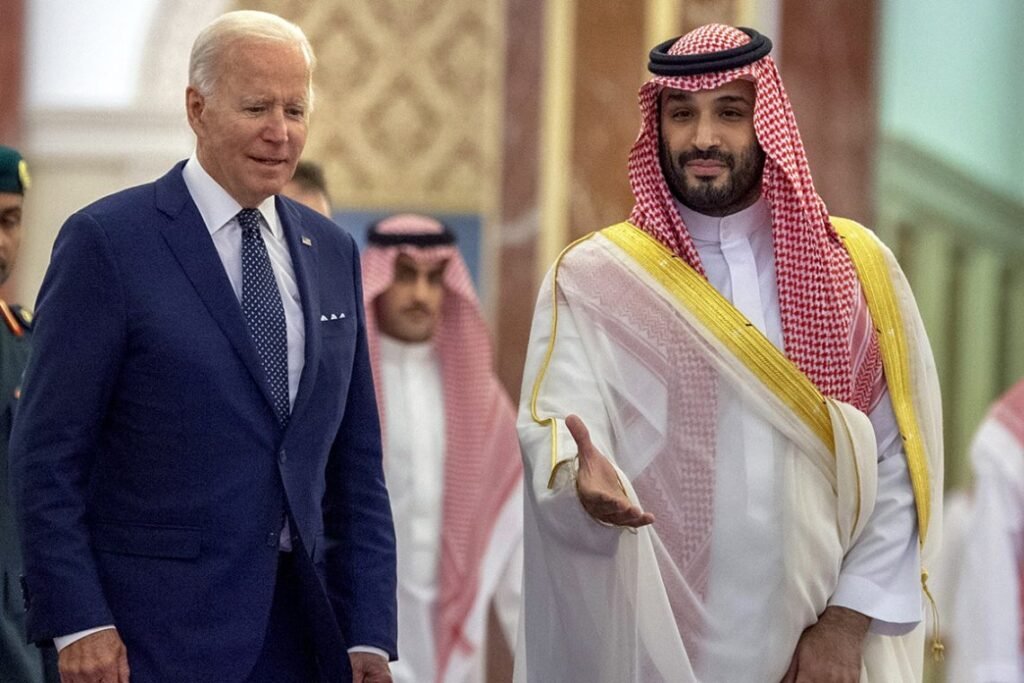
Juan Cole: In Saudi Arabia, Biden Plays Defence Against Russia, China and Iran

Juan Cole

July 21, 2022

Although President Joe Biden’s trip to Saudi Arabia was ostensibly about petroleum and attempting to lower gasoline prices in the US, it doesn’t seem to me that that rationale entirely explains Biden’s about-face on Saudi Arabia. For one thing, Biden must have been told that Saudi Arabia does not have much extra capacity to put more petroleum on the market and so cannot itself lower prices. Whether OPEC will be willing to loosen the quotas for member states is unclear, and whether there is much extra capacity in the organization as a whole is a question mark.

So if it isn’t all about oil, what is driving the president’s Middle East trip? On the one hand, I think he is trying to pressure Iran into coming back to the Joint Comprehensive Plan of Action or JCPOA, the 2015 nuclear deal. If Biden could close that deal, Iran would put 2 million barrels a day on the market immediately, which would likely begin bringing down prices at the pump in short order.

On the other hand, I wonder if Biden is playing defense, trying to keep long-time US partners from switching to China and Russia.

Published initially on Juan Cole’s “Informed Comment” on July 16, 2022

Biden’s central foreign policy initiative as of last February is to defeat Russia in Ukraine or at least to make it pay an enormous price for its invasion of Ukraine. Biden has orchestrated a widespread boycott of the Russian economy by America’s European allies, and the provision of military and other aid to Ukraine.

While Biden has had some success in overcoming German skittishness about getting involved in that effort and has gotten all of the EU except for Hungary on board with ending imports of petroleum from Russia, his efforts have fallen on fallow ground in the Middle East.

No diplomatic partner of the US in the latter region has shown any interest in joining Biden’s crusade against the Russian Federation.

Even the one actual U.S. ally in the region, Turkey, despite being part of NATO, is declining to boycott Russia, though it does sell drones to Ukraine. The most Turkey is willing to do is to negotiate with Russia to allow Ukrainian grain exports, from which Turkey would benefit.

Neither Saudi Arabia nor Israel has pledged to defend the US, and so they are not allies, unlike Turkey, which fought alongside US troops as part of NATO in Korea and again in Afghanistan

Israel has been careful not to offend Russia, only yielding to US pressure on a few minor votes at the U.N. Egypt is cosying up to Russia and China, and desperately needs Russian wheat if it is to avoid another revolution.

Saudi Arabia is actually importing discounted Russian oil at a third off for its own citizens’ use and then exporting more of its own petroleum at world market prices, making a pretty penny on the transaction. The Russian oil is so deeply discounted because of US sanctions on both petroleum and on Russian bank transactions, making it difficult to move.

Not only are US partners not stepping up to boycott Russia, but some are also actively swinging to Russia and China for security and trade relations because they have developed doubts about the US commitment to them. President Barack Obama’s 2015 Iran deal shook the Arab Gulf states to their core. They liked Trump better but were aware that he could not exactly be depended on in a crunch, seeing how he threw Qatar under the bus in 2017 and was willing to break up NATO.

Russia is part of OPEC+, the extended Organization of Petroleum Exporting Countries, and coordinates on pricing efforts. What if Russia could prevail upon OPEC to tighten oil exports, bringing higher prices and more revenues both to Moscow and to the central OPEC states?

By meeting with the Saudi royal family and, on Saturday, with the Gulf Cooperation Council, Biden is attempting to forestall a stampede of these countries to China, with which most of them already do a great deal of business, and which never bothers them about not having free and fair elections. How security-linked the trip was is obvious from the agreements the White House signed in Saudi Arabia.

Article continues after bonus IC video
CBC News: “Biden fist bumps Saudi crown prince ahead of controversial meeting”

Reuters quotes Jake Sullivan, the National Security Adviser, as saying of Biden, “He’s intent on ensuring that there is not a vacuum in the Middle East for China and Russia to fill.”

Of course, Biden is also striving for further Israeli integration into the Middle East. Saudi Arabia announced Thursday evening that it was granting all countries overflight rights, which benefits Israel’s El Al, which can now save fuel by not having to skirt the kingdom.

He also wants to cement the ceasefire in Yemen, and finally end the Saudi/ UAE war on Yemen, about which Congress has been upset.

Finally, Biden is trying to establish security ties between Israel and the Gulf oil monarchies so as to make a united front against Iran. Some Washington hawks dream of a Middle Eastern NATO against Iran.

This hope is forlorn. The United Arab Emirates just announced an upgrade in diplomatic relations with Iran and said it is not interested in making a common front against Iran. Dubai is said to be a major money launderer of Iranian funds. Qatar has and will keep correct relations with Iran. The Arab states can’t coordinate too closely with Israel without giving away their own military secrets, and they are too suspicious to do that, even with each other. Being too close to Israel is also a security risk for the Arab states, whose peoples are deeply interested in the fate of the Palestinians, unlike Biden and many of the royal families.

If Biden wants to get a deal with Iran, he should take off some of Trump’s maximum sanctions, which have nothing to do with the country’s civilian nuclear enrichment program, especially the sanctions on the central bank, which hurt civilians. Tehran is not afraid of the Gulf postage stamp countries, even if they do have better relations than before with Israel.

As for defending US interests in the Middle East against Russia and China, it is too soon to say whether Biden’s personal diplomacy has done much to stop these countries from diversifying their security bets.

Please support TFF’s work for peace through research and public education. We are all-volunteer, people-financed and do not accept money from governments or corporations. In other words, one of the very last free research think tanks in this world – and for a noble purpose: Peace by peaceful – intelligent – means. It is fast, easy and secure. Click here. Thanks!
Juan Cole is the founder and chief editor of Informed Comment. He is Richard P. Mitchell Professor of History at the University of Michigan. He is the author of, among many other books, Muhammad: Prophet of Peace amid the Clash of Empires and The Rubaiyat of Omar Khayyam. Follow him on Twitter at @jricole or the Informed Comment Facebook Page.

No data was found

Share

Leave a Reply

Your email address will not be published. Required fields are marked *

Related Posts

A slightly modified version of a text published on Sept. 1, 2025 in TMS. On August 25 Thomas Friedman, always a weathervane for political and economic establishment thinking in the West, wrote a notable column in the NY Times that was pragmatic in tone, misleading in substance, and regressive in intention. Yet it reflects a growing ambivalence toward Israel’s prolonged genocide even among longtime supporters of Israel that now highlights starvation, famine, and a gross distortion of the delivery of humanitarian aid under emergency conditions. But expressed dangerously without hiding the hope that Israel could even now restore its legitimacy without being held accountable for crimes in Gaza and despite all, still expecting to be rewarded by excluding Hamas from any further governance role in Gaza and continuing to move toward the annexation of the West Bank by formal action or through further settlement expansion. It is notable that the headline of...
Professor emeritus, TFF Associate Oxford (Special to Informed Comment; Feature) The dam has burst. Netanyahu and his far-right regime have gone too far. Public pressure on politicians in Europe and many other countries has become irresistible, forcing them to change course. Most countries, 147 of the UN’s 193 members, have formally recognized a Palestinian state, and last week, France pledged to do so at the UN meeting in September. Fourteen nations, including Canada, New Zealand and Australia, join France in a push to recognize a Palestinian state. The British Prime Minister Keir Starmer, one of Israel’s staunchest allies who even refused to condemn the Israeli blockade of food, water, medicine and fuel to the Palestinians after the terrible events of 7th October, has buckled under the pressure of public opinion. More than 255 MPs of all parties signed a letter addressed to the prime minister in which they urged him to...
The Gaza People’s Tribunal, at the end of its first public assembly in Sarajevo, issued a Declaration that expresses our commitment to peace and justice for the Palestinian people in their struggle to realize their basic rights, above all their inalienable right to self-determination. We are inviting like-minded friends to read and endorse the Sarajevo Declaration and to share the link with others who might join our solidarity initiative at this critical time. Here is the link to Change.org where you can find the full text of the Declaration and endorser information.

Recent Articles

We know that medical personnel have failed to report to higher authorities wounds that were clearly caused by torture and that they have neglected to take steps to interrupt this torture. In addition, they have turned over prisoners’ medical records to interrogators who could use them to exploit the prisoners’ weaknesses or vulnerabilities. We have not yet learned the extent of medical involvement in delaying and possibly falsifying the death certificates of prisoners who have been killed by torturers. A May 22 article on Abu Ghraib in the New York Times states that “much of the evidence of abuse at the prison came from medical documents” and that records and statements “showed doctors and medics reporting to the area of the prison where the abuse occurred several times to stitch wounds, tend to collapsed prisoners or see patients with bruised or reddened genitals.” http://www.truthout.org/docs_04/080604J.shtml#16 According to the article, two doctors who...
Jan Øberg behandler i artiklen en lang række faktorer, som ligger til grund for den måde vores samfund er organiseret på – og derfor også for konflikter. Artiklen introducerer således sammenhængen mellem familien, foreninger, regeringer, NGO’ er, nation, stat, nationalstat og alliancer for på denne måde bedre at kunne forstå konflikter og i sidste ende blive klogere mht. at løse disse. Øberg, der er fortaler for global bevidsthed, hvilket skal ses i lyset af den øgede globalisering, skelner mellem kulturkamp og kulturdialog. Endelig behandles begrebet magt og magtesløshed: giver magt ret til at udøve magt – fordi man mener at have ret? Litteraturliste og arbejdsspørgsmål efter artiklen. Ordene vi bruger om verden I satellitperspektiv kan man godt tale om den menneskelige familie eller menneskeheden. Udtrykket understreger, at der eksisterer – eller burde eksistere – et fællesskab fordi vi alle er mennesker og sammen bebor denne klode og ingen anden. Og...
Kapitel 2: Forskellige sider af Europa og USA…fortsat 2.5 Militære relationer I forbifarten har vi allerede sagt nogle ting om USA’s militære situation. Kig lige en gang til på afsnit 2.3. Nu skal vi uddybe det militære forhold mellem USA og EU. Der er en række ligheder mellem visse europæiske landes og USA’s militær. Næsten alle er med på en eller anden måde i NATO, direkte som medlem – selv Island, der ikke har et forsvar – eller indirekte i Partnerskab for Fred. USA og Canada er med i OSCE (på dansk OSSE), Organisationen for Sikkerhed og Samarbejde i Europa, der tæller over 50 lande. USA samt England og Frankrig er kernevåbenstater og de har styrker til intervention langt borte fra hjemlandet, om end USA’s er tifold større. Alle har også en omfattende våbeneksport og bruger den som et middel til at tjene penge og få loyale venner på, det...

TFF on Substack

Discover more from TFF Transnational Foundation & Jan Oberg.

Most Popular

We know that medical personnel have failed to report to higher authorities wounds that were clearly caused by torture and that they have neglected to take steps to interrupt this torture. In addition, they have turned over prisoners’ medical records to interrogators who could use them to exploit the prisoners’ weaknesses or vulnerabilities. We have not yet learned the extent of medical involvement in delaying and possibly falsifying the death certificates of prisoners who have been killed by torturers. A May 22 article on Abu Ghraib in the New York Times states that “much of the evidence of abuse at the prison came from medical documents” and that records and statements “showed doctors and medics reporting to the area of the prison where the abuse occurred several times to stitch wounds, tend to collapsed prisoners or see patients with bruised or reddened genitals.” http://www.truthout.org/docs_04/080604J.shtml#16 According to the article, two doctors who...
Jan Øberg behandler i artiklen en lang række faktorer, som ligger til grund for den måde vores samfund er organiseret på – og derfor også for konflikter. Artiklen introducerer således sammenhængen mellem familien, foreninger, regeringer, NGO’ er, nation, stat, nationalstat og alliancer for på denne måde bedre at kunne forstå konflikter og i sidste ende blive klogere mht. at løse disse. Øberg, der er fortaler for global bevidsthed, hvilket skal ses i lyset af den øgede globalisering, skelner mellem kulturkamp og kulturdialog. Endelig behandles begrebet magt og magtesløshed: giver magt ret til at udøve magt – fordi man mener at have ret? Litteraturliste og arbejdsspørgsmål efter artiklen. Ordene vi bruger om verden I satellitperspektiv kan man godt tale om den menneskelige familie eller menneskeheden. Udtrykket understreger, at der eksisterer – eller burde eksistere – et fællesskab fordi vi alle er mennesker og sammen bebor denne klode og ingen anden. Og...
Kapitel 2: Forskellige sider af Europa og USA…fortsat 2.5 Militære relationer I forbifarten har vi allerede sagt nogle ting om USA’s militære situation. Kig lige en gang til på afsnit 2.3. Nu skal vi uddybe det militære forhold mellem USA og EU. Der er en række ligheder mellem visse europæiske landes og USA’s militær. Næsten alle er med på en eller anden måde i NATO, direkte som medlem – selv Island, der ikke har et forsvar – eller indirekte i Partnerskab for Fred. USA og Canada er med i OSCE (på dansk OSSE), Organisationen for Sikkerhed og Samarbejde i Europa, der tæller over 50 lande. USA samt England og Frankrig er kernevåbenstater og de har styrker til intervention langt borte fra hjemlandet, om end USA’s er tifold større. Alle har også en omfattende våbeneksport og bruger den som et middel til at tjene penge og få loyale venner på, det...
Read More
Imagen-thumbnail-The-Transnational-1
We know that medical personnel have failed to report to higher authorities wounds that were clearly caused by torture and that they have neglected to take steps to interrupt this torture. In addition, they have turned over prisoners’ medical records to interrogators who could use them to exploit the prisoners’ weaknesses or vulnerabilities. We have not yet learned the extent of medical involvement in delaying and possibly falsifying the death certificates of prisoners who have been killed by torturers. A May 22 article on Abu Ghraib in the New York Times states that “much of the evidence of abuse at the prison came from medical documents” and that records and statements “showed doctors and medics reporting to the area of the prison where the abuse occurred several times to stitch wounds, tend to collapsed prisoners or see patients with bruised or reddened genitals.” http://www.truthout.org/docs_04/080604J.shtml#16 According to the article, two doctors who...
Imagen-thumbnail-The-Transnational-1
Jan Øberg behandler i artiklen en lang række faktorer, som ligger til grund for den måde vores samfund er organiseret på – og derfor også for konflikter. Artiklen introducerer således sammenhængen mellem familien, foreninger, regeringer, NGO’ er, nation, stat, nationalstat og alliancer for på denne måde bedre at kunne forstå konflikter og i sidste ende blive klogere mht. at løse disse. Øberg, der er fortaler for global bevidsthed, hvilket skal ses i lyset af den øgede globalisering, skelner mellem kulturkamp og kulturdialog. Endelig behandles begrebet magt og magtesløshed: giver magt ret til at udøve magt – fordi man mener at have ret? Litteraturliste og arbejdsspørgsmål efter artiklen. Ordene vi bruger om verden I satellitperspektiv kan man godt tale om den menneskelige familie eller menneskeheden. Udtrykket understreger, at der eksisterer – eller burde eksistere – et fællesskab fordi vi alle er mennesker og sammen bebor denne klode og ingen anden. Og...
Imagen-thumbnail-The-Transnational-1
Kapitel 2: Forskellige sider af Europa og USA…fortsat 2.5 Militære relationer I forbifarten har vi allerede sagt nogle ting om USA’s militære situation. Kig lige en gang til på afsnit 2.3. Nu skal vi uddybe det militære forhold mellem USA og EU. Der er en række ligheder mellem visse europæiske landes og USA’s militær. Næsten alle er med på en eller anden måde i NATO, direkte som medlem – selv Island, der ikke har et forsvar – eller indirekte i Partnerskab for Fred. USA og Canada er med i OSCE (på dansk OSSE), Organisationen for Sikkerhed og Samarbejde i Europa, der tæller over 50 lande. USA samt England og Frankrig er kernevåbenstater og de har styrker til intervention langt borte fra hjemlandet, om end USA’s er tifold større. Alle har også en omfattende våbeneksport og bruger den som et middel til at tjene penge og få loyale venner på, det...
Imagen-thumbnail-The-Transnational-1
Background Christian Harleman and Jan Oberg conducted a fact-finding mission to Burundi between November 26 and December 6, 2003. (See websites about the country here). The first TFF mission took place in March 1999. Unfortunately, since then it has not been practically possible to implement the co-operation with Burundi’s Ministry of Education and Burundian NGOs that was planned at the time. The 2003 mission had three purposes. First, to do fact-finding in general about the situation and, in particular, the progress under the Arusha Peace Process. Second, to explore the possibilities for co-operation between the government and relevant NGOs on the one hand and TFF on the other, in order to develop and deepen the existing competence in fields such as conflict-understanding, reconciliation and peace-building. Finally, third, to find out whether it would be possible, in co-operation with the Swedish Rescue Services Agency (Statens Räddningsverk), to establish a health care unit that...
Imagen-thumbnail-The-Transnational-1
Former UN Under-Secretary-General with special responsibility for peacekeeping operations TFF associate August 20, 2003 YRINGHAM, Mass.- Ralph Bunche was born in Detroit 100 years ago today (August 7, 2003). His passionate determination to get results did not extend to seeking credit for them, so his work is better remembered than he is. Of all his many accomplishments – civil rights pioneer, Nobel Peace Prize laureate, chief drafter of two chapters of the United Nations charter, negotiator of the armistices that ended the first Arab-Israeli war – Bunche said he was proudest of developing what came to be known as peacekeeping. Setting up the United Nations Truce Supervision Organization in Palestine in 1948, Bunche formulated the principles that have governed peacekeeping operations ever since. In the 1956 Suez crisis, working with Secretary General Dag Hammarskjold and Lester Pearson of Canada, he organized the first peacekeeping force, the United Nations Emergency Force...
– nästan 11 månader Till Sofia nästan 11 månader # 1  Till Sofias huvudsida Till alla Privata Foto-Serier