
Jeremy Corbyn and other voices of reason over the UK nerve gas incident

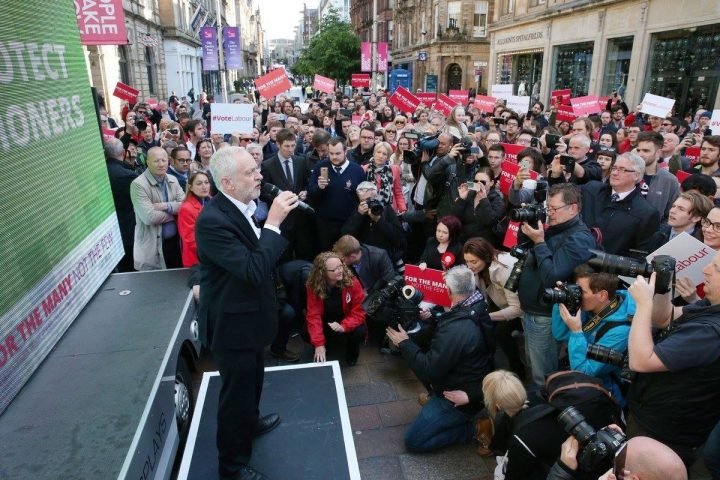
Jeremy Corbyn June 2017 (Image by Jeremy Corbyn Facebook)


By Silvia Swinden

A Russian father, former double spy convicted in Russia and exchanged by Britain for other spies, and his daughter were found unconscious on a bench in Salisbury. Preliminary assessment suggests a nerve gas agent. The government has jumped to accuse Russia and in particular Putin of ordering this assassination attempt. The word “war” has been repeated in many speeches from PM May and other members of her government.

Originally published by Pressenza here

Jeremy Corbyn has appealed for clam and to involve international bodies that deal with chemical warfare in order to test the substance properly as well as establishing controls on the money laundering activities of Russian oligarchs and mafias operating in the UK rather than a simple diplomatic tit-for-tat.

Unsurprisingly this has caused a deluge of criticism from the media (the BBC photoshoped his picture with a Russian style hat and the Kremlin as backdrop) and some within his own party, who have been waiting for an opportunity to get the knives out after being silenced by Corbyn’s enormous popularity.

Writing for the Guardian  Corbyn said:

“There can be no one in Britain who is not outraged by the appalling attack on Sergei Skripal and his daughter Yulia in Salisbury last week. The use of military nerve agents on the streets of Britain is barbaric and beyond reckless. This horrific event demands first of all the most thorough and painstaking criminal investigation, conducted by our police and security services. They have a right to expect full support in their work, just as the public should also be able to expect calm heads and a measured response from their political leaders. To rush way ahead of the evidence being gathered by the police, in a fevered parliamentary atmosphere, serves neither justice nor our national security.” …… “That means working through the Organisation for the Prohibition of Chemical Weapons to reduce the threat from these horrific weapons, including if necessary an investigation by chemical weapons inspectors into the distribution of Soviet-era weapons.”…

“There can and should be the basis for a common political response to this crime. But in my years in parliament I have seen clear thinking in an international crisis overwhelmed by emotion and hasty judgments too many times. Flawed intelligence and dodgy dossiers led to the calamity of the Iraq invasion. There was overwhelming bipartisan support for attacking Libya, but it proved to be wrong. A universal repugnance at the 9/11 attacks led to a war on Afghanistan that continues to this day, while terrorism has spread across the globe.”


It is no secret that with the collapse of the Soviet Union control over chemical weapons was lost in the ensuing chaos, as well as fissile material. Nobody can guarantee that such dangerous materials have not fallen (for profit) into the hands of rogue elements:

“In September of 1993 as The Irish Times Moscow correspondent I obtained a list of chemical and biological weapons, including Novichok, that were being produced by Russia as the successor state to the Soviet Union. I brought these documents to the recognised expert at the time Dr Thomas Stock of the Stockholm International Peace Research Institute (SIPRI). Dr Stock’s reaction was that Russia immediately needed western financial help to stop Novichok and other chemical and biological agents being exported illegally by criminal elements. Western help arrived eventually but was it too late. The countries of the former Soviet Union, with the exception of the Baltic nations, were in chaos at the time.” The Irish Times


For his part, former Uzbekistan Ambassador Craig Murray writes in his website:

“I have now received confirmation from a well placed FCO source that Porton Down scientists are not able to identify the nerve agent as being of Russian manufacture, and have been resentful of the pressure being placed on them to do so. Porton Down would only sign up to the formulation “of a type developed by Russia” after a rather difficult meeting where this was agreed as a compromise formulation.

The Russians were allegedly researching, in the “Novichok” programme a generation of nerve agents which could be produced from commercially available precursors such as insecticides and fertilisers. This substance is a “novichok” in that sense. It is of that type. Just as I am typing on a laptop of a type developed by the United States, though this one was made in China.

To anybody with a Whitehall background this has been obvious for several days. The government has never said the nerve agent was made in Russia, or that it can only be made in Russia.

The exact formulation “of a type developed by Russia” was used by Theresa May in parliament, used by the UK at the UN Security Council, used by Boris Johnson on the BBC yesterday and, most tellingly of all, “of a type developed by Russia” is the precise phrase used in the joint communique issued by the UK, USA, France and Germany yesterday:

“This use of a military-grade nerve agent, of a type developed by Russia, constitutes the first offensive use of a nerve agent in Europe since the Second World War.”

When the same extremely careful phrasing is never deviated from, you know it is the result of a very delicate Whitehall compromise. My FCO source, like me, remembers the extreme pressure put on FCO staff and other civil servants to sign off the dirty dossier on Iraqi WMD, some of which pressure I recount in my memoir Murder in Samarkand. She volunteered the comparison to what is happening now, particularly at Porton Down, with no prompting from me.”


Why ”War”

The use of the word “war” in this situation is disingenuous. A war with Russia is unimaginable. There would be nothing left, on either side. But the word serves a number of purposes:

  • It distracts from Brexit, the destruction of the NHS, education and imposes on the Conservative party a unity that is far from real.
  • In war dissent is treason.
  • It creates an opportunity to try to destroy the image of Jeremy Corbyn who is ahead in the polls. They can count on Corbyn trying to calm things down and avoid war. He has always done it. In Iraq, Libya and Afghanistan. He was always right, but every time the media presented his views as going against British interests, even if he was proven right later, which went unacknowledged.
  • War, being the UK a NATO member demands uncritical support from other members.
  • Sabre rattling is a proven way to present individuals in government a tough and leader-like, often a good election strategy. (Local government elections in May).
  • Hostilities with Russia can guarantee a justification for the renewal of Trident nuclear system, which costing in excess of £100bn, is absurd in the face of other much more urgent needs such as Health, Education, Housing and Welfare. Not to mention that nuclear weapons are useless, immoral and illegal and they should be done away with completely. Unsurprisingly the UK has not agreed to the UN treaty to abolish them.

No doubt the rhetoric will grow and accusations, founded or not, will continue to lead into the path of a new Cold War, because there is nothing like having an enemy without to hold on to power within.

Originally published by Pressenza here

Share

Leave a Reply

Your email address will not be published. Required fields are marked *

Related Posts

Launched on November 17, 2024Updated with new materials regularly TFF Board members Thore Vest. Everywhere, the delegation was met with a sincere wish to develop knowledge, dialogue, cooperative projects, and initiatives based on citizens’ diplomacy – in general, but with the West in particular. For more, see “Report from the Nordic delegation to China’s Xinjiang Province, September 7-15, 2024.” While the delegation was in Xinjiang, various ideas were already being discussed from the local to the top level, i.e., with the governor and party leaders of Xinjiang. The two TFF Associates suggested that TFF set up a special section – in addition to its “China and Silk” – where various quality materials about Xinjiang would regularly be published to promote public education about Xinjiang, particularly its contemporary development – worldwide but in the West in particular. This is now a reality – as can be seen below – but it...
Foreword The Board of The Transnational Foundation in Sweden has decided to publish an easy-to-read, scholarly anthology that addresses one of the most important – and potentially dangerous – issues of our time: Why are the political, economic, and medialised Western images of China so consistently negative – and what can you do to understand China better? These images may be expressions of a political will to present only various shades of grey and black with the aim of building a consciousness about China as an enemy and not a partner. They may also be seen as a sort of world-dominating ethos of ignorance based upon the assumption that “we’ve-got-nothing-to-learn-from-others,’ we are the teacher. Another possibility is that the West, deep down, feels that it is getting relatively weaker from a macro-historical perspective and comforts itself with denial and accusations against “the other” of being the reason for its manifest...
A report from the Valdai Discussion Club event in November 2024 Professor and director of the Global Changes Centre in Skopje, Macedonia and TFF Board member The intelligence services have probably noted this meticulously, but let me publicly share my experience of attending, for the first time, the annual conference of the renowned Valdai Discussion Club in Russia. For 20 years now, it has convened near Sochi, nestled among the stunning mountain peaks of the Russian Caucasus. Personally, this year stands out for many reasons. My first visits to China, and now to Russia, are undoubtedly among the most significant. Due to the format of the conference, I can’t describe Russia to you in the same way I recounted my experience in China. Over four days, around 130 participants (professors, analysts, strategists, diplomats, former generals, journalists—mostly from foreign countries, with fewer from Russia) representing over 50 nations engaged in discussions...

Recent Articles

PressInfo # 141, December 21, 2001It’s time to prepare reconciliation between Albanians and Serbs PressInfo # 140, December 14, 2001Ibrahim Rugova’s decade-long leadership in Kosovo/a PressInfo # 139, 11. december, 2001En god nyhet: Jugoslaviens Sannings- och försoningskommission PressInfo # 139, 11. december, 2001Gode nyheder: Jugoslaviens Sandheds- og Forsoningskommission PressInfo # 139, December 11, 2001Good news: Yugoslavia’s Truth and Reconciliation Commission PressInfo # 138, November 8, 2001TFF co-founder PhD with thesis about young people with roots in other cultures PressInfo # 138, November 8, 2001TFF:s medstiftare doktor på avhandling om unga med ursprung i andra kulturer PressInfo # 137, October 17, 2001A new Marshall Plan: Advancing human security and controlling terrorism PressInfo # 136, October 15, 2001The UN and Annan really deserve it PressInfo # 135, October 10, 2001Preventing a terrorist mushroom cloud PressInfo # 134, 17 oktober, 2001Sverige og 11. september PressInfo # 134, October 9, 2001Sweden and September 11...
Peace is promoted by constructive proposals and dialogue Four preceding PressInfos have expressed concern over — and criticised — the ongoing, militarisation of the EU. Some will say: but there are no alternatives. We believe that there are always alternatives, that democracies are characterised by alternatives and choice, and that openly discussed alternatives will improve the quality and legitimacy of society’s decision–making. In addition, it is an intellectual and moral challenge to not only criticise but also be constructive. If we only tell people that we think they are wrong, they are not likely to listen. However, if we say: what are your views on this set of ideas and steps? — we may sometimes engage them in dialogue and sow a seed. Most people in power circles live their daily lives in in a time frame and a social space where certain ideas, viewpoints and concepts are just not...
Photos © TFF 2000 Read PressInfo 90 “Lift the Sanctions and Bring More Aid to Yugoslavia” See Pictures from Belgrade © TFF 2000 Please reprint, copy, archive, quote or re-post this item, but please retain the source.

TFF on Substack

Discover more from TFF Transnational Foundation & Jan Oberg.

Most Popular

PressInfo # 141, December 21, 2001It’s time to prepare reconciliation between Albanians and Serbs PressInfo # 140, December 14, 2001Ibrahim Rugova’s decade-long leadership in Kosovo/a PressInfo # 139, 11. december, 2001En god nyhet: Jugoslaviens Sannings- och försoningskommission PressInfo # 139, 11. december, 2001Gode nyheder: Jugoslaviens Sandheds- og Forsoningskommission PressInfo # 139, December 11, 2001Good news: Yugoslavia’s Truth and Reconciliation Commission PressInfo # 138, November 8, 2001TFF co-founder PhD with thesis about young people with roots in other cultures PressInfo # 138, November 8, 2001TFF:s medstiftare doktor på avhandling om unga med ursprung i andra kulturer PressInfo # 137, October 17, 2001A new Marshall Plan: Advancing human security and controlling terrorism PressInfo # 136, October 15, 2001The UN and Annan really deserve it PressInfo # 135, October 10, 2001Preventing a terrorist mushroom cloud PressInfo # 134, 17 oktober, 2001Sverige og 11. september PressInfo # 134, October 9, 2001Sweden and September 11...
Peace is promoted by constructive proposals and dialogue Four preceding PressInfos have expressed concern over — and criticised — the ongoing, militarisation of the EU. Some will say: but there are no alternatives. We believe that there are always alternatives, that democracies are characterised by alternatives and choice, and that openly discussed alternatives will improve the quality and legitimacy of society’s decision–making. In addition, it is an intellectual and moral challenge to not only criticise but also be constructive. If we only tell people that we think they are wrong, they are not likely to listen. However, if we say: what are your views on this set of ideas and steps? — we may sometimes engage them in dialogue and sow a seed. Most people in power circles live their daily lives in in a time frame and a social space where certain ideas, viewpoints and concepts are just not...
Photos © TFF 2000 Read PressInfo 90 “Lift the Sanctions and Bring More Aid to Yugoslavia” See Pictures from Belgrade © TFF 2000 Please reprint, copy, archive, quote or re-post this item, but please retain the source.
Read More
Imagen-thumbnail-The-Transnational-1
PressInfo # 141, December 21, 2001It’s time to prepare reconciliation between Albanians and Serbs PressInfo # 140, December 14, 2001Ibrahim Rugova’s decade-long leadership in Kosovo/a PressInfo # 139, 11. december, 2001En god nyhet: Jugoslaviens Sannings- och försoningskommission PressInfo # 139, 11. december, 2001Gode nyheder: Jugoslaviens Sandheds- og Forsoningskommission PressInfo # 139, December 11, 2001Good news: Yugoslavia’s Truth and Reconciliation Commission PressInfo # 138, November 8, 2001TFF co-founder PhD with thesis about young people with roots in other cultures PressInfo # 138, November 8, 2001TFF:s medstiftare doktor på avhandling om unga med ursprung i andra kulturer PressInfo # 137, October 17, 2001A new Marshall Plan: Advancing human security and controlling terrorism PressInfo # 136, October 15, 2001The UN and Annan really deserve it PressInfo # 135, October 10, 2001Preventing a terrorist mushroom cloud PressInfo # 134, 17 oktober, 2001Sverige og 11. september PressInfo # 134, October 9, 2001Sweden and September 11...
Imagen-thumbnail-The-Transnational-1
Peace is promoted by constructive proposals and dialogue Four preceding PressInfos have expressed concern over — and criticised — the ongoing, militarisation of the EU. Some will say: but there are no alternatives. We believe that there are always alternatives, that democracies are characterised by alternatives and choice, and that openly discussed alternatives will improve the quality and legitimacy of society’s decision–making. In addition, it is an intellectual and moral challenge to not only criticise but also be constructive. If we only tell people that we think they are wrong, they are not likely to listen. However, if we say: what are your views on this set of ideas and steps? — we may sometimes engage them in dialogue and sow a seed. Most people in power circles live their daily lives in in a time frame and a social space where certain ideas, viewpoints and concepts are just not...
Imagen-thumbnail-The-Transnational-1
Photos © TFF 2000 Read PressInfo 90 “Lift the Sanctions and Bring More Aid to Yugoslavia” See Pictures from Belgrade © TFF 2000 Please reprint, copy, archive, quote or re-post this item, but please retain the source.
Imagen-thumbnail-The-Transnational-1
Av FRANK SØHOLM GREVIL 16 augusti 2004  Vi er nu nået til tredje akt i det absurde teaterstykke, der i analogi med de store skueprocesser i Moskva 1936-38 er blevet døbt ‘Grevil-sagen’. Første akt bestod i min anonyme fremlæggelse af egenhændigt nedklassificerede rapporter i Berlingske Tidende i februar og marts. Andet akt udgjordes af min fremtræden med navn og billede i Information i april samt den efterfølgende mediestorm, som uden min direkte medvirken kostede en forsvarsminister taburetten samt en sigtelse for brud på tavshedspligten. Tredje akt bliver en retssag, hvor jeg står tiltalt for at have overtrådt straffelovens bestemmelser om uberettiget videregivelse eller udnyttelse af fortrolige oplysninger. Statsanklageren har ovenikøbet valgt at påberåbe sig særligt skærpende omstændigheder. Da jeg aldrig har modtaget betaling for at stille rapporterne til rådighed eller lade mig interviewe, må det skærpende bestå i, at “videregivelsen eller udnyttelsen er sket under sådanne omstændigheder, at det påfører...
Imagen-thumbnail-The-Transnational-1
Af Svenska Irakkommittén mot de Ekonomiska Sanktionerna (SIES) 13 september 2002 FN:s ekonomiska sanktioner mot Irak har nu pågått i tolv år och drabbat det irakiska folket med svåra lidanden. Enligt FN:s egna siffror har mer än 1,5 miljoner människor, varav ca 600 000 barn, dött som en direkt följd av sanktionerna. Dessutom har ett lågintensivt bombkrig mot landet pågått under dessa år. Av all denna förödelse- orsakad huvudsakligen av amerikansk och brittisk politik- har Saddam Husseins brutala och diktatoriska regim snarast stärkts än försvagats. Nu förbereder USA under president Bushs ledning ett storskaligt bombkrig mot Irak som kommer att innebära ett ännu större lidande för civilbefolkningen. Ett sådant krig kommer dessutom att ytterligare undergräva freden och säkerheten i världen. Att upprätta en demokratisk regim i Irak är det irakiska folkets angelägenhet och får enligt folkrätten inte ske med krigshandlingar utifrån. Folkrätten och FN:s stadgar måste respekteras. Vi vädjar till...