
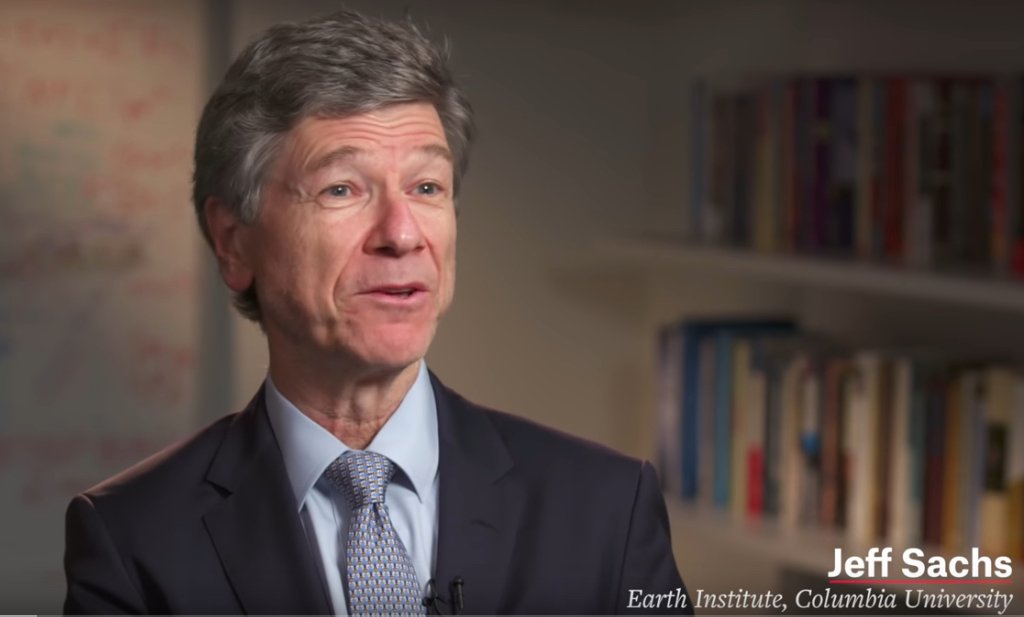
Jeffrey Sachs
By Amy Goodman (*) – Democracy Now!
September 19, 2022
Jeffrey Sachs: “Dangerous” U.S. Policy & “West’s False Narrative” Stoking Tensions with Russia, China
GUESTS: Jeffrey Sachs, director of the Center for Sustainable Development at Columbia University, president of the U.N. Sustainable Development Solutions Network, sustainable development solutions advocate under Secretary-General António Guterres, and former adviser to three U.N. secretaries-general.
We discuss Western hegemony and U.S. policy in Russia, Ukraine and China with Columbia University economist Jeffrey Sachs, whose new article is headlined “The West’s False Narrative About Russia and China.” Sachs says the bipartisan U.S. approach to foreign policy is “unaccountably dangerous and wrongheaded,” and warns the U.S. is creating “a recipe for yet another war” in East Asia.
Originally published at Other News on September 5, 2022
Transcript
This is a rush transcript. Copy may not be in its final form.
AMY GOODMAN: Politico is reporting the Biden administration is preparing to ask Congress to approve a new $1.1 billion arms sale to Taiwan. The package reportedly includes 60 anti-ship missiles, 100 air-to-air missiles. This comes after two U.S. warships sailed through the Taiwan Strait Sunday for the first time since House Speaker Nancy Pelosi visited Taiwan earlier this month. China condemned the visit and launched major military drills near Taiwan.
Meanwhile, President Biden announced $3 billion in more military aid for Ukraine last week, including money for missiles, artillery rounds and drones to help Ukrainian forces fight Russia.
We begin today’s show looking at U.S. policy on Russia and China. We’re joined by the economist Jeffrey Sachs, director of the Center for Sustainable Development at Columbia University. He’s president of the U.N. Sustainable Development Solutions Network. He served as adviser to three U.N. secretaries-general. His latest article is headlined “The West’s False Narrative About Russia and China.”
He begins the article by writing, quote, “The world is on the edge of nuclear catastrophe in no small part because of the failure of Western political leaders to be forthright about the causes of the escalating global conflicts. The relentless Western narrative that the West is noble while Russia and China are evil is simple-minded and extraordinarily dangerous,” Jeffrey Sachs writes.
Jeffrey Sachs, welcome to Democracy Now! Why don’t you take it from there?
JEFFREY SACHS: Thank you. Good to be with you.
AMY GOODMAN: What is the story that people in the West and around the world should understand about what’s happening right now with these conflicts, with Russia, with Russia and Ukraine, and with China?
JEFFREY SACHS: The main point, Amy, is that we are not using diplomacy; we are using weaponry. This sale now announced to Taiwan that you’ve been discussing this morning is just another case in point. This does not make Taiwan safer. This does not make the world safer. It certainly doesn’t make the United States safer.
This goes back a long way. I think it’s useful to start 30 years ago. The Soviet Union ended, and some American leaders got it into their head that there was now what they called the unipolar world, that the U.S. was the sole superpower, and we could run the show. The results have been disastrous. We have had now three decades of militarization of American foreign policy. A new database that Tufts is maintaining has just shown that there have been more than 100 military interventions by the United States since 1991. It’s really unbelievable.
And I have seen, in my own experience over the last 30 years working extensively in Russia, in Central Europe, in China and in other parts of the world, how the U.S. approach is a military-first, and often a military-only, approach. We arm who we want. We call for NATO enlargement, no matter what other countries say may be harmful to their security interests.
We brush aside anyone else’s security interests. And when they complain, we ship more armaments to our allies in that region. We go to war when we want, where we want, whether it was Afghanistan or Iraq or the covert war against Assad in Syria, which is even today not properly understood by the American people, or the war in Libya.
And we say, “We’re peace-loving. What’s wrong with Russia and China? They are so warlike. They’re out to undermine the world.” And we end up in terrible confrontations.
The war in Ukraine — just to finish the introductory view — could have been avoided and should have been avoided through diplomacy. What President Putin of Russia was saying for years was “Do not expand NATO into the Black Sea, not to Ukraine, much less to Georgia,” which if people look on the map, straight across to the eastern edge of the Black Sea.
Russia said, “This will surround us. This will jeopardize our security. Let us have diplomacy.” The United States rejected all diplomacy. I tried to contact the White House at the end of 2021 — in fact, I did contact the White House and said there will be war unless the U.S. enters diplomatic talks with President Putin over this question of NATO enlargement. I was told the U.S. will never do that. That is off the table. And it was off the table. Now we have a war that’s extraordinarily dangerous.
And we are taking exactly the same tactics in East Asia that led to the war in Ukraine. We’re organizing alliances, building up weaponry, trash-talking China, having Speaker Pelosi fly to Taiwan, when the Chinese government said, “Please, lower the temperature, lower the tensions.” We say, “No, we do what we want,” and now send more arms. This is a recipe for yet another war. And to my mind, it’s terrifying.
We are at the 60th anniversary of the Cuban missile crisis, which I’ve studied all my life and I’ve written about, have written a book about the aftermath. We are driving to the precipice, and we are filled with our enthusiasm as we do so. And it’s just unaccountably dangerous and wrongheaded, the whole approach of U.S. foreign policy. And it’s bipartisan.
JUAN GONZÁLEZ: Jeffrey Sachs, I wanted to ask you — one of the things that you mentioned in a recent article that was published in Consortium News was this insistence of the United States, dragging Europe along, as well, in maintaining hegemony throughout the world at a time when the economic power of the West is declining. You mention, for instance, that the BRICS nations — Brazil, Russia, India, China and South Africa — represent more than 40% of the world population and have a greater GDP than the G7 nations, yet their interests and their concerns are pretty much dismissed or, in the case, obviously, of Russia and China, portrayed to the American people as the aggressors, as the authoritarians, as the ones that are creating turmoil in the world.
JEFFREY SACHS: Your point is —
JUAN GONZÁLEZ: I’m wondering if you could expand on that.
JEFFREY SACHS: Yeah, absolutely, and directing us to that is extremely important. The disproportionate power of the Western world, and especially the Anglo-Saxon world, which started with the British Empire, and now the United States, is about 250 years old, so a short period in world history. It happened, for a lot of very interesting reasons, that the Industrial Revolution came to England first. The steam engine was invented there. That’s probably the single most important invention of modern history. Britain became militarily dominant in the 19th century, like the United States was in the second half of the 20th century. Britain ran the show. Britain had the empire on which the sun never set. And the West, meaning the United States and Western Europe, now meaning the U.S. and the European Union, the U.K., Canada, Japan — in other words, the G7, the European Union together — is a small part of the world population, perhaps now roughly 10%, a little bit more, maybe 12.5% if you add in Japan to Western Europe and the U.S. But the mindset is “We run the world.” And that was the way it was for 200 years in this Industrial Age.
But times have changed. And really, since the 1950s, the rest of the world, when it gained independence from European imperialism, started to educate its populations, started to adopt and adapt and innovate technologies. And lo and behold, a small sliver of the world really didn’t run the world or didn’t have a monopoly on wisdom or knowledge or science or technology. And this is wonderful. The knowledge and possibility of decent lives is spreading throughout the whole world.
But in the United States, there is a resentment to this, a deep resentment. I think there’s also a tremendous historical ignorance, because I think a lot of U.S. leaders have no clue as to modern history. But they resent China’s rise. That is an affront to the United States. How dare China rise! This is our world! This is our century! And so, starting around 2014, I saw, step by step — I watched it with intense detail, because it’s my daily activity — how the United States recast China not as a country that was recovering from a century and a half of great difficulty, but rather as an enemy. And we consciously, as a matter of American foreign policy, started to say, “We need to contain China. China’s rise is no longer in our interest,” as if the United States is to determine whether China is prosperous or not. The Chinese are not naive; in fact, they’re extraordinarily sophisticated. They watched all of this exactly the same way that I did. I know the authors of the U.S. texts. They are my colleagues, at Harvard or other places. I was shocked when this kind of containment idea started to be applied.
But the basic point is, the West has led the world for a brief period, 250 years, but feel, “That’s our right. This is a Western world. We are the G7. We get to determine who writes the rules of the game.” Indeed, Obama, you know, a good guy on the spectrum of what we have in foreign policy, said, “Let’s write the rules of trade for Asia, but not have China write any of those rules. The U.S. will write the rules.” This is an incredibly naive and dangerous and outmoded way to understand the world. We in the United States are 4.2% of the world’s population. We do not run the world. We are not world leader. We are a country of 4.2% of the people in a big, diverse world, and we should learn to get along, play in the sandbox peacefully, not demand that we have all the toys in the sandbox. And we’re not over that thinking yet. And unfortunately, it’s both political parties. It’s what motivates Speaker Pelosi to go to Taiwan in the middle of all of this, as if she really had to go to stir up the tensions. But it’s the mindset that the U.S. is in charge.
JUAN GONZÁLEZ: I wanted to go back a little bit to — back into the 1990s. You recall, I’m sure, the enormous financial collapse that occurred in Mexico in the 1990s, where the Clinton administration authorized $50 billion in a bailout to Mexico, which was really to Wall Street investors. At the time, you were advising the post-Soviet Russian government, which also had a financial — had deep financial problems at the time but was unable to get any significant Western assistance, even from the International Monetary Fund. And you were critical of that at the time. I’m wondering if you could talk about the differences how the U.S. responded to the Mexico crisis versus the Russian financial crisis, and what the roots of that may have been in what the current situation is in Russia today.
JEFFREY SACHS: Absolutely. And I had a controlled experiment, because I was economic adviser both to Poland and to the Soviet Union in the last year of President Gorbachev and to President Yeltsin in the first two years of Russian independence, 1992, ’93. My job was finance, to actually help Russia find a way to address, as you described it, a massive financial crisis. And my basic recommendation in Poland, and then in Soviet Union and in Russia, was: To avoid a societal crisis and a geopolitical crisis, the rich Western world should help to tamp down this extraordinary financial crisis that was taking place with the breakdown of the former Soviet Union.
Well, interestingly, in the case of Poland, I made a series of very specific recommendations, and they were all accepted by the U.S. government — creating a stabilization fund, canceling part of Poland’s debts, allowing many financial maneuvers to get Poland out of the difficulty. And, you know, I patted myself on the back. “Oh, look at this!” I make a recommendation, and one of them, for a billion dollars, stabilization fund, was accepted within eight hours by the White House. So, I thought, “Pretty good.”
Then came the analogous appeal on behalf of, first, Gorbachev, in the final days, and then President Yeltsin. Everything I recommended, which was on the same basis of economic dynamics, was rejected flat out by the White House. I didn’t understand it, I have to tell you, at the time. I said, “But it worked in Poland.” And they’d stare at me blankly. In fact, an acting secretary of state in 1992 said, “Professor Sachs, it doesn’t even matter whether I agree with you or not. It’s not going to happen.”
And it took me, actually, quite a while to understand the underlying geopolitics. Those were exactly the days of Cheney and Wolfowitz and Rumsfeld and what became the Project for the New American Century, meaning for the continuation of American hegemony. I didn’t see it at the moment, because I was thinking as an economist, how to help overcome a financial crisis. But the unipolar politics was taking shape, and it was devastating. Of course, it left Russia in a massive financial crisis that led to a lot of instability that had its own implications for years to come.
But even more than that, what these people were planning, early on, despite explicit promises to Gorbachev and Yeltsin, was the expansion of NATO. And Clinton started the expansion of NATO with the three countries of Central Europe — Poland, Hungary and Czech Republic — and then George W. Bush Jr. added seven countries — Bulgaria, Romania, Slovakia, Slovenia and the three Baltic states — but right up against Russia. And then, in 2008, the coup de grâce, which was the U.S. insistence, over the private opposition of the European leaders — and European leaders talked to me privately about it at the time.
But in 2008, Bush said NATO will expand to Ukraine and to Georgia. And again, if you take out a map and look at the Black Sea, the explicit goal was to surround Russia in the Black Sea. By the way, it’s an old playbook. It’s the same playbook as Palmerston in 1853 to 1856 in the first Crimean War: surround Russia in the Black Sea, cut off its ability to have a military presence and to project any kind of influence into the eastern Mediterranean. Brzezinski himself said in 1997 that Ukraine would be the geographic pivot for Eurasia.
So, what these neocons were doing in the early 1990s was building the U.S. unipolar world. And they were already contemplating lots of wars in order to take out the former Soviet-allied countries — wars to overthrow Saddam, wars to overthrow Assad, wars to overthrow Gaddafi. Those were all rolled out in the next 20 years. They’ve been a complete disaster, debacle for those countries, horrible for the United States, trillions of dollars wasted. But it was a plan.
And that neoconservative plan is in its heyday right now on two fronts: in the Ukraine front and on the Taiwan Strait front. And it’s extraordinarily dangerous, what these people are doing to American foreign policy, which hardly is, you know, a policy of democracy. It’s a policy of a small group that has the idea that a unipolar world and U.S. hegemony is the way that we need to go.
AMY GOODMAN: Jeffrey Sachs, we don’t have much time, but since this was such a big issue — Naomi Klein took you on big time with The Shock Doctrine, talking about you recommending shock therapy. Can you draw a line between what happened as the Russian economy unraveled to the conditions leading up to the Ukraine invasion? I mean, how did the economic catastrophe that followed the collapse of the Soviet Union lead to the rise of the oligarchic class and, indeed, the presidency of Vladimir Putin?
JEFFREY SACHS: Yeah, I’ve tried to explain to Naomi, whom I admire a great deal, for years that what I was recommending was financial help to — whether it was Poland or to the Soviet Union or to Russia. I was absolutely aghast at the cheating and the corruption and the giveaways. And I said so very explicitly at the time and resigned over it, both because I was useless in trying to get Western help and also because I did not like at all what was going on.
And I would say that the failure of an orderly approach, which was achieved in Poland but failed in the former Soviet Union because there was no Western constructive engagement, definitely played a role in the instability in the 1990s, definitely played a role in the rise of the oligarch class. In fact, I was absolutely explaining to the U.S. and to the IMF and the World Bank in 1994, ’95, what was going on. They didn’t care, because they thought, “Well, that’s OK. That’s for Yeltsin, perhaps,” all of that cheating in the shares-for-loans process. Having said all of that, it was a —
AMY GOODMAN: We have less than a minute.
JEFFREY SACHS: OK. Having said all of that, I think what is important to say is that there is no linear determinism, even from events like that, which were destabilizing and very unhappy and unnecessary, to what is happening now, because when President Putin came in, he was not anti-European, he was not anti-American. What he saw, though, was the incredible arrogance of the United States, the expansion of NATO, the wars in Iraq, the covert war in Syria, the war in Libya, against the U.N. resolution. So, we created so much of what we’re facing right now through our own ineptitude and arrogance. There was no linear determination. It was step-by-step U.S. arrogance that has helped to bring us to where we are today.
AMY GOODMAN: Jeffrey Sachs, economist and director of the Center for Sustainable Development at Columbia University, president of the U.N. Sustainable Development Solutions Network, has served as adviser to three U.N. secretaries-general. I want to thank you so much for being with us, joining us from Austria, where he’s attending a conference.
Originally published at Other News on September 5, 2022
About the author
(*) Amy Goodman – Award-winning investigative journalist and syndicated columnist, author and host/executive producer of Democracy Now! www.democracynow.org
Please help TFF remain truly independent by contributing if you benefited from this article
[paypal-donation]
