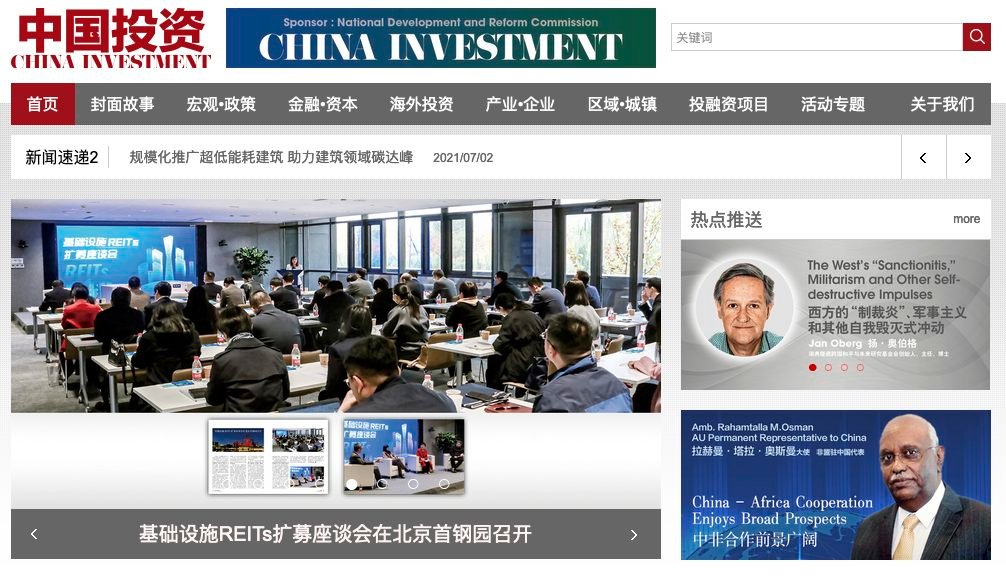
This article was written in October for the distinguished China Investment – a magazine sponsored by China’s National Development and Reform Commission. It was published in November here in both Chinese and English.
Due to the reactions to my articles there, it looks like I shall become a regular contributor to China Investment like I am to the China Daily.
The European Commission has just decided on new sanctions against Russia – in fact, the eighth round of such sanctions. This time the reason is that Russia has held referenda in the Donbas region of Ukraine. I sense we’re witnessing a new disease – Sanctionitis.
It seems related to a larger, fatal disease with few treatment options, namely the SHMSI Syndrome:
Sanctionitis + Hubris + Masochism + Self-Destructive Impulses.
The patient has foggy ideas about reality and his own strength and exaggerates ad absurdum the positive effects of his supposedly noble deeds. The pleasure of punishing others and excluding them – preferably millions of innocent people – approaches the orgiastic.
The patient also suffers from two obsessions: one about his own innocence in everything that goes wrong for the patient, and the other that concepts like negotiation, cooperation, and peace are vicious propaganda out of step with what the patient perceives as “reality.”
It cannot be ruled out that the patient may be a danger to those around him.
If the patient does not get help in time, the risk increases that he will eventually lead an isolated social life, suffer financial ruin and end up as a beggar.
•
Well, on a more serious note: I wonder how many more sanctions packages can be implemented without someone in those circles realising that the sanctions do not work – and certainly not in this way – and that their effects are increasingly self-destructive.
The US has imposed close to 10 000 sanctions around the world, a constant economic warfare. If harsh enough and lasting long enough, sanctions become a weapon of mass destruction. More people died in Iraq because of 13 years of sanctions than because of the military war.
Sanctions can be helpful if they have a precise target and a clear criteria for being lifted again. Even if Russia left Ukraine tomorrow, the sanctions would not be lifted. In Iran, Western sanctions have destroyed the middle class that could – if any – force through reforms. In Iraq, more than 500 000 women and children had died – I was there myself, visited children’s hospitals and talked with doctors – when then US Secretary of State, Madeleine Albright, told the world that – yes, it is a high price but the US thinks it is worth it.
All the red warning lights are flashing of a deep and wide crisis across Europe this winter, and yet the EU elites persist, because self-justifying punishment and Russophobia have replaced every rational thought.
And decisions are taken so quickly, so hastily and reflexively that there is no time for impact assessments. Did anyone calculate the long-term effect of thousands of Western companies leaving everything behind in Russia – and likely not coming back the next few decades? Did anyone apply the common knowledge that if sanctions – and other threats are perceived as existentially threatening – they tend to galvanise both the leadership and the people?
•
Obviously no one in the US and the EU did a brainstorm on issues such as these:
• Will the world support our policy against Russia?
• How will Russia’s isolation from the West stimulate it to seek other cooperative structures?
• How important is Russia’s interaction with Europe compared with other regions of the world?
No, it was taken for granted that Russia would be weakened militarily in Ukraine and economically at home – and then break down.
Political decision-making in the West has increasingly lost touch with the complex global reality. It’s conducted through – for instance – Madam von der Leyen’s appearance in blue and yellow with Mme Zelensky (in white) sitting in the first row.
It’s become a facade, signalling and show – spiced with anti-intellectual, banal Twitter-like statements. It’s the contemporary version of the Emperor’s new blue and yellow clothes – uniform on the outside and uniform thinking, if any, on the inside.
•
This extremely ill-considered knee-jerk reaction to Russia’s illegal and unethical – but certainly not un-provoked – war in Ukraine seems now to become rapidly more self-destructive to Europe. And not only that – it’s self-isolating too.
Remember that over 80% of the world’s population lives in countries that do not support NATO/EU sanctions policies and the rearmament of Ukraine, just as those countries that face only US/Western confrontation are increasingly coming together in new forms – independent of the West – of economic, political and cultural cooperation. Just think of China, India, Russia, Iran, and Indonesia – think of the Shanghai Cooperation Organisation (SCO) and the Belt And Road Initiative (BRI) – the world’s largest peaceful cooperation involving some 140 countries, all non-Western.
In the 1970s, we called it horizontal, collective self-reliance – replacing vertical dependence on the US empire and old European colonial relations. It points to a new multi-polar world order. It offers hope.
•
Let’s now open just a few media and look at the forecasts for the European and Western economies:
• In mid-September, Bill Gates tells the Financial Times that ”The Ukraine war is stretching the European countries budgets with defence costs, refugee costs, electricity subsidies and shipping costs.” He points out that that undermines their ability to me the UN development goals.
• Back in July 2022, The Guardian’s Simon Jenkins wrote under the headline, ”The rouble is soaring and Putin is stronger than ever – our sanctions have backfired”:
”Western sanctions against Russia are the most ill-conceived and counterproductive policy in recent international history. Military aid to Ukraine is justified, but the economic war is ineffective against the regime in Moscow, and devastating for its unintended targets. World energy prices are rocketing, inflation is soaring, supply chains are chaotic and millions are being starved of gas, grain and fertiliser.”
• Then there is La Nina – a powerful weather pattern over Europe influenced by cooler temperatures in the Pacific.” Energy experts point to the risk that this will add to the probability of significant gas shortages – also hitting electricity supplies.”
• Russia’s RT reported on September 12, 2022, that ”The biggest challenge the German industrial sector currently faces is posed by rising energy costs, The Economist reported on Sunday, citing the association of German industry BDI.
“The substance of our industry is under threat,” BDI President Siegfried Russwurm said as quoted by the media, adding that the situation was looking “toxic” for many businesses.
According to the association, the electricity price for next year has already increased fifteen-fold, and the price of gas ten-fold. In July, the country’s industry, which has been forced to reduce production capacities, reportedly consumed 21% less gas than in the same month in 2021.”
It’s quite a statement about one of the strongest economies in the world. Add to that the mind-boggling costs associated with thousands of German companies, including the biggest, having left everything behind in Russia.
• And add to that also Chancellor Scholz’s immediate message after Russia’s invasion of Ukraine that Germany would throw in about $ 100 billion to its already substantial military budget (Russia’s total military expenditures are about $ 70 billion, dependent on how one calculates a series of things, but a military expenditure dwarf up against the 12 times – and soon perhaps 20 times bigger NATO expenditures by 30 countries).
• Scholz’ – like President Biden’s – visit to Saudi Arabia not only undermined every talk about human rights but also did not yield the desired result: CNN reported on October 5, 2022, that these were ”failed efforts to dissuade OPEC from cutting oil production to avoid a ’total disaster.’” And further, reports CNN: ”OPEC+ said Wednesday that it will slash oil production by 2 million barrels per day, the biggest cut since the start of the pandemic, in a move that threatens to push gasoline prices higher just weeks before US midterm elections.
• The group of major oil producers, which includes Saudi Arabia and Russia, announced the production cut following its first meeting in person since March 2020. The reduction is equivalent to about 2% of global oil demand.”
• On October 4, 2022, Countercurrents reports what the International Energy Agency (IEA) in Paris has just told the Europeans:
”Europe faces “unprecedented risks” to its natural gas supplies this winter after Russia cut off most pipeline shipments and could wind up competing with Asia for already scarce and expensive liquid gas that comes by ship, the International Energy Agency (IEA) said.
Media reports including an AP report said: The Paris-based IEA said in its quarterly gas report released Monday that European Union countries would need to reduce use by 13% over the winter in case of a complete Russian cutoff amid the war in Ukraine. Much of that cutback would have to come from consumer behavior such as turning down thermostats by 1 degree and adjusting boiler temperatures as well as industrial and utility conservation, the group said.”
• And two days later, on October 6, 2022, The Guardian reports that ”IMP chief warns world heading towards age of greater instability. Kristalina Georgieva points to ‘fundamental shift’, with fragile global ties and more frequent natural disasters.”
She elaborates on this by stating that we’ll see “greater uncertainty, higher economic volatility, geopolitical confrontations, and more frequent and devastating natural disasters – a world in which any country can be thrown off course more easily and more often…The IMF has downgraded its growth projections three times, down to 3.2% for 2022 and 2.9% for 2023. “As you will see in our updated World Economic Outlook next week, we will downgrade growth for next year,” Georgieva said. “And we will flag that the risks of recession are rising.”
• At the time of writing, there are conflicts around whether Germany is ”selfish” because it sets up a kind of funding mechanism for the crisis (by contracting loans for itself), while some argue for common EU steps to be taken. However, when it comes to deciding a maximum gas price, it has just proven impossible to achieve unity at the just-held informal EU summit in Prague. In contrast, they did agree to send more economic and military aid to Ukraine.
These examples will do as everyday media-reported forecasts just within the last few weeks. Western institutions are fairly blunt about the likely – dark – future. What is lacking is not prognosis but woefully – diagnosis and treatment – radical reforms, transition and adaption to a new multi-polar world order, new structures and a common vision.
•
But what is it we hear again and again – and then again? We hear Western leaders state that they have set off money to solve this and that problem. So much so that nobody seems to ask the rather relevant question: So why doesn’t it work, why are big plans and budgets not leading to bright new developments, greater welfare for everybody, better infrastructure and higher socio-economic efficiency? Why do things, in contrast, increasingly seem to not work – as I have argued in this analysis a couple of years back – ”Could everyday micro malfunctions be signs of a coming macro breakdown?”
In the US aviation transport economy, the standard term now is ”The Nothing Works Syndrome.”
President Biden’s speech at the UN General Assembly in September this year contained basically two things – a) confrontational words about Russia and China, and b) a long list of all the good the US has done to help solve the problems humanity faces by mentioning the dollar sums his administration has set off – problem after problem – and predicting its beneficial effects as well as praising implicitly the American global visionary leadership presumably expressed by these billlion dollar allocations.
It will soon become clear that pumping money into defunct systems instead of outlining system reforms could well bring the entire system to a standstill.
•
Why will most of this probably yield little results, if any?
The missing links, one might say, were exactly between diagnosis, prognosis and those dollar sums as problem-solvers. Neither were we informed how the US, the world’s most indebted economy, is going to finance all the military adventures, pay the costs for the Covid-pandemic, win the fight over Russia once and for all – to turn against China – and then carry through all the stipulated allocations for a better world.
One is actually reminded of Oscar Wilde’s spot-on conversation: “Cecil Graham: What is a cynic? Lord Darlington: A man who knows the price of everything and the value of nothing.”
To put it crudely – Western capitalism has become obsessed with prices and markets and the belief in God’s invisible hand. But there is no such hand. Drunk by the historic successes Western liberal capitalism has had – and the victory over Soviet communism – it seems to have forgotten along the road what it means that something is of value – i.e. is something that can not be measured by its performance on a market but has intrinsic quality, something that is important but cannot be translated into money, cannot be bought and sold – or, is pricelessly valuable.
If this holds some truth, we are facing cynicism of global proportions because if everything is reduced to a market function, there will eventually be nothing left of value. Why? Because it seems as if the last few decades of neo-liberal capitalism expressed through market fundamentalism will end up destroying everything of value by converting – and perverting – it to be expressed by a price.
However, in the real world, health doesn’t come about primarily from investments in a health sector. They may help, of course, but health is about a way of living, about the quality of life – not the least psychologically. Peace and security won’t come about because we invest more in weapons and increase military expenditures. Lasting creations in art and other culture comes from an inner urge, a desire to see and interpret the world – not from what fetches absurd prices at auction houses, galleries and art fairs.
That is – the value come from the inside, intrinsically. The prize is an outside, conferred mechanism, external and very often leading to even more cynicism – also in the sphere of politics.
•
Now back to the confluence of crisis and their feedback loops and reinforcement dynamics over time. You may use catchword such as: Climate, Migration, Pandemic, Energy, Infrastructure, Supply chains, Inflation, Food, Fertiliser and Warfare/Militarism and combine them in numerous ways. Everything is related to and influences everything else – but mechanical natural science thinking seems to have replaced organic social science and humanist thinking, and thus we drift towards decline and fall.
And that is the main reason that cancelling Russia across the board – no matter what one may think of its war on Ukraine – is unwise and an indicator of missing reality checks. But it keeps the West believing in solidarity inside its own sphere.
The EU never became a real innovation hub – neither technologically nor politically. It has consistently lacked a common vision as Europe and also been unable to develop a role for itself as the ’alternative’ West to the United States (with or without the European country called Russia).
In the final end, national(istic) thinking has prevailed over common union thinking and vision.
In 2015, the EU crumbled morally and politically by not being able to accommodate 1,5 million asylum seekers that came predominantly from countries destroyed by the US and some of the EU/NATO countries themselves. That is, 410 million EU citizens were not willing (but certainly in principle able) to care for a limited period of time for 1,5 million people.
In parenthesis, before the outbreak of violence in Syria with 25 milllion people, it had received 2 million from devastated Iraq. The EU chose to pay non-EU Turkey to take care of most of these refugees.
That was, so to speak, the first crisis, and it was way more than an economic issue. It was a moment of soul-searching:
• Who are we, and what are we afraid of? Why can’t we carry such a small extra burden without risking more racism, populism and socio-economic fragmentation as well as inner-EU conflicts?
• Then came the Corona. Again, no common Union ground was found. Denmark, for instance, simply announced that it closed its border – with the rest gaping. This crisis, like the refugee crisis preceding it, could have served as the crisis that would make Europe come together and solve a common burden through a common, coordinated and burden-sharing way. It didn’t. China and Russia and others helped save the Italians.
• Then came the Russian invasion of Ukraine – following the US-orchestrated regime change in Kyiv in 2014, Russia’s responsive annexation of Crimea, a series of NATO countries’ militarisation of Ukraine, the civil war over 8 years and the repeated Western lack of respect for continuously stated Russian concerns from Gorbachev in 1989 to Putin’s demand of a dialogue about security reforms in December 2021.
The EU and US/NATO countries’ reaction to that invasion – rather than the invasion itself – is what is now causing most of the terrible boomerang effects and dark predictions about the future of the European societies.
The US profits and fares better – now exporting its energy resources and experiencing a fabulous boom in its military industry and export – to NATO in general and to Ukraine, a non-NATO member, in particular.
In this perspective, the war in Ukraine and the self-destructive economic policies of the EU function as a precious opportunity for the US that is itself in decline.
And it is also in this perspective one may view the sabotage of Nord Stream 1 and 2 that took place on Monday, September 26, 2022. We know that President Biden and Assistant Secretary of State Victoria Nuland have stated that Nord Stream would not exist if Russia invaded Ukraine. But at the moment, we do not know of empirical evidence that point to the perpetrator. But it gives economic warfare a new, very serious dimension.
In short, the mentioned confluence of crises emerges at the very moment when the world economy is arriving at some fundamental system limitations in capitalism – exploitation of man, of Nature, of resources, of inequality and in or of legitimacy. And it coincides with the Western relative decline. This makes for both opportunities and dangers.
To handle it, the emphasis must be placed on statesmanship, cooperation, effective coordination, fast implementation and a common, determined, inclusive march towards solutions. But of this, we see little.
Crisis upon crisis have not compelled the main players, the United States in particular, to come together and join hands with the EU and the rest of the world. Sadly, we primarily witness confrontation, threats, sanctions, punishments and militarism.
As a matter of fact, the only thing that does seem to have a potential for making the West stand together is deeply negative with further self-destructive effects in decades ahead – namely isolating and defeating Russia, cancelling it and further arm the already wildly overarmed NATO system.
It doesn’t augur well for humanity’s future.
•
When honest people in Europe can no longer pay their bills or have to choose between heating or food this coming winter, you can count on them to take to the streets and protest so it can be heard and seen. There will be further electoral landslides to the right – as recently in Sweden and Italy – social unrest, and there will likely be violent demonstrations throughout Europe.
Democracy and freedom of speech as well as other freedoms will be further restricted, and criticism will not be tolerated, for there is – officially – only one truth. It is the truth of the elites – some of them unelected like those running the EU – and these elites are more in solidarity with each other than with their respective citizens.
Democracies are in great danger of becoming what they – simplifying and propagandistically – accuse others of being: authoritarian.
It won’t be long before people start asking:
• Why should we pay this price for NATO’s expansion – NATO was supposed to give us security, and we are now on the brink of nuclear war?
• Why must my family suffer because of Russia’s totally counterproductive war in Ukra