
Jan Oberg: The Doomsday Clock - Deceptive and rather an indicator of US foreign policies

Jan Oberg

January 26, 2023

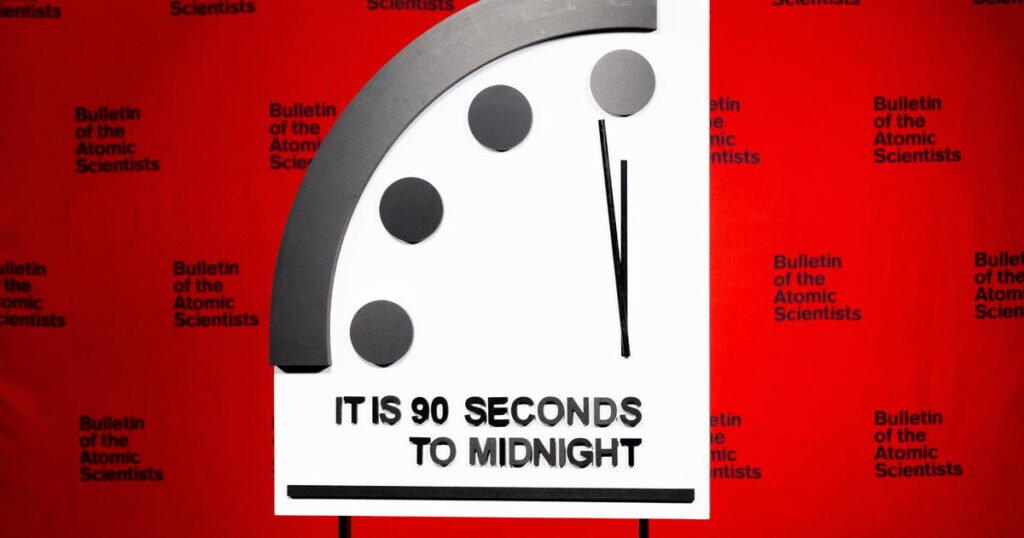
Like the Nobel Prizes, the Doomsday Clock of the Bulletin of the Atom Scientists attracts enormous media attention. It simplifies a very complex issue into a time measure: How close is the world to global catastrophe?

This year it is at 90 seconds to midnight. Between 2020 and 2022, it was at 100 seconds. 75 years ago, it was ticking at 7 minutes, and in 1991, at the end of the First Cold War, it stood at 17 minutes to midnight. Philosophically, this is highly enigmatic: Out of 24 hours, the world has always been a few minutes or seconds from global catastrophe. Over 75 years!

The whole thing is arbitrary or symbolic, if not bizarre. But it does alert the media and does have the positive effect of turning people’s attention at the global rather than regional or local issues. At least for a few moments.

Anyone who has studied risks and threats a bit seriously knows that it is not an easy piece of cake. It involves some theory, lots of different expertise, scenario-creativity and very solid natural and social science expertise. The Bulletin of the Atomic Scientists doesn’t have it.

But the media love it – and never, again like with the Nobel Peace Prize, do they do any research on how it is actually constructed and who is behind it.

They ought to.

Because this is not a genuinely global assessment with estimates and analyses from around the world. It is a US thing which – when you read this year’s statement – very clearly serves US foreign policies and NATO in the NATO-Russia conflict that so tragically plays out in Ukraine.

By and large, it’s a diatribe against Russia – something that has also popped up in articles in the Bulletin more frequently (and, as I have experienced, something the Bulletin does not respond to critical letters of).

And it comes in the wake of the Bulletin’s extremely one-sided condemnation of Russia’s invasion from March 2022. Be sure that such a thing as NATO expansion against all promises and NATO activities inside Ukraine over the last 30 years is part of the Bulletin’s analytical capacity and probably not something this US Bulletin can allow itself even to mention.

It lacks every conflict analysis and macro perspective in time and space – and runs like any other outlet of the omission-prone, self-righteous Western media narrative.

One would expect more from a group of high-level scientists. But perhaps not; because being a natural scientist does not mean being any more competent in political analysis and understanding of the world than the average citizen, but that is what is pretended – and swallowed by the media.

It is as indefensible – and laughable – as if the present author, educated in sociology and peace research, would play it as an expert in physics.

Siegfried Hecker, from left, Daniel Holz, Sharon Squassoni, Mary Robinson and Elbegdorj Tsakhia with the Bulletin of the Atomic Scientists, remove a cloth covering the Doomsday Clock before a virtual news conference at the National Press Club in Washington, Tuesday, Jan. 24, 2023. The Bulletin of the Atomic Scientists announced that it has moved the minute hand of the Doomsday Clock to 90 seconds to midnight. (AP Photo/Patrick Semansky)

You’ll see in this article by the Bulletin’s editor, journalist John Mecklin, which is supposed to explain this year’s Doomsday Clock that virtually everybody else but the US is responsible for the world’s close-to-catastrophe situation; it’s Russia, China, Iran (that does not have any nukes), North Korea and India. He also maintains that Russia, more than the other UN Security Council Nuclear-Haves should “make a renewed commitment to confront nuclear dangers through arms control efforts and strategic stability agreement…”

Would he even think of saying something similar about the United States and other NATO-nuclear countries?

The US nuclear activity is mentioned only cursorily “The United States, Russia, and China are now pursuing full-fledged nuclear weapons modernization programs, setting the table for a dangerous new “third nuclear age” of competition. Long-standing concerns about arms racing in South Asia and missile arms races in Northeast Asia complete a dismal picture that needs to be addressed.”

The neutrality of that sentence is remarkable – they are all equally responsible for what goes on over there? That the US is roaming around with nuclear submarines close to China doesn’t seem to be a concern to Mr Mecklin. Exercises, the US’ Taiwan armament provocation and that sort of thing?

The huge British nuclear weapons programs is not mentioned. Same thing with Israel’s nuclear weapons – while non-nuclear Iran, as mentioned, is pointed out as part of a global risk assessment. Yes, perhaps Iran is sick and tired of being harassed year after year and, in particular, since then US President Trump ruined the 2015 JCPOA, the most important diplomatic agreement in decades, by withdrawing from it and by the fact that the Biden administration follows his policy – a pretext, one may assume, for a later military action against Iran?

The manifest US Cold War policy against China, well-financed and also orchestrated through the Western mainstream media – goes unmentioned too.

As does the ongoing US nuclear escalation in Europe – the equivalent of 83 Hiroshima bombs, according to ICAN, the Geneva-based coalition of 652 non-governmental partner organisations in 107 countries, promoting adherence to and implementation of the UN Treaty on the Prohibition of Nuclear Weapons, received the 2017 Nobel Peace Prize.

That Treaty on the prohibition of nuclear weapons is also not mentioned – that is, the positive fact that the huge majority of humanity does not want nuclear weapons.

And, finally, while the Russians are blamed 100% for what now goes on in Ukraine – which is peak anti-intellectualism – the Bulletin of the Atomic Scientists and its editor do not have one word to say about the risk of catastrophe associated with – as of now – NATO countries having dispatched weapons for about US$ 150 billion, totally ignored every possibility of a negotiated solution and told President Zelensky to stop talking about negotiations – to the effect that he has signed a law that prohibits negotiation with Russia as long as its president is Vladimir Putin.

All this is not a concern to those who decide about the – alarming – Doomsday Clock.

You should wonder why.

Here is my primary explanation: It is, for all practical purposes, a US public relation thing. The Doomsday Clock can also be seen as an indicator of where the world is today as a consequence of the policies of the largest and most killing and nuclear global actor of all – the US – and its allies and partners in NATO, all in all 72 countries. That such an entity needs to blame others and see threats and catastrophes in everything those others do – what I would call psycho-political projection of its own dark sides onto others – is anything but unlikely.

To back this up, look at what the Bulletin says and what it really is.

The Science and Security Board (SASB) is comprised of a select group of globally recognized leaders with a specific focus on nuclear risk, climate change, and disruptive technologies. The SASB provides the Bulletin with objective external perspectives on trends and issues in these related fields and connects the organization to outside experts. The SASB’s responsibilities include: (1) setting the hands of the Doomsday Clock…”

“Globally recognised leaders…objective…” This falsely conveys the impression that this is a globally-composed expert group. Also, the criteria for their being globally recognised are not stated (I, for one, have heard about only 1or 2 of them, sorry for my ignorance. It is marketing/PR language).

This Board consists of 22 members, at least 19 of whom are Americans. (I have not been able to identify the nationality of 3, but they are US-educated, and one is a professor at Oxford). Not exactly an international or global group assessing global threats to humanity. Many of them are Standford University people and members of the US Academy of Sciences. Surely high-level, but perhaps with a bit of a US-biased worldview – and, naturally, a politically correct anti-Russian sentiment?

Furthermore, 7 of them have had or have relations with US government and military institutions such as State Department, Pentagon, the White House, National Defence College, Homeland Security and the US Airforce.

Could it be that they might not that easily see the log that is in their own US eyes but see very well the speck that is in their brothers’ eyes?

Finally, the Doomsday Clock is Western-biased in the extreme. If it is Russia and it happens in Europe, it’s very dangerous to the whole world. Secondly, the Bulletin gives no explanation as to how the regional conflict of NATO and Russia in Ukraine necessarily would translate into a global threat or humanity’s annihilation. Or under what circumstances the conventional war and escalation there would escalate to the level of the use of tactical nukes in the regional theatre and then to a global all-out Holocaust.

Of course, that scenario cannot be excluded, but to make it a world media issue without any analytical explanation is alarmist. But that is, one must assume, OK in these US politico-academic circles when it comes to Russia – as if NATO did not have a nuclear doctrine, too, that includes the right to use nukes even against a conventional attack.

I suppose the Bulletin and the experts behind its Doomsday Clock find that nuclear posture purely defensive and morally right. Remember, NATO is officially a defensive alliance. And that the Ukraine conflict is quite an extraordinary, unique conflict in that it has only one party.

We have enough doom and gloom.

Time is indeed ticking for this outdated, deceptive clock.

Share

Leave a Reply

Your email address will not be published. Required fields are marked *

Related Posts

Drones over Nordic airports. No damage. No trace. No answers. Most assume Russia—but what if that’s not so? Why is there so much we are not told? This article explores the strategic ambiguity behind recent drone incursions and asks: Who else might benefit from sending drones into NATO airspace? From Ukraine’s surprising drone supremacy to Russia’s possible signalling, the silence itself may be the loudest message. These are the kinds of questions decent, intelligent investigative journalists and commentators could easily research. Why don’t they? Did you, dear reader, know or think of this? That the most powerful weapon in today’s conflicts might be the one that leaves no trace – and no answers. Just enough fear to justify the next move? Recently, drones have repeatedly appeared over Nordic airports and near some military facilities. They cause no damage – for which reason the designation “hybrid attack” is misleading but serves a purpose. These...
A slightly modified version of a text published on Sept. 1, 2025 in TMS. On August 25 Thomas Friedman, always a weathervane for political and economic establishment thinking in the West, wrote a notable column in the NY Times that was pragmatic in tone, misleading in substance, and regressive in intention. Yet it reflects a growing ambivalence toward Israel’s prolonged genocide even among longtime supporters of Israel that now highlights starvation, famine, and a gross distortion of the delivery of humanitarian aid under emergency conditions. But expressed dangerously without hiding the hope that Israel could even now restore its legitimacy without being held accountable for crimes in Gaza and despite all, still expecting to be rewarded by excluding Hamas from any further governance role in Gaza and continuing to move toward the annexation of the West Bank by formal action or through further settlement expansion. It is notable that the headline of...
Photo Jan Oberg China has recently garnered significant attention due to its advancements in various technological fields, such as quantum physics and artificial intelligence. In media discussions and my lectures on China, it is common to encounter objections asserting that the West, particularly the United States, is certainly ahead of China. These assertions appear to be more emotional than factual. However, a more fundamental consideration is whether this question holds any significance. Cultural Perspective One aspect that Westerners often overlook is the cultural variation in understanding the relationship between abstract academic insights and practical applications of those insights. To comprehend the origin and significance of discussions on technological superiority, it is essential to acknowledge cultural and social differences between China and the West. I have explored this topic before in some of my previous articles published on the TFF website. Particularism On the cultural dimension universalist – particularist, China exhibits...

Recent Articles

PressInfo # 141, December 21, 2001It’s time to prepare reconciliation between Albanians and Serbs PressInfo # 140, December 14, 2001Ibrahim Rugova’s decade-long leadership in Kosovo/a PressInfo # 139, 11. december, 2001En god nyhet: Jugoslaviens Sannings- och försoningskommission PressInfo # 139, 11. december, 2001Gode nyheder: Jugoslaviens Sandheds- og Forsoningskommission PressInfo # 139, December 11, 2001Good news: Yugoslavia’s Truth and Reconciliation Commission PressInfo # 138, November 8, 2001TFF co-founder PhD with thesis about young people with roots in other cultures PressInfo # 138, November 8, 2001TFF:s medstiftare doktor på avhandling om unga med ursprung i andra kulturer PressInfo # 137, October 17, 2001A new Marshall Plan: Advancing human security and controlling terrorism PressInfo # 136, October 15, 2001The UN and Annan really deserve it PressInfo # 135, October 10, 2001Preventing a terrorist mushroom cloud PressInfo # 134, 17 oktober, 2001Sverige og 11. september PressInfo # 134, October 9, 2001Sweden and September 11...
Peace is promoted by constructive proposals and dialogue Four preceding PressInfos have expressed concern over — and criticised — the ongoing, militarisation of the EU. Some will say: but there are no alternatives. We believe that there are always alternatives, that democracies are characterised by alternatives and choice, and that openly discussed alternatives will improve the quality and legitimacy of society’s decision–making. In addition, it is an intellectual and moral challenge to not only criticise but also be constructive. If we only tell people that we think they are wrong, they are not likely to listen. However, if we say: what are your views on this set of ideas and steps? — we may sometimes engage them in dialogue and sow a seed. Most people in power circles live their daily lives in in a time frame and a social space where certain ideas, viewpoints and concepts are just not...
Photos © TFF 2000 Read PressInfo 90 “Lift the Sanctions and Bring More Aid to Yugoslavia” See Pictures from Belgrade © TFF 2000 Please reprint, copy, archive, quote or re-post this item, but please retain the source.

TFF on Substack

Discover more from TFF Transnational Foundation & Jan Oberg.

Most Popular

PressInfo # 141, December 21, 2001It’s time to prepare reconciliation between Albanians and Serbs PressInfo # 140, December 14, 2001Ibrahim Rugova’s decade-long leadership in Kosovo/a PressInfo # 139, 11. december, 2001En god nyhet: Jugoslaviens Sannings- och försoningskommission PressInfo # 139, 11. december, 2001Gode nyheder: Jugoslaviens Sandheds- og Forsoningskommission PressInfo # 139, December 11, 2001Good news: Yugoslavia’s Truth and Reconciliation Commission PressInfo # 138, November 8, 2001TFF co-founder PhD with thesis about young people with roots in other cultures PressInfo # 138, November 8, 2001TFF:s medstiftare doktor på avhandling om unga med ursprung i andra kulturer PressInfo # 137, October 17, 2001A new Marshall Plan: Advancing human security and controlling terrorism PressInfo # 136, October 15, 2001The UN and Annan really deserve it PressInfo # 135, October 10, 2001Preventing a terrorist mushroom cloud PressInfo # 134, 17 oktober, 2001Sverige og 11. september PressInfo # 134, October 9, 2001Sweden and September 11...
Peace is promoted by constructive proposals and dialogue Four preceding PressInfos have expressed concern over — and criticised — the ongoing, militarisation of the EU. Some will say: but there are no alternatives. We believe that there are always alternatives, that democracies are characterised by alternatives and choice, and that openly discussed alternatives will improve the quality and legitimacy of society’s decision–making. In addition, it is an intellectual and moral challenge to not only criticise but also be constructive. If we only tell people that we think they are wrong, they are not likely to listen. However, if we say: what are your views on this set of ideas and steps? — we may sometimes engage them in dialogue and sow a seed. Most people in power circles live their daily lives in in a time frame and a social space where certain ideas, viewpoints and concepts are just not...
Photos © TFF 2000 Read PressInfo 90 “Lift the Sanctions and Bring More Aid to Yugoslavia” See Pictures from Belgrade © TFF 2000 Please reprint, copy, archive, quote or re-post this item, but please retain the source.
Read More
Imagen-thumbnail-The-Transnational-1
PressInfo # 141, December 21, 2001It’s time to prepare reconciliation between Albanians and Serbs PressInfo # 140, December 14, 2001Ibrahim Rugova’s decade-long leadership in Kosovo/a PressInfo # 139, 11. december, 2001En god nyhet: Jugoslaviens Sannings- och försoningskommission PressInfo # 139, 11. december, 2001Gode nyheder: Jugoslaviens Sandheds- og Forsoningskommission PressInfo # 139, December 11, 2001Good news: Yugoslavia’s Truth and Reconciliation Commission PressInfo # 138, November 8, 2001TFF co-founder PhD with thesis about young people with roots in other cultures PressInfo # 138, November 8, 2001TFF:s medstiftare doktor på avhandling om unga med ursprung i andra kulturer PressInfo # 137, October 17, 2001A new Marshall Plan: Advancing human security and controlling terrorism PressInfo # 136, October 15, 2001The UN and Annan really deserve it PressInfo # 135, October 10, 2001Preventing a terrorist mushroom cloud PressInfo # 134, 17 oktober, 2001Sverige og 11. september PressInfo # 134, October 9, 2001Sweden and September 11...
Imagen-thumbnail-The-Transnational-1
Peace is promoted by constructive proposals and dialogue Four preceding PressInfos have expressed concern over — and criticised — the ongoing, militarisation of the EU. Some will say: but there are no alternatives. We believe that there are always alternatives, that democracies are characterised by alternatives and choice, and that openly discussed alternatives will improve the quality and legitimacy of society’s decision–making. In addition, it is an intellectual and moral challenge to not only criticise but also be constructive. If we only tell people that we think they are wrong, they are not likely to listen. However, if we say: what are your views on this set of ideas and steps? — we may sometimes engage them in dialogue and sow a seed. Most people in power circles live their daily lives in in a time frame and a social space where certain ideas, viewpoints and concepts are just not...
Imagen-thumbnail-The-Transnational-1
Photos © TFF 2000 Read PressInfo 90 “Lift the Sanctions and Bring More Aid to Yugoslavia” See Pictures from Belgrade © TFF 2000 Please reprint, copy, archive, quote or re-post this item, but please retain the source.
Imagen-thumbnail-The-Transnational-1
Av FRANK SØHOLM GREVIL 16 augusti 2004  Vi er nu nået til tredje akt i det absurde teaterstykke, der i analogi med de store skueprocesser i Moskva 1936-38 er blevet døbt ‘Grevil-sagen’. Første akt bestod i min anonyme fremlæggelse af egenhændigt nedklassificerede rapporter i Berlingske Tidende i februar og marts. Andet akt udgjordes af min fremtræden med navn og billede i Information i april samt den efterfølgende mediestorm, som uden min direkte medvirken kostede en forsvarsminister taburetten samt en sigtelse for brud på tavshedspligten. Tredje akt bliver en retssag, hvor jeg står tiltalt for at have overtrådt straffelovens bestemmelser om uberettiget videregivelse eller udnyttelse af fortrolige oplysninger. Statsanklageren har ovenikøbet valgt at påberåbe sig særligt skærpende omstændigheder. Da jeg aldrig har modtaget betaling for at stille rapporterne til rådighed eller lade mig interviewe, må det skærpende bestå i, at “videregivelsen eller udnyttelsen er sket under sådanne omstændigheder, at det påfører...
Imagen-thumbnail-The-Transnational-1
Af Svenska Irakkommittén mot de Ekonomiska Sanktionerna (SIES) 13 september 2002 FN:s ekonomiska sanktioner mot Irak har nu pågått i tolv år och drabbat det irakiska folket med svåra lidanden. Enligt FN:s egna siffror har mer än 1,5 miljoner människor, varav ca 600 000 barn, dött som en direkt följd av sanktionerna. Dessutom har ett lågintensivt bombkrig mot landet pågått under dessa år. Av all denna förödelse- orsakad huvudsakligen av amerikansk och brittisk politik- har Saddam Husseins brutala och diktatoriska regim snarast stärkts än försvagats. Nu förbereder USA under president Bushs ledning ett storskaligt bombkrig mot Irak som kommer att innebära ett ännu större lidande för civilbefolkningen. Ett sådant krig kommer dessutom att ytterligare undergräva freden och säkerheten i världen. Att upprätta en demokratisk regim i Irak är det irakiska folkets angelägenhet och får enligt folkrätten inte ske med krigshandlingar utifrån. Folkrätten och FN:s stadgar måste respekteras. Vi vädjar till...