
Jan Oberg: The 2022 NATO Nobel Human Rights Prize

The Nobel Committee should include a member of the US or another NATO country – alternatively, it should be transferred to State Department or NATO. That would be more honest than playing these games which repeatedly and blatantly violate Alfred Nobel’s will.
Our media ought to be able to read three lines about his intentions, but no research is done to reveal the fraud. It would be too US/NATO politically incorrect.

Yet another gross violation of Alfred Nobel’s will – letter and spirit

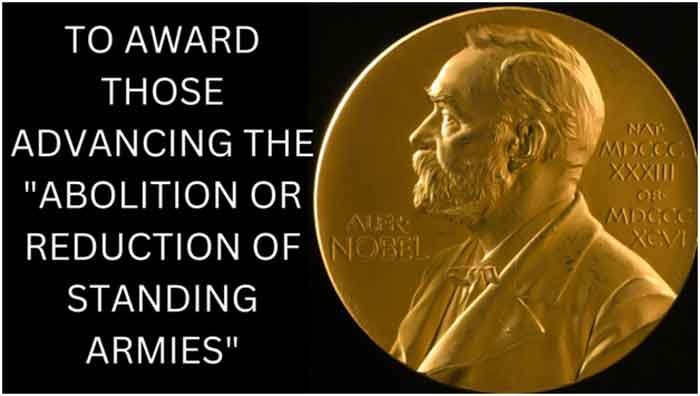
I feel sad and tired writing it again: Alfred Nobel wanted his Peace Prize to support those who have “done the most or best to advance fellowship among nations, the abolition or reduction of standing armies, and the establishment and promotion of peace congresses.”

It is a prize for demilitarization – such as the reduction or abolition of armies, peace negotiations – for the reduction of violence and for “champions of peace”. Read Nobel’s will here. There should be nothing to discuss: It is not a human rights prize – nor is it a general Do-Good prize. Nobel wanted to reduce and abolish warfare. With NATO’s tremendous over-armament – 12 times and in future perhaps 20 times bigger military expenditures than Russia – it is, by definition, a radical claim in times when everything peace has been tabooed by militarism in research, politics and media.

Therefore, on this ground alone, the 2022 Prize – once again – is a gross violation of Alfred Nobel’s will – irrespective of what one may otherwise think of the important work for global human rights in general and the three laureates of this year.

Legal authorities ought to investigate how far an organisation’s administrators and decision-makers can deliberately deviate from the Statutes they are responsible for implementing. The media ought to focus on this question. They don’t.

And there is no excuse for that except lack of source investigation, research or self-censorship. For those who still read analytical books, there are many available, but the world’s leading expert on the prize is Norwegian lawyer Fredrik Heffermehl who has written two deep-research books: The Nobel Peace Prize. What Alfred Nobel Really Wanted and Fame or Shame (in Norwegian, Medaljens Bakside). And here is Heffermehl’s take on last year’s prize.

So what about this year’s laureates?

Here is the Nobel Committee’s motivation for the three laureates. It omits all references to Nobel’s will and argues that the decision is to “honour three outstanding champions of human rights, democracy and peaceful co-existence in the neighbour countries Belarus, Russia and Ukraine.”

Peaceful co-existence? Well! The leader of the Ukrainian Center for Civil Liberties is Oleksandra Matviichuk – partly educated at Stanford University and already a recipient of numerous Western mainstream prizes – who has, among others, published this article on the CCL homepage “Ukraine Will Not Negotiate Its Existence.”

Her content, style and concepts are basically replica of NATO or State Department messages. Like this one about Russia’s warfare which she NATO style – calls “unprovoked”:

“This grotesque experiment is reminiscent of the brainwashing of Uyghur Muslims by the Chinese government in Xinjiang concentration camps. But apparently some want Ukraine to hand over our people to these tormentors for the sake of a non-existent “negotiated settlement” with Russia.” And: “In the face of a genocidal campaign, Ukrainians should not be told to negotiate our existence. In recent days, I have spoken with human rights defender colleagues from Syria and Libya, both countries in which Russian forces and mercenaries sow death and destruction with complete impunity. The world cannot allow Ukraine to be added to this list. We will not be the last. Those that dress up their cynicism with so-called pragmatism need to go back to school and learn that the only way to defeat a bully is to stand up to it.”

No serious investigation of Xinjiang has documented anything that can be called genocide – see here. And more of the same rhetoric here – shaming everyone who may be for compromise and non-violent resolution of the conflict. She also excludes all international organisations’ possible involvement and advocates substantial armament of Ukraine as the only solution.

Judge for yourself – also when you add that her organisation is behind “Tribunal for Putin” but not for all possible war crimes and that CCL receives funds from the US State Department, the European Commission and – conspicuously – from the National Endowment for Democracy (NED) which channels money from CIA and State Department to various groups inside other countries under headings such as human rights and democracy (See below).

So is it for…

Peace? No!

Coexistence? No!

Demilitarisation and the abolition of armies and warfare? No!

Support to the peace and human right to conscientious objection in Ukraine? No! (That right as well as alternative service has been suspended in Ukraine).

– or for US/NATO expansion – of arming Ukraine to defeat Russia and to weaponise human rights commitments – Oh yes!

The Nobel Committee – situated in the capital of NATO member Norway, is on a political pro-militarism mission. It cannot possibly be unaware of the content on its laureate’s homepage. Or it takes orders – directly or indirectly – from US/NATO circles?

Whatever the explanation, it is beyond a doubt completely incompatible with Alfred Nobel’s words and intentions.

The National Endowment for Democracy (NED) is funded primarily by the US Congress. See NED’s homepage here. In passing, here is how NED is presented on Wikipedia: It is a US agency that was founded in 1983 with the stated goal of promoting democracy abroad. While sometimes referred to as a non-governmental organisation, the NED functions as a quasi-autonomous near-governmental organisation. 

In 1986, NED’s then (founding) President Carl Gershman (also an adviser to the Victims of Communism Memorial Foundation with Adrian Zenz, see later) said that the NED was created because “It would be terrible for democratic groups around the world to be seen as subsidised by the CIA. We saw that in the 1960’s and that’s why it has been discontinued.” (More here in chapter 2.3.2).

So, not that much peaceful coordination. But a good laureate of what ought to be called the NATO Nobel Human Rights Prize 2022.

Further, NED awarded the CCL and other Ukrainian civil society organisations with its Democracy Award in May this year. NED gave its Democracy Award 2004 to another of this year’s laureates – the International Memorial Society, and it is a kind of donation industry in Russia and in Belarus, too.

There is no excuse. The thing just described has gone on – and quite openly – for decades. They are described here by Washington Post’s David Ignatius 31 years ago!

All this is tragic from a peace perspective. However, the global peace movement seems pretty ignorant about it – seemingly not even dismayed by having been deprived of humanity’s most prestigious prize – as the Novel Peace Prize is often called. Some even applaud the Nobel Committee’s decisions – even the Right Livelihood Award!

Who could have received it this year?

Obviously, a person or organization that works for non-violence, the UN Charter norm for making peace by peaceful means (Art 1), courageous people who insist on civilian non-violent action, symbolic actions and other methods – and anyone who advocates and makes strategies for solutions to the NATO-Russia conflict in Ukraine that do not imply the use of the weapons, armies etc. that Alfred Nobel was so strongly against.

One such super-relevant option would have been Yurii Sheliazhenko, the leader of the Ukrainian Pacifist Movement – and similar brave true civil society peace organisations all over the world – in the West/NATO too.

By awarding such people who are principled and do not advocate militarism and do not take this or that side in a conflict – the Nobel Committee would have made a very very important point. It chose not to. Because nonviolence and genuine peace is politically incorrect and implicitly critical of NATO and the US – that US which has conducted no fewer than 251 military deployments/interventions abroad since 1991, dwarfing anything Russia has done.

Here is a very fine article at Countercurrents listing other relevant candidates and arguments for a true Nobel Peace Prize.

And – as all the earlier years – I point to Daniel Ellsberg. The scholar-activist who has devoted his life to informing the world about just how mad and immoral and illegal – and risky – nuclear weapons are. But such a laureate would not have pleased the US, so he won’t get it.

Neither will any peace scholar, intellectual or academically knowledgeable about these matters receive this prize. Because it has – in contrast to other Nobel prizes – not been given to scientists of peace, nonviolence, civil conflict-resolution and alternative security.

But with the present communities of research, media and politics illiterate – yes, there are a few exceptions… – about conflict-resolution, nonviolence and peace, the Nobel Peace Prize Committee will surely continue its violations of Alfred Nobel’s words and intentions and be applauded.

After all, the only peace and security talked about in these dangerous and perversely militarist times are armed peace and weaponised human rights.

And both are clear indicators of the West, moral and intellectual decay.

Today, I made this statement to RT:
Peace & future researcher + ‌Art Photographer

Share

Leave a Reply

Your email address will not be published. Required fields are marked *

Related Posts

PRESS RELEASE – 6 OCTOBER 2025 LAY DOWN YOUR ARMSPEACE PRIZE FOR 2025 is awarded Francesca Albanese The United Nations Special Rapporteur on the occupied Palestinian territories – as the person who, in accordance with Alfred Nobel’s will, has “done the most or the best work for fraternity between nations and for the abolition or reduction of standing armies as well as for the holding and promotion of peace congresses.” Francesca Albanese has forcefully and unwaveringly worked against Israel’s full-scale war on the occupied Palestinian territories, in particular Israel´s ongoing genocide against the Palestinian people. She has confronted Israel’s systematic war crimes and crimes against humanity in a truly global outreach. Further, she has brought governments, international organisations and people’s groups together to underline the responsibility of the world at large to act and to stop arming, enabling, and profiting from Israel’s ongoing criminal actions. But first of all, Albanese...
Not so prestigious or noble The media often describe the Nobel Peace Prize as the world’s most prestigious prize. That is, however, slightly bizarre for at least two reasons: first, there exists no system or set of criteria to rank prizes in various fields in terms of prestige. Secondly, over decades, this Prize has been awarded to people and organisations that reveal a careless interpretation of Alfred Nobel’s short and precise will, if not a direct violation of what he intended his Prize to support. 

A more benign interpretation could also be that it is prestigious because it has a focus on what is probably worldwide seen as the most noble or highest value, namely peace. Or, in a banal materialistic sense, that the huge amount of money accompanying the Prize makes it ’prestigious.’ A few introductory considerations This article discusses what has gone wrong with this prize and how...
Swanson is the founding director of World Beyond War and a TFF Associate. Fredrik Heffermehl (1938-2023) established the prize, which Lay Down Your Arms awards. This is the public announcement about the November 10, 2024, ceremony in Oslo. You are hereby cordially invited! WHO WILL RECEIVE THE PRIZE IN A PUBLIC CEREMONY ATLITTERATURHUSET IN OSLO, SUNDAY, NOVEMBER 10, 2024.Participating Jannik Bonnevie (poetry), Xiangtian Liu (grand piano), Marie Flognfeldt Jones (song), Jakob Rekdal Jones (guitar). After lunch, David Swanson will introduce a roundtable on “How can we stop today’s militarization?” with among others Glenn Diesen, Ingeborg Breines, Jan Oberg, Thore Vestby, Mariell Leraand, Ola Friholt, Tomas Magnusson and Ola TunanderFree entry More about Fredrik Heffermehl, his impressive research work and last book, “The Real Nobel Peace Prize” here and here.

Recent Articles

In response to an urgent Appeal from all the living Nobel Peace Prize Laureates, the General Assembly of the United Nations, on November 1998, unanimously declared the first decade of the twenty-first century to be The Decade for a Culture of Peace and Nonviolence. While people are naturally concerned about the amount of violence in our world and how it threatens our future, the Nobel Laureates are right to remind us of the potential of nonviolence and our calling to build a culture of peace and nonviolence.  The twentieth century is instructive in the way that the philosophy and practice of nonviolence have begun to flourish and in the way that nonviolent movements have had an exponential growth across the world. Mohandas Gandhi and Martin Luther King, Jr. are the most famous nonviolent leaders but many have built upon the paths they charted as in country after country, tyrannies and...
We know that medical personnel have failed to report to higher authorities wounds that were clearly caused by torture and that they have neglected to take steps to interrupt this torture. In addition, they have turned over prisoners’ medical records to interrogators who could use them to exploit the prisoners’ weaknesses or vulnerabilities. We have not yet learned the extent of medical involvement in delaying and possibly falsifying the death certificates of prisoners who have been killed by torturers. A May 22 article on Abu Ghraib in the New York Times states that “much of the evidence of abuse at the prison came from medical documents” and that records and statements “showed doctors and medics reporting to the area of the prison where the abuse occurred several times to stitch wounds, tend to collapsed prisoners or see patients with bruised or reddened genitals.” http://www.truthout.org/docs_04/080604J.shtml#16 According to the article, two doctors who...
Jan Øberg behandler i artiklen en lang række faktorer, som ligger til grund for den måde vores samfund er organiseret på – og derfor også for konflikter. Artiklen introducerer således sammenhængen mellem familien, foreninger, regeringer, NGO’ er, nation, stat, nationalstat og alliancer for på denne måde bedre at kunne forstå konflikter og i sidste ende blive klogere mht. at løse disse. Øberg, der er fortaler for global bevidsthed, hvilket skal ses i lyset af den øgede globalisering, skelner mellem kulturkamp og kulturdialog. Endelig behandles begrebet magt og magtesløshed: giver magt ret til at udøve magt – fordi man mener at have ret? Litteraturliste og arbejdsspørgsmål efter artiklen. Ordene vi bruger om verden I satellitperspektiv kan man godt tale om den menneskelige familie eller menneskeheden. Udtrykket understreger, at der eksisterer – eller burde eksistere – et fællesskab fordi vi alle er mennesker og sammen bebor denne klode og ingen anden. Og...

TFF on Substack

Discover more from TFF Transnational Foundation & Jan Oberg.

Most Popular

In response to an urgent Appeal from all the living Nobel Peace Prize Laureates, the General Assembly of the United Nations, on November 1998, unanimously declared the first decade of the twenty-first century to be The Decade for a Culture of Peace and Nonviolence. While people are naturally concerned about the amount of violence in our world and how it threatens our future, the Nobel Laureates are right to remind us of the potential of nonviolence and our calling to build a culture of peace and nonviolence.  The twentieth century is instructive in the way that the philosophy and practice of nonviolence have begun to flourish and in the way that nonviolent movements have had an exponential growth across the world. Mohandas Gandhi and Martin Luther King, Jr. are the most famous nonviolent leaders but many have built upon the paths they charted as in country after country, tyrannies and...
We know that medical personnel have failed to report to higher authorities wounds that were clearly caused by torture and that they have neglected to take steps to interrupt this torture. In addition, they have turned over prisoners’ medical records to interrogators who could use them to exploit the prisoners’ weaknesses or vulnerabilities. We have not yet learned the extent of medical involvement in delaying and possibly falsifying the death certificates of prisoners who have been killed by torturers. A May 22 article on Abu Ghraib in the New York Times states that “much of the evidence of abuse at the prison came from medical documents” and that records and statements “showed doctors and medics reporting to the area of the prison where the abuse occurred several times to stitch wounds, tend to collapsed prisoners or see patients with bruised or reddened genitals.” http://www.truthout.org/docs_04/080604J.shtml#16 According to the article, two doctors who...
Jan Øberg behandler i artiklen en lang række faktorer, som ligger til grund for den måde vores samfund er organiseret på – og derfor også for konflikter. Artiklen introducerer således sammenhængen mellem familien, foreninger, regeringer, NGO’ er, nation, stat, nationalstat og alliancer for på denne måde bedre at kunne forstå konflikter og i sidste ende blive klogere mht. at løse disse. Øberg, der er fortaler for global bevidsthed, hvilket skal ses i lyset af den øgede globalisering, skelner mellem kulturkamp og kulturdialog. Endelig behandles begrebet magt og magtesløshed: giver magt ret til at udøve magt – fordi man mener at have ret? Litteraturliste og arbejdsspørgsmål efter artiklen. Ordene vi bruger om verden I satellitperspektiv kan man godt tale om den menneskelige familie eller menneskeheden. Udtrykket understreger, at der eksisterer – eller burde eksistere – et fællesskab fordi vi alle er mennesker og sammen bebor denne klode og ingen anden. Og...
Read More
Imagen-thumbnail-The-Transnational-1
In response to an urgent Appeal from all the living Nobel Peace Prize Laureates, the General Assembly of the United Nations, on November 1998, unanimously declared the first decade of the twenty-first century to be The Decade for a Culture of Peace and Nonviolence. While people are naturally concerned about the amount of violence in our world and how it threatens our future, the Nobel Laureates are right to remind us of the potential of nonviolence and our calling to build a culture of peace and nonviolence.  The twentieth century is instructive in the way that the philosophy and practice of nonviolence have begun to flourish and in the way that nonviolent movements have had an exponential growth across the world. Mohandas Gandhi and Martin Luther King, Jr. are the most famous nonviolent leaders but many have built upon the paths they charted as in country after country, tyrannies and...
Imagen-thumbnail-The-Transnational-1
We know that medical personnel have failed to report to higher authorities wounds that were clearly caused by torture and that they have neglected to take steps to interrupt this torture. In addition, they have turned over prisoners’ medical records to interrogators who could use them to exploit the prisoners’ weaknesses or vulnerabilities. We have not yet learned the extent of medical involvement in delaying and possibly falsifying the death certificates of prisoners who have been killed by torturers. A May 22 article on Abu Ghraib in the New York Times states that “much of the evidence of abuse at the prison came from medical documents” and that records and statements “showed doctors and medics reporting to the area of the prison where the abuse occurred several times to stitch wounds, tend to collapsed prisoners or see patients with bruised or reddened genitals.” http://www.truthout.org/docs_04/080604J.shtml#16 According to the article, two doctors who...
Imagen-thumbnail-The-Transnational-1
Jan Øberg behandler i artiklen en lang række faktorer, som ligger til grund for den måde vores samfund er organiseret på – og derfor også for konflikter. Artiklen introducerer således sammenhængen mellem familien, foreninger, regeringer, NGO’ er, nation, stat, nationalstat og alliancer for på denne måde bedre at kunne forstå konflikter og i sidste ende blive klogere mht. at løse disse. Øberg, der er fortaler for global bevidsthed, hvilket skal ses i lyset af den øgede globalisering, skelner mellem kulturkamp og kulturdialog. Endelig behandles begrebet magt og magtesløshed: giver magt ret til at udøve magt – fordi man mener at have ret? Litteraturliste og arbejdsspørgsmål efter artiklen. Ordene vi bruger om verden I satellitperspektiv kan man godt tale om den menneskelige familie eller menneskeheden. Udtrykket understreger, at der eksisterer – eller burde eksistere – et fællesskab fordi vi alle er mennesker og sammen bebor denne klode og ingen anden. Og...
Imagen-thumbnail-The-Transnational-1
Kapitel 2: Forskellige sider af Europa og USA…fortsat 2.5 Militære relationer I forbifarten har vi allerede sagt nogle ting om USA’s militære situation. Kig lige en gang til på afsnit 2.3. Nu skal vi uddybe det militære forhold mellem USA og EU. Der er en række ligheder mellem visse europæiske landes og USA’s militær. Næsten alle er med på en eller anden måde i NATO, direkte som medlem – selv Island, der ikke har et forsvar – eller indirekte i Partnerskab for Fred. USA og Canada er med i OSCE (på dansk OSSE), Organisationen for Sikkerhed og Samarbejde i Europa, der tæller over 50 lande. USA samt England og Frankrig er kernevåbenstater og de har styrker til intervention langt borte fra hjemlandet, om end USA’s er tifold større. Alle har også en omfattende våbeneksport og bruger den som et middel til at tjene penge og få loyale venner på, det...
Imagen-thumbnail-The-Transnational-1
Background Christian Harleman and Jan Oberg conducted a fact-finding mission to Burundi between November 26 and December 6, 2003. (See websites about the country here). The first TFF mission took place in March 1999. Unfortunately, since then it has not been practically possible to implement the co-operation with Burundi’s Ministry of Education and Burundian NGOs that was planned at the time. The 2003 mission had three purposes. First, to do fact-finding in general about the situation and, in particular, the progress under the Arusha Peace Process. Second, to explore the possibilities for co-operation between the government and relevant NGOs on the one hand and TFF on the other, in order to develop and deepen the existing competence in fields such as conflict-understanding, reconciliation and peace-building. Finally, third, to find out whether it would be possible, in co-operation with the Swedish Rescue Services Agency (Statens Räddningsverk), to establish a health care unit that...
Imagen-thumbnail-The-Transnational-1
Former UN Under-Secretary-General with special responsibility for peacekeeping operations TFF associate August 20, 2003 YRINGHAM, Mass.- Ralph Bunche was born in Detroit 100 years ago today (August 7, 2003). His passionate determination to get results did not extend to seeking credit for them, so his work is better remembered than he is. Of all his many accomplishments – civil rights pioneer, Nobel Peace Prize laureate, chief drafter of two chapters of the United Nations charter, negotiator of the armistices that ended the first Arab-Israeli war – Bunche said he was proudest of developing what came to be known as peacekeeping. Setting up the United Nations Truce Supervision Organization in Palestine in 1948, Bunche formulated the principles that have governed peacekeeping operations ever since. In the 1956 Suez crisis, working with Secretary General Dag Hammarskjold and Lester Pearson of Canada, he organized the first peacekeeping force, the United Nations Emergency Force...
