
Iran, Saudi Arabia and a history of American aggression
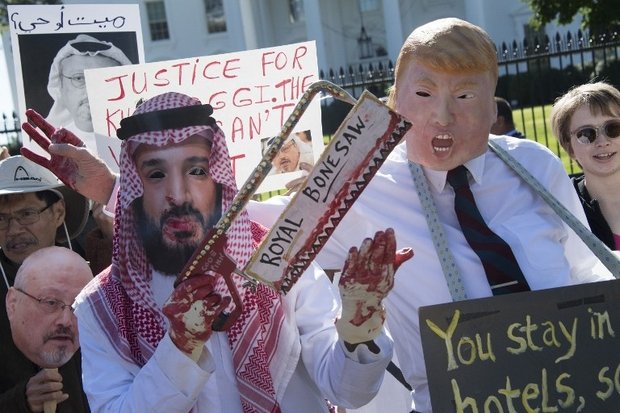
Photo: Demonstrators dressed as Saudi Crown Prince Mohammed bin Salman and US President Donald Trump protest outside the White House in Washington on 19 October 2018, demanding justice for missing Saudi journalist Jamal Khashoggi (AFP) (Photo credit: middleeasteye.net).


Tehran has repeatedly delivered on its promises, while Washington has fallen short and backed Riyadh’s disastrous regional adventures.


November 22, 2018


By Seyed Hossein Mousavian

In a recent op-ed in The New York Times, Thomas Friedman criticised former US President Barack Obama’s bet on Iran and President Donald Trump’s bet on Saudi Arabia, noting that both countries responded with their worst impulses.

Friedman argues that the Iran nuclear deal was a bet worth making, but like many critics of the deal, he claims that it enabled Iran’s overreach in four Arab capitals: Baghdad, Damascus, Sanaa and Beirut. I believe he is wrong.

In the Iran-US wrangling over the past three decades, Tehran has repeatedly delivered on its promises, while the US has fallen short. In the late 1980s, President George HW Bush asked Iran to help with the release of Western hostages in Lebanon, vowing “goodwill for goodwill”. Iran facilitated the release; in return, the US increased pressure on Iran.

Originally published at middleeasteye.net

The ‘axis of evil’

In 2001, when the US asked for Iran’s support in its “war on terror” in Afghanistan, Iran’s Revolutionary Guard Corps gave crucial intelligence to the US military. Tehran also played a constructive role in Afghanistan by throwing its full support behind the US-backed president, Hamid Karzai – but President George W Bush responded by putting it on the “axis of evil”.

According to Ryan Crocker, the former US ambassador to Afghanistan and Iraq, Iranian diplomats were “pragmatic and focused” when it came to assisting in Afghanistan, at one point even producing “an extremely valuable map showing the Taliban’s order of battle just before American military action began”.

That all ended after the infamous “axis of evil” speech, as the Iranian leadership “concluded that in spite of their cooperation with the American war effort, the United States remained implacably hostile to the Islamic Republic”.

In each of these important episodes, Iran respected the rules of the game, while the US reneged on its promises

Iran also delivered on its promises in the 2015 nuclear deal. The International Atomic Energy agency repeatedly confirmed that Iran was upholding its end of the bargain – but not only did the US withdraw from the deal, it has also since engaged in a maximum pressure policy, aiming to force Iran to capitulate to its demands.

In his recent statement, Trump launched straight into an attack on Iran as the root of all evil, rather than immediately addressing what was meant to be the subject at hand, namely Saudi Arabia and the killing of journalist Jamal Khashoggi. Trump should also know that 15 of the 19 hijackers who perpetrated the 9/11 attacks on the United States were Saudis. There was not even one Iranian among them.
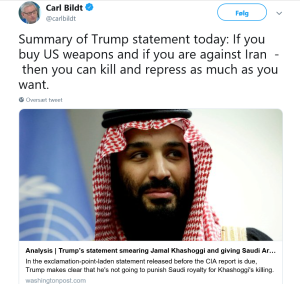
Carl Bildt on Twitter

In each of the important episodes outlined above, Iran respected the rules of the game, while the US reneged on its promises. It is also important to recall that Iran’s engagements throughout the region predated the nuclear deal. After the 2003 US invasion of Iraq, Iran intervened in Iraq only after a number of US officials openly called for an American invasion of Iran to follow that of Iraq. In Syria, Iran’s involvement has not happened in a vacuum, either.


Projecting Saudi power

On Saudi Arabia, Friedman argues that Trump vowed to advance US interests in the region by selling $110bn in arms to Saudi Arabia and betting on Crown Prince Mohammed bin Salman – but bin Salman “used his carte blanche” to project power and stretch far beyond his capabilities by intervening in Yemen, blockading Qatar, abducting the prime minister of Lebanon, cracking down on female activists and “permitting, if not ordering, his team to murder moderate Saudi democracy advocate Jamal Khashoggi”.
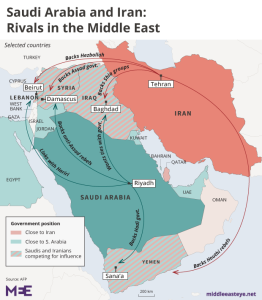
Friedman is wrong about Saudi Arabia too. The wars in Yemen, Syria and Libya have all been joint Saudi-US campaigns. Moreover, Washington and Riyadh jointly supported Saddam’s invasion of Iran and the use of chemical weapons against Iranians. The US turned a blind eye to Saudi Arabia, even though it was well aware of the latter’s support for extremist groups.

In the 1990s, the Saudis heavily funded madrassas that taught a fundamentalist version of Islam, Obama acknowledged, according to a 2016 Atlantic article. The US-backed Saudi campaign in Yemen has led to the world’s worst humanitarian disaster, and has bolstered extremist groups in the region and beyond. Even after the gruesome murder of Khashoggi, the US imposed severe sanctions on Iran, but did nothing to punish Saudi Arabia.


US domination

There is no doubt that Obama’s strategy was different from Trump’s. “The competition between the Saudis and the Iranians – which has fuelled proxy wars and chaos in Syria and Iraq and Yemen – requires us to say to our friends as well as to the Iranians that they need to find an effective way to share the neighbourhood and institute some sort of cold peace,” Obama told the Atlantic. Yet, despite the Khashoggi affair, Saudi Arabia today lies at the centre of Washington’s strategic and political policy in the region.

The Middle East has been dominated by the US for decades. Multiple wars in the region – from Afghanistan, to Iraq, to Libya, to Yemen – are the real source of instability, sectarian conflict and the rise of terrorist groups such as the Islamic State (IS) and al-Qaeda. “Iran has not launched an aggressive war in modern history (unlike the US or Israel), and its leaders have a doctrine of ‘no first strike’,” notes University of Michigan history professor Juan Cole.

While the West and some regional actors are concerned about Iran’s regional influence, Tehran also has serious and legitimate concerns. As a confidence-building measure, all parties to the nuclear deal – including the US – should respect their obligations to foster peace and stability in the Middle East.


Originally published at middleeasteye.net


Seyed Hossein Mousavian


No data was found

Share

Leave a Reply

Your email address will not be published. Required fields are marked *

Related Posts

Contrary to what we stated when publishing this Call, the UN General Assembly (GA) opened on September 9, 2025, in New York, not in Geneva, as we initially wrote. However, due to the host role-violating US ban on visas to Palestinians, the Special GA Segment on Palestine will be held in the UN Geneva from September 22. And it builds up to something historic. Anyhow, here is what we believe you must advocate or do to help stop the Israeli genocide. It’s called people’s power or citizens’ diplomacy. SHARE! The first of three appeals from TFF. The second is here, and the third here. Across the world, people are witnessing the systematic destruction of Palestinian lives, homes, and communities. The scale and intensity of Israel’s military operations — especially in Gaza — have led leading legal bodies, including the International Court of Justice, to warn of a plausible genocide. The...
Professor Zhang Weiwei is a highly respected Chinese intellectual and professor at Fudan University in Shanghai. He is the director of its China Institute and also runs a series of conversations with many different people around the world. Here is what came out of their meetings there and in Skopje, Macedonia in October 2024: & ◪ As you can see, also at the end of the second one, we both enjoy win-win exchanges like these about world order issues. Zhang Weiwei is known for using videos and social media to reach a large audience in China and worldwide. We suggest you see many more of Zhang Weiwei’s conversations – like recently with Professor Jeffrey Sachs – on the Thinkers’ Forum on YouTube. PS TFF posts hundreds of videos, its own and those of others, in our Video Collections on TFF Substack – including those that appear on YouTube. However, TFF...
The text below was published in “The Nation” on July 15, 2025, appears here unmodified. The delay is due to a weak Internet here in Turkey. There has been much critical reaction to this US Government defamatory statement justifying the imposition of sanctions on this exceptional independent expert appointed by the UN to an unpaid position, and left to hang in the wind by the politically motivated show of indifference by the UN Secretariat.] Justifying US Sanctions US Secretary of State, Marco Rubio, in a dazzling Orwellian display inverted reality by slapping sanctions on Francesca Albanese, the much-embattled UN Special Rapporteur for the Occupied Palestinian Territories of East Jerusalem, West Bank, and Gaza. If the sanctions are implemented against this extraordinary citizen of Italy, in the face of strong UN objections, Albanese will be barred from entering the US, presumably even to discharge her annual UN duty to present a...

Recent Articles

Gandhi, Arun. Lord Richard Attenborough. Kasturba: a lifeNew Delhi: Penguin Books Ltd., 2000.315 pp, 295 Indian Rs, US $22.51 January 29, 2002 Arun Gandhi, grandson to Mohandas and Kasturba, has written a thorough account of Kasturba’s life. Arun begins with a description of Kasturba’s childhood in Porbandar in the late1800s, before she met Mohandas. By having chosen to embark on difficult research into his grandmother’s life, including her first years which are not well-documented, Arun ensures that the reader receives an intimate and life-long portrait of this amazing woman. Kasturba is presented as a lively woman &endash; obedient, yet with a mind of her own. As the relationship between Kasturba and Mohandas developed, Arun maintains that Kasturba’s influence over Mohandas in her own quiet way also grew, to which some of Mohandas’ writings also attest.  Arun paints a vivid picture of the beginnings of Mohandas’ non-violence movement in South Africa, a...
In response to an urgent Appeal from all the living Nobel Peace Prize Laureates, the General Assembly of the United Nations, on November 1998, unanimously declared the first decade of the twenty-first century to be The Decade for a Culture of Peace and Nonviolence. While people are naturally concerned about the amount of violence in our world and how it threatens our future, the Nobel Laureates are right to remind us of the potential of nonviolence and our calling to build a culture of peace and nonviolence.  The twentieth century is instructive in the way that the philosophy and practice of nonviolence have begun to flourish and in the way that nonviolent movements have had an exponential growth across the world. Mohandas Gandhi and Martin Luther King, Jr. are the most famous nonviolent leaders but many have built upon the paths they charted as in country after country, tyrannies and...
We know that medical personnel have failed to report to higher authorities wounds that were clearly caused by torture and that they have neglected to take steps to interrupt this torture. In addition, they have turned over prisoners’ medical records to interrogators who could use them to exploit the prisoners’ weaknesses or vulnerabilities. We have not yet learned the extent of medical involvement in delaying and possibly falsifying the death certificates of prisoners who have been killed by torturers. A May 22 article on Abu Ghraib in the New York Times states that “much of the evidence of abuse at the prison came from medical documents” and that records and statements “showed doctors and medics reporting to the area of the prison where the abuse occurred several times to stitch wounds, tend to collapsed prisoners or see patients with bruised or reddened genitals.” http://www.truthout.org/docs_04/080604J.shtml#16 According to the article, two doctors who...

TFF on Substack

Discover more from TFF Transnational Foundation & Jan Oberg.

Most Popular

Gandhi, Arun. Lord Richard Attenborough. Kasturba: a lifeNew Delhi: Penguin Books Ltd., 2000.315 pp, 295 Indian Rs, US $22.51 January 29, 2002 Arun Gandhi, grandson to Mohandas and Kasturba, has written a thorough account of Kasturba’s life. Arun begins with a description of Kasturba’s childhood in Porbandar in the late1800s, before she met Mohandas. By having chosen to embark on difficult research into his grandmother’s life, including her first years which are not well-documented, Arun ensures that the reader receives an intimate and life-long portrait of this amazing woman. Kasturba is presented as a lively woman &endash; obedient, yet with a mind of her own. As the relationship between Kasturba and Mohandas developed, Arun maintains that Kasturba’s influence over Mohandas in her own quiet way also grew, to which some of Mohandas’ writings also attest.  Arun paints a vivid picture of the beginnings of Mohandas’ non-violence movement in South Africa, a...
In response to an urgent Appeal from all the living Nobel Peace Prize Laureates, the General Assembly of the United Nations, on November 1998, unanimously declared the first decade of the twenty-first century to be The Decade for a Culture of Peace and Nonviolence. While people are naturally concerned about the amount of violence in our world and how it threatens our future, the Nobel Laureates are right to remind us of the potential of nonviolence and our calling to build a culture of peace and nonviolence.  The twentieth century is instructive in the way that the philosophy and practice of nonviolence have begun to flourish and in the way that nonviolent movements have had an exponential growth across the world. Mohandas Gandhi and Martin Luther King, Jr. are the most famous nonviolent leaders but many have built upon the paths they charted as in country after country, tyrannies and...
We know that medical personnel have failed to report to higher authorities wounds that were clearly caused by torture and that they have neglected to take steps to interrupt this torture. In addition, they have turned over prisoners’ medical records to interrogators who could use them to exploit the prisoners’ weaknesses or vulnerabilities. We have not yet learned the extent of medical involvement in delaying and possibly falsifying the death certificates of prisoners who have been killed by torturers. A May 22 article on Abu Ghraib in the New York Times states that “much of the evidence of abuse at the prison came from medical documents” and that records and statements “showed doctors and medics reporting to the area of the prison where the abuse occurred several times to stitch wounds, tend to collapsed prisoners or see patients with bruised or reddened genitals.” http://www.truthout.org/docs_04/080604J.shtml#16 According to the article, two doctors who...
Read More
Imagen-thumbnail-The-Transnational-1
Gandhi, Arun. Lord Richard Attenborough. Kasturba: a lifeNew Delhi: Penguin Books Ltd., 2000.315 pp, 295 Indian Rs, US $22.51 January 29, 2002 Arun Gandhi, grandson to Mohandas and Kasturba, has written a thorough account of Kasturba’s life. Arun begins with a description of Kasturba’s childhood in Porbandar in the late1800s, before she met Mohandas. By having chosen to embark on difficult research into his grandmother’s life, including her first years which are not well-documented, Arun ensures that the reader receives an intimate and life-long portrait of this amazing woman. Kasturba is presented as a lively woman &endash; obedient, yet with a mind of her own. As the relationship between Kasturba and Mohandas developed, Arun maintains that Kasturba’s influence over Mohandas in her own quiet way also grew, to which some of Mohandas’ writings also attest.  Arun paints a vivid picture of the beginnings of Mohandas’ non-violence movement in South Africa, a...
Imagen-thumbnail-The-Transnational-1
In response to an urgent Appeal from all the living Nobel Peace Prize Laureates, the General Assembly of the United Nations, on November 1998, unanimously declared the first decade of the twenty-first century to be The Decade for a Culture of Peace and Nonviolence. While people are naturally concerned about the amount of violence in our world and how it threatens our future, the Nobel Laureates are right to remind us of the potential of nonviolence and our calling to build a culture of peace and nonviolence.  The twentieth century is instructive in the way that the philosophy and practice of nonviolence have begun to flourish and in the way that nonviolent movements have had an exponential growth across the world. Mohandas Gandhi and Martin Luther King, Jr. are the most famous nonviolent leaders but many have built upon the paths they charted as in country after country, tyrannies and...
Imagen-thumbnail-The-Transnational-1
We know that medical personnel have failed to report to higher authorities wounds that were clearly caused by torture and that they have neglected to take steps to interrupt this torture. In addition, they have turned over prisoners’ medical records to interrogators who could use them to exploit the prisoners’ weaknesses or vulnerabilities. We have not yet learned the extent of medical involvement in delaying and possibly falsifying the death certificates of prisoners who have been killed by torturers. A May 22 article on Abu Ghraib in the New York Times states that “much of the evidence of abuse at the prison came from medical documents” and that records and statements “showed doctors and medics reporting to the area of the prison where the abuse occurred several times to stitch wounds, tend to collapsed prisoners or see patients with bruised or reddened genitals.” http://www.truthout.org/docs_04/080604J.shtml#16 According to the article, two doctors who...
Imagen-thumbnail-The-Transnational-1
Jan Øberg behandler i artiklen en lang række faktorer, som ligger til grund for den måde vores samfund er organiseret på – og derfor også for konflikter. Artiklen introducerer således sammenhængen mellem familien, foreninger, regeringer, NGO’ er, nation, stat, nationalstat og alliancer for på denne måde bedre at kunne forstå konflikter og i sidste ende blive klogere mht. at løse disse. Øberg, der er fortaler for global bevidsthed, hvilket skal ses i lyset af den øgede globalisering, skelner mellem kulturkamp og kulturdialog. Endelig behandles begrebet magt og magtesløshed: giver magt ret til at udøve magt – fordi man mener at have ret? Litteraturliste og arbejdsspørgsmål efter artiklen. Ordene vi bruger om verden I satellitperspektiv kan man godt tale om den menneskelige familie eller menneskeheden. Udtrykket understreger, at der eksisterer – eller burde eksistere – et fællesskab fordi vi alle er mennesker og sammen bebor denne klode og ingen anden. Og...
Imagen-thumbnail-The-Transnational-1
Kapitel 2: Forskellige sider af Europa og USA…fortsat 2.5 Militære relationer I forbifarten har vi allerede sagt nogle ting om USA’s militære situation. Kig lige en gang til på afsnit 2.3. Nu skal vi uddybe det militære forhold mellem USA og EU. Der er en række ligheder mellem visse europæiske landes og USA’s militær. Næsten alle er med på en eller anden måde i NATO, direkte som medlem – selv Island, der ikke har et forsvar – eller indirekte i Partnerskab for Fred. USA og Canada er med i OSCE (på dansk OSSE), Organisationen for Sikkerhed og Samarbejde i Europa, der tæller over 50 lande. USA samt England og Frankrig er kernevåbenstater og de har styrker til intervention langt borte fra hjemlandet, om end USA’s er tifold større. Alle har også en omfattende våbeneksport og bruger den som et middel til at tjene penge og få loyale venner på, det...
Imagen-thumbnail-The-Transnational-1
Background Christian Harleman and Jan Oberg conducted a fact-finding mission to Burundi between November 26 and December 6, 2003. (See websites about the country here). The first TFF mission took place in March 1999. Unfortunately, since then it has not been practically possible to implement the co-operation with Burundi’s Ministry of Education and Burundian NGOs that was planned at the time. The 2003 mission had three purposes. First, to do fact-finding in general about the situation and, in particular, the progress under the Arusha Peace Process. Second, to explore the possibilities for co-operation between the government and relevant NGOs on the one hand and TFF on the other, in order to develop and deepen the existing competence in fields such as conflict-understanding, reconciliation and peace-building. Finally, third, to find out whether it would be possible, in co-operation with the Swedish Rescue Services Agency (Statens Räddningsverk), to establish a health care unit that...
