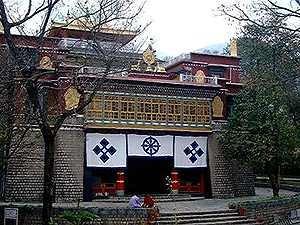
Following Gandhi's Path - Part 1 - Really, India shouldn't be possible

Travelling is living, as H. C. Andersen has said. Travelling in India is like living another kind of life. Actually, the only way to do it successfully is to leave Swedish life at home and not think anymore about it. India is infinitely large, mysterious, wonderful and disgusting. It is poor and rich; it is sublime, meditative and infernally noisy. It has a dazzling beauty but it is about to die because of the pollution. It is nice and friendly; yet I haven’t seen any other place in the world where there are so many tiresome, nagging, obtrusive and indeed insolent people, according to the Swedish norms that is.

It is perfectly impossible to make sweeping general statements about India, other than that it makes generalizations impossible. Travelling in India is experiencing a constant interplay of love and hate. And of positive surprises about life. A challenge, to say the least!

India is one and yet many civilisations in a particular arrangement, a part of the world which probably would survive without difficulties even if the rest of the world disappeared – maybe even enjoying a renaissance. It is neither Orient nor Occident. It is both of them but it is first and foremost India, nothing else. India is not its name, which is something invented by westerners; its real name is Bharat. Hinduism has not only one, but at least 300,000 manifestations of gods, including actors from the Bombay film industry, Bollywood. Yet they have a Hindu fundamentalism, all the same. The word “Hindu”, just like the word “curry” is not part of any language in India; it refers to a people living beyond the river Sindu or Indus. Indus has given name to the country of India, but the region today belongs to the country of Pakistan!

How to write about a country or rather a notion, which has the longest constitution in the world (400 pages), 17 official languages, 35 different languages being spoken by more than one million people and 22,000 dialects? A society where Hindi is understood (but not spoken) by somewhat less than half of the population, making it and all other languages minority-languages. What to think of the assertion that India is “the biggest democracy of the world”, when half of its people are still illiterate and the majority, the 700,000 villages, do not seem to make any kind of progress at all?

This India is a myth, a dream, a vision which is not thought to be true. Still it is a very tangible reality which no one in the world can avoid being influenced by, whether travelling there or not. India is the mother of two world religions, Hinduism and Buddhism, and of Jainism and Sikhism. It is also the biggest Muslim country. India is backward, but at the same time it is one of the most outstanding countries in the world as far as research and technology is concerned. It is also a nuclear power. Here you can live on US$1,5 a day with full pension, but you can also find the most luxurious hotels with rooms that cost US$ 400 a day. India remains obstinately itself, yet it is also a tragic product of colonialism and present globalization.

I shall write about this enigmatical Bharat in a series of articles under the title, “Following Gandhi’s Path”. Well, not exactly, since during nine weeks of wandering about, I never went further south than Bombay nor further east than Sevagram, a tiny village in the middle of the country, where Gandhi once was sitting in a clay hut and through a telephone installed by the English directed most things. Thus, I have familiarized myself with a third of this macrocosmos, and, in truth, know just a little about India. My purpose was not to study India, just let it be the environment in which I had four other objectives.
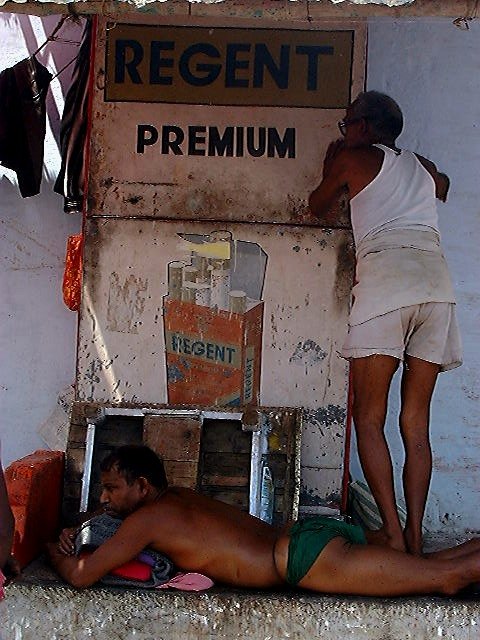
Massage at Varanasi – © Photo Jan Öberg TFF 2001

To begin with, I wanted to live a different life. I wanted to look at my ordinary life in Sweden and the west from the outside, at a distance. I wanted to be quit of all the material profusion, live simply, reflect on what I am actually doing, take it easier, be open to impressions, and just be carried along by a slower rhythm. However, for reasons I’ll tell you later on, I could not enjoy too much peace of mind, the woods and beaches of Skåne in southern Sweden seem to be more apt for that, but India has much that Skåne is missing!

Another purpose I had was the lectures I was to give to young Tibetans in Dharamsala at the foot of the Himalayas. Under the guidance of the Danish Center for Conflict-Resolution, they will establish a training centre which teaches young Tibetans how to handle their own conflicts, which they inevitably have in the Indian communities where they live. It gave me an opportunity to come to a better and useful understanding of the question of Tibet, and to realize how huge, deep and unhappy a matter it is and how ignorant I had been for so long as a person in my profession – a peace researcher.

A third purpose of mine was to visit the places of central significance to Mohandas K. Gandhi, whom I don’t call Mahatma, i.e. “Great Soul”, because he really didn’t like that word used about himself. At the same time I also wanted to meet researchers and popular movements who act in the spirit of Gandhi.

So I travelled to Delhi, Amritsar, Bombay, Puna, Sevagram, Ahmedabad (however, after the earthquake), Surat, Dandi and Dharasana. Gandhi does not play much more than a symbolic role nowadays. Still he means a lot to many people living in the countryside. If he was living now, the federal politicians would certainly have imprisoned him. Today India is practising politics that are a systematic negation of all that Gandhi stood for. And I daresay that this is an important underlying reason for the tragedy that is also happening in India right now.

A fourth matter concerned the fact that it is practically impossible to travel to India without thinking also of religion, even if the interest is purely that of a tourist. Varanasi is the centre of Hinduism. Bodghaya and Rajgir are two of the most important places of Buddhism. This is where Shakyamuni had wandered around, dedicating his life to full asceticism, but discovered better ideas and reached full wisdom under the papal or Bodhi tree at Bodghaya. At Sarnath outside Varanasi he started spreading his newly won philosophy to his disciples.

Of course, I also wanted to see The Golden Temple at Amritsar in the Punjab in order to understand at least a small part of Sikhism, which can be defined as a sort of mixture of Hinduism and Islam. Finally I went to see all the small Jain temples I could find. Jainism is the most ascetic and non-violent of all religions. There are Jainists who sweep the way clean before their feet in order to eliminate the risk of trampling any living organism to death! However, Jain temples are wonderfully un-ascetic, they are filled with fantastic statues, colours, bells and mystery.

Finally, I also had a fifth purpose: to have India as the background to the other four. The world cannot escape India anyway. Not taking account of it is impossible. Whatever its millions of inhabitants decide to do today or tomorrow is of great importance and is likely to affect the rest of the world, as is the case with China. I decided to be a special sort of tourist. Most of them arrive in buses, are guided around in groups and fly large distances from one city to another. Others try to manage it on their own, hiring cars with a guide or buying local travel packages.

I decided to do it in a more “Indian” way by arranging the travel on my own, travelling by train and local coaches, trying to find tickets and sleeping accommodation using the Lonely Planet-bible as well as local (mis)informants. This way I met people of all kinds and I was compelled to share the rhythm of the local population; average speed of a coach is 20-30 km/hour and that of the express train is 50-60 km/hour. In the beginning, it is totally frustrating, but then, little by little, you discover that this slowness makes you feel better.

Leaving one’s ordinary life in order to enter another world is like leading a fascinating double-life. You become more observant; life feels more vital. Describing such a journey is actually a way of prolonging life.

Please come along with me, but do also travel on your own!

Translated by Alice Moncada
Translation edited by Sara E. Ellis
Peace & future researcher + ‌Art Photographer

Share

Leave a Reply

Your email address will not be published. Required fields are marked *

Related Posts

Since the beginning of the violence in Republic of Macedonia there has been an imposed “peace process” by the President of Republic of Macedonia and the “international community”. Now, when the framework Agreement for Solution of the Political and Security Crises is in its final draft, it is likely that the violence will not stop. The reasons are not solely the Agreement or the “players” who reached it. It has become obvious that the “President’s peace plan” and all the actions in the “peace process,” no matter if by the Government, the President or others, had been set on the wrong foot from the beginning. The aim of this article is to highlight some of the facts that speak about the premises and proposed solutions in the “peace process” rather than perpetuates the popular “picture” and the international image-making. That is why the concrete proposals of the peace plan are...
The plunging airliners, commandeered by terrorists, ripped gaping holes in more than the towers of the World Trade Center. They ripped away the veneer of security that we believed surrounded us. We in America can never again feel secure in the same way.  We were vulnerable before the hurtling planes crashed into the World Trade Center, but we never stopped to think that this could happen to us. Now we understand our vulnerability, and our lives will never be the same.  What madmen seek to kill us? Are the plans for the next attacks already set in motion? Are there more suicidal phantoms, coiled like cobras, in our midst? We remain apprehensive with good reason.  Some Americans are calling for vengeance. But we are fighting phantoms, and our military power is not sufficient to assure an end to future threats. It will not be so easy to find these terrorists...
In the world of nuclear deterrence theory, beliefs are everything. What the leaders of a country perceive and believe is far more important than the reality. Nuclear deterrence is a seemingly simple proposition: Country A tells country B that if B does X, A will attack it with nuclear weapons. The theory is that country B will be deterred from doing X by fear of nuclear attack by country A. For deterrence to work, the leaders of country B must also believe that country A has nuclear weapons and will use them. Nuclear deterrence theory holds that even if country A might not have nuclear weapons, so long as the leaders of country B believed that it did they would be deterred. The theory goes on to hold that country A can generally rely upon nuclear deterrence with any country except one that also has nuclear weapons or one that...

Recent Articles

Everyone driving must turn around at the bus and cab station. Dharamsala is actually car-free, peaceful, chaotic and characterised by an astounding pioneering spirit. The street scene is dominated by monks in wine-red clothes and a remarkably great number of beggars with leprousy. On this dangerous, Himalayan slope, fantastic architectural constructions, often hotels, are being built. But they are said to collapse quicker than they have been built, when heavy rains or glacier-melt water come down in torrents. Everything is beautiful around here, except the trees. It is forbidden to cut down their very trunk, but everywhere people have climbed up and chopped off all their limbs. After all, they need firewood. Power cuts happen on a daily basis and, of course, electricity is rationed – except when the governor of the federal state of Himachal Pradesh, to which Dharamsala belongs, descends on his subjects for an official visit. At...
Travelling is living, as H. C. Andersen has said. Travelling in India is like living another kind of life. Actually, the only way to do it successfully is to leave Swedish life at home and not think anymore about it. India is infinitely large, mysterious, wonderful and disgusting. It is poor and rich; it is sublime, meditative and infernally noisy. It has a dazzling beauty but it is about to die because of the pollution. It is nice and friendly; yet I haven’t seen any other place in the world where there are so many tiresome, nagging, obtrusive and indeed insolent people, according to the Swedish norms that is. It is perfectly impossible to make sweeping general statements about India, other than that it makes generalizations impossible. Travelling in India is experiencing a constant interplay of love and hate. And of positive surprises about life. A challenge, to say the...
Since the beginning of the violence in Republic of Macedonia there has been an imposed “peace process” by the President of Republic of Macedonia and the “international community”. Now, when the framework Agreement for Solution of the Political and Security Crises is in its final draft, it is likely that the violence will not stop. The reasons are not solely the Agreement or the “players” who reached it. It has become obvious that the “President’s peace plan” and all the actions in the “peace process,” no matter if by the Government, the President or others, had been set on the wrong foot from the beginning. The aim of this article is to highlight some of the facts that speak about the premises and proposed solutions in the “peace process” rather than perpetuates the popular “picture” and the international image-making. That is why the concrete proposals of the peace plan are...

TFF on Substack

Discover more from TFF Transnational Foundation & Jan Oberg.

Most Popular

Everyone driving must turn around at the bus and cab station. Dharamsala is actually car-free, peaceful, chaotic and characterised by an astounding pioneering spirit. The street scene is dominated by monks in wine-red clothes and a remarkably great number of beggars with leprousy. On this dangerous, Himalayan slope, fantastic architectural constructions, often hotels, are being built. But they are said to collapse quicker than they have been built, when heavy rains or glacier-melt water come down in torrents. Everything is beautiful around here, except the trees. It is forbidden to cut down their very trunk, but everywhere people have climbed up and chopped off all their limbs. After all, they need firewood. Power cuts happen on a daily basis and, of course, electricity is rationed – except when the governor of the federal state of Himachal Pradesh, to which Dharamsala belongs, descends on his subjects for an official visit. At...
Travelling is living, as H. C. Andersen has said. Travelling in India is like living another kind of life. Actually, the only way to do it successfully is to leave Swedish life at home and not think anymore about it. India is infinitely large, mysterious, wonderful and disgusting. It is poor and rich; it is sublime, meditative and infernally noisy. It has a dazzling beauty but it is about to die because of the pollution. It is nice and friendly; yet I haven’t seen any other place in the world where there are so many tiresome, nagging, obtrusive and indeed insolent people, according to the Swedish norms that is. It is perfectly impossible to make sweeping general statements about India, other than that it makes generalizations impossible. Travelling in India is experiencing a constant interplay of love and hate. And of positive surprises about life. A challenge, to say the...
Since the beginning of the violence in Republic of Macedonia there has been an imposed “peace process” by the President of Republic of Macedonia and the “international community”. Now, when the framework Agreement for Solution of the Political and Security Crises is in its final draft, it is likely that the violence will not stop. The reasons are not solely the Agreement or the “players” who reached it. It has become obvious that the “President’s peace plan” and all the actions in the “peace process,” no matter if by the Government, the President or others, had been set on the wrong foot from the beginning. The aim of this article is to highlight some of the facts that speak about the premises and proposed solutions in the “peace process” rather than perpetuates the popular “picture” and the international image-making. That is why the concrete proposals of the peace plan are...
Read More
Norbulinka1
Everyone driving must turn around at the bus and cab station. Dharamsala is actually car-free, peaceful, chaotic and characterised by an astounding pioneering spirit. The street scene is dominated by monks in wine-red clothes and a remarkably great number of beggars with leprousy. On this dangerous, Himalayan slope, fantastic architectural constructions, often hotels, are being built. But they are said to collapse quicker than they have been built, when heavy rains or glacier-melt water come down in torrents. Everything is beautiful around here, except the trees. It is forbidden to cut down their very trunk, but everywhere people have climbed up and chopped off all their limbs. After all, they need firewood. Power cuts happen on a daily basis and, of course, electricity is rationed – except when the governor of the federal state of Himachal Pradesh, to which Dharamsala belongs, descends on his subjects for an official visit. At...
Imagen-thumbnail-The-Transnational-1
Since the beginning of the violence in Republic of Macedonia there has been an imposed “peace process” by the President of Republic of Macedonia and the “international community”. Now, when the framework Agreement for Solution of the Political and Security Crises is in its final draft, it is likely that the violence will not stop. The reasons are not solely the Agreement or the “players” who reached it. It has become obvious that the “President’s peace plan” and all the actions in the “peace process,” no matter if by the Government, the President or others, had been set on the wrong foot from the beginning. The aim of this article is to highlight some of the facts that speak about the premises and proposed solutions in the “peace process” rather than perpetuates the popular “picture” and the international image-making. That is why the concrete proposals of the peace plan are...
Imagen-thumbnail-The-Transnational-1
The plunging airliners, commandeered by terrorists, ripped gaping holes in more than the towers of the World Trade Center. They ripped away the veneer of security that we believed surrounded us. We in America can never again feel secure in the same way.  We were vulnerable before the hurtling planes crashed into the World Trade Center, but we never stopped to think that this could happen to us. Now we understand our vulnerability, and our lives will never be the same.  What madmen seek to kill us? Are the plans for the next attacks already set in motion? Are there more suicidal phantoms, coiled like cobras, in our midst? We remain apprehensive with good reason.  Some Americans are calling for vengeance. But we are fighting phantoms, and our military power is not sufficient to assure an end to future threats. It will not be so easy to find these terrorists...
Imagen-thumbnail-The-Transnational-1
In the world of nuclear deterrence theory, beliefs are everything. What the leaders of a country perceive and believe is far more important than the reality. Nuclear deterrence is a seemingly simple proposition: Country A tells country B that if B does X, A will attack it with nuclear weapons. The theory is that country B will be deterred from doing X by fear of nuclear attack by country A. For deterrence to work, the leaders of country B must also believe that country A has nuclear weapons and will use them. Nuclear deterrence theory holds that even if country A might not have nuclear weapons, so long as the leaders of country B believed that it did they would be deterred. The theory goes on to hold that country A can generally rely upon nuclear deterrence with any country except one that also has nuclear weapons or one that...
Imagen-thumbnail-The-Transnational-1
framfart och resenärer Introduktion Globalisering är ett ord som nämns allt oftare i tidningar, på TV och av gemene man. Trots detta är det inte många som vet vad termen globalisering egentligen innebär och vad den verkligen syftar till. Det är inte underligt då sökandet efter den rätta definitionen är i full gång och åsikterna går isär om hur en sådan ska se ut. Det finns heller ingen konsensus om vilka konsekvenser globaliseringen genererar. Vissa talar om homogenisering och andra om fragmentering. Några betonar ekonomiska faktorer som framväxten av transnationella företag och en världsmarknad, medan somliga fokuserar på teknologiska framsteg och ökad kommunikation. Det råder ovisshet och osäkerhet om vad som egentligen händer och i vilken riktning vi är på väg. Vad innebär dagens utveckling för individer, samhällen och nationalstater? Detta är enligt vår mening en viktig och spännande fråga till vilken det dock inte finns något enkelt och tillgängligt...
Imagen-thumbnail-The-Transnational-1
What people around the world wrote to and about TFF 1136 letters, comments and signature by September 12 – and more come in every day! From people of all walks of life in 62 countries. We did not know that we had SO MANY friends. More than one-third chose to not only write their name in support of TFF but also add very warm, sometimes strong, appreciaiton of our work. You may find your own words here. We are overwhelmed. We thank you from the bottom of our hearts. All messages were copied and sent on September 14 to the Minister of Foreign Affairs, HE Anna Lindh and to the Ministry’s preparatory committee which recommends which organisations to give organisztional support. Please see also the analysis of the worldwide constituencies and our analysis in Swedish of the Ministry’s decision. The Swedish government shoul be proud to support TFF and its efforts to a...