Ending the fight in Ukraine

The struggle for the Donbass region in the eastern and southern Ukraine goes on, seemingly never ending. It’s now six years since dissident militias threw off the yoke of the central government in Kiev and declared their de-facto independence. They were supported by Russian troops which at first president Vladimir Putin denied and then later admitted.

It was the Russians who supplied the missile launcher that accidentally shot down a Malaysian Airlines passenger jet. Altogether 17,000 people, mostly civilians, have died in this conflict.

Negotiations, brokered by Germany and France, have been held on and off for six years. In December the latest effort was held in Paris. The parameters of a settlement are easily put: in return for Donbass being granted a large amount of autonomy (it could be approximately the same as Scotland has today), Russian troops would withdraw and the militias disbanded.

Nevertheless, the gap between the positions of Moscow and Kiev appears almost impossible to bridge, not least because the central government has been slow to reform itself in the way that the Western negotiators have demanded.

The US and the EU have tried to encourage it to move faster but rather than using economic and military pressure to get it to the starting line they have taken a soft approach, indeed sometimes going the wrong way with the US’s supply of sophisticated armaments to the Kiev government.

There is one very appealing way to cut through the impasse. It is for Kiev to act unilaterally and announce it is giving up Donbass. Why not? It is a drain on Ukraine, both politically and economically, and Donbass offers little to the rest of Ukraine except territory.

It would no longer have to subsidise what is in effect a rust belt of decaying industries and where unemployment is massive and inflation has soared. Nor does it have to deal with the region’s disproportionate number of corrupt oligarchs, political elites and criminal gangs.

Moreover, without the Donbass participating in Kiev’s decision making, the centre has been freer to push ahead with economic reforms and improving the quality of its governance. Indeed, much of the economic burden has fallen on Russia. No wonder that Kiev sometimes gives the impression it likes the status quo.

President Putin has created his own imbroglio and Russian popular support for Donbass has withered. The fighting has stalemated and the costs appear to increase every year.

The alternative of Russia invading Donbass and taking it over is a non-starter as far as the Kremlin is concerned. It would only inherit an economic stew that it would be burdened with for years to come.

It would create a Ukrainian resistance movement and millions of refugees. I suspect that a majority of Russians have “Donbass fatigue”.

Thus, if Kiev ended its sovereignty over Donbass unilaterally, it would be checkmate for Russia and a win for Ukraine. Since the Cold War ended Kiev has had an uneasy relationship with Donbass that has long been part of Russian culture, religion and mainly speaks that language.

It should be happy to part ways.

Ukraine should count the benefits of letting Donbass go. The government could cut the costs for its military and no longer need to import expensive weaponry.

If it succeeded in negotiations in winning Donbass back, the economist Anders Aslund estimates it would cost 20 billion US dollars to put Donbass on its feet again when Ukraine’s entire annual budget is around 26 billion. (1)

The environmental damage caused by the fighting is immense.

The rust-belt factories are even more run down. Health services have been degraded. Infrastructure has been neglected. There are 35,000 separatist soldiers. They have to be demobbed and then retrained for civilian jobs- another significant expense.

Even then the tens of thousands of weapons in circulation would have to be run to ground. Inevitably some of these soldiers, enjoying combat, would remain a thorn in Ukraine’s side.  

Does the Kiev government need such an expensive mess? Surely not.

If Donbass were integrated back into Ukraine several million anti-Western voters would be added to Ukraine’s already divisive mix. Indeed, only because they no longer appear on Ukraine’s voter rolls Ukraine has been more able to pass the reforms of the last five years. The Donbass-based oligarchs would regain their foothold.

The one trouble with these arguments for letting the Donbass go is that Putin in his heart may not want eternal responsibility for the Donbass, with all its flaws and troubles.

Faced with Kiev saying it no longer wants the Donbass what would he do? 

In this situation he may capitulate to Kiev. Then Kiev would have no choice but to initiate a slow process of re-integration, despite the cost.

On the positive side, in time, as the fighting passed into a distant memory, Ukraine could be considered for membership of the EU. At the moment that is frozen which does Ukraine no good at all.

It’s a paradox but true: if Kiev says it is prepared to let Donbass secede, it will keep it and the Russians will go.

Editor’s note

The government budget is slightly higher (around US$ 45 billion), according to some sources – but, still, the argument is valid and the country has huge debts. The quoted source here also seems to mix million and billion.

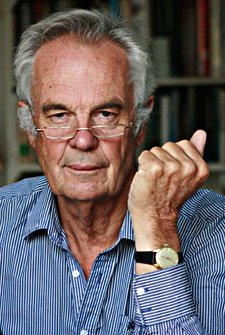
Foreign affairs columnist, film-maker and author

Share

Leave a Reply

Your email address will not be published. Required fields are marked *

Related Posts

Officially, the drones were not identified. By simply thinking critically – which journalists and selected experts no longer do – there may be a good reason for that. And this article will never be mentioned in Denmark… Drones over Denmark. No damage. No trace. No answers. Yet the headlines scream “Russian threat,” and Prime Minister Mette Frederiksen speaks with a certainty that defies logic: “We don’t know they were Russian—but we know Russia is the biggest threat to Europe.” It could be nobody else – unless you make an interest analysis which I did two days ago. This is not security policy. It’s theatre. And the audience is being played. Let’s rewind. These drones—unphotographed, untracked, unclaimed—appear and vanish like ghosts. Airports shut down. Panic spreads. Military budgets swell. And the narrative hardens: Russia is behind it. But what if that’s not just wrong but deliberately misleading? Here’s a hypothesis for...
And why the world, especially the EU, must now declare itself independent of the United States. UN’s 80th anniversary This year, the United Nations celebrates the 80th anniversary of its founding. The UN was formed after the scourge of the Second World War, in which 70 to 85 million people were killed and many countries were destroyed. That war came on the heels of the First World War, which also killed between 15 and 22 million people. After the Second World War, especially after the use of nuclear weapons by the United States, which marked a turning point in the history of warfare that could result in the end of civilisation as we know it, humanity decided to move away from the era of empires and big power politics and usher in a new era of peace, freedom and cooperation. These were the principles enshrined in the UN Charter. The United States...
Drones over Nordic airports. No damage. No trace. No answers. Most assume Russia—but what if that’s not so? Why is there so much we are not told? This article explores the strategic ambiguity behind recent drone incursions and asks: Who else might benefit from sending drones into NATO airspace? From Ukraine’s surprising drone supremacy to Russia’s possible signalling, the silence itself may be the loudest message. These are the kinds of questions decent, intelligent investigative journalists and commentators could easily research. Why don’t they? Did you, dear reader, know or think of this? That the most powerful weapon in today’s conflicts might be the one that leaves no trace – and no answers. Just enough fear to justify the next move? Recently, drones have repeatedly appeared over Nordic airports and near some military facilities. They cause no damage – for which reason the designation “hybrid attack” is misleading but serves a purpose. These...

Recent Articles

Former UN Under-Secretary-General with special responsibility for peacekeeping operations TFF associate August 20, 2003 YRINGHAM, Mass.- Ralph Bunche was born in Detroit 100 years ago today (August 7, 2003). His passionate determination to get results did not extend to seeking credit for them, so his work is better remembered than he is. Of all his many accomplishments – civil rights pioneer, Nobel Peace Prize laureate, chief drafter of two chapters of the United Nations charter, negotiator of the armistices that ended the first Arab-Israeli war – Bunche said he was proudest of developing what came to be known as peacekeeping. Setting up the United Nations Truce Supervision Organization in Palestine in 1948, Bunche formulated the principles that have governed peacekeeping operations ever since. In the 1956 Suez crisis, working with Secretary General Dag Hammarskjold and Lester Pearson of Canada, he organized the first peacekeeping force, the United Nations Emergency Force...
– nästan 11 månader Till Sofia nästan 11 månader # 1  Till Sofias huvudsida Till alla Privata Foto-Serier
Till Sofias huvudsida

TFF on Substack

Discover more from TFF Transnational Foundation & Jan Oberg.

Most Popular

Former UN Under-Secretary-General with special responsibility for peacekeeping operations TFF associate August 20, 2003 YRINGHAM, Mass.- Ralph Bunche was born in Detroit 100 years ago today (August 7, 2003). His passionate determination to get results did not extend to seeking credit for them, so his work is better remembered than he is. Of all his many accomplishments – civil rights pioneer, Nobel Peace Prize laureate, chief drafter of two chapters of the United Nations charter, negotiator of the armistices that ended the first Arab-Israeli war – Bunche said he was proudest of developing what came to be known as peacekeeping. Setting up the United Nations Truce Supervision Organization in Palestine in 1948, Bunche formulated the principles that have governed peacekeeping operations ever since. In the 1956 Suez crisis, working with Secretary General Dag Hammarskjold and Lester Pearson of Canada, he organized the first peacekeeping force, the United Nations Emergency Force...
– nästan 11 månader Till Sofia nästan 11 månader # 1  Till Sofias huvudsida Till alla Privata Foto-Serier
Till Sofias huvudsida
Read More
Imagen-thumbnail-The-Transnational-1
Former UN Under-Secretary-General with special responsibility for peacekeeping operations TFF associate August 20, 2003 YRINGHAM, Mass.- Ralph Bunche was born in Detroit 100 years ago today (August 7, 2003). His passionate determination to get results did not extend to seeking credit for them, so his work is better remembered than he is. Of all his many accomplishments – civil rights pioneer, Nobel Peace Prize laureate, chief drafter of two chapters of the United Nations charter, negotiator of the armistices that ended the first Arab-Israeli war – Bunche said he was proudest of developing what came to be known as peacekeeping. Setting up the United Nations Truce Supervision Organization in Palestine in 1948, Bunche formulated the principles that have governed peacekeeping operations ever since. In the 1956 Suez crisis, working with Secretary General Dag Hammarskjold and Lester Pearson of Canada, he organized the first peacekeeping force, the United Nations Emergency Force...
– nästan 11 månader Till Sofia nästan 11 månader # 1  Till Sofias huvudsida Till alla Privata Foto-Serier
Till Sofias huvudsida
BlackNobel
OK, Trump did not get it. But he got a full endorsement of a possible future US regime change in Venezuela. And that is what Ms Machado has advocated. On October 10, 2025, the Norwegian Nobel Committee awarded its Peace Prize to Venezuelan opposition figure María Corina Machado. The citation praised her “tireless work promoting democratic rights.” But Ms Machado has openly called for U.S. military intervention in Venezuela, stating on CBS: “The only way to stop the suppression is by force—U.S. force.” She or her party has received funding from the National Endowment for Democracy (NED), a U.S. government-backed body known as a CIA front organisation and for supporting regime-change operations worldwide. And in 2018, she sent a letter to Israeli Prime Minister Benjamin Netanyahu, asking him to use “force and influence” to help dismantle Venezuela’s government—citing alleged ties to terrorism, Iran and narcotrafficking. This year’s NATO Norwegian prize...
Screenshot-2025-10-08-163458
PRESS RELEASE – 6 OCTOBER 2025 LAY DOWN YOUR ARMSPEACE PRIZE FOR 2025 is awarded Francesca Albanese The United Nations Special Rapporteur on the occupied Palestinian territories – as the person who, in accordance with Alfred Nobel’s will, has “done the most or the best work for fraternity between nations and for the abolition or reduction of standing armies as well as for the holding and promotion of peace congresses.” Francesca Albanese has forcefully and unwaveringly worked against Israel’s full-scale war on the occupied Palestinian territories, in particular Israel´s ongoing genocide against the Palestinian people. She has confronted Israel’s systematic war crimes and crimes against humanity in a truly global outreach. Further, she has brought governments, international organisations and people’s groups together to underline the responsibility of the world at large to act and to stop arming, enabling, and profiting from Israel’s ongoing criminal actions. But first of all, Albanese...
Copilot_20251003_003414
Officially, the drones were not identified. By simply thinking critically – which journalists and selected experts no longer do – there may be a good reason for that. And this article will never be mentioned in Denmark… Drones over Denmark. No damage. No trace. No answers. Yet the headlines scream “Russian threat,” and Prime Minister Mette Frederiksen speaks with a certainty that defies logic: “We don’t know they were Russian—but we know Russia is the biggest threat to Europe.” It could be nobody else – unless you make an interest analysis which I did two days ago. This is not security policy. It’s theatre. And the audience is being played. Let’s rewind. These drones—unphotographed, untracked, unclaimed—appear and vanish like ghosts. Airports shut down. Panic spreads. Military budgets swell. And the narrative hardens: Russia is behind it. But what if that’s not just wrong but deliberately misleading? Here’s a hypothesis for...