
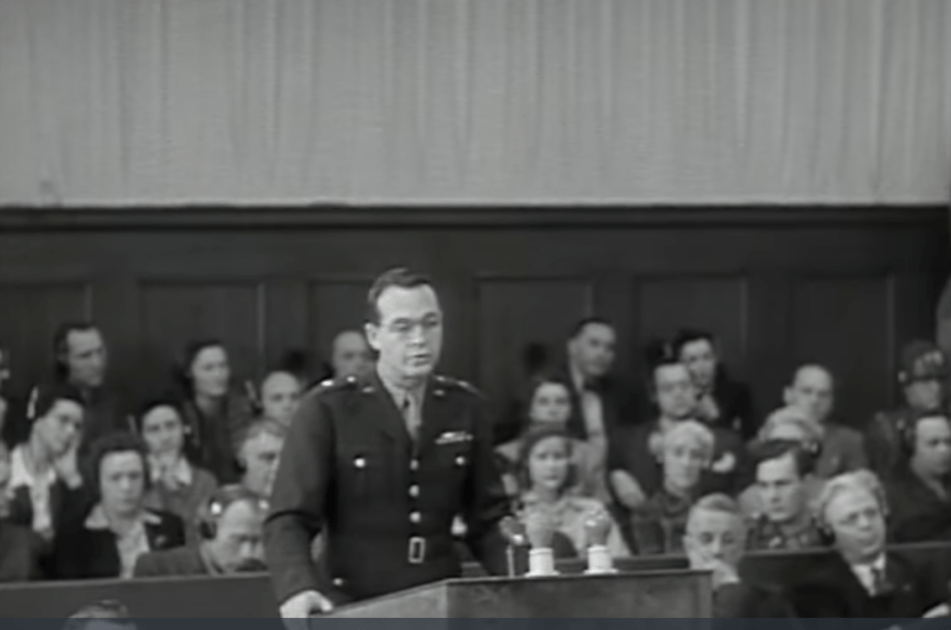
Telford Taylor giving his opening remarks at the judges trial, Nuremberg, 1947.
June 12, 2022
I was in Nuremberg during the war crimes trials which followed WWII. My father, Brig. Gen. Telford Taylor, was Chief Prosecutor during the second, American phase. The French, Russian and British staffs had gone home to continue trials at home, but the US stayed longer, and scheduled about 400 additional defendants. They were divided into twelve categories: judges, doctors, industrialists, etc. There were 142 convictions and ten death sentences.
I remember the high spirits of the occupying troops and tribunal staff,
The joy of triumph and victory. I danced with them in the ballroom of the Grand Hotel, where the officials and court lawyers spent their evenings. I scared myself by looking into seemingly-bottomless bomb craters, played in the war-shattered wreckage of our commandeered townhouse, and listened to stories told by the servants, who were tearfully glad to be fed and sheltered during the hunger-stricken post-war years.
And, without paying much attention or expressing any precocious interest, I grew up convinced of the axiomatic importance, however difficult it might be to maintain universal accountability, of international law for human survival.
Originally published by Counterpunch on June 3, 2022
Although war crimes continued to flourish, the Nuremberg tribunal slowly drifted into the dustbin, often disparaged as victor’s justice. My dad, in his book about the My Lai massacre in Vietnam, was pessimistic about the enforceability of its precepts. The International Criminal Court, established in 2002, seemed to concentrate mostly in Africa, and the ghost of colonialism was in attendance at all the special tribunals. Books were written accusing the US of war crimes in Iraq, which created a mere ripple in the public consciousness.
However, as a result of Russia’s invasion of Ukraine, this year, journalists have taken up the subject of war crimes with enthusiasm. Even my local paper published an editorial demanding that a war crimes tribunal be organized to hang Putin, as the Nuremberg war criminals were hanged. Karim Khan, chief prosecutor for the International Criminal Court (ICC), is on site conducting investigations. Vladimir Putin is accused of waging aggressive war.
At the Nuremberg tribunals, four charges were brought against defendants: premeditated conspiracy to commit the crimes against the peace, the crime of initiating aggressive war, war crimes, and crimes against humanity. The judges asserted that waging aggressive war was the gravest crime of all: it was “essentially an evil thing” and “not only an international crime; it is the supreme international crime, differing only from other war crimes in that it contains within itself the accumulated evil of the whole”.
To my knowledge, since then, no one has been charged with the first two charges: conspiracy to instigate a war, and the initiation of a war of aggression. However, many influential voices are now accusing Russian President Putin of committing these crimes.
Russia invaded Ukraine on Feb 24th 2022. By describing this assault as a “special operation” instead of an act of war, Russian President Putin avoided legal interface with a document for which he confesses great respect, the United Nations Charter. This document, like the Nuremberg Charter, has been frequently dismissed by state actors as obsolete, and is nonchalantly violated by many nations including the US. Although he distinguished the invasion as a special operation, Putin has referred to the document in the context of Russia’s actions:
Chapter 2 article 4 states that “All Members…shall refrain from the threat or use of force” against another nation. Chapter 7 Article 51, however, states that “nothing… shall impair the inherent right of… self-defense if an armed attack occurs against a Member”.
The OSCE (Organization for Security and Cooperation in Europe), an intergovernmental organization with Observer status in the United Nations, addresses the issue of the limits of security: ”States will not strengthen their security at the expense of other states…every state has an equal right to security, with comparable levels of security for all”.
The OSCE Charter was designed expressly to contribute to the formation of a common and indivisible security space in the OSCE area, free of dividing lines.
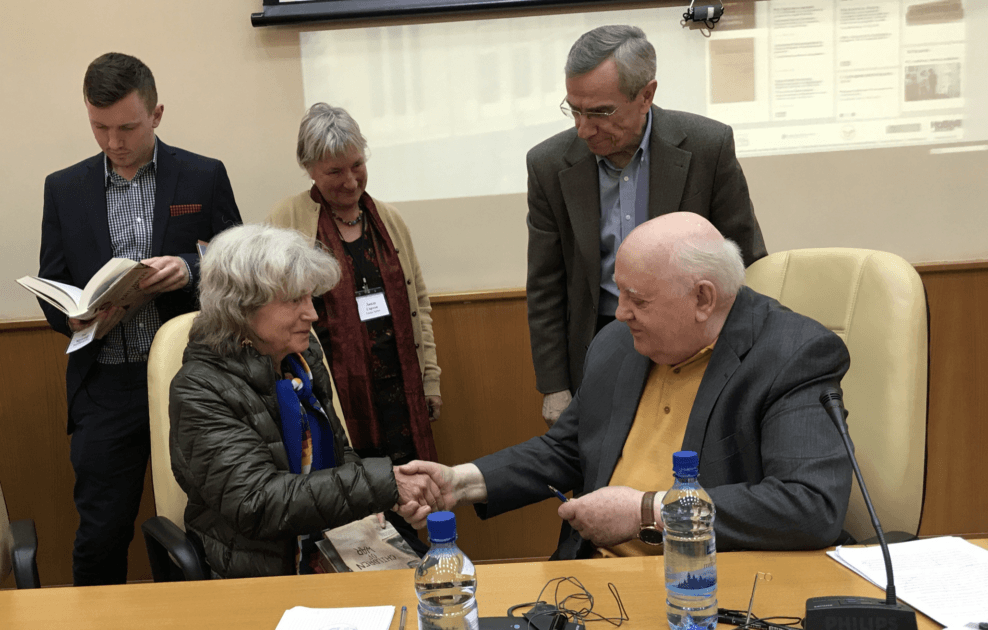
Russian efforts to achieve peace in Europe and security for the Russian people were exemplary and extensive since the fall of the Berlin Wall, and the subsequent dissolution of the Union of Soviet Socialist Republics. President Michael Gorbachev had been euphoric when the Berlin Wall went down in 1991. He himself had barely escaped WWII : only three out of a hundred boys, just a little older than he, survived. He nevertheless suffered heavy personal losses, from the war, and under Stalin.
Now, as the wall fell, his anxiety evaporated, and in his elation he dared to speak of “Our Common European Home – from the Atlantic to the Urals”. He had formed friendships with most of Europe’s leaders. He believed that his acceptance of German reunification would lead to an age of peace, and that the heretofore hostile military organization, NATO, would cease its aggression.
He had been assured of this, over and over, by US Secretary of State, James Baker (NATO will move “not one inch eastward”), German Vice-Chancellor Hans-Dietrich Genscher (“ the changes in Eastern Europe and the German unification process must not lead to an impairment of Soviet security interests”), Helmut Kohl, German Chancellor( “We believe that NATO should not expand the sphere of its activity”), Baker again (“Before saying a few words about the German issue, I wanted to emphasize that our policies are not aimed at separating Eastern Europe from the Soviet Union. We had that policy before. But today we are interested in building a stable Europe, and doing it together with you”),French leader Francois Mitterrand (“The West must…. create security conditions for you, as well as European security as a whole”), Margaret Thatcher ( “We must find ways to give the Soviet Union confidence that its security would be assured…. CSCE could be an umbrella for all this, as well as being the forum which brought the Soviet Union fully into discussion about the future of Europe.”), G. H.W. Bush ( “So what we tried to do was to take account of your concerns expressed to me and others, and we did it in the following ways: by our joint declaration on non-aggression; in our invitation to you to come to NATO; in our agreement to open NATO to regular diplomatic contact with your government and those of the Eastern European countries; and our offer on assurances on the future”), NATO Secretary General Manfred Woerner (“We must not permit the isolation of the USSR from the European community…the fact that we will not place a NATO army outside of German territory gives the Soviet Union a firm guarantee”), and President G.H.W.Bush ( “We have no intention, even in our thoughts, of harming the Soviet Union in any way”). He believed that that a bright new world was at hand.
Because of the terrors of its history in the last centuries, Russia was unwilling to give up this dream expressed by Gorbachev. Therefore, its expressions of indignation were muted when the United States began almost instantly to meddle in Russian affairs, transmitting information acquired through the NSA to help Boris Yeltsin’s rise to power. When the Soviet Union collapsed, Russian assets were sold off, many to foreign conglomerates, and the economy was pillaged.
Russian protest, also, was mild, when, in 1999, the West definitively broke its word, and a procession of countries, whose borders extended 800 miles to the east of the 1991 lines, began to make their entrances into NATO. By 2007, fourteen countries had been added to NATO since the Wall had fallen.
George Kennan was a well-known historian and diplomat, and ambassador to Russia through the Stalinist period. He greeted this next step, the expansion of NATO to include the previous Warsaw Pact countries, with disbelief and disgust:
“I think it is a tragic mistake. There is no reason for this whatsoever. No one was threatening anybody else. I was particularly bothered the references to Russia as a country dying to attack Western Europe. What bothers me is how superficial and ill-informed the whole Senate debate was. Russia’s democracy is as far advanced, if not farther, than any of these countries we’ve just signed up to defend from Russia.
But something of the highest importance is at stake here. Perhaps it is not too late to advance the view that, I believe, is not only mine alone but is shared by a number of others with extensive and in most instances more recent experience in Russian matters. The view, bluntly stated, is that expanding NATO would be the most fateful error of American foreign policy in the entire post-Cold-War era.”
Vladimir Putin, who came to power in 2000, exhibited the same reluctance to give up the Dream, expressed by Gorbachev, of a “Common European Home”. In 2000, he asked then-US- President Clinton if Russia could join NATO. This was not a novel idea: Krushchev had made the same request in 1954, and Boris Yeltsin in 1991. Both requests were dismissed.
As for Clinton, he bluntly retorted that if Russia were part of NATO there would be no reason for it to exist.
Putin’s life, like Gorbachev’s, had been devastated by WWII: his brother killed, his family destroyed by the terrible siege of Leningrad.
The spectacle of military installations bristling with missiles in an ominously strengthening cordon surrounding Russia, and the tramp of thousands of boots, as NATO conducted military exercises on its borders (estimated at about four simulated battles a month, with Russia in the role of enemy force) finally woke up Russia’s historical memory of invasion. At the Munich Conference, in 2007, addressing the 43rd Munich Conference of Security Policy, an alarmed President Putin delivered a powerful and now famous speech, addressing the noose he perceived, tightening around Russia.
He began by quoting FDR, “security for one is security for all” and denouncing the unipolar world which had resulted from the Soviet Union’s collapse: a world with only one master, which is destructive of that security “pernicious not only for all those within this system, but also for the sovereign itself because it destroys itself from within.”
Observing that unipolarity does not bring peace and alluding to the wars in the Middle East, he noted that “more people are dying than ever before” due to the “uncontained use of hyper-force in international relations”.
“No one feels safe!” he repeated. “No one can feel like international law is like a stone wall which will protect them!” and, after addressing the ring of NATO bases and missiles surrounding Russia, he asked, pointedly,
“I think it is obvious that NATO expansion does not have any relation with the modernization of the Alliance itself or with ensuring security in Europe. On the contrary, it represents a serious provocation that reduces the level of mutual trust. And we have the right to ask: against whom is this expansion intended?”
The audience of diplomats and statesmen and women exchanged glances and were silent.
Then he presented a visual picture of a new architecture of global security which called to mind Gorbachev’s “Common European Home”. He detailed the need for bringing about a fairer system of global economic relations to replace the current one in which donor countries “deliver charity with one hand and collect profits with the other.”
He lamented the stagnation of disarmament efforts and the billions spent on nuclear weapons. He decried the US withdrawal from the ABM treaty, and announced he had brought a proposal to the conference, to end the threatened US militarization of space. He embraced the UN Charter as a cornerstone for the new security architecture and a foundation with which to replace the unipolar system with multipolarity.
Putin did not mince words in his speech. He was earnest and unambiguous. But, two months later, with a proverbial poke in the Russian Bear’s eye, in Bucharest, at the NATO ministerial summit, NATO welcomed Ukraine’s and Georgia’s Euro-Atlantic aspirations for membership in NATO.
Since then, Russia has made every possible effort to express its alarm at the spectacle of NATO’s armed might on its borders.
It has watched, as NATO’s military exercises have increased: battalions from the different countries are deployed on Russia’s borders and engage “the enemy” in various scenarios, including nuclear, an estimated forty time a year. One such script envisioned atrocities being committed against Estonia, a NATO country, by conventional invading Russian forces. Enacted responses practiced the use of low-yield nuclear missiles deployed from US submarines.
There are military bases well-supplied with weapons in every NATO country on Russia’s borders, including trillion-dollar missile shields in Romania and Poland. The ABMs can be converted to offensive weapons by merely inserting a disc.
“Europe 2020” was designed to be the largest military exercise in 25 years. It deployed 125,000 troops from NATO countries. US troops brought 20,000 pieces of equipment from home, and rushed toward previously established storage positions around Europe to deploy more weapons as swiftly as possible and meet 9000 troops already in Europe on Russia’s border. As a sort of psyops feature, the exercise was to have consummated on the 80th anniversary of Operation Barbarossa, the Nazi invasion of Russia in 1941, a deeply traumatic and resonating catastrophe in Russian history. The exercise had to be aborted because of covid.
In the face of this menace, Russia’s General Gerasimov stated he was convinced that NATO was preparing for war. And indeed there is no way these exercises can be described as nonthreatening. But the US views them differently. In the words of former Army Secretary Ryan McCarthy, “The last 18 years of conflict built muscle memory in counterinsurgency, but with this came atrophy in other areas. We are now engaging these other muscle groups.”
US diplomats , clearly not expecting to be believed, claimed that missiles positioned on Russia’s borders were intended for Iran. Jack Matlock, former ambassador to Russia, practically laughing as he spoke, told Putin that NATO’s line of fortresses was merely a jobs plan, intended to decrease the US unemployment rates.
General Tod Wolters, Commander of US forces in Europe and Supreme Allied Commander Europe, favors a “flexible first-use policy” regarding nuclear weapons.
As General Mark Milley , chairman of the Joint Chiefs of Staff, observed, “the character of war is changing frequency”. Our nation is bent on an aggressive upgrade of existing weapons systems, and purchase of new technology: hypersonic weapons capable of 15,000mph speeds, artificial intelligence surpassing the imagination of science fiction, autonomous systems and platforms, 5G, “low-yield” nuclear weapons, dramatic advances in cyberspace with microelectronics swifter by many orders of magnitude. For outer space we have developed what former President Trump described at their unveiling as “some of the most incredible weapons the world has ever seen”.
The new National Defense Strategy embodies the same spirit as its predecessors going back to the Plan for the New American Century of 1996. It requires full-spectrum dominance. It prepares for a high-end, “near-peer” war. Its goals are” integrated deterrence, campaigning and actions that build enduring advantages”. “Integrated deterrence” here means, engaging the contributions of all branches of the military, the above-described forward motion of weapons and bases toward enemies, exercises, and adventures such as the provocative entrance of guided missile-carrying destroyers with aerial escort, sailing (as they did) into the Barents Sea, to “enforce freedom of navigation”.
“Campaigning” includes infiltration, use of special forces, the media, disinformation dissemination, cyber sabotage, sanctions, and other tactics to achieve the objectives of full spectrum dominance. “Build enduring advantages” means unwavering attention to and purchase of the latest weapons technologies.
The word “Competitor” is used in the document interchangeably with “enemy”.
Over the years, in preparation for furthering this dominance, in spite of entreaties from the UN, allies, and Russia and China themselves, the US has withdrawn from multiple treaties: ABM(2002),Iran Nuclear Deal (2018), UN Human Rights Council(2018), INF (2019), the Nuclear Nonproliferation treaty (2020), and the Open Skies Treaty (2020).
Neither Russia or China is eager for the role of US adversary, the “near-peer” enemy which will help the US to “reactivate atrophied muscle groups”. They have had to be teased, baited and tortured, like reluctant bulls in a bullfight, into responding. The Ukraine catastrophe is part of the result.
Russians are deeply attached to the Ukraine, which was part of Russia for far longer than the US has existed: indeed, for most of Ukraine, from the 9th century until 1991. This love has been dismissed as mystical nonsense by editorials in the New York Times and other opinion-forming media. Naomi Klein has described it as “toxic nostalgia.”
Nostalgia occupies an enormous realm in human nature. It is the deep and ever-stirring nursery for human creativity. It sometimes motivates self-defense, as in the American indigenous peoples’ resistance to assimilation, or the Russian kulaks’ resistance to Stalin-imposed collectivization. It is toxic when it drives military or cultural aggression.
However, nostalgia notwithstanding, Russia did not resist Ukraine’s bid for independence in 1991, nor did it interfere with the illegal coup of 2014, only taking the critically self-protective step of reclaiming its naval base in Sebastopol and liberating Krushchev’s gift to Ukraine, Russian Crimea.
To be sure, there is nostalgia, just as the people of my bioregion dream of the mighty salmon runs and giant trees of their childhood. Ukraine and Russia have what might be called a chthonic relationship, one relating to the earth, the rivers, the spirit. Students of Russian history, culture and literature, begin their educational journey with immersion in the life and events of Rus, what is now Ukraine. The Russian Orthodox Church had its origins in Ukraine.
The action of Russia’s great epic poem, “The Song of Igor’s Campaign,” occurs in present-day Ukraine. It is, is, in beauty and profundity, comparable to the Shanameh of Persia, the Kalevala of Scandinavia, the Mesopotamian Gilgamesh, or the French Song of Roland. It is beloved in Russia and memorized by Russian schoolchildren. Many of Russia’s and the world’s favorite authors are Ukrainian: Nikolai Gogol, Mikhail Sholokov, Mikhail Bulgakov, Isaac Babel, Taras Shevchenko. Aleksander Solzenitsyn’s mother was Ukrainian.
The Cossack culture which persisted for centuries in eastern Ukraine between the Don and the Dnieper, is a romantic, and music -and -legend-filled part of Russian cultural heritage. Though much older and deeper, it has a role in art and history not unlike US western movies and literature.
Ukrainians are extensively intermarried with Russians, statesmen among them. Leonid Brezhnev was Ukrainian, Nikita Krushchev had a Ukrainian wife and was raised in the Ukraine, where he was Governor for many years. Dmitri Medvedev’s wife is Ukrainian.
Although there were separatist revolts after WWII in Ukraine, mainly instigated by western Ukrainians who had fought with the Nazis, the fact that Krushchev gave Crimea, home of the Russian Navy for almost 250 years, to Ukraine, in 1954, is evidence that he had not the slightest doubt of its intimate relationship with Russia.
Ukraine was the trusted repository for a large quantity (one-third!) of the Soviet Union’s nuclear arsenal, and an important nuclear research facility was located in Kharkov. However, it did not have command and control powers over these weapons and the preplanned launch codes remained in Russia. Therefore, after 1991 they were returned to Russia in the name of nonproliferation.
Thus, the destruction of this arsenal was in reality a destruction of Russian weapons. The Ukraine received assurances. It was inconceivable at the time that one day Ukraine would request their replacement with US weapons, to be pointed at Russia.
In the last decade Ukraine has been the flashpoint of NATO aggression. In 2014 the United States engineered “the most blatant coup in history” as George Friedman, CEO of Stratfor, the “shadow CIA”, described it. The US subsidized it with 5 billion dollars, and engineered it through, among others, Assistant Secretary of State Victoria Nuland, whose clearly recorded conversation with the US Ambassador to Ukraine, was hacked and revealed to the world. The coup was led by the Svoboda (Nazi) Party, and also recorded on tape and video as it violently overthrew democratically-elected Ukrainian President Victor Yanukovich and his government.
Since then, Ukraine has been swiftly developed into a theatre for potential military operations. NATO has conducted exercises. Scripts such as Rapid Trident, involving thousands of Ukrainians and foreigners, have been carried out at Yavoriv, a military base in Ukraine, in the Black Sea, and elsewhere. The Ukrainian military has become skilled, versatile, flexible and, with the help of NATO countries, especially the US, extremely well- armed. Academi, a private military company formerly infamous as Blackwater, has been training Ukrainian soldiers since 2015, especially in city warfare. Ukraine has developed a first-class military.
Over the past two decades Russian diplomats have exhaustively conveyed their objections to the ever-nearing shadow of NATO in Ukraine, but, after Maidan, Russian troops started to appear in greater numbers on Ukraine’s eastern border.
As President Putin observed, “For the US, Ukraine is a matter of geopolitical dividends. For Russia, it is a matter of life or death”.
Vladimir Zelensky campaigned for President of Ukraine in 2019 on a platform of peace, promising to end the fighting in eastern Ukraine where 14,000 eastern Ukrainians had died in the previous five years resisting the coup-imposed Ukrainian regime. He promised to implement the Minsk accords which entailed withdrawal of troops, meaningful dialogue, amnesty for participants in the fighting, release of prisoners, foreign aid withdrawal, special status for autonomy for Luhansk and Donetsk, Ukrainian control of the borders, and monitoring by the OSCE, the European Security and Cooperation organization.
He did not fulfill these campaign promises. Instead, he repeated Ukraine’s intentions to take back the Crimea and suppress the eastern oblasts, in March 2021. Russia’s consternation was expressed in the immediate deployment of tens of thousands of troops to the Ukrainian border.
For the next nine months Russia attempted to negotiate, without success. And, while NATO and US weapons and expertise continued to flow into Ukraine, the Russian standing army grew bigger and bigger on Ukraine’s eastern frontier. Putin reported, “Russia has been forced to respond at every step. The situation keeps worsening and deteriorating. And we are here today, in a situation when we’re forced to resolve it somehow”.
Accompanying Russia’s final negotiations proposal, in December 2021, Putin emphasized that he had “a knife at his throat” and “nowhere further to retreat to”.
His proposal again fell on deaf ears.
By now, Russia had amassed an army of over 100,000 troops on its western border with Ukraine. Opposite them Ukraine had itself amassed an army, the advance guard of which had for the previous decade managed to kill an estimated 14,000 eastern Ukrainians resisting the Maidan coup. As a further threat, NATO had sent additional troops and massive armaments to its member-countries along the Russian border.
Russia repeatedly and steadfastly denied US accusations that it was preparing to invade Ukraine. Ukrainian President Zelensky himself appeared not to believe it.
NATO’s intention was to precipitate an attack. From the legal perspective it was imperative not to be identified as the aggressor. Russia was aware of this too. The looming presence of the Russian army on the border was intended be a negotiations tactic, a forceful demonstration of Russia’s demand for security. Russian leadership owed this to its people: the responsibility to protect.
Rather than preparation for attack, the apparition of 100,00 Russian troops was more like a hunger strike. In the case of both, failure is death, and therein lies its strength, but also its weakness. The hunger striker depends on his captor’s interest in his survival, and it only works if he cares.
By February, U.S. President Biden was fairly dancing with his news that Russia was on the verge of an attack. On Feb. 15th, the OSCE reported that there had been 41 shellings of the Donbas by the Ukranian army. This increased to 756 the next day, then 316, 654, 1,413, 2,026, 2,026, 1,484, on the successive days. Russia, convinced that an attack was imminent, despairing of negotiations, persuaded by information contained in a hacked email, and aware of the danger of waiting any longer,
