
June 13, 2022
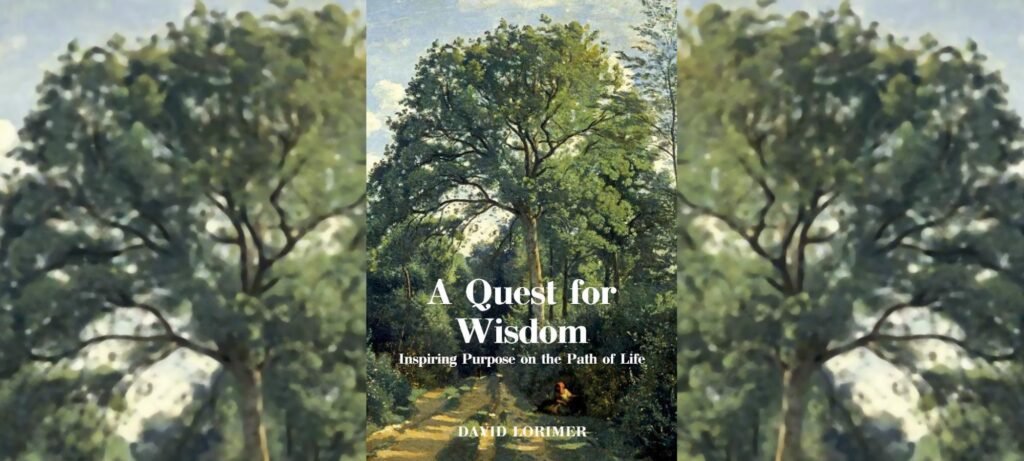
This is a fascinating and beautiful book, one of those gems you serendipitously discover and shake your head at your good fortune. Although it is new and I received it as a gift, it reminds me of a few books I have discovered over the years while rummaging through used bookstores that have startled me into a new perspective on life.
Ironically, these books have advised me, whether explicitly or implicitly, to be done with books, because what I was seeking cannot be found in them, for it floats on the wind. But this paradox is their secret. Such discoveries are memorable, and this is a memorable book in so many ways.
Originally published at off-guardian.org
Despite having read more books than I wish to remember, I had never heard of David Lorimer until being informed by a friend. A Scottish writer, poet, editor, and lecturer of great accomplishments, he is the editor of The Paradigm Explorer and was the Director of the Scientific and Medical Network from 1986-2000 where he is now Program Director. He has written or edited over a dozen books.
He is one of a dying breed: a true intellectual with a soul, for his writing covers the waterfront, by which I mean the vast ocean of philosophy, science, theology, literature, psychology, spirituality, politics, etc. A Quest for Wisdom [isbn.nu] is precisely what its name implies.
It is a compendium of wide-ranging essays written over the past forty years in pursuit of the meaning of life and the sagacity to realize one never arrives at wisdom since it is a process, not a product. Like living.
His opening essay on Victor Frankl, the Austrian psychiatrist who survived Auschwitz and wrote so profoundly about it in Man’s Search for Meaning, [isbn.nu] sets the stage for all the essays that follow.
For Frankl’s life and work, and the stories he tells about it, are about experiential, not theoretical, discoveries in the world where one finds oneself – even Auschwitz – where he learned that Nietzsche’s words were true:
He who has a why to live can bear almost any how.” He discovered that along life’s path – between life and death, happiness and suffering, peaks and valleys, yesterday and tomorrow, etc. – is where we always find ourselves by responding to the questions life asks us. He tells us, “Everything can be taken from a man but one thing: the last of the human freedoms—to choose one’s attitude in any given set of circumstances, to choose one’s own way.”
We are always in-between, and it is our attitude and conduct that allows us to freely will the meaning of our lives, no matter what. Frankl came to call this search for meaning logotherapy, or meaning therapy, by which an individual is always free to choose one’s stance or course of action, and it is by such choosing that the greatness of life can be measured and meaning confirmed in any single moment, even retrospectively.
He maintains that modern people are disorientated and living in “an existential vacuum,” pursuing happiness when it cannot be pursued since it is a derivative, a side effect, and “it is the very pursuit of happiness that thwarts happiness.” Happiness falls out of our pockets when we aren’t looking. Additionally, as Lorimer writes about Frankl, “He rejects psychoanalytical determinism…and the actualization of the self through any form of gratification.”
So does Lorimer, for he is an in-between man (as we all are if only we realized it), whether he is writing about Frankl, the absurd and the mysterious, the Tao, science and spirituality, the brain and the mind, near-death experiences (“near” being the key word), Albert Schweitzer, Dag Hammarskjöld, freedom and determinism, ethics and politics, etc.
Whatever subject he touches, he illuminates, leaving the reader to interrogate oneself. I find such questions in every essay in this book, and the path to answer them snaking through its pages.
I was especially touched by his 2008 essay, which was originally a memorial lecture, about his friend the Irish writer and philosopher John Moriarty, who died in 2007. Moriarty’s work was rooted in the wild land of western Ireland, a place whose rugged beauty has sprouted many a passionate artist and visionary who have drunk deep of the mythical spiritual connections of Irish culture and natural beauty.
He was a brilliant thinker and storyteller – that mysterious quality that seems so Irish – who left an academic career to seek deeper truths in nature. Influenced by D. H. Lawrence, Wordsworth, Yeats, Boehme, Melville, and Nietzsche, among other visionary seeking artists, he discovered a Blakean sense of reality that counteracted the deification of Reason and emphasized the need to recover our souls through sympathetic knowing that involved an embrace of intuition that went beyond cognition.
Lorimer writes:
Or, as John would put it, we have fallen out of our story and need to find a new one. Not only a new story, but also a new way of seeing and being, of relating as a part to the whole, as individuals to society, as cells to the body…To be is to have the potential to become something else, a potential which we don’t always fulfill, in spite of life’s invitations and initiations…We too easily retreat into fear, we batten down the hatches in the name of security, which is a mere shadow of peace.
Lorimer is clearly not anti-science, since for thirty-five years he has been deeply involved with the Scientific and Medical Network. But he has long realized the limitations of science and all the essays touch on this theme in one way or another. Wisdom is his goal, not knowledge.
He mentions Iain McGilchrist’s work in this regard – The Master and his Emissary: The Divided Brain and the Making of the Western World – wherein McGilchrist argues for a re-emphasis on the master right hemisphere “with its creative and holistic mode of perception,” rather than the left hemisphere with its logical, scientific mode of perception.
“Two voyages,” says Lorimer, “two modes of perception, which should coexist in a state of mutual respect. The rational and the intuitive are complementary rather than mutually exclusive.” Nevertheless, in his pursuit of wisdom, Lorimer, despite his nod to this mutuality, has discovered that the recovery of soul and meaning can only be found beyond cognition and Kantian categories.
His essay on “Tao and the Path towards Integration,” drawing on Carl Jung and Herman Hesse, et al., is a lucid exploration of what Jung calls “the vocation to personality.” This is the call life puts to everyone but many refuse to hear or answer: “Become who you are,” in Nietzsche’s enigmatic words, advice that is as much a question as a declaration. Lorimer writes:
Those who have not been confronted with this question will often consider those who have as peculiar, adding that there is no such thing as a vocation to personality, and their sense of being isolated and different is a form of spiritual arrogance; they should concern themselves with the really important things in life, viz ‘getting on’, and leading an inconspicuously normal existence.
These restless-busyness people are caught on the treadmill of getting and spending, and in their alienation from their true selves must disdain those who seek wholeness by grasping life’s polarities and paradoxes. Stillness in movement, being in becoming. Paradox: from Latin para = contrary to, and doxa = opinion. Contrary to common belief or expectation.
In “Cultivating a Sense of Beauty,” Lorimer uses his etymological understanding – which is so important for deep thinking and which he uses liberally throughout the book – to explain “the beauty of holiness, and the correspondence between beauty and truth.”
He is not some bliss-ninny who is in the interior soul decoration business devoid of political consciousness and care. Far from it. He understands the connection between real beauty in its deepest sense and its connection to love for all existence and the responsibility that this confers on everyone to resist war and all forms of political oppression.
What Camus tried to do: To serve beauty and suffering
“The English word ‘beauty’, like the French ‘beauté, is derived from the Latin ‘beare’ meaning to bless or gladden, and the ‘beatus’, blessed are the happy.” Appropriately, Lorimer quotes Wordsworth from “Intimations of Immortality.”
Thanks to the human heart by which we live,
Thanks to its tenderness, its joys, its fears,
To me the meanest flower that grows can give
Thoughts that do often lie too deep for tears.
Whether he is writing about Albert Schweitzer, Swedenborg, Voltaire, Dag Hammarskjöld, Peter Deunov (a Bulgarian mystic I first learned about here), he weaves their thought and witness into his overarching theme of the search for wisdom. Wisdom not in the navel-gazing sense but in the larger sense as wisdom for creating a world of truth, peace, and justice.
In the middle of the book’s three sections, called “Consciousness, Death, and Transformation,” he offers various intriguing pieces that explore near-death experiences and the philosophical, experiential, and scientific arguments for their reality.
In this rejection of the materialist conception of mind, brain, and consciousness, he relies on thinkers such as William James and Henri Bergson, but especially the Swedish scientist, philosopher, theologian, and mystic Emanuel Swedenborg (1688-1772) who had many psychic and spiritual experiences that have been both accepted as inspired and rejected as hokum.
Lorimer reminds us that Swedenborg was not some nutcase but a brilliant and accomplished thinker. “It’s not well known that Swedenborg wrote a 700-page book on the brain, in which he was the first to suggest complementary roles for the two hemispheres.”
Likewise, Lorimer’s work with The Scientific and Medical Network and the Galileo Commission over the decades roots his writing on this topic in the work of many prominent neuroscientists and is far from New Age gibberish. It is serious work that demands serious attention. He accurately writes:
The problem of death will not disappear if we ignore it. Sooner or later we must come to terms with our own nature and destiny. What is the nature of man, of death, and what are the nature of the implications of death for the way in which we live our lives? The first two questions amount to asking about the nature of consciousness.
In the third and final section – “Taking Responsibility: Ethics and Society” – Lorimer, drawing often on Albert Schweitzer who has deeply influenced him, applies the natural consequences of the soulful wisdom he embraces in the first two sections.
In the face of endless wars, poverty, ecological degradation, and the threat of nuclear war, etc., he writes:
Those who have the interests of humanity at heart cannot simply stand back in helplessness and despair: they must act themselves and arouse those around them to similar action or else abdicate their humanity by not shouldering their responsibility.”
This can be accomplished through a commitment to truth, love, peaceableness, kindness, and non-violent action, first at the individual level but crucially then when a sufficient number of people can be organized for this effort.
This in turn demands a spiritual commitment and an initial step of faith or confidence, which the person who wishes to devote him- and herself to humanity cannot not afford to make.”
His essay on Dag Hammarskjöld, the former Secretary-General of the United Nations, who was a key ally of President John F. Kennedy in their work for peace and decolonization and who, like JFK, was assassinated by CIA organized forces, is a perfect example of such faith and commitment in a true public servant.
Hammarskjöld was a deeply spiritual man, a mystical political man of action, and Lorimer, drawing on Hammarskjöld’s own writing, shows how he embodied all the qualities found in one who was truly wise: self-effacement, stillness in action, detachment, humility, forgiveness, and courage in the face of the unknown. He quotes Hammarskjöld:
Now, when I have overcome my fears – of others, of myself, of the underlying darkness – at the frontier of the unheard-of: Here ends the known. But, from a source beyond it, something fills my being with its possibilities.
I am reminded of JFK’s love of Abraham Lincoln’s prayer, which Kennedy lived by in the dark times before his assassination, which he anticipated: “I know there is a God – and I see a storm coming. If he has a place for me, I believe that I am ready.”
The last essay in this illuminating and inspiring book – “Towards a Culture of Love-an Ethic of Interconnectedness” – was written in 2007, and all of them go back many decades, but in case a reader of this review may wonder where Lorimer stands today, he has added an afterword with a postscript in which he writes briefly about today’s assault on heresy, dissidence, and those who have been falsely called “conspiracy theorists” in the CIA’s weaponized term.
I mention that to make clear that A Quest for Wisdom is not an encouragement to navel-gazing and some sort of pseudo-spirituality. It is a call to a spiritual awakening in today’s fight against radical evil. He makes clear that the conspiracy theorist label is being unjustly used against those who question the JFK assassination, the 9/11 Commission Report, Covid-19, etc.
He says we are being subjected to a major information war and extensive censorship of non-mainstream views.” He sums it up this way:
Over the past few months we have witnessed a new episode of Inquisition and the implicit creation of an online Index of Prohibited Material. There has been a steep rise in censorship by social media companies of views at variance with mainstream narratives: dissident content is summarily removed. Heretical and subversive views are not tolerated, open debate is stifled in favor of officially sanctioned orthodoxy, whistle-blowers are abused and demonized. Manipulated by fear and on a flimsy pretext of security, we are in danger of abjectly surrendering the very freedom of thought and expression that our ancestors fought so courageously to secure in the eighteenth century and which constitutes the essence of our Enlightenment legacy…
These are the words of a wise man and the author of a wonderful book.
Originally published at off-guardian.org
About the author

Edward Curtin is an independent writer whose work has appeared widely over many years. His website is edwardcurtin.com and his new book is Seeking Truth in a Country of Lies.
Please help TFF remain truly independent by contributing if you benefited from this article
[paypal-donation]
