
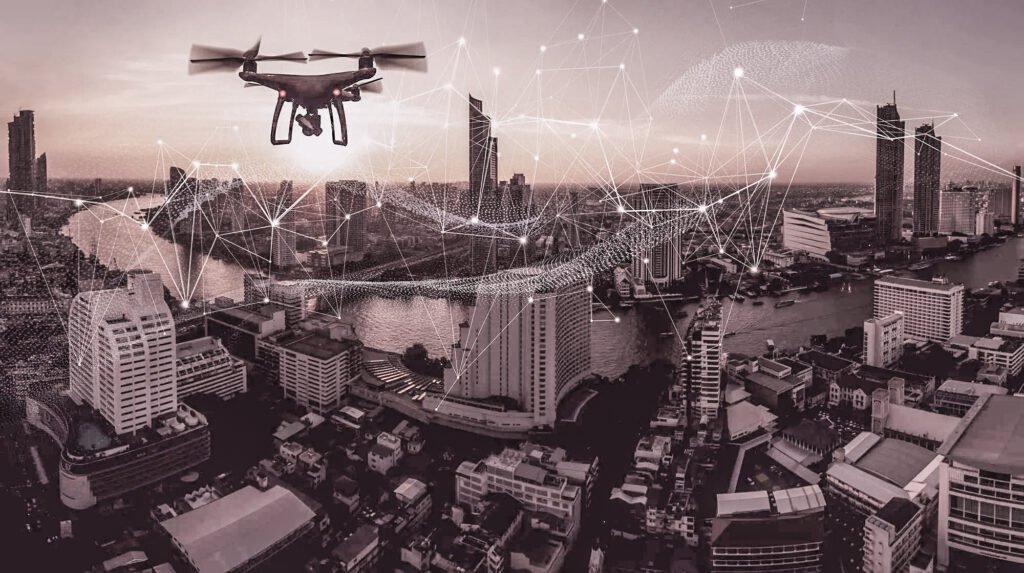
Don't be fooled: Others Could Have More Interest in Sending Drones to the Nordic Countries than Russia

Drones over Nordic airports. No damage. No trace. No answers. Most assume Russia—but what if that’s not so? Why is there so much we are not told?

This article explores the strategic ambiguity behind recent drone incursions and asks: Who else might benefit from sending drones into NATO airspace?

From Ukraine’s surprising drone supremacy to Russia’s possible signalling, the silence itself may be the loudest message.

These are the kinds of questions decent, intelligent investigative journalists and commentators could easily research. Why don’t they?

Did you, dear reader, know or think of this? That the most powerful weapon in today’s conflicts might be the one that leaves no trace – and no answers. Just enough fear to justify the next move?

Recently, drones have repeatedly appeared over Nordic airports and near some military facilities. They cause no damage – for which reason the designation “hybrid attack” is misleading but serves a purpose. These drones appear out of nowhere, leave no trace, and disappear. They seem not even to be photographed, pushed away or shot at. Yet airports shut down, headlines flare, and defence budgets will likely increase further – as will hatred against those pesky Russians whose evil they unfortunately can not show us any evidence of.

No one claims responsibility. No drones are intercepted. No origin is confirmed. This isn’t a technical failure. It’s a tactic. A pattern of engineered ambiguity, where the absence of attribution becomes the trigger for escalation.

We’ve seen this logic before. The Nord Stream pipeline was sabotaged. Russia was blamed. But no hard evidence ever appeared. Still, the consequences were immediate: energy decoupling, deepened economic crisis, NATO buildup, and hardened public opinion.

Now, drones seem to do something similar. They don’t attack. They just appear. And disappear. And leave behind fear – as well as speculation, and a growing appetite for military readiness. But let’s try an interest analysis which nobody does for reasons you can imagine.

Who might be behind it – and why?

Russia?

Can’t be excluded, of course. It could be testing NATO’s airspace defences, sowing confusion, or signalling reach. But it’s risky. If proven, it could justify NATO retaliation or deeper involvement in Ukraine. So far, Russia denies everything – and no country has presented hard proof.

And What If It Is Russia?

Suppose the drones are Russian. What then?

It could be a signal, a quiet warning. A way of saying: This is just a taste of what you’ll get if you keep building US bases, funding Ukrainian weapons factories, and buy new weapons that you know very well that we see as a direct threat -as you would if you were us.

Denmark, for example, has just announced it will acquire long-range strike weapons for the first time, perhaps including systems like the Tomahawk cruise missile and JASSM-ER for its F-35s. This marks a major shift: from defence to offensive deterrence, from shielding cities to striking deep into enemy territory.

From Russia’s perspective, this isn’t just military modernisation – it’s provocation and encirclement. And drone incursions, if they are Russian, could be a way to test airspace, disrupt readiness, and remind NATO that escalation cuts both ways.

But again – no one claims responsibility. No one confirms origin. And that silence is the loudest part of the message.

Ukraine?

Surprisingly, yes—Ukraine now has the technical ability to carry out such missions. You are not told that its drone industry has grown at an astonishing speed and out-competes that of Russia:

– Over 500 manufacturers.

– Monthly output of 200,000 FPV drones.

– Long-range systems reaching up to 750–800 km.

– AI-assisted swarms trained on thousands of combat missions.

Ukraine’s drones have already struck targets deep inside Russia. Reaching Nordic airspace is well within their range. If launched from a NATO country – say, Poland or a Baltic republic – they could be untraceable. And if they don’t cause damage, they leave only questions.

Would NATO ever tell you if Ukraine were behind such incursions? Certainly not – NATO would have endorsed it and even participated in this false flag operation. It would fracture alliances, expose covert coordination, and undermine the West’s narrative. Silence is safer.

Britain?

It’s possible. Britain has deep ties to Ukraine’s drone programs and a long history of covert operations. It could provide logistics, tech, or strategic framing – especially if the goal is to provoke Russia without direct confrontation.

Why airports?

Because they’re symbolic. Civilian infrastructure. Dual-use hubs. Shutting down an airport causes panic, grabs headlines, annoys travelling citizens and sends a message: “You’re vulnerable.” And in radar-heavy zones, drones are harder to track – perfect for plausible deniability.

What’s the Bigger Picture?

This isn’t just about drones. It’s about shaping public perception. Creating fear and justifying even higher defence spending. And preparing the ground for NATO’s deeper involvement in Ukraine – possibly under the label of “peacekeeping,” even though Russia would never accept NATO troops on Ukrainian soil, and NATO has no experience or capabilities in the field of peace-keeping.

The drones don’t need to explode. They just need to appear and vanish to make their masters’ point. And leave behind the – nasty – story used e.g. by the Danish PM about “we do not have the evidence that it is Russia, but we know Russia is the largest threat to Europe.”

But don’t be fooled. Someone knows exactly who staged this drone spectacle. The Nordic leaders know it too—and they know precisely what they want you to think and not to think.

And if they genuinely don’t know, then their military and civilian “intelligence” services are incompetent. To put it mildly.

Why this could be a false flag

I’ve got a nasty mind—and a few decades in the trenches of so-called security politics.

Here’s my hypothesis: When Zelensky met Trump at the UN, The Independent reports he got the green light to strike deep into Russia. Special Envoy Keith Kellogg confirmed the White House “does not object.” NATO’s Matt Whitaker echoed it: deeper strike capabilities to pressure Russia into negotiations. This marks a radical shift—a reckless escalation masquerading as strategy. And it’s madness – a madness that has to be justified.

In that light, the drone “attacks” look suspiciously like a false flag – designed to justify the next step up the escalation ladder. Media people and politically correct commentators focus on the here-and-now event, not on complexity and how events relate to each other.

The elites of MIMAC – the Military-Industrial-Media-Academic Complex – know nothing but military moves. They abandoned diplomacy, conflict resolution, and confidence-building – not to mention peace – long ago.

They operate in an echo chamber so thick with self-righteous groupthink that they can’t imagine that they could be wrong.

But they could well be. Fatally wrong – because they are more loyal to other elites than their own citizens and largely ignorant about the consequences of their deeds: After all they think it is about “us” winning and “them” losing. Because they do not have the intellectual capacity to solve problems, only to use hammers where none are needed.

In summary, watch events over the next 1–3 weeks. Then you’ll see what the drone “attacks” were really about.

Peace & future researcher + ‌Art Photographer

Share

Leave a Reply

Your email address will not be published. Required fields are marked *

Related Posts

PRESS RELEASE – 6 OCTOBER 2025 LAY DOWN YOUR ARMSPEACE PRIZE FOR 2025 is awarded Francesca Albanese The United Nations Special Rapporteur on the occupied Palestinian territories – as the person who, in accordance with Alfred Nobel’s will, has “done the most or the best work for fraternity between nations and for the abolition or reduction of standing armies as well as for the holding and promotion of peace congresses.” Francesca Albanese has forcefully and unwaveringly worked against Israel’s full-scale war on the occupied Palestinian territories, in particular Israel´s ongoing genocide against the Palestinian people. She has confronted Israel’s systematic war crimes and crimes against humanity in a truly global outreach. Further, she has brought governments, international organisations and people’s groups together to underline the responsibility of the world at large to act and to stop arming, enabling, and profiting from Israel’s ongoing criminal actions. But first of all, Albanese...
Officially, the drones were not identified. By simply thinking critically – which journalists and selected experts no longer do – there may be a good reason for that. And this article will never be mentioned in Denmark… Drones over Denmark. No damage. No trace. No answers. Yet the headlines scream “Russian threat,” and Prime Minister Mette Frederiksen speaks with a certainty that defies logic: “We don’t know they were Russian—but we know Russia is the biggest threat to Europe.” It could be nobody else – unless you make an interest analysis which I did two days ago. This is not security policy. It’s theatre. And the audience is being played. Let’s rewind. These drones—unphotographed, untracked, unclaimed—appear and vanish like ghosts. Airports shut down. Panic spreads. Military budgets swell. And the narrative hardens: Russia is behind it. But what if that’s not just wrong but deliberately misleading? Here’s a hypothesis for...
And why the world, especially the EU, must now declare itself independent of the United States. UN’s 80th anniversary This year, the United Nations celebrates the 80th anniversary of its founding. The UN was formed after the scourge of the Second World War, in which 70 to 85 million people were killed and many countries were destroyed. That war came on the heels of the First World War, which also killed between 15 and 22 million people. After the Second World War, especially after the use of nuclear weapons by the United States, which marked a turning point in the history of warfare that could result in the end of civilisation as we know it, humanity decided to move away from the era of empires and big power politics and usher in a new era of peace, freedom and cooperation. These were the principles enshrined in the UN Charter. The United States...

Recent Articles

Everyone driving must turn around at the bus and cab station. Dharamsala is actually car-free, peaceful, chaotic and characterised by an astounding pioneering spirit. The street scene is dominated by monks in wine-red clothes and a remarkably great number of beggars with leprousy. On this dangerous, Himalayan slope, fantastic architectural constructions, often hotels, are being built. But they are said to collapse quicker than they have been built, when heavy rains or glacier-melt water come down in torrents. Everything is beautiful around here, except the trees. It is forbidden to cut down their very trunk, but everywhere people have climbed up and chopped off all their limbs. After all, they need firewood. Power cuts happen on a daily basis and, of course, electricity is rationed – except when the governor of the federal state of Himachal Pradesh, to which Dharamsala belongs, descends on his subjects for an official visit. At...
Travelling is living, as H. C. Andersen has said. Travelling in India is like living another kind of life. Actually, the only way to do it successfully is to leave Swedish life at home and not think anymore about it. India is infinitely large, mysterious, wonderful and disgusting. It is poor and rich; it is sublime, meditative and infernally noisy. It has a dazzling beauty but it is about to die because of the pollution. It is nice and friendly; yet I haven’t seen any other place in the world where there are so many tiresome, nagging, obtrusive and indeed insolent people, according to the Swedish norms that is. It is perfectly impossible to make sweeping general statements about India, other than that it makes generalizations impossible. Travelling in India is experiencing a constant interplay of love and hate. And of positive surprises about life. A challenge, to say the...
Since the beginning of the violence in Republic of Macedonia there has been an imposed “peace process” by the President of Republic of Macedonia and the “international community”. Now, when the framework Agreement for Solution of the Political and Security Crises is in its final draft, it is likely that the violence will not stop. The reasons are not solely the Agreement or the “players” who reached it. It has become obvious that the “President’s peace plan” and all the actions in the “peace process,” no matter if by the Government, the President or others, had been set on the wrong foot from the beginning. The aim of this article is to highlight some of the facts that speak about the premises and proposed solutions in the “peace process” rather than perpetuates the popular “picture” and the international image-making. That is why the concrete proposals of the peace plan are...

TFF on Substack

Discover more from TFF Transnational Foundation & Jan Oberg.

Most Popular

Everyone driving must turn around at the bus and cab station. Dharamsala is actually car-free, peaceful, chaotic and characterised by an astounding pioneering spirit. The street scene is dominated by monks in wine-red clothes and a remarkably great number of beggars with leprousy. On this dangerous, Himalayan slope, fantastic architectural constructions, often hotels, are being built. But they are said to collapse quicker than they have been built, when heavy rains or glacier-melt water come down in torrents. Everything is beautiful around here, except the trees. It is forbidden to cut down their very trunk, but everywhere people have climbed up and chopped off all their limbs. After all, they need firewood. Power cuts happen on a daily basis and, of course, electricity is rationed – except when the governor of the federal state of Himachal Pradesh, to which Dharamsala belongs, descends on his subjects for an official visit. At...
Travelling is living, as H. C. Andersen has said. Travelling in India is like living another kind of life. Actually, the only way to do it successfully is to leave Swedish life at home and not think anymore about it. India is infinitely large, mysterious, wonderful and disgusting. It is poor and rich; it is sublime, meditative and infernally noisy. It has a dazzling beauty but it is about to die because of the pollution. It is nice and friendly; yet I haven’t seen any other place in the world where there are so many tiresome, nagging, obtrusive and indeed insolent people, according to the Swedish norms that is. It is perfectly impossible to make sweeping general statements about India, other than that it makes generalizations impossible. Travelling in India is experiencing a constant interplay of love and hate. And of positive surprises about life. A challenge, to say the...
Since the beginning of the violence in Republic of Macedonia there has been an imposed “peace process” by the President of Republic of Macedonia and the “international community”. Now, when the framework Agreement for Solution of the Political and Security Crises is in its final draft, it is likely that the violence will not stop. The reasons are not solely the Agreement or the “players” who reached it. It has become obvious that the “President’s peace plan” and all the actions in the “peace process,” no matter if by the Government, the President or others, had been set on the wrong foot from the beginning. The aim of this article is to highlight some of the facts that speak about the premises and proposed solutions in the “peace process” rather than perpetuates the popular “picture” and the international image-making. That is why the concrete proposals of the peace plan are...
Read More
Norbulinka1
Everyone driving must turn around at the bus and cab station. Dharamsala is actually car-free, peaceful, chaotic and characterised by an astounding pioneering spirit. The street scene is dominated by monks in wine-red clothes and a remarkably great number of beggars with leprousy. On this dangerous, Himalayan slope, fantastic architectural constructions, often hotels, are being built. But they are said to collapse quicker than they have been built, when heavy rains or glacier-melt water come down in torrents. Everything is beautiful around here, except the trees. It is forbidden to cut down their very trunk, but everywhere people have climbed up and chopped off all their limbs. After all, they need firewood. Power cuts happen on a daily basis and, of course, electricity is rationed – except when the governor of the federal state of Himachal Pradesh, to which Dharamsala belongs, descends on his subjects for an official visit. At...
Massage
Travelling is living, as H. C. Andersen has said. Travelling in India is like living another kind of life. Actually, the only way to do it successfully is to leave Swedish life at home and not think anymore about it. India is infinitely large, mysterious, wonderful and disgusting. It is poor and rich; it is sublime, meditative and infernally noisy. It has a dazzling beauty but it is about to die because of the pollution. It is nice and friendly; yet I haven’t seen any other place in the world where there are so many tiresome, nagging, obtrusive and indeed insolent people, according to the Swedish norms that is. It is perfectly impossible to make sweeping general statements about India, other than that it makes generalizations impossible. Travelling in India is experiencing a constant interplay of love and hate. And of positive surprises about life. A challenge, to say the...
Imagen-thumbnail-The-Transnational-1
Since the beginning of the violence in Republic of Macedonia there has been an imposed “peace process” by the President of Republic of Macedonia and the “international community”. Now, when the framework Agreement for Solution of the Political and Security Crises is in its final draft, it is likely that the violence will not stop. The reasons are not solely the Agreement or the “players” who reached it. It has become obvious that the “President’s peace plan” and all the actions in the “peace process,” no matter if by the Government, the President or others, had been set on the wrong foot from the beginning. The aim of this article is to highlight some of the facts that speak about the premises and proposed solutions in the “peace process” rather than perpetuates the popular “picture” and the international image-making. That is why the concrete proposals of the peace plan are...
Imagen-thumbnail-The-Transnational-1
The plunging airliners, commandeered by terrorists, ripped gaping holes in more than the towers of the World Trade Center. They ripped away the veneer of security that we believed surrounded us. We in America can never again feel secure in the same way.  We were vulnerable before the hurtling planes crashed into the World Trade Center, but we never stopped to think that this could happen to us. Now we understand our vulnerability, and our lives will never be the same.  What madmen seek to kill us? Are the plans for the next attacks already set in motion? Are there more suicidal phantoms, coiled like cobras, in our midst? We remain apprehensive with good reason.  Some Americans are calling for vengeance. But we are fighting phantoms, and our military power is not sufficient to assure an end to future threats. It will not be so easy to find these terrorists...
Imagen-thumbnail-The-Transnational-1
In the world of nuclear deterrence theory, beliefs are everything. What the leaders of a country perceive and believe is far more important than the reality. Nuclear deterrence is a seemingly simple proposition: Country A tells country B that if B does X, A will attack it with nuclear weapons. The theory is that country B will be deterred from doing X by fear of nuclear attack by country A. For deterrence to work, the leaders of country B must also believe that country A has nuclear weapons and will use them. Nuclear deterrence theory holds that even if country A might not have nuclear weapons, so long as the leaders of country B believed that it did they would be deterred. The theory goes on to hold that country A can generally rely upon nuclear deterrence with any country except one that also has nuclear weapons or one that...
Imagen-thumbnail-The-Transnational-1
framfart och resenärer Introduktion Globalisering är ett ord som nämns allt oftare i tidningar, på TV och av gemene man. Trots detta är det inte många som vet vad termen globalisering egentligen innebär och vad den verkligen syftar till. Det är inte underligt då sökandet efter den rätta definitionen är i full gång och åsikterna går isär om hur en sådan ska se ut. Det finns heller ingen konsensus om vilka konsekvenser globaliseringen genererar. Vissa talar om homogenisering och andra om fragmentering. Några betonar ekonomiska faktorer som framväxten av transnationella företag och en världsmarknad, medan somliga fokuserar på teknologiska framsteg och ökad kommunikation. Det råder ovisshet och osäkerhet om vad som egentligen händer och i vilken riktning vi är på väg. Vad innebär dagens utveckling för individer, samhällen och nationalstater? Detta är enligt vår mening en viktig och spännande fråga till vilken det dock inte finns något enkelt och tillgängligt...