
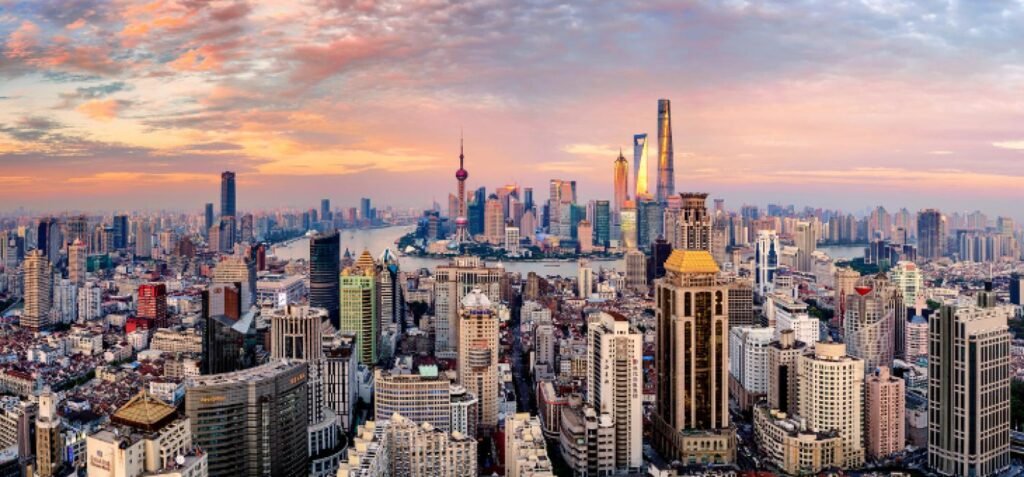

China: Key Player in a New World Game

The world’s rising powerhouse

China, the largest economy measured in Purchasing Power Parity | Image from Wall Street International.

In 1986 on returning for my first 3-week visit to China, I wrote an article, “China: Key Player in a New World Game” in The Futurist, December 1986. I had been invited by China’s State Council at the recommendation of my good friends, Alvin and Heidi Toffler, best-selling authors of Future Shock (1970), who both had, and still, have a big following in China.

This surprise invitation was to speak at “The First International Conference on Creativity”, co-sponsored by the United Nations Education & Scientific Cooperation Organization (UNESCO), along with Edward de Bono of Britain and US psychologist/philosopher Jean Houston, author of The Possible Human (1982).

Mystified, I called the phone number in China of Professor Xu, the convenor at Shanghai-based Jiaotong University, and asked why I had been invited to this event, all expenses paid. Professor Xu replied in perfect English, “In China, you are a great scholar and your two books Creating Alternative Futures (1978) and The Politics of the Solar Age (1981) are widely-read in their Chinese translations”.

Naturally, I was intrigued and accepted. Even though I was not aware of these translations, I was thrilled to have my work read by Chinese people and I was excited to make a closer connection with some of China’s 1 billion citizens and their over 5,000-year-old culture.

Fast forward to today and China, the world’s rising powerhouse, already the largest economy measured in Purchasing Power Parity (PPP), which corrects for over and undervalued currencies, which The Economist measures as “The Big Mac Index”, a more inclusive index than the Western-oriented GDP which still dominates mass media.

China is the world’s largest goods-trading partner of 64 countries versus 38 for the USA | Image from Wall Street International.

Today, our 21st Century global economy is no longer dominated by the USA, but is again a multi-polar world. According to The Economist, March 20, 2021, China now makes 22% of global manufactured exports and 15 of China’s tech firms are worth over $50 billion each. China is the world’s largest goods-trading partner of 64 countries versus 38 for the USA.

Western-oriented multi-nationals, Apple, Morgan Stanley, Goldman Sachs, Siemens, Facebook, Starbucks and many others, boost China’s economy. Beijing-dominated Hong Kong, still managing $11 trillion of US dollar payments in 2020, is also still hosting its $10 trillion of cross-border investments.

Meanwhile, China’s mainland attracted $163 billion of multi-national investments in 2020 and opened its capital markets to $900 billion of foreign investments. China’s leadership in solar, wind and batteries, still growing from 2009 to 2020 and today, is documented in our Green Transition Scoreboard® reports.

Over 500 Chinese companies produce electric vehicles, competing with Tesla in mid-range and lower-priced cars selling to Chinese buyers and capturing markets abroad. China’s Belt and Road global expansion is building with its high-speed rail and port-building expertise links to all the countries adjacent to Eurasia’s historic Silk Road.

These connections create infrastructure linking China to Europe, Pakistan, Russia, Vietnam, Cambodia, Sri Lanka along with other South Asian countries and many in Africa and Latin America.

These massive infrastructure investments are China’s form of development assistance loans and diplomacy, criticized by some as creating unrepayable debt. These projects are much cheaper than military hardware, with China’s military budget still a fraction of the US military budget.

China’s mainland attracted $163 billion of multi-national investments in 2020 | Image from Wall Street International.

China’s vaccine diplomacy for Covid 19 is winning friends in many developing countries while its pharmaceuticals, medical supplies and key exports have made the USA dependent, along with other countries on importing millions of cheap consumer items. Continuation of the Trump administration’s tariff policies and sanctions will prove counter-productive, as are its efforts to ban other countries from buying Huawei 5G electronic components.

The European Union inked a trade deal with China, after US requests to delay this until the incoming Biden administration could review it. Even US efforts to sanction China for its human rights violations of Uyghurs in Xinjiang and in Hong Kong are proving ineffective.

China merely deflects these by pointing out that as of the past five years the US form of democracy is failing internally due to racism, voter suppression, minority rule, and is now judged by many former allies as unreliable, after Trump’s dismantling of federal agencies and withdrawals from many treaty obligations.

China’s new approach to development assistance for other countries contrasts with the Western model, as described by Kristen A. Cordell of the Carnegie Endowment for International Peace, March 23, 2021.

Chinese economists are also overhauling their statistics, for the greening of finance and their Green GDP, as well as the approach to steering the Belt and Road projects toward green infrastructure, as Simon Zadek and Ma Jun describe in their report, Decarbonizing the Belt and Road: A Green Finance Roadmap from Shanghai’s Xinhua University, 2020.

China’s robust approach to impact and ethical investing is active in Syntao, headed by co-founders Guo Peiyuan and US asset manager Wayne Silby. Such more granular assessments are welcome on China’s current 5-Year Plan; 2021-2025, its rise as a preeminent world power and its “socialism with Chinese characteristics “displaying its pragmatic mix of markets, government, state-owned enterprises, digital entrepreneurs and monetary politics.

China now makes 22% of global manufactured exports | Image from Wall Street International.

These analyses, including Thomas Orlik’s China: The Bubble That Never Pops (2020), are based on lived experience in China and largely conform to my own. Of course, I share many of the more positive approaches to engaging China now coming from President Biden’s Press Conference of March 25th, based on his long experience and personal meetings with China’s more autocratic President Xi Jinping.

We can expect a careful, honest calibration on many issues between the USA and China, as Biden reknits all US relations with its allies ruptured so carelessly by Trump.

China’s rise is fundamentally different than that of the USA during the 20th Century, with emphasis since the 1980s of both Reagan in the USA and Margaret Thatcher in Britain, based on restoring open markets and prices to guide development and globalization with privatization, open capital markets, free trade and de-regulation.

These money and price-based policies and metrics are still prevalent, as in GDP and still pursued until recently by the World Bank, the International Monetary Fund (IMF) and the World Trade Organization (WTO), under the banner of the “Washington Consensus”.

GDP‘s money and price based cash flow measure was never intended by its inventor Simon Kuznets, to be an overall model of a country’s progress, as emphasized by the European Commission’s Beyond GDP conference in 2007, on which I served as an advisor, presenting the Calvert-Henderson Quality of Life Indicators.

GDP still does not have a separate asset account, as in double-entry book-keeping, to balance all governments’ investments in public goods and services: the vital roads, rails, ports, sewage treatment, public health and education that underpin all markets in all countries, including China and its massive expertise at providing China’s vast domestic infrastructure.

This means that all countries’ debt-to-GDP ratios are over-stated since these investments are recorded in GDP only as “debt”, and not balanced by the valuable public assets they created, along with all the private sector contracts let to private companies to provide them. This much-needed correction means that for 30 years these over-stated “debt-to-GDP ratios” could be cut by up to 50%, with a few keystrokes!

China opened its capital markets to $900 billion of foreign investments | Image from Wall Street International.

Western economists, the international financial institutions (IFIs), including the Bank for International Settlements (BIS) still focus on China’s “debt-to-GDP ratio” as equivalent to 254.4% of its GDP; Bloomberg’s estimate is 276.2 % and others’ estimates reach as high as 328 percent.

Thus, most fears of China’s “bubble” are still based on such faulty metrics. Today, as in most countries, notably in the EU, Canada, the USA and Brazil, politicians have shifted 180 degrees away from austerity, fears of debt, inflation and burdens of interest on our children toward the stimulus and the massive government investments needed to staunch the economic losses due to the pandemic.

Many are finally embracing the new paradigm of Modern Monetary Theory (MMT) which fully recognizes that deficits matter, but so do all these public assets, goods, services and infrastructure which underpin markets and private-sector production.

Prof. Stephanie Kelton, a former economist for the US Senate Budget Committee explains how these ideologies shifted in her The Deficit Myth (2020). Economic advisor to EU governments Mariana Mazzucato makes similar points in her The Entrepreneurial State (2015) and “The Value of Everything (2020). However, her recent view of China seems to reflect a lack of actual experience within China and with its leaders.

This new pragmatism is embraced after the failures of “market fundamentalism “and its misapplication of markets and money in social domains requiring collective government initiatives, where they create all the obvious “market-failures”. I describe these failures in Texas to provide water supplies and electricity in Faith in Electricity, as well as those in climate change, seen as the world’s biggest market failure.

Today, central banks admit that they create their sovereign nations’ money supply directly, issued by buying dud mortgages and other bonds for their asset accounts, as computer entries in their “Quantitative Easing” (Q.E). They also admit that they can create money directly, issuing currencies through their national Treasuries, rather than continuing to cede this immense privilege to their private banks.

These private commercial banks then create new money as loans to their customers, as new computer entries into their accounts. Amazingly, they also additionally impose interest on these loans and rely on the generous government allowances of holding only 10% of their fractional reserves on their books.

Economists, including John Kenneth Galbraith and many others, have described this kind of money creation as politics, with little transparency or effort to distribute this new money fairly, which citizens would find scandalous. In truth, as I point out in Fixing the Money Meme, governments can spend their sovereign currencies directly into their economies, not needing to “borrow” it at interest from private investors through bond dealers.

15 of China’s tech firms are worth over $50 billion each | Image from Wall Street International.

The constitutional authority to coin money is with governments, as in the USA, where Congress has the power of the purse, as described by many critics openly, including our monetary expert, lawyer Ellen Brown, in her many books and founder/president of the Public Banking Institute. In her Engine of Inequality: The Fed and the Future of Wealth in America (2021) monetary expert Karen Petrou spells out the shocking details.

This has always been true in China, where its currency the renminbi (RMB) or “yuan” is issued and controlled by the central Peoples Bank of China and all its government-directed investment banks. This is a reason why Western economists do not understand that Chinese banks will not fail, as Wall Street finance did in the 2008 collapse and 2009 government bailouts.

The diligence, creativity and intellectual achievements I witnessed in my many further trips to China after 1986 are now in full flower. There is already such deep interpenetration between the US and Chinese economies, as with many others in today’s globalization, that fomenting conflicts by any would be a “win-lose” for all, as I described in Building a Win-Win-World: Life Beyond Economic Warfare (1996, 2004 e-book).

Opportunities for mutual cooperation abound: building on and continuing the Paris climate agreements in 2015, in accelerating the growing greener, cleaner, renewable technologies and circular economies and their massive energy efficiency gains for all societies.

China has demonstrated ways of distributing the gains of smarter development internally, by bringing more of its people out of poverty than any other society in the world. China is now focusing on more domestic consumption by its own now affluent consumers, and its leadership in online finance, payments and fintech systems.

There is room for competition, cooperation and creativity in all relationships now demanded on our endangered planet: restoring biodiversity and re-directing assets stranded in fossilized sectors to the Solar Age economies now becoming mainstream investing.

Yet the money-meme and its narrow statistics and fundamentalist market economics still seem to rule the mainstream thinking, even in today’s Mediocracies and Attention Economies.

Yet we also witness both the USA and China joining the 193 signers of the United Nations’ Sustainable Development Goals (SDGs) and both countries still operating with the global rules generated by all the other UN treaties they have ratified. Therefore, like many other recent commentators, I see no need for any new “Cold War” between the USA and China.

There are so many deep connections and frank interchanges on internet access, regulation of harmful social media disinformation, research on pandemics, vaccines and sharing in global governance standards and bodies in UN treaties and all its agencies. This vision is spelled out by Prof. Zhouying Jin, of China’s prestigious Chinese Academy of Social Sciences in Beijing in her masterful The Future of Humanity: Global Civilization and China’s Rejuvenation (2018) in which I was honored to write a Preface.

As I wrote in 1996 of the global shifts to attention economies, we are seeing that consumers are now seeking experience and expanding their horizons, rather than ever more consumption of planet-destroying material goods. We are Steering our Powers of Persuasion Toward Human Goals on this planet, together!
Share

Leave a Reply

Your email address will not be published. Required fields are marked *

Related Posts

Editorial for Transcend Media Service, TMS, and published in an edited Q & A version by the China Social Science Network-China Social Science News. See also this follow-up, “Condemn all UN member states: They spend 100 times more on militarism than on the entire UN system.” The UN has been extremely important over the last 80 years in terms of, for instance, global dialogue, multi-dimensional development, international law, peace-keeping, normativity, violence condemnation, and ethics. It has been the place to hold member states accountable. The UN Charter is the most Gandhian document ever signed by the world’s governments. If the great majority of member states lived up to their obligations in accordance with the UN Charter and including the resolutions they have signed up to, the world would be a much more peaceful, just, democratic, and lawful place. Regrettably, there are several reasons why the world is not in accordance with those fine Charter norms and provisions:a) The majority...
Professor Zhang Weiwei is a highly respected Chinese intellectual and professor at Fudan University in Shanghai. He is the director of its China Institute and also runs a series of conversations with many different people around the world. Here is what came out of their meetings there and in Skopje, Macedonia in October 2024: & ◪ As you can see, also at the end of the second one, we both enjoy win-win exchanges like these about world order issues. Zhang Weiwei is known for using videos and social media to reach a large audience in China and worldwide. We suggest you see many more of Zhang Weiwei’s conversations – like recently with Professor Jeffrey Sachs – on the Thinkers’ Forum on YouTube. PS TFF posts hundreds of videos, its own and those of others, in our Video Collections on TFF Substack – including those that appear on YouTube. However, TFF...
Launched on November 17, 2024Updated with new materials regularly TFF Board members Thore Vest. Everywhere, the delegation was met with a sincere wish to develop knowledge, dialogue, cooperative projects, and initiatives based on citizens’ diplomacy – in general, but with the West in particular. For more, see “Report from the Nordic delegation to China’s Xinjiang Province, September 7-15, 2024.” While the delegation was in Xinjiang, various ideas were already being discussed from the local to the top level, i.e., with the governor and party leaders of Xinjiang. The two TFF Associates suggested that TFF set up a special section – in addition to its “China and Silk” – where various quality materials about Xinjiang would regularly be published to promote public education about Xinjiang, particularly its contemporary development – worldwide but in the West in particular. This is now a reality – as can be seen below – but it...

Recent Articles

We know that medical personnel have failed to report to higher authorities wounds that were clearly caused by torture and that they have neglected to take steps to interrupt this torture. In addition, they have turned over prisoners’ medical records to interrogators who could use them to exploit the prisoners’ weaknesses or vulnerabilities. We have not yet learned the extent of medical involvement in delaying and possibly falsifying the death certificates of prisoners who have been killed by torturers. A May 22 article on Abu Ghraib in the New York Times states that “much of the evidence of abuse at the prison came from medical documents” and that records and statements “showed doctors and medics reporting to the area of the prison where the abuse occurred several times to stitch wounds, tend to collapsed prisoners or see patients with bruised or reddened genitals.” http://www.truthout.org/docs_04/080604J.shtml#16 According to the article, two doctors who...
Jan Øberg behandler i artiklen en lang række faktorer, som ligger til grund for den måde vores samfund er organiseret på – og derfor også for konflikter. Artiklen introducerer således sammenhængen mellem familien, foreninger, regeringer, NGO’ er, nation, stat, nationalstat og alliancer for på denne måde bedre at kunne forstå konflikter og i sidste ende blive klogere mht. at løse disse. Øberg, der er fortaler for global bevidsthed, hvilket skal ses i lyset af den øgede globalisering, skelner mellem kulturkamp og kulturdialog. Endelig behandles begrebet magt og magtesløshed: giver magt ret til at udøve magt – fordi man mener at have ret? Litteraturliste og arbejdsspørgsmål efter artiklen. Ordene vi bruger om verden I satellitperspektiv kan man godt tale om den menneskelige familie eller menneskeheden. Udtrykket understreger, at der eksisterer – eller burde eksistere – et fællesskab fordi vi alle er mennesker og sammen bebor denne klode og ingen anden. Og...
Kapitel 2: Forskellige sider af Europa og USA…fortsat 2.5 Militære relationer I forbifarten har vi allerede sagt nogle ting om USA’s militære situation. Kig lige en gang til på afsnit 2.3. Nu skal vi uddybe det militære forhold mellem USA og EU. Der er en række ligheder mellem visse europæiske landes og USA’s militær. Næsten alle er med på en eller anden måde i NATO, direkte som medlem – selv Island, der ikke har et forsvar – eller indirekte i Partnerskab for Fred. USA og Canada er med i OSCE (på dansk OSSE), Organisationen for Sikkerhed og Samarbejde i Europa, der tæller over 50 lande. USA samt England og Frankrig er kernevåbenstater og de har styrker til intervention langt borte fra hjemlandet, om end USA’s er tifold større. Alle har også en omfattende våbeneksport og bruger den som et middel til at tjene penge og få loyale venner på, det...

TFF on Substack

Discover more from TFF Transnational Foundation & Jan Oberg.

Most Popular

We know that medical personnel have failed to report to higher authorities wounds that were clearly caused by torture and that they have neglected to take steps to interrupt this torture. In addition, they have turned over prisoners’ medical records to interrogators who could use them to exploit the prisoners’ weaknesses or vulnerabilities. We have not yet learned the extent of medical involvement in delaying and possibly falsifying the death certificates of prisoners who have been killed by torturers. A May 22 article on Abu Ghraib in the New York Times states that “much of the evidence of abuse at the prison came from medical documents” and that records and statements “showed doctors and medics reporting to the area of the prison where the abuse occurred several times to stitch wounds, tend to collapsed prisoners or see patients with bruised or reddened genitals.” http://www.truthout.org/docs_04/080604J.shtml#16 According to the article, two doctors who...
Jan Øberg behandler i artiklen en lang række faktorer, som ligger til grund for den måde vores samfund er organiseret på – og derfor også for konflikter. Artiklen introducerer således sammenhængen mellem familien, foreninger, regeringer, NGO’ er, nation, stat, nationalstat og alliancer for på denne måde bedre at kunne forstå konflikter og i sidste ende blive klogere mht. at løse disse. Øberg, der er fortaler for global bevidsthed, hvilket skal ses i lyset af den øgede globalisering, skelner mellem kulturkamp og kulturdialog. Endelig behandles begrebet magt og magtesløshed: giver magt ret til at udøve magt – fordi man mener at have ret? Litteraturliste og arbejdsspørgsmål efter artiklen. Ordene vi bruger om verden I satellitperspektiv kan man godt tale om den menneskelige familie eller menneskeheden. Udtrykket understreger, at der eksisterer – eller burde eksistere – et fællesskab fordi vi alle er mennesker og sammen bebor denne klode og ingen anden. Og...
Kapitel 2: Forskellige sider af Europa og USA…fortsat 2.5 Militære relationer I forbifarten har vi allerede sagt nogle ting om USA’s militære situation. Kig lige en gang til på afsnit 2.3. Nu skal vi uddybe det militære forhold mellem USA og EU. Der er en række ligheder mellem visse europæiske landes og USA’s militær. Næsten alle er med på en eller anden måde i NATO, direkte som medlem – selv Island, der ikke har et forsvar – eller indirekte i Partnerskab for Fred. USA og Canada er med i OSCE (på dansk OSSE), Organisationen for Sikkerhed og Samarbejde i Europa, der tæller over 50 lande. USA samt England og Frankrig er kernevåbenstater og de har styrker til intervention langt borte fra hjemlandet, om end USA’s er tifold større. Alle har også en omfattende våbeneksport og bruger den som et middel til at tjene penge og få loyale venner på, det...
Read More
Imagen-thumbnail-The-Transnational-1
We know that medical personnel have failed to report to higher authorities wounds that were clearly caused by torture and that they have neglected to take steps to interrupt this torture. In addition, they have turned over prisoners’ medical records to interrogators who could use them to exploit the prisoners’ weaknesses or vulnerabilities. We have not yet learned the extent of medical involvement in delaying and possibly falsifying the death certificates of prisoners who have been killed by torturers. A May 22 article on Abu Ghraib in the New York Times states that “much of the evidence of abuse at the prison came from medical documents” and that records and statements “showed doctors and medics reporting to the area of the prison where the abuse occurred several times to stitch wounds, tend to collapsed prisoners or see patients with bruised or reddened genitals.” http://www.truthout.org/docs_04/080604J.shtml#16 According to the article, two doctors who...
Imagen-thumbnail-The-Transnational-1
Jan Øberg behandler i artiklen en lang række faktorer, som ligger til grund for den måde vores samfund er organiseret på – og derfor også for konflikter. Artiklen introducerer således sammenhængen mellem familien, foreninger, regeringer, NGO’ er, nation, stat, nationalstat og alliancer for på denne måde bedre at kunne forstå konflikter og i sidste ende blive klogere mht. at løse disse. Øberg, der er fortaler for global bevidsthed, hvilket skal ses i lyset af den øgede globalisering, skelner mellem kulturkamp og kulturdialog. Endelig behandles begrebet magt og magtesløshed: giver magt ret til at udøve magt – fordi man mener at have ret? Litteraturliste og arbejdsspørgsmål efter artiklen. Ordene vi bruger om verden I satellitperspektiv kan man godt tale om den menneskelige familie eller menneskeheden. Udtrykket understreger, at der eksisterer – eller burde eksistere – et fællesskab fordi vi alle er mennesker og sammen bebor denne klode og ingen anden. Og...
Imagen-thumbnail-The-Transnational-1
Kapitel 2: Forskellige sider af Europa og USA…fortsat 2.5 Militære relationer I forbifarten har vi allerede sagt nogle ting om USA’s militære situation. Kig lige en gang til på afsnit 2.3. Nu skal vi uddybe det militære forhold mellem USA og EU. Der er en række ligheder mellem visse europæiske landes og USA’s militær. Næsten alle er med på en eller anden måde i NATO, direkte som medlem – selv Island, der ikke har et forsvar – eller indirekte i Partnerskab for Fred. USA og Canada er med i OSCE (på dansk OSSE), Organisationen for Sikkerhed og Samarbejde i Europa, der tæller over 50 lande. USA samt England og Frankrig er kernevåbenstater og de har styrker til intervention langt borte fra hjemlandet, om end USA’s er tifold større. Alle har også en omfattende våbeneksport og bruger den som et middel til at tjene penge og få loyale venner på, det...
Imagen-thumbnail-The-Transnational-1
Background Christian Harleman and Jan Oberg conducted a fact-finding mission to Burundi between November 26 and December 6, 2003. (See websites about the country here). The first TFF mission took place in March 1999. Unfortunately, since then it has not been practically possible to implement the co-operation with Burundi’s Ministry of Education and Burundian NGOs that was planned at the time. The 2003 mission had three purposes. First, to do fact-finding in general about the situation and, in particular, the progress under the Arusha Peace Process. Second, to explore the possibilities for co-operation between the government and relevant NGOs on the one hand and TFF on the other, in order to develop and deepen the existing competence in fields such as conflict-understanding, reconciliation and peace-building. Finally, third, to find out whether it would be possible, in co-operation with the Swedish Rescue Services Agency (Statens Räddningsverk), to establish a health care unit that...
Imagen-thumbnail-The-Transnational-1
Former UN Under-Secretary-General with special responsibility for peacekeeping operations TFF associate August 20, 2003 YRINGHAM, Mass.- Ralph Bunche was born in Detroit 100 years ago today (August 7, 2003). His passionate determination to get results did not extend to seeking credit for them, so his work is better remembered than he is. Of all his many accomplishments – civil rights pioneer, Nobel Peace Prize laureate, chief drafter of two chapters of the United Nations charter, negotiator of the armistices that ended the first Arab-Israeli war – Bunche said he was proudest of developing what came to be known as peacekeeping. Setting up the United Nations Truce Supervision Organization in Palestine in 1948, Bunche formulated the principles that have governed peacekeeping operations ever since. In the 1956 Suez crisis, working with Secretary General Dag Hammarskjold and Lester Pearson of Canada, he organized the first peacekeeping force, the United Nations Emergency Force...
– nästan 11 månader Till Sofia nästan 11 månader # 1  Till Sofias huvudsida Till alla Privata Foto-Serier
