US Empire

Showing 1-10 of 689 stories

Sort by
Categories

Year

Author / Contributor

Region

ObergIAleppo-1_PhSh
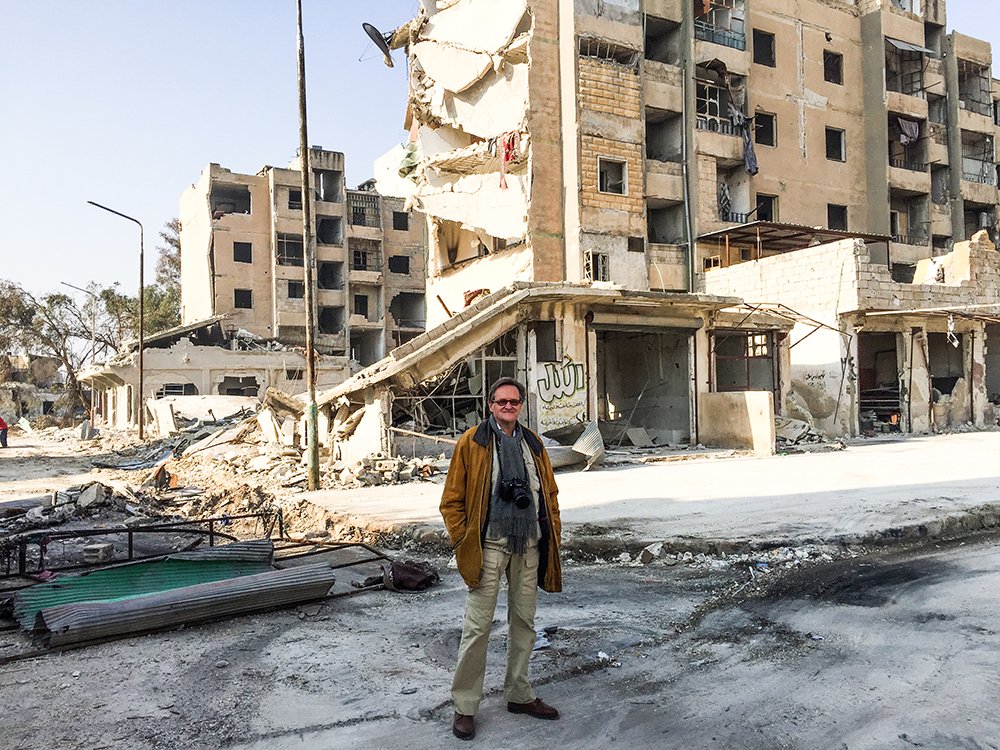
, marks the anniversary of the liberation – the West called it fall – of Aleppo in Syria. What happened is conveniently forgotten today by the West. Some of us can’t and won’t forget what was both world, regional and local history. Important for Syria, for the West and for the future world order – for at least 5 reasons. 1. The Western mainstream media’s deceptive – constructed, ignorant, or both – narrative since 2011 was debunked. Perspectives that media and political decision-makers deliberately omitted (remember omitted stuff is more important than fake): • History and the colonialists’ role in Syria. • The immense complexity of the Syrian society. • Syria as a 7000 year-old civilisation and as end of the Silk Road. • The decades-long conflicts underlying the violence, since CIA’s coup in 1949. • The Western-driven regime change policies years since before 2011. • Other causes of the...
COntsort
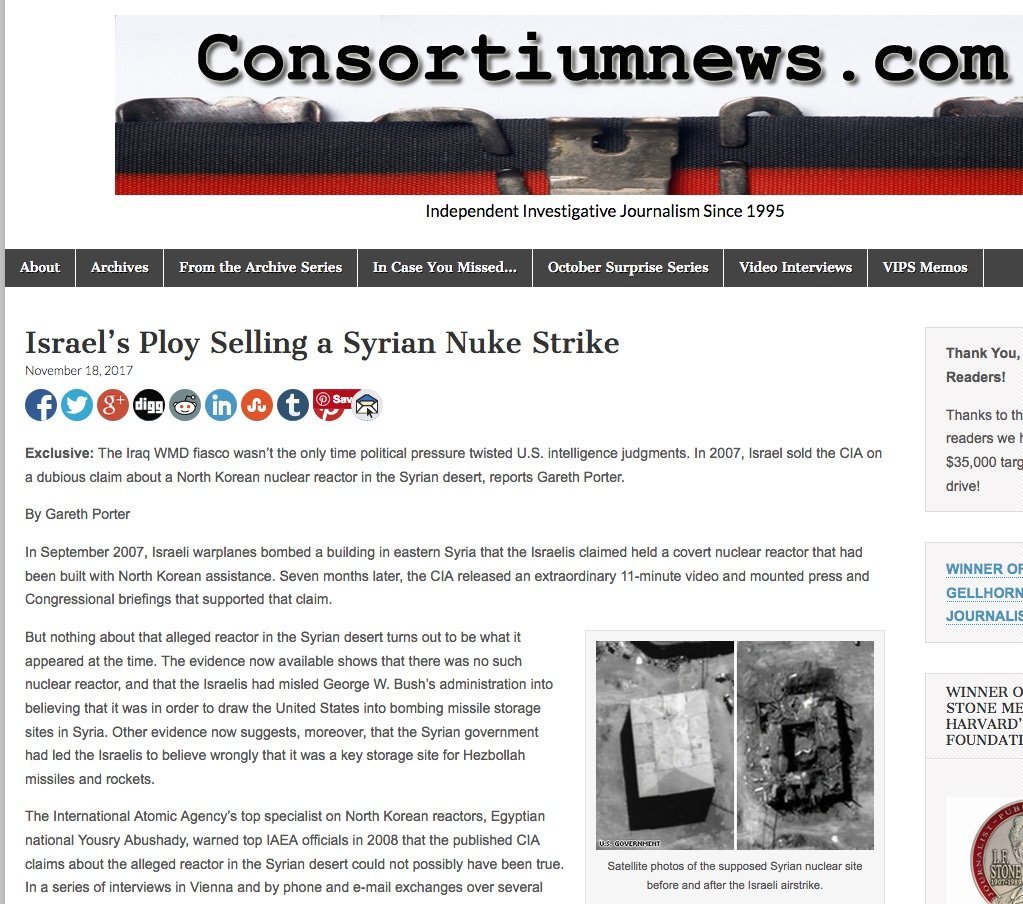
By Gareth Porter In September 2007, Israeli warplanes bombed a building in eastern Syria that the Israelis claimed held a covert nuclear reactor that had been built with North Korean assistance. Seven months later, the CIA released an extraordinary 11-minute video and mounted press and Congressional briefings that supported that claim. But nothing about that alleged reactor in the Syrian desert turns out to be what it appeared at the time. The evidence now available shows that there was no such nuclear reactor, and that the Israelis had misled George W. Bush’s administration into believing that it was in order to draw the United States into bombing missile storage sites in Syria. Other evidence now suggests, moreover, that the Syrian government had led the Israelis to believe wrongly that it was a key storage site for Hezbollah missiles and rockets. Continue reading Porter’s investigative report at ConsortiumNews.com
jonathanpower2
When Donald Trump stretched his hand across our television screens on Sunday to shake the hand of the Philippines’ president, Rodrigo Duterte, and then said he had “a great relationship” with him I felt my gorge contracting. Having tasted the great, if sometimes flawed, (remember the totally counterproductive policy of arming the Afghani mujahedeen against the Soviet invaders) campaign of another US president, Jimmy Carter, to put human rights at the centre of American foreign, to see this bald regression is a bitter fruit to swallow. Duterte recently boasted that he personally killed a man in a fight when he was 16. During his presidential campaign he darkly hinted at other killings he had made and since then has waged a no-hands-barred fight against suspected drug dealers. Arrests, courts, justice? Forget it. But then under President Donald Trump we have seen presidential support, as we did under President George W....
ObergIAleppo-1_PhSh
/11/tff-pressinfo-434-nuclear-weapons-use-within-months-part-1-why/”>Part 1 about the risks here Fact is that we are dealing here with a conflict that is the most threatening to humankind’s survival and it would be rather more easy to solve than most other conflicts. This has recently been pointed out by TFF Board Member and former Co-President of International Physicians for the Prevention of Nuclear War, IPPNW, 2004-2008, Gunnar Westberg, in a short analysis.
ObergIAleppo-1_PhSh
/11/pi-435-likely-nuclear-use-within-months-part-2-how-to-avoid-it/”>Part II here. That’s what I hold quite likely in case the present US administration under Donald Trump’s formal leadership continues down the path its in-fighting militarist fractions seem to have chosen. We’re in the worst, most dangerous situation since the Cuban Missile Crisis. Sitting down and hoping for the best is neither responsible nor viable or wise. I can only hope that I will be proved wrong. That the present extremely dangerous tension-building will die down by some kind of unforeseen events or attention being directed elsewhere. The world could quite well be drifting toward what Albert Einstein called ’unparalleled catastrophe’. It’s something we may – or may not – know more about when President Trump returns from his trip to Japan, South Korea, China, Vietnam (APEC where he also likely to meet Russian President Putin) and the Philippines. Except for 93-year old Jimmy Carter offering to go to...
RichardFalk20141
Prefatory Note This post is a slightly modified version of my presentation to the Human Rights Commission of the Italian Parliament on October 11, 2017. The Commission is composed of members of Parliament and chaired by Hon. Pia Elda Locatelli, representing the city of Bergamo. The presentation was followed by a discussion, and a generally favourable response on the central issue of switching from an emphasis on ‘occupation’ to ‘apartheid.’ An Overview of Present Realities We meet at a difficult time from the perspective of the Palestinian people: several developments nationally, regionally, and internationally now deprive Palestinians of that glimmer of hope that comes from seeing light at the end of the tunnel; more fully appraised, the situation is not as bleak for Palestinians as the picture of their struggle being painted from a realistic perspective. A series of factors pointing in both directions can be identified, first to highlight...
JO_RTStudio
/10/22/the-u-s-will-invade-west-africa-in-2023-after-an-attack-in-new-york-according-to-pentagon-war-game/”>The Intercept is pretty revealing for the lack of even the slightest re-thinking of what the Global War On Terror (GWOT) is really all about. The US military’s game is about violence-for-violence, tit-for-tat. The main result from this – anti-intellectual – attitude and policy is that there are about 80 times – yes, times – more people killed today than in the year 2000. Just consult the Global Terror Index and you’ll find that the figure is about 32,000 people, predominantly in the Middle East and not at all in the West. Measure that against the roughly 400 killed and 700 wounded in the year 2000 (figures then available at the US State Department homepage, however, as it seems, later taken down). I say a few things about that here on Russia Today. The video is inside the article but can also be accessed here.
david-swanson
By David Swanson Let’s read a New York Times editorial from Monday: “The United States has been at war continuously since the attacks of 9/11 and now has just over 240,000 active-duty and reserve troops in at least 172 countries and territories. While the number of men and women deployed overseas has shrunk considerably over the past 60 years, the military’s reach has not. American forces are actively engaged not only in the conflicts in Afghanistan, Iraq, Syria and Yemen that have dominated the news, but also in Niger and Somalia, both recently the scene of deadly attacks, as well as Jordan, Thailand and elsewhere.” That’s a big “elsewhere” that includes Libya, Pakistan, the Philippines, etc. “An additional 37,813 troops serve on presumably secret assignment in places listed simply as ‘unknown.’ The Pentagon provided no further explanation. There are traditional deployments in Japan (39,980 troops) and South Korea (23,591) to...

imgres
By Gareth Porter U.S-Iran policy is closer to Israel than it has been in years. President Donald Trump’s new Iran policy clearly represents a dangerous rejection of diplomacy in favor of confrontation. But it’s more than that: It’s a major shift toward a much closer alignment of U.S. policy with that of the Israeli government of Prime Minister Benjamin Netanyahu. Whether explicitly or not, Trump’s vow to work with Congress to renegotiate the Iran nuclear agreement, and his explicit threat to withdraw from the deal if no renegotiation takes place, appear to be satisfying the hardline demands Netanyahu has made of Washington’s policy toward Tehran. Specifically, Netanyahu has continued to demand… Continue reading Porter’s article here.
Categories

Year

Author / Contributor

Region