Peace Culture

Showing 1-10 of 56 stories

Sort by
Categories

Year

Author / Contributor

Region

TFF-Logo-White-1
“The future belongs to those who imagine it — not those who declare it doomed.” Silence is unusual for us. But even a foundation devoted to peace and ideas needs a pit stop now and then — a moment to refuel, re‑engineer, and prepare for the road ahead. Because the road ahead matters. On January 1, 2026, TFF turns 40. Four decades of independent research, education, and advocacy for the UN Charter norm that “peace shall be established by peaceful means.” And we are not celebrating with nostalgia — we are rebuilding for the future: We are bringing in new Associates, engaging in conferences across continents, and preparing to do what so few dare: offer solutions instead of despair. Because let’s be honest: describing the world as doomed is easy. It is also lazy, unprofessional, and unethical. Imagine a doctor telling a patient: “You’re dying, I can’t see what can...
image
Editorial for Transcend Media Service, TMS, and published in an edited Q & A version by the China Social Science Network-China Social Science News. See also this follow-up, “Condemn all UN member states: They spend 100 times more on militarism than on the entire UN system.” The UN has been extremely important over the last 80 years in terms of, for instance, global dialogue, multi-dimensional development, international law, peace-keeping, normativity, violence condemnation, and ethics. It has been the place to hold member states accountable. The UN Charter is the most Gandhian document ever signed by the world’s governments. If the great majority of member states lived up to their obligations in accordance with the UN Charter and including the resolutions they have signed up to, the world would be a much more peaceful, just, democratic, and lawful place. Regrettably, there are several reasons why the world is not in accordance with those fine Charter norms and provisions:a) The majority...

joie-de-vivre
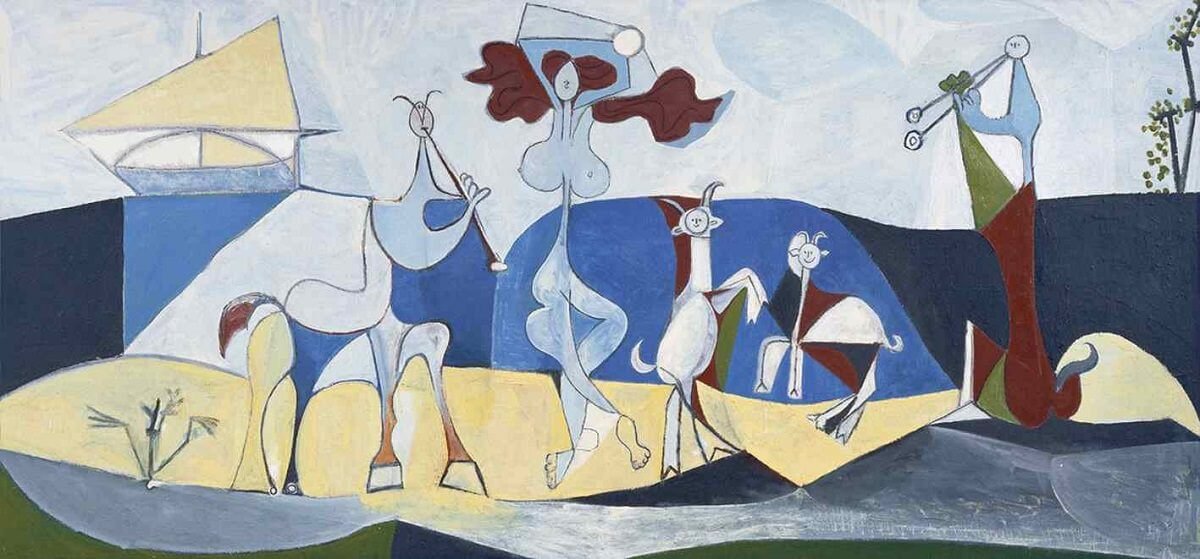
Joie De Vivre, 1946 by Pablo Picasso Not recognizing the magic of the present moment may just be a crime against our humanity. David Andersson August 5, 2025 TFF publishes this with particular joy because, while we have always been pro-peace, future-oriented and proposal-making, we need even more of that now: Peace is to be FOR something and go for it. In my recent article, From Personal Development to Human Development, I explored the imbalance between our inner growth and society’s relentless focus on external activity. One of the greatest obstacles to genuine human development today is the sheer level of negativity we encounter daily. As an editor, I regularly receive submissions from Western contributors. Many center on themes like political corruption—even among progressive leaders—technological control, cognitive warfare, genocide, alarming climate forecasts (“only three years left to avoid the worst”), and Europe’s persistent, deadly hypocrisy. The list continues, each entry more...
HMOriginal-1E4590A1-C273-4402-B9D7-552C99535592
Johan Galtung wrote this article in 2010, the original here. It is remarkable, bordering on the prophetic, that Galtung already suggested – in section 4 below – what closely resembles China’s and President Xi Jinping’s Belt and Road Initiative (BRI), which was launched in 2013. 1. East Asia With the current regionalization of the world where and even the biggest states will find their place, an East Asian Community of the two Chinas, the two Koreas and the three Japans (with the Ryu Kyu Islands–Okinawa–and an Ainu region both at high autonomy levels), is inevitable.  The European Community-Union got started around steel and coal, ESC; how about starting with the tricky issues, like right now Diaoyu, of the islet clusters and their economic zones in the East Asian Sea?  An East Asian Sea Authority could declare joint sovereignty, and go beyond joint ventures, exploiting and protecting resources together, the costs and benefits being...
NoMoreWar
War-preparation and militarism are now the main factors that keep the West together, and will make it fall faster. The Western world has lost its consciousness, perception, and instruments of conflict analysis, resolution, peace-making, and reconciliation. They’ve been squeezed out by militarism’s kakistocrats – a political science term that means government by “the worst, least qualified, or most unscrupulous people.” Consequently, there is now a risk of more than 50% that a major war will happen in Europe. I’ve been observing silently for weeks and months now how geopolitical experts – also very qualified ones – and people who comment independently as well as in the mainstream media and many others have worked on the tacit, implicit assumption that President Trump would help create peace in Ukraine; they seem to believe that what we have witnessed has anything to do with knowledge-based, professional peace-making or would have even the slightest...
mw960367054-2JDK5jZZ430-unsplash
On the invisible codes of culture that shape our worldviews long before memory or reason. This analysis was initially published on the author’s “China21 Journal” which contains several analyses of related issues, China-Western relations and how to increase knowledge and mutual understanding. Last week, we picked up our 5-year-old son from his public kindergarten in Beijing. On the way home, he proudly recited a Tang Dynasty poem by heart — 春望 (Chūnwàng, or Spring View, 757 AD), one of the most famous and widely recited works from that vibrant dynastic era over a thousand years ago, written by the renowned poet 杜甫 (Dù Fǔ, 712–770). The poem reflects on wartime and exile — hardly light or child-friendly themes. But that’s not the point. Children (and adults) recite ancient poems not just for their content, but for their rhythm, rhyme, tone, and the cultural feeling embedded in them. This is how cultural programming begins: not through rules or explanations,...
freepik__primitive-violent-caveman__10528
AI generated imagine on Freepik A 2-minute “appetiser” for an extended interview by China’s CGTN. More to come!
Eclecticism_90cm_300dpi_1200_100dpi
Wang Yuewei(王玥玮) March 24, 2025 This is a chapter in a TFF anthology in the making “If You Want To Understand China.” Foreword, Introduction, Authors and Table of Content here. How to treat others is a core issue in a nation’s foreign policy and a direct reflection of its moral tradition. Throughout history, the performance of Western civilizations and Chinese civilization has been different. When it comes to dealing with others, China insists on pacifism and coexistence, whereas the West adopts expansionism and interventionism. Pacifism and expansionism are neither inherently good nor bad; each has its own achievements and losses. Pacifist China did not launch bloody colonial conquests despite its strength, but its conservative stance caused it to miss the Industrial Revolution. The expansionist West, through both violence and peace, spread modern technology and systems globally, but this often resulted in slaughter, plunder, and sometimes genocide in the colonies. National...
Eclecticism_90cm_300dpi_1200_100dpi
This is a chapter in a TFF anthology in the making “If You Want To Understand China.” Foreword, Introduction, Authors and Table of Content here. Cultural bias Before looking at concrete patterns of manipulation, it is necessary to point at the cultural bias that is partly driving the manipulation. Not only the regulations and protocols of most international organizations like the UN, WTO, NATO, etc., are culturally biased, the very idea of a ‘rules-based world’ as the ultimate goal of humanity is rooted in Western cultural values that are not supported by most non-Western nations. In fact, the basic idea behind TFF’s Smokescreen Report cannot be fully understood without taking the cultural bias into account. Dimensions of culture This section uses the 7-Dimension (7-D) model of national culture developed by Fons Trompenaars and Charles Hampden-Turner. These two management consultants identified the seven dimensions of culture, and the model was published...
Eclecticism_90cm_300dpi_1200_100dpi
But does the West want to understand China? This is a chapter in a TFF anthology in the making “If You Want To Understand China.” Foreword, Introduction, Authors and Table of Content here. We learn about other cultures than our own mostly through our media – however, in many cases, also through books, films, travels and personal encounters. All news are micro glimpses in time and space – something happens there and then, something else happens the next minute. In addition, the world is seen through negative lenses: dramatic and ’bad’ stuff makes the news. Bad news makes good news. We look for causes behind news and events in the immediate past or present, like B did this because A recently did that. It’s all micro in time and space, and very seldom do we get the macro – the larger/broader or deeper space and time – call them macro-history,...
Eclecticism_90cm_300dpi_1200_100dpi
This is a chapter in a TFF anthology in the making “If You Want To Understand China.” Foreword, Introduction, Authors and Table of Content here. China has had an unprecedented development in the last 4 decades. It cannot be disputed. The progress list is long and covers absolutely everything, literally all walks of life, from on pavements to in space, from schools to research, from microchips to quantum computing, from one child to many and on and on. In several fields, though, China remains stable: the culture, the hard work and the commitment to The Project, the project for a shared future for humankind. It is a fact that the West is in decline, and China is on the rise. Relatively speaking, it is logical because that is how it is in zero-sum games. But is it really a zero-sum game? I do not think so; the cake can be...
MopsMore4_1000_100dpi
I assume that most readers here know me as a peace and conflict researcher and as co-founder and director of the Transnational Foundation for Peace and Future Research, TFF. However, since 2009, I’ve also worked as an art photographer, done projects, and arranged almost 30 exhibitions in my studio here in Lund, Sweden. See more on Oberg PhotoGraphics. I grew up with contemporary art; it’s always been an essential, joyful interest of mine. And in 2002-2003, I found out that I could reach people not only with texts but also with images. Back then, I went on fact-finding in Iraq and interviewed some 160 people at all levels and also took photos with an early digital low-resolution camera – of people, cafées, nature, streets, children, cultural places, museums and… life in general, nothing special. It was merely snapshots made between meetings in an otherwise quite tight meeting schedule. Upon my...
Categories

Year

Author / Contributor

Region