
Branko Marcetic
January 28, 2023
Editor’s note
This is probably the most detailed and solid documentation of the historical fact that NATO leaders knew perfectly well that Russia was deeply concerned and against NATO’s expansion and stated those concern for more than 20 years. In other words, that NATO decided deliberately not to listen and not to respect those concerns. It also shows that Russia’s thickest red line was – yes, Ukraine.
It was originally published by the very important and respected American Committee for US-Russia Accord here.
Jan Oberg
Nearly a year in, the war in Ukraine has cost hundreds of thousands of lives and brought the world to the brink of, in President Joe Biden’s own words, “Armageddon.” Alongside the literal battlefield has been a similarly bitter intellectual battle over the war’s causes.
Commentators have rushed to declare the long-criticized policy of NATO expansion as irrelevant to the war’s outbreak, or as a mere fig leaf used by Russian President Vladimir Putin to mask what Condoleezza Rice and Robert Gates recently called “his messianic mission” to “reestablish the Russian Empire.” Fiona Hill, a presidential advisor to two Republican administrations, has deemed these views merely the product of a “Russian information war and psychological operation,” resulting in “masses of the US public … blaming NATO, or blaming the US for this outcome.”
Yet a review of the public record and many dozens of diplomatic cables made publicly available via WikiLeaks shows that US officials were aware, or were directly told over the span of years, that expanding NATO was viewed by Russian officials well beyond Putin as a major threat and provocation, that expanding it to Ukraine was a particularly bright red line for Moscow, that it would inflame and empower hawkish, nationalist parts of the Russian political spectrum, and that it could ultimately lead to war.
In a particularly prophetic set of warnings, US officials were told that pushing for Ukrainian membership in NATO would not only increase the chance of Russian meddling in the country, but risked destabilizing the divided nation — and that US and other NATO officials pressured Ukrainian leaders to reshape this unfriendly public opinion in response. All of this was told to US officials in both public and private by not just senior Russian officials going all the way up to the presidency, but by NATO allies, various analysts and experts, liberal Russian voices critical of Putin, even, sometimes, US diplomats themselves.
This history is particularly relevant as US officials now test the red line China has drawn around Taiwan’s independence, risking military escalation that will first and foremost be aimed at the island state. The US diplomatic record regarding NATO expansion suggests the perils of ignoring or outright crossing another military power’s red lines, and the wisdom of a more restrained foreign policy that treats other powers’ spheres of influence with the care they treat the United States’ own.
An Early Exception
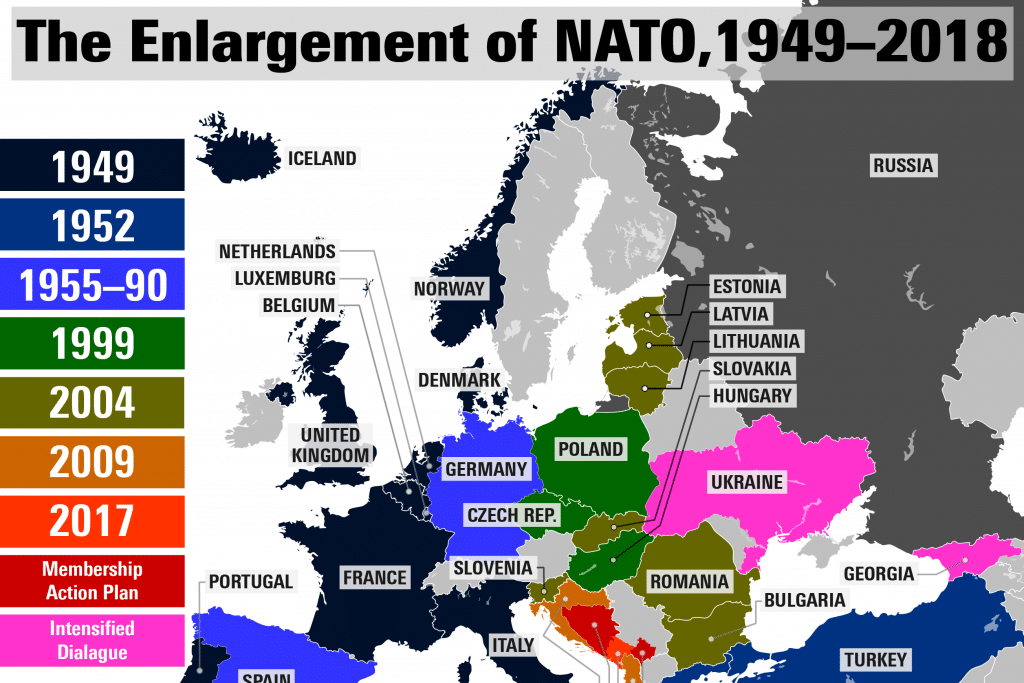
NATO expansion had been fraught from the start. The pro-Western Boris Yeltsin had told Bill Clinton he “saw nothing but humiliation for Russia if you proceed” with plans to renege on the verbal promises made years earlier not to enlarge NATO eastward and warned it would be “sowing the seeds of mistrust” and would “be interpreted, and not only in Russia, as the beginning of a new split in Europe.” Just as containment architect George Kennan had predicted, the decision to go ahead helped inflame Russian hostility and nationalism: The Duma (the Russian parliament) declared it “the largest military threat to our country over the last fifty years,” while the leader of the opposition Communist Party called it “a Treaty of Versailles for Russia.”
By the time Putin became president the day before the new Millennium, “the initial hopes and plans of the early ‘90s [were] dead,” a leading liberal Russian politician declared. The first round of NATO enlargement had been followed by NATO’s 1999 bombing of Yugoslavia, done without UN security council authorization, triggering a Russian cut-off of contact with the alliance. By 2000, the revised Russian national security strategy warned that NATO using force beyond its borders “’is a threat of destabilization of the whole strategic situation,” while military officers and politicians started claiming“that if NATO expands further, it would ‘create a base to intervene in Russia itself,’” the Washington Post reported.
Ironically, there would be one exception to the next two decades’ worth of rising tensions over NATO’s eastward creep that followed: the early years of Putin’s presidency, when the new Russian president defied the Russian establishment to try and make outreach to the United States. Under Putin, Moscow re-established relations with NATO, finally ratified the START II arms control treaty, even publicly floated the idea of Russia eventually joining the alliance, inviting attacks from his political rivals for doing so. Even so, he continued to raise Moscow’s traditional concerns about the alliance’s expansion, telling NATO’s secretary-general it was “a threat to Russia.”
“If a country like Russia feels threatened, this would destabilize the situation in Europe and the entire world,” he’d said in a speech in Berlin in 2000.
Putin softened his opposition as he sought to make a common cause with the George W. Bush administration. “If NATO takes on a different shape and is becoming a political organization, of course, we would reconsider our position with regard to such expansion, if we are to feel involved in the processes,” he said in October 2001, drawing attacks from political rivals and other Russian elites.
As NATO, for the first time, granted Russia a consultive role in its decision-making, Putin sought to assist its expansion. Italian president Silvio Berlusconi made a “personal request” to Bush, according to an April 2002 cable, to “understand Putin’s domestic requirements,” that he “needs to be seen as part of the NATO family,” and to give him “help in building Russian public opinion to support NATO enlargement.” In another cable a top-ranking state department official urges holding a NATO-Russia summit to “help President Putin neutralize opposition to enlargement,” after the Russian leader said allowing NATO expansion without an agreement on a new NATO-Russia partnership would be politically impossible for him.
This would be the last time any Russian openness toward NATO expansion is recorded in the diplomatic record held by WikiLeaks.
Allies Weigh In
By the middle of the 2000s, US-Russian relations had deteriorated, partly owing to Putin’s bristling at US criticism of his growing authoritarianism at home, and to US opposition to his meddling in the 2004 Ukrainian election. But as explained in a September 2007 cable by New Eurasia Foundation president Andrey Kortunov, now a Russian foreign policy advisor who has publicly criticized both Kremlin policy and the current war, US mistakes were also to blame, including Bush’s invasion of Iraq and a general sense that he’d given little in return for Putin’s concessions.
“Putin had clearly embarked on an ‘integrationist’ foreign policy at the beginning of his second presidential term, which was fueled by the 9/11 terrorist attacks and good relations with key leaders like President Bush” and other leading NATO allies, Kortunov said according to the cable. “However,” he said, “a string of perceived anti-Russian initiatives,” which included Bush’s withdrawal from the Anti-Ballistic Missile (ABM) Treaty and “further expansion of NATO,” ultimately “dashed Putin’s hopes.”
What followed was a steady drumbeat of warnings about NATO’s expansion, particularly regarding neighbouring Ukraine and Georgia, much of it from Washington’s NATO allies.
“[French presidential diplomatic advisor Maurice] Gourdault-Montagne warned that the question of Ukrainian accession to NATO remained extremely sensitive for Moscow, and concluded that if there remained one potential cause for war in Europe, it was Ukraine,” reads a September 2005 cable. “He added that some in the Russian administration felt we were doing too much in their core zone of interest, and one could wonder whether the Russians might launch a move similar to Prague in 1968, to see what the West would do.”
This was just one of many similar warnings from French officials, that admitting the two states “would cross Russian ‘tripwires’,” for instance. A February 2007 cable records then-director general for political affairs Gérard Araud’s recounting of “a half-hour anti-US harangue” from Putin in a meeting one day earlier, in which he “linked all the dots” of Russian unhappiness with US behaviour, including “US unilateralism, its denial of the reality of multipolarity, [and] the anti-Russian nature of NATO enlargement.”
Germany likewise raised repeated concerns about a potentially bad Russian reaction to a NATO Membership Action Plan (MAP) for the two states, with deputy national security advisor Rolf Nikel stressing that Ukraine’s entry was particularly sensitive. “While Georgia was ‘just a bug on the skin of the bear,’ Ukraine was inseparably identified with Russia, going back to Vladimir of Kiev in 988,” Nikel recounted, according to the cable.
Other NATO allies repeated similar concerns. In a January 2008 cable, Italy affirmed it was a “strong advocate” for other states’ entry into the alliance, “but is concerned about provoking Russia through hurried Georgian integration.” Norway’s foreign minister (and today, prime minister) Jonas Gahr Stoere made a similar point in an April 2008 cable, even as he insisted Russia mustn’t be able to veto NATO’s decisions. “At the same time he says that he understands Russia’s objections to NATO enlargement and that the alliance needs to work to normalize the relationship with Russia,” reads the cable.
Almost Complete Consensus
The thinkers and analysts that US officials conferred with likewise made clear the Russian elite’s anxieties over NATO and its expansion, and the lengths they might go to counteract it. Many were transmitted by then-US Ambassador to Russia William Burns, today serving as Biden’s CIA director.
Recounting his conversations with various “Russian observers” from both regional and US think tanks, Burns concluded in a March 2007 cable that “NATO enlargement and U.S. missile defense deployments in Europe play to the classic Russian fear of encirclement.” Ukraine and Georgia’s entry “represents an ‘unthinkable’ predicament for Russia,” he reported six months later, warning that Moscow would “cause enough trouble in Georgia” and counted on “continued political disarray in Ukraine” to halt it. In an especially prescient set of cables, he summed up scholars’ views that the emerging Russia-China relationship was largely “the by-product of ‘bad’ US policies,” and was unsustainable — “unless continued NATO enlargement pushed Russia and China even closer together.”
Cables record Russian intellectuals across the political spectrum making such points again and again. One June 2007 cable records the words of a “liberal defense expert” and the “liberal editor” of a leading Russian foreign policy journal, that after Russia had done “everything to ‘help’ the US post-9/11, including opening up Central Asia for coalition anti-terrorism efforts,” it had expected “respect for Russia’s ‘legitimate interests.’” Instead, Lyukanov said, it had been “confronted with NATO expansion, zero-sum competition in Georgia and Ukraine, and US military installations in Russia’s backyard.”
“Ukraine was, in the long term, the most potentially destabilizing factor in US-Russian relations, given the level of emotion and neuralgia triggered by its quest for NATO membership,” went the counsel of Dmitri Trenin, then-deputy director of the Russian branch of the US-based Carnegie Endowment for International Peace, in a Burns-authored February 2008 cable. For Ukraine, he said prophetically, it would mean that
elements within the Russian establishment would be encouraged to meddle, stimulating US overt encouragement of opposing political forces, and leaving the US and Russia in a classic confrontational posture.
Indeed, opposing NATO’s enlargement eastward, particularly in Ukraine and Georgia, was “one of the few security areas where there is almost complete consensus among Russian policymakers, experts and the informed population,” he cabled in March 2008. Ukraine was the “line of last resort” that would complete Russia’s encirclement, said one defense expert, and its entry into NATO was universally viewed by the Russian political elite as an “unfriendly act.” Other experts cautioned “that Putin would be forced to respond to Russian nationalist feelings opposing membership” of Georgia, and that MAPs for either would trigger a cut-back in the Russian military’s genuine desire for cooperation with NATO.
From Liberals to Hardliners
These analysts were reiterating what cables show US officials heard again and again from Russian officials themselves, whether diplomats, members of parliament, or senior Russian officials all the way up to the presidency, recorded in nearly three-dozen cables at least.
NATO enlargement was “worrisome” said one Duma member, while Russian generals were “suspicious of NATO and US intentions,” cables record. Just as analysts and NATO officials had said, Kremlin officials characterized NATO’s designs on Georgia and Ukraine as especially objectionable, with the ambassador to NATO Dmitry Rogozin stressing in a February 2008 cable that offering MAPs to either “would negatively impact NATO’s relations with Russia” and “raise tension along the borders between NATO and Russia.”
Deputy foreign minister Grigory Karasin “underscored the depth of Russian opposition” to their membership, a different March 2008 cable states, underlining that the political elite “firmly believes” it “represented a direct security threat to Russia.” The future, he said, rested on the “strategic choice” Washington made about “what kind of Russia” it wanted to deal with: “a Russia that is stable and ready to calmly discuss issues with the US, Europe and China, or one that is deeply concerned and filled with nervousness.”
Indeed, numerous officials — including then-director for security and disarmament Anatoly Antonov, today serving as Russia’s ambassador to the United States — warned pushing ahead would produce a less cooperative Russia. Pushing NATO’s borders to the two former Soviet states “threatened Russian and the entire region’s security, and could also negatively impact Russia’s willingness to cooperate in the [NATO-Russia Council],” one foreign ministry official warned, while others pointed to the policy to explain Putin’s threats to suspend the Conventional Armed Forces in Europe (CFE) treaty. “CFE would not survive NATO enlargement,” went a Russian threat in one March 2008 cable.
Maybe most pertinent were the words of Russian Foreign Minister Sergei Lavrov, at the time a veteran diplomat respected in the West, and who continues to serve in the position today. At least eight cables, a number of them written by Burns, record Lavrov’s expressions of opposition to expanding NATO to Ukraine and Georgia over the course of 2007-08, when Bush’s decision, over the objections of allies, to publicly affirm their future accession led to a spike in tensions.
“While Russia might believe statements from the West that NATO was not directed against Russia, when one looked at recent military activities in NATO countries … they had to be evaluated not by stated intentions but by potential,” went Burns’s summary of Lavrov’s annual foreign policy review in January 2008. On the same day, he wrote, a foreign ministry spokesperson warned that Ukraine’s “likely integration into NATO would seriously complicate the many-sided Russian-Ukrainian relations” and lead Moscow to “have to take appropriate measures.”
Besides being an easy way to garner domestic support from nationalists, Burns wrote, “Russia’s opposition to NATO membership for Ukraine and Georgia is both emotional and based on perceived strategic concerns about the impact on Russia’s interests in the region.”
“While Russian opposition to the first round of NATO enlargement in the mid-1990’s was strong, Russia now feels able to respond more forcefully to what it perceives as actions contrary to its national interests,” he concluded.
Lavrov’s criticism was shared by a host of other officials, not all of them hardliners. Burns recounted a meeting with former prime minister Yevgeny Primakov, a Gorbachev protégé who had negotiated over NATO’s first expansion with Madeleine Albright, who warmly eulogized him years later as a pragmatist. The US push for MAP for Georgia and Ukraine “‘infuriated’ Russians and threatened other areas of US-Russia strategic cooperation,” Primakov had said, according to Burns, mentioning he’d be asked later that day on TV about rethinking Crimea’s status as Ukrainian territory. “[T]this is the kind of discussion that MAP produces,” he said — meaning, that it inflamed nationalist and hardline sentiment.
“Primakov said that Russia would never return to the era of the early 1990s and it would be a ‘colossal mistake’ to think that Russian reactions today would mirror those during its time of strategic weakness,” Burns’s cable states in closing.
This went all the way to the top, as US officials noted in cables reacting to a famously strident speech Putin gave at the Munich Security Conference in February 2007, which saw Putin assail NATO expansion and other policies as part of a wider, destabilizing US abuse of its sole-superpower status. Putin’s tone may have been “unusually sharp,” Primakov told Burns, but their substance “reflected well-known Russian complaints predating Putin’s election,” shown by the fact that “talking heads and Duma members were almost unanimous” in supporting the speech. A year later, a March 2008 cable reported German chancellor Angela Merkel’s final, two-hour-long meeting with Putin, in which he “argued strongly” against MAP for Ukraine and Georgia.
Putin’s Exit
Any illusions this stance would evaporate with Putin leaving the presidency were quickly dispelled. Such warnings continued and, if anything, grew more intense, after Putin was replaced by his liberal successor, Dmitry Medvedev, whose ascent sparked hopes for a more democratic Russia and an improved US-Russian relationship.
Under Medvedev, officials from the Russian ambassador to NATO and various officials in the foreign ministry to the chairman of the Duma’s international affairs committee made much the same warnings, cables show. In some cases, as with Karasin and Lavrov, it was the same officials making these long-standing complaints.
Medvedev himself “reiterated well-known Russian positions on NATO enlargement” to Merkel in his first trip to Europe in June 2008, even as he avoided bringing up MAP for Ukraine and Georgia specifically. “Behind Medvedev’s polite demeanour, Russian opposition to NATO enlargement remained a red-line, according to both conservative and moderate observers,” one June 2008 cable reads, a view shared by a leading liberal analyst. Even critics to his right read Medvedev’s words as “an implicit commitment to use Russian economic, political and social levers to raise the costs for Ukraine and Georgia” if they moved closer to the alliance. The cable’s author, Deputy Chief of Mission at the US embassy in Moscow Daniel Russell, concluded he “agree[d] with the common wisdom.”
By August 2008, following the war with Georgia, Medvedev started to sound a lot more like his predecessor, threatening to cut ties with the alliance and restating grievances about encirclement. A cable from after the end of the five-day war — which an EU-commissioned report would later blame the Georgian government for starting — stated that “even the most pro-Western political experts” were “pointing the finger at the US” for jeopardizing US-Russian relations, with US dismissal of Russia’s concerns over, among other things, NATO expansion a key part of some of their analysis. Echoing Burns, one analyst argued that Russia finally felt “strong enough to stand up to the West” when it ignored its concerns.
Those concerns were central at a roundtable of Russian analysts months later, a January 2009 cable shows, who explained to a group of visiting US congresspeople Russians’ “deep displeasure” with the US government, and stressed the “bitter divorce” between Russia and Georgia would be even uglier with Ukraine. Pushing MAP for the country “helped the ‘America haters c
