
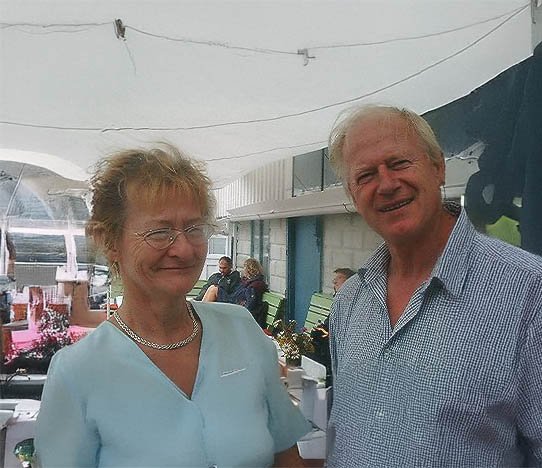
ERNI FRIHOLT was born in Lilienfeld, Austria, on November 27, 1936. As a child, she was exposed to war and post-war conditions. One elder brother died during the campaign in the Soviet Union, and her father was killed on the home front just before the war ended.
Since then she has been a devoted peace worker and activist and a solidarity worker in India and Bangladesh.
From 1950 onwards, in Sweden, she studied through the adult education system and finished as a student of German, English and pedagogy, after this she worked for a few years as a primary school teacher, which in turn she left for full-time peace and development work from 1970 onwards. She was particularly involved in supporting the birth of Bangladesh in connection with their liberation war. She also went there to study a development project in 1973, in Thanapara village. In 1974, she met her "compar":
OLA FRIHOLT was born in Morlanda on the Swedish west coast on April 26, 1937. He experienced the social change of his home town from a rather self-supporting and self-governing fishing village into mainly a summer resort with its income generated in the world market, after the exodus of a whole generation. After that he gradually became a devoted development worker and peace activist and a solidarity worker in India and Bangladesh. After his academic exam he studied teachers training and general linguistics. His subjects are Latin, French and English. After three years as a college teacher, he left for a fishing project in Madras, India, in 1970. From 1973, he worked with information for the public in a volunteer NGO, making exhibitions, editing magazines and lecturing.
Then came 1974:
CURRICULUM COMMUNE COMPARUM FRIHOLT
The Friholt couple were elected onto the same board of management for both peace and solidarity development work. So it happened. Since then they very soon embarked upon their life project as freelance activists, writers of hundreds of unpaid and paid articles in various fora, lecturers in hundreds of schools, community colleges, development training courses, some university institutions (as guest lecturers). One main aim was to connect the NGO-movements for peace, solidarity, environment and gender issues with the academic world of research and useful data and theory.
Throughout all of this, they kept in touch with the Indian and Bangladeshi action groups they had once worked with, via various stipends, etc - 11 times in India. As consultants to SIDA, they made two evaluation studies of third world information work carried out by Swedish NGOs and organisations for adult education. All along they were also activists dealing with concrete development / disarmament and other development issues.
From 1977 and onwards, they belonged to groups editing peace periodicals like Pax, Milda Makter, Vi mänskor, at present with hundreds of issues.
They wrote one book on India-development from below (1984). Ola made some booklets on subjects like "living in a slum", "Solidarity trade", "Slum-development-mobilization of women". Erni wrote numerous reports on gender issues in India, Bangladesh, Ethiopia, Kenya, Mozambique, Zambia, South Africa, and Namibia (as a member of the Women's Council).
They engage in solidarity trade through their summer cafe, which is guided by considerations of justice, local production, local development, the environment and educating their customers.
Through that channel they also disseminate the facts and complexity of the Balkan conflicts and of the peace action groups there, e.g. the numerous conscientious objectors in Serbia, the Zitzer Spiritual Republic in Vojvodina, etc. Collecting funds for today's victims of war there is their latest branch of action. Their life in general is devoted to giving a shape and a face to the idea of "another development".
The couple also has five daughters and four grandchildren, who seem to approve of their activities.
The Friholts joined TFF as advisers in 2003.