
An Unending U.S. War in Syria

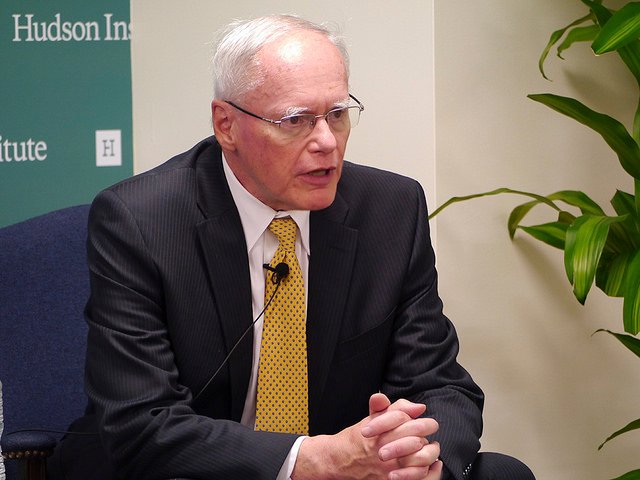
Photo: James Jeffrey – Special Representative for Syria Engagement in the United States (Hudson Institute via Flickr)


By Paul R. Pillar

September 19, 2018

Amid a week of attention-grabbing drama about the dysfunction of Donald Trump’s presidency, it almost escaped notice that his administration is putting U.S. troops in harm’s way in a foreign war for a new purpose—a purpose that does not entail countering a threat to the United States.

Newly appointed special envoy for Syria, James Jeffrey stated that under a “new policy” on Syria, the United States is “no longer pulling out by the end of the year.”

This policy goes against what Trump had been saying not only in the presidential campaign about wanting less U.S. involvement in Middle Eastern wars but also, more recently and more specifically, about wanting to withdraw the 2,200 U.S. soldiers now in Syria.

Those troops have been in the northeastern part of the country, hitherto focused on aiding the fight against the so-called Islamic State (ISIS or IS).

But now, according to Jeffrey, besides mopping up the remnants of IS’s former mini-state in eastern Syria, U.S. troops are to stay in Syria indefinitely with the objective of ejecting from the country all troops of Syria’s ally Iran.

Administration officials say that a motivation for the new policy is growing doubt that Russia will be either able or willing to assist in such an ejection.


Originally published at lobelog.com

The new policy is an entirely new war aim, not an extension or corollary of the prior declared purpose of combating IS. In fact, Iran’s presence in Syria, aimed at supporting the Bashar al-Assad regime, has been on the opposite side of the Syrian civil war from IS, which has aimed to overthrow that regime.

Hawks in the administration have been talking for some time, of course, about confronting and opposing Iran anyway and anywhere they can, but Jeffrey’s statement marks an official departure from what had been a U.S. war objective in Syria exclusively focused on IS.


An Unscrutinized War Aim

That shift warrants much more scrutiny and debate than it is getting. U.S. service members are being dispatched to a foreign war for the purpose of somehow getting one Middle Eastern state that has had a longstanding security relationship with another Middle Eastern state to remove its personnel from that second state.

Exactly how are U.S. interests supposedly affected by whether those personnel stay or go?

The only Americans who might be harmed under one scenario but not the other are the very soldiers who are being dispatched. The Syrian-Iranian alliance has existed for decades, going back to when the two states shared an adversary in the form of Saddam Hussein’s regime in Iraq.

The issue is not only whether U.S. interests are affected but whether they are affected enough to justify the participation of the U.S. military in a foreign war—which should entail a higher standard.

Suppose that Article I, Section 8 of the U.S. Constitution were observed, as it ought to be but generally is not, and that a congressional declaration of war preceded involvement of the U.S. military in any foreign war.

Suppose further that when an already deployed U.S. force is given an entirely different mission, that this mission and the deployment intended to serve it are given a thorough zero-based review—which it ought to be but generally is not.

Would the elected representatives of the American people vote to send U.S. soldiers into a war for the purpose of getting a Middle Eastern state to move some of its own troops from point A to point B (troops that had gone to point A not as invaders but instead to assist the incumbent government)?

Probably not, despite years of rhetoric depicting Iran as evil incarnate.

To be fair, withdrawing an already deployed U.S. expeditionary force is not entirely the same as deploying one afresh, whether or not the mission has changed.

When Richard Nixon and Henry Kissinger inherited the Vietnam War in 1969, their task was not centered on the question of whether the war had been a good or a bad idea in the first place but instead on how to extract a half-million-man army in a way that could plausibly be presented as “peace with honor.”

But the scale of extraction and of the associated emotions and politics involving sunk costs are vastly different with the small U.S. force in Syria. Any legitimate issues about extraction there should focus on the previously established mission of mopping up IS.


No Good Solutions

The Syrian war always has been, and still is, a problem with no good solutions as far as U.S. policy is concerned. Robert Malley, who coordinated Middle Eastern policy in the Obama White House, describes Syria as a “failure” for the administration in which he worked.
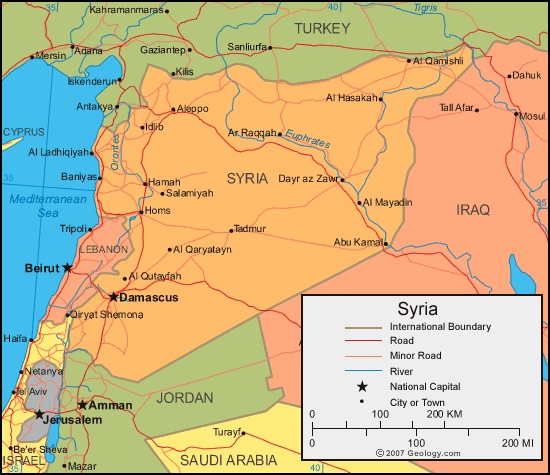
Map of Syria. Photo credit: danmark-land.blogspot.com

The agonizing over Syria is likely to accelerate in the coming days as the Syrian regime attempts to capture Idlib province, the last major remaining redoubt of rebel forces, and one to which many fighters ousted from other rebel enclaves had earlier repaired.

Ignoring uncomfortable truths about the Syria conflict keeps getting in the way of sober policy-making. The regime, aided by its Russian and Iranian allies, already has recaptured most rebel-held territory.

Probably the shortest route to mitigating further suffering from this war — in which upwards of a half million people have died and millions more have been displaced — is for government forces to complete the victory that they are well on the way to achieving.

But the brutal and disagreeable nature of the Assad regime has made that prospect a nonstarter as a basis for (openly avowed) U.S. policy-making, even if the “Assad must go” slogan has quietly been retired.

Idlib presents more uncomfortable truths. Although Syria, Russia, and Iran routinely describe all Syrian rebels as “terrorists” in their propaganda, the label fits to a large degree in Idlib.

The strongest armed group in Idlib, and the de facto ruler over most of the province, is Hei’at Tahrir al-Sham (HTS), which is the latest name of the al-Qaeda affiliate in Syria.

A regime offensive in Idlib may indeed bring about the grievous casualties and displacements about which many commentators are currently warning. But a successful offensive also would end the inhumane local rule of HTS, which has featured mass arrests, secret prisons, and torture.

Finding the least bad solution must involve multilateral diplomacy, given the number of external actors involved in the conflict.

The most important players in that diplomacy have been Russia, Iran, and Turkey, although the presidents of those three countries failed to achieve any breakthrough agreement on Syria in a summit meeting they just held in Tehran. All three have stronger interests in Syria than does the United States.

For both Russia and Iran, Syria represents the single biggest, longest, and friendliest relationship either regime has enjoyed in the Arab world. For Turkey, Syria presents a host of immediate problems, including more than three million Syrian refugees already on its soil, the prospect of still more from fighting in Idlib, border security issues, and the Kurdish question.

The U.S. fixation on opposing and isolating Iran at every opportunity makes the difficult task of finding the least bad solution to the Syrian war even more difficult. The fixation was impeding Syria-related diplomacy even before the Trump administration took office.

It was not until October 2015, three months after the multilateral agreement restricting Iran’s nuclear program was signed, that the Obama administration ended the longstanding U.S. objection to Iranian participation in Syrian peace talks sponsored by the United Nations.

Jeffrey and other Trump administration officials have not explained how keeping those U.S. troops in Syria will help achieve a withdrawal of Iranian personnel.

Conceivably they could function as a bargaining chip, with a hope of achieving some agreement about withdrawal of all foreign forces from Syria. But two can play that game.

Iranian President Hassan Rouhani said at the summit meeting in Tehran not only that “fighting terrorism in Idlib is an unavoidable part of the mission of restoring peace and stability to Syria” but also that “we have to force the United States to leave” Syria.

In that game, Iran, as noted above, has a stronger incentive to keep playing than does the United States.

The principal effect of keeping those American soldiers in Syria indefinitely, with opposing Iran as their new mission, is to increase the chance of a direct U.S.-Iranian military clash, possibly escalating into a major war. That’s not good, even though it might be what some in power want.


Originally published at lobelog.com

Paul R. Pillar is Non-resident Senior Fellow at the Center for Security Studies of Georgetown University and an Associate Fellow of the Geneva Center for Security Policy. He retired in 2005 from a 28-year career in the U.S. intelligence community. His senior positions included National Intelligence Officer for the Near East and South Asia, Deputy Chief of the DCI Counterterrorist Center, and Executive Assistant to the Director of Central Intelligence. He is a Vietnam War veteran and a retired officer in the U.S. Army Reserve. Dr. Pillar’s degrees are from Dartmouth College, Oxford University, and Princeton University. His books include Negotiating Peace (1983), Terrorism and U.S. Foreign Policy (2001), Intelligence and U.S. Foreign Policy (2011), and Why America Misunderstands the World (2016).

Share

Leave a Reply

Your email address will not be published. Required fields are marked *

Related Posts

A slightly modified version of a text published on Sept. 1, 2025 in TMS. On August 25 Thomas Friedman, always a weathervane for political and economic establishment thinking in the West, wrote a notable column in the NY Times that was pragmatic in tone, misleading in substance, and regressive in intention. Yet it reflects a growing ambivalence toward Israel’s prolonged genocide even among longtime supporters of Israel that now highlights starvation, famine, and a gross distortion of the delivery of humanitarian aid under emergency conditions. But expressed dangerously without hiding the hope that Israel could even now restore its legitimacy without being held accountable for crimes in Gaza and despite all, still expecting to be rewarded by excluding Hamas from any further governance role in Gaza and continuing to move toward the annexation of the West Bank by formal action or through further settlement expansion. It is notable that the headline of...
Professor emeritus, TFF Associate Oxford (Special to Informed Comment; Feature) The dam has burst. Netanyahu and his far-right regime have gone too far. Public pressure on politicians in Europe and many other countries has become irresistible, forcing them to change course. Most countries, 147 of the UN’s 193 members, have formally recognized a Palestinian state, and last week, France pledged to do so at the UN meeting in September. Fourteen nations, including Canada, New Zealand and Australia, join France in a push to recognize a Palestinian state. The British Prime Minister Keir Starmer, one of Israel’s staunchest allies who even refused to condemn the Israeli blockade of food, water, medicine and fuel to the Palestinians after the terrible events of 7th October, has buckled under the pressure of public opinion. More than 255 MPs of all parties signed a letter addressed to the prime minister in which they urged him to...
The Gaza People’s Tribunal, at the end of its first public assembly in Sarajevo, issued a Declaration that expresses our commitment to peace and justice for the Palestinian people in their struggle to realize their basic rights, above all their inalienable right to self-determination. We are inviting like-minded friends to read and endorse the Sarajevo Declaration and to share the link with others who might join our solidarity initiative at this critical time. Here is the link to Change.org where you can find the full text of the Declaration and endorser information.

Recent Articles

PressInfo # 141, December 21, 2001It’s time to prepare reconciliation between Albanians and Serbs PressInfo # 140, December 14, 2001Ibrahim Rugova’s decade-long leadership in Kosovo/a PressInfo # 139, 11. december, 2001En god nyhet: Jugoslaviens Sannings- och försoningskommission PressInfo # 139, 11. december, 2001Gode nyheder: Jugoslaviens Sandheds- og Forsoningskommission PressInfo # 139, December 11, 2001Good news: Yugoslavia’s Truth and Reconciliation Commission PressInfo # 138, November 8, 2001TFF co-founder PhD with thesis about young people with roots in other cultures PressInfo # 138, November 8, 2001TFF:s medstiftare doktor på avhandling om unga med ursprung i andra kulturer PressInfo # 137, October 17, 2001A new Marshall Plan: Advancing human security and controlling terrorism PressInfo # 136, October 15, 2001The UN and Annan really deserve it PressInfo # 135, October 10, 2001Preventing a terrorist mushroom cloud PressInfo # 134, 17 oktober, 2001Sverige og 11. september PressInfo # 134, October 9, 2001Sweden and September 11...
Peace is promoted by constructive proposals and dialogue Four preceding PressInfos have expressed concern over — and criticised — the ongoing, militarisation of the EU. Some will say: but there are no alternatives. We believe that there are always alternatives, that democracies are characterised by alternatives and choice, and that openly discussed alternatives will improve the quality and legitimacy of society’s decision–making. In addition, it is an intellectual and moral challenge to not only criticise but also be constructive. If we only tell people that we think they are wrong, they are not likely to listen. However, if we say: what are your views on this set of ideas and steps? — we may sometimes engage them in dialogue and sow a seed. Most people in power circles live their daily lives in in a time frame and a social space where certain ideas, viewpoints and concepts are just not...
Photos © TFF 2000 Read PressInfo 90 “Lift the Sanctions and Bring More Aid to Yugoslavia” See Pictures from Belgrade © TFF 2000 Please reprint, copy, archive, quote or re-post this item, but please retain the source.

TFF on Substack

Discover more from TFF Transnational Foundation & Jan Oberg.

Most Popular

PressInfo # 141, December 21, 2001It’s time to prepare reconciliation between Albanians and Serbs PressInfo # 140, December 14, 2001Ibrahim Rugova’s decade-long leadership in Kosovo/a PressInfo # 139, 11. december, 2001En god nyhet: Jugoslaviens Sannings- och försoningskommission PressInfo # 139, 11. december, 2001Gode nyheder: Jugoslaviens Sandheds- og Forsoningskommission PressInfo # 139, December 11, 2001Good news: Yugoslavia’s Truth and Reconciliation Commission PressInfo # 138, November 8, 2001TFF co-founder PhD with thesis about young people with roots in other cultures PressInfo # 138, November 8, 2001TFF:s medstiftare doktor på avhandling om unga med ursprung i andra kulturer PressInfo # 137, October 17, 2001A new Marshall Plan: Advancing human security and controlling terrorism PressInfo # 136, October 15, 2001The UN and Annan really deserve it PressInfo # 135, October 10, 2001Preventing a terrorist mushroom cloud PressInfo # 134, 17 oktober, 2001Sverige og 11. september PressInfo # 134, October 9, 2001Sweden and September 11...
Peace is promoted by constructive proposals and dialogue Four preceding PressInfos have expressed concern over — and criticised — the ongoing, militarisation of the EU. Some will say: but there are no alternatives. We believe that there are always alternatives, that democracies are characterised by alternatives and choice, and that openly discussed alternatives will improve the quality and legitimacy of society’s decision–making. In addition, it is an intellectual and moral challenge to not only criticise but also be constructive. If we only tell people that we think they are wrong, they are not likely to listen. However, if we say: what are your views on this set of ideas and steps? — we may sometimes engage them in dialogue and sow a seed. Most people in power circles live their daily lives in in a time frame and a social space where certain ideas, viewpoints and concepts are just not...
Photos © TFF 2000 Read PressInfo 90 “Lift the Sanctions and Bring More Aid to Yugoslavia” See Pictures from Belgrade © TFF 2000 Please reprint, copy, archive, quote or re-post this item, but please retain the source.
Read More
Imagen-thumbnail-The-Transnational-1
PressInfo # 141, December 21, 2001It’s time to prepare reconciliation between Albanians and Serbs PressInfo # 140, December 14, 2001Ibrahim Rugova’s decade-long leadership in Kosovo/a PressInfo # 139, 11. december, 2001En god nyhet: Jugoslaviens Sannings- och försoningskommission PressInfo # 139, 11. december, 2001Gode nyheder: Jugoslaviens Sandheds- og Forsoningskommission PressInfo # 139, December 11, 2001Good news: Yugoslavia’s Truth and Reconciliation Commission PressInfo # 138, November 8, 2001TFF co-founder PhD with thesis about young people with roots in other cultures PressInfo # 138, November 8, 2001TFF:s medstiftare doktor på avhandling om unga med ursprung i andra kulturer PressInfo # 137, October 17, 2001A new Marshall Plan: Advancing human security and controlling terrorism PressInfo # 136, October 15, 2001The UN and Annan really deserve it PressInfo # 135, October 10, 2001Preventing a terrorist mushroom cloud PressInfo # 134, 17 oktober, 2001Sverige og 11. september PressInfo # 134, October 9, 2001Sweden and September 11...
Imagen-thumbnail-The-Transnational-1
Peace is promoted by constructive proposals and dialogue Four preceding PressInfos have expressed concern over — and criticised — the ongoing, militarisation of the EU. Some will say: but there are no alternatives. We believe that there are always alternatives, that democracies are characterised by alternatives and choice, and that openly discussed alternatives will improve the quality and legitimacy of society’s decision–making. In addition, it is an intellectual and moral challenge to not only criticise but also be constructive. If we only tell people that we think they are wrong, they are not likely to listen. However, if we say: what are your views on this set of ideas and steps? — we may sometimes engage them in dialogue and sow a seed. Most people in power circles live their daily lives in in a time frame and a social space where certain ideas, viewpoints and concepts are just not...
Imagen-thumbnail-The-Transnational-1
Photos © TFF 2000 Read PressInfo 90 “Lift the Sanctions and Bring More Aid to Yugoslavia” See Pictures from Belgrade © TFF 2000 Please reprint, copy, archive, quote or re-post this item, but please retain the source.
Imagen-thumbnail-The-Transnational-1
Av FRANK SØHOLM GREVIL 16 augusti 2004  Vi er nu nået til tredje akt i det absurde teaterstykke, der i analogi med de store skueprocesser i Moskva 1936-38 er blevet døbt ‘Grevil-sagen’. Første akt bestod i min anonyme fremlæggelse af egenhændigt nedklassificerede rapporter i Berlingske Tidende i februar og marts. Andet akt udgjordes af min fremtræden med navn og billede i Information i april samt den efterfølgende mediestorm, som uden min direkte medvirken kostede en forsvarsminister taburetten samt en sigtelse for brud på tavshedspligten. Tredje akt bliver en retssag, hvor jeg står tiltalt for at have overtrådt straffelovens bestemmelser om uberettiget videregivelse eller udnyttelse af fortrolige oplysninger. Statsanklageren har ovenikøbet valgt at påberåbe sig særligt skærpende omstændigheder. Da jeg aldrig har modtaget betaling for at stille rapporterne til rådighed eller lade mig interviewe, må det skærpende bestå i, at “videregivelsen eller udnyttelsen er sket under sådanne omstændigheder, at det påfører...
Imagen-thumbnail-The-Transnational-1
Af Svenska Irakkommittén mot de Ekonomiska Sanktionerna (SIES) 13 september 2002 FN:s ekonomiska sanktioner mot Irak har nu pågått i tolv år och drabbat det irakiska folket med svåra lidanden. Enligt FN:s egna siffror har mer än 1,5 miljoner människor, varav ca 600 000 barn, dött som en direkt följd av sanktionerna. Dessutom har ett lågintensivt bombkrig mot landet pågått under dessa år. Av all denna förödelse- orsakad huvudsakligen av amerikansk och brittisk politik- har Saddam Husseins brutala och diktatoriska regim snarast stärkts än försvagats. Nu förbereder USA under president Bushs ledning ett storskaligt bombkrig mot Irak som kommer att innebära ett ännu större lidande för civilbefolkningen. Ett sådant krig kommer dessutom att ytterligare undergräva freden och säkerheten i världen. Att upprätta en demokratisk regim i Irak är det irakiska folkets angelägenhet och får enligt folkrätten inte ske med krigshandlingar utifrån. Folkrätten och FN:s stadgar måste respekteras. Vi vädjar till...