Africa roaring to go
Generic thumbnail

June 25, 2010

The World Cup, now being played out in South Africa, is not a mirage. It is succeeding beyond anyone’s wildest dreams. Not only has the game thrilled its adherents all over the world, the new infrastructure has not failed to impress visitors – from the amazing stadiums, to the new roads and the high speed rail link to the airport. All was completed on schedule, testimony to the country’s growing expertise in management and sophisticated technology. The “crime wave” foreseen by many has not occurred.

But for those who can take their eye off the ball, think not of football but of the African continent as a whole. It is beginning to roar. As the tigers have growled in South East Asia the last three decades, with an almost stratospheric rise in economic growth and living standards, the roaring African lions seem intent on emulating their Asian cousins which only a couple of generations ago were at the same economic level as West Africa.

Of course, as the BBC reported recently from Niger, drought and bad management can reduce a poor African country to widespread hunger. But for most of Africa this is not only not true it is distorting reality – a common problem among broadcasters who are attracted to visual suffering far more than they are to the non-visual, dry as a bone, statistics of the International Monetary Fund.

Africa has played its cards well during the US-led “Great Recession”. It confronted the recession from a position of strength, following years of policy reform. Nigeria has used significant amounts of its saved oil revenues to counter the dampening effects of the recession. Kenya’s proactive measures by the central bank helped mitigate the recession’s impact on the banking sector – it remains liquid and well capitalized. Many countries have a sound fiscal position and were able to increase government spending – mainly on health and education – to buttress economic activity. Interest rates were brought down and today the business friendly environment attracts a huge amount of foreign investment.

The World Bank ranked Rwanda as the world’s top performer in encouraging entrepreneurship. The IMF predicts that next year economic growth will average in sub-Saharan Africa 5.75%. In Tanzania it will be 8%, in Uganda 7%, in Mozambique 8%, in Ghana 7.3%, in Mali 6.3%, in Nigeria 8% and in Kenya 5.8%. Even the Zimbabwe of the Marxist dictator, Robert Mugabe, has begun to show signs of recovery from its years of mismanagement with an expected growth rate of 4% and an inflation rate falling from over 1000% to 8%.

Foreign direct investment in Africa has increased from $10 billion a year to $88 billion – compare this with India’s $42 billion and China’s $108 billion. Is this just a reflection of the world’s lust (especially China’s and India’s) for oil and minerals? Only in part – the natural-resource sector accounts only a third of Africa’s growth. The Boston Consulting Group in a report published earlier this month says there are a number of African countries whose performance rivals the Bric countries (Brazil, Russia, India and China). The report says that 500 African companies have been growing at more than 8% a year since 1998, helping produce a rise in export growth of 18%. Some of these countries are in North Africa but most are in sub-Saharan Africa- in particular South Africa but also in Nigeria, Angola and Togo.


Foreign affairs columnist, film-maker and author

Share

Related Posts

Former UN Under-Secretary-General with special responsibility for peacekeeping operations TFF associate August 20, 2003 YRINGHAM, Mass.- Ralph Bunche was born in Detroit 100 years ago today (August 7, 2003). His passionate determination to get results did not extend to seeking credit for them, so his work is better remembered than he is. Of all his many accomplishments – civil rights pioneer, Nobel Peace Prize laureate, chief drafter of two chapters of the United Nations charter, negotiator of the armistices that ended the first Arab-Israeli war – Bunche said he was proudest of developing what came to be known as peacekeeping. Setting up the United Nations Truce Supervision Organization in Palestine in 1948, Bunche formulated the principles that have governed peacekeeping operations ever since. In the 1956 Suez crisis, working with Secretary General Dag Hammarskjold and Lester Pearson of Canada, he organized the first peacekeeping force, the United Nations Emergency Force...
LONDON – So far so good, at least on the wider level. While internally Iraq seems on the edge of chaos, the much heralded clash of civilizations between the Muslim and Judaeo-Christian worlds has yet to become apparent. We have anger and despair aplenty in the Arab and Muslim worlds. But very little rushing to the standard and there was no great pilgrimage of warriors to join the fight, as happened when the Soviet Union invaded Afghanistan twenty years ago, and then, having driven the Red Army out, were left to ferment in that mountainous redoubt. With the armaments supplied by the CIA the mujahidin were transformed into Al Qaeda that became, for a relatively brief moment as these things go, ‘the greatest threat to the homeland that America has ever known.’ Nevertheless a ‘Cold War’ between much of the Muslim world and the West is certainly in full swing. Winston...
Will the Bush regime “prevail” and go to war? Or will it listen to citizens – and quite a few governments – around the world and think? Could it be that President Bush is projecting his own subconscious and fears when he tells Saddam that “the game is over”? Could it be that he and the apparently desperate people around him are beginning to feel that their bullying and vision-less game – not with the world but against it – could spell the end of their regime and the U.S. empire? Political fundamentalism The Bush regime is politically fundamentalist: we are right, they are wrong. It’s based on the flawed assumption that policies can be based on a) dictating to friends and foes alike that they are either with us/U.S. or against us/U.S., and b) ignoring every type of listening, consulting and consensus-building policies with rightfully concerned parties, including its closest friends. So, regrettable...

Recent Articles

Former UN Under-Secretary-General with special responsibility for peacekeeping operations TFF associate August 20, 2003 YRINGHAM, Mass.- Ralph Bunche was born in Detroit 100 years ago today (August 7, 2003). His passionate determination to get results did not extend to seeking credit for them, so his work is better remembered than he is. Of all his many accomplishments – civil rights pioneer, Nobel Peace Prize laureate, chief drafter of two chapters of the United Nations charter, negotiator of the armistices that ended the first Arab-Israeli war – Bunche said he was proudest of developing what came to be known as peacekeeping. Setting up the United Nations Truce Supervision Organization in Palestine in 1948, Bunche formulated the principles that have governed peacekeeping operations ever since. In the 1956 Suez crisis, working with Secretary General Dag Hammarskjold and Lester Pearson of Canada, he organized the first peacekeeping force, the United Nations Emergency Force...
– nästan 11 månader Till Sofia nästan 11 månader # 1  Till Sofias huvudsida Till alla Privata Foto-Serier
Till Sofias huvudsida

TFF on Substack

Discover more from TFF Transnational Foundation & Jan Oberg.

Most Popular

Former UN Under-Secretary-General with special responsibility for peacekeeping operations TFF associate August 20, 2003 YRINGHAM, Mass.- Ralph Bunche was born in Detroit 100 years ago today (August 7, 2003). His passionate determination to get results did not extend to seeking credit for them, so his work is better remembered than he is. Of all his many accomplishments – civil rights pioneer, Nobel Peace Prize laureate, chief drafter of two chapters of the United Nations charter, negotiator of the armistices that ended the first Arab-Israeli war – Bunche said he was proudest of developing what came to be known as peacekeeping. Setting up the United Nations Truce Supervision Organization in Palestine in 1948, Bunche formulated the principles that have governed peacekeeping operations ever since. In the 1956 Suez crisis, working with Secretary General Dag Hammarskjold and Lester Pearson of Canada, he organized the first peacekeeping force, the United Nations Emergency Force...
– nästan 11 månader Till Sofia nästan 11 månader # 1  Till Sofias huvudsida Till alla Privata Foto-Serier
Till Sofias huvudsida
Read More
Imagen-thumbnail-The-Transnational-1
Former UN Under-Secretary-General with special responsibility for peacekeeping operations TFF associate August 20, 2003 YRINGHAM, Mass.- Ralph Bunche was born in Detroit 100 years ago today (August 7, 2003). His passionate determination to get results did not extend to seeking credit for them, so his work is better remembered than he is. Of all his many accomplishments – civil rights pioneer, Nobel Peace Prize laureate, chief drafter of two chapters of the United Nations charter, negotiator of the armistices that ended the first Arab-Israeli war – Bunche said he was proudest of developing what came to be known as peacekeeping. Setting up the United Nations Truce Supervision Organization in Palestine in 1948, Bunche formulated the principles that have governed peacekeeping operations ever since. In the 1956 Suez crisis, working with Secretary General Dag Hammarskjold and Lester Pearson of Canada, he organized the first peacekeeping force, the United Nations Emergency Force...
– nästan 11 månader Till Sofia nästan 11 månader # 1  Till Sofias huvudsida Till alla Privata Foto-Serier
Till Sofias huvudsida
BlackNobel
OK, Trump did not get it. But he got a full endorsement of a possible future US regime change in Venezuela. And that is what Ms Machado has advocated. On October 10, 2025, the Norwegian Nobel Committee awarded its Peace Prize to Venezuelan opposition figure María Corina Machado. The citation praised her “tireless work promoting democratic rights.” But Ms Machado has openly called for U.S. military intervention in Venezuela, stating on CBS: “The only way to stop the suppression is by force—U.S. force.” She or her party has received funding from the National Endowment for Democracy (NED), a U.S. government-backed body known as a CIA front organisation and for supporting regime-change operations worldwide. And in 2018, she sent a letter to Israeli Prime Minister Benjamin Netanyahu, asking him to use “force and influence” to help dismantle Venezuela’s government—citing alleged ties to terrorism, Iran and narcotrafficking. This year’s NATO Norwegian prize...
Screenshot-2025-10-08-163458
PRESS RELEASE – 6 OCTOBER 2025 LAY DOWN YOUR ARMSPEACE PRIZE FOR 2025 is awarded Francesca Albanese The United Nations Special Rapporteur on the occupied Palestinian territories – as the person who, in accordance with Alfred Nobel’s will, has “done the most or the best work for fraternity between nations and for the abolition or reduction of standing armies as well as for the holding and promotion of peace congresses.” Francesca Albanese has forcefully and unwaveringly worked against Israel’s full-scale war on the occupied Palestinian territories, in particular Israel´s ongoing genocide against the Palestinian people. She has confronted Israel’s systematic war crimes and crimes against humanity in a truly global outreach. Further, she has brought governments, international organisations and people’s groups together to underline the responsibility of the world at large to act and to stop arming, enabling, and profiting from Israel’s ongoing criminal actions. But first of all, Albanese...
Copilot_20251003_003414
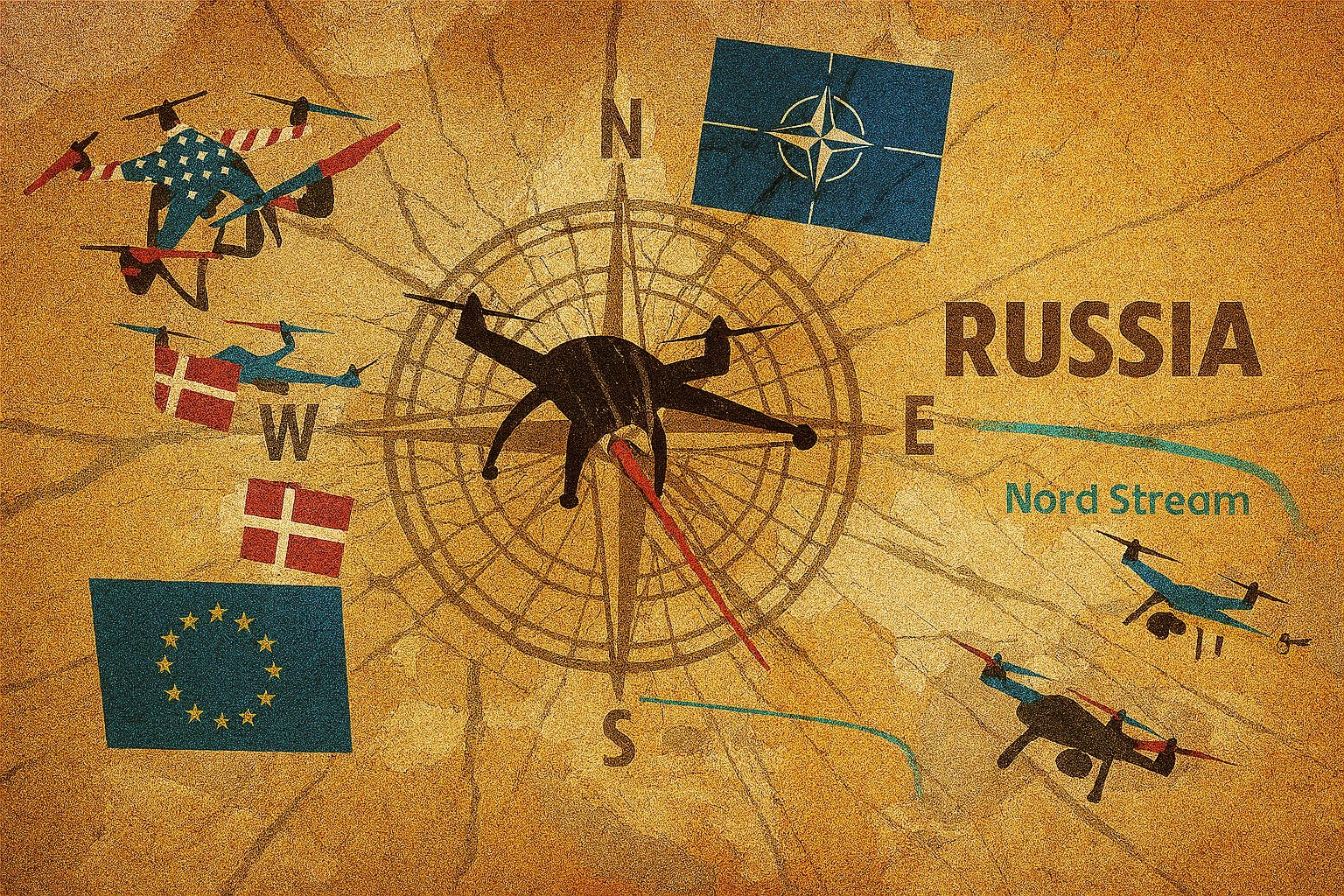
Officially, the drones were not identified. By simply thinking critically – which journalists and selected experts no longer do – there may be a good reason for that. And this article will never be mentioned in Denmark… Drones over Denmark. No damage. No trace. No answers. Yet the headlines scream “Russian threat,” and Prime Minister Mette Frederiksen speaks with a certainty that defies logic: “We don’t know they were Russian—but we know Russia is the biggest threat to Europe.” It could be nobody else – unless you make an interest analysis which I did two days ago. This is not security policy. It’s theatre. And the audience is being played. Let’s rewind. These drones—unphotographed, untracked, unclaimed—appear and vanish like ghosts. Airports shut down. Panic spreads. Military budgets swell. And the narrative hardens: Russia is behind it. But what if that’s not just wrong but deliberately misleading? Here’s a hypothesis for...