Japan

Showing 1-10 of 37 stories

Sort by
Categories

Year

Author / Contributor

Region

a226e378-ed4b-4aaa-a9c3-c26dd6be7eb3-1
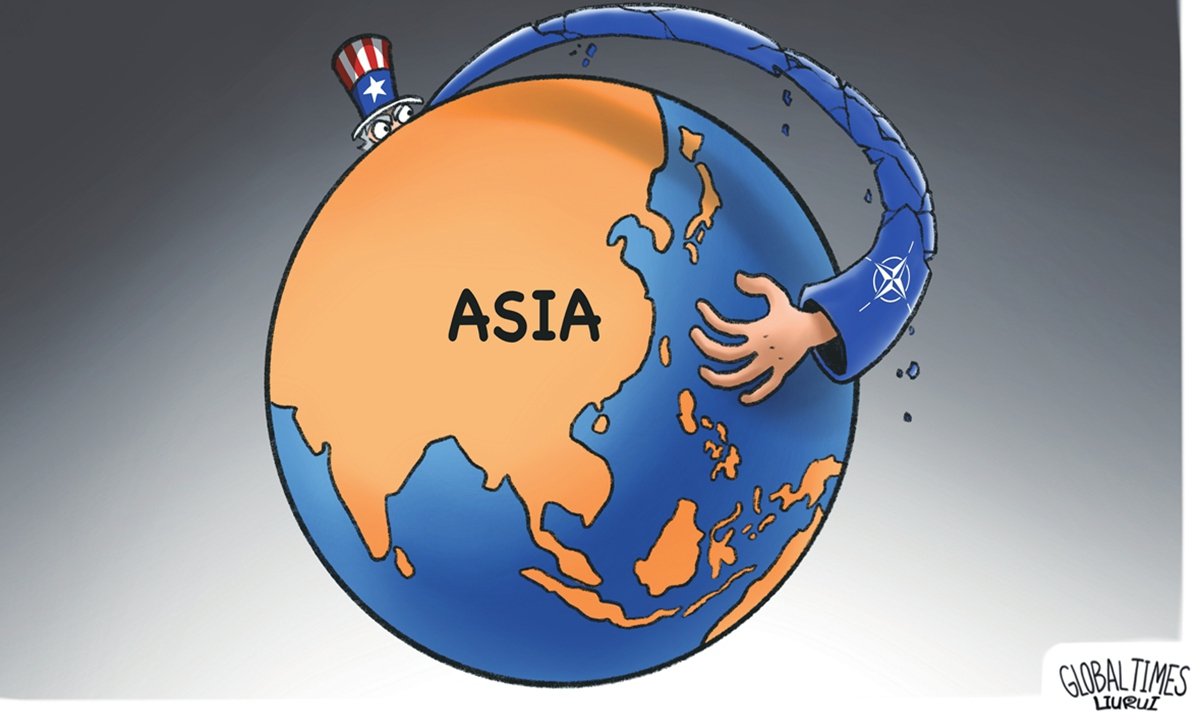
Jens Stoltenberg says the alliance is ‘not just regional but global’, a Western overreach that will be dangerous and destabilising Alex Lo September 24, 2024 In politics and war, delusion often sounds like vision. Jens Stoltenberg certainly has “that vision thing”, as the late George H.W. Bush once derisively called it. If the retiring Nato chief is anything to go by, and I hope not, the biggest military alliance in history with “North Atlantic” in its title is about to go global. Is this Western alliance about to expand into the East? If so, what do you call that? Western imperialism redux? This article was first printed by the South China Morning Post on September 24, 2024 In his parting gift for world peace or rather world war, Stoltenberg said in an interview with Foreign Policy, which is itself an undeclared information organ of Washington’s security and foreign policy elites,...
Japan-Fumio-Kishida-Military
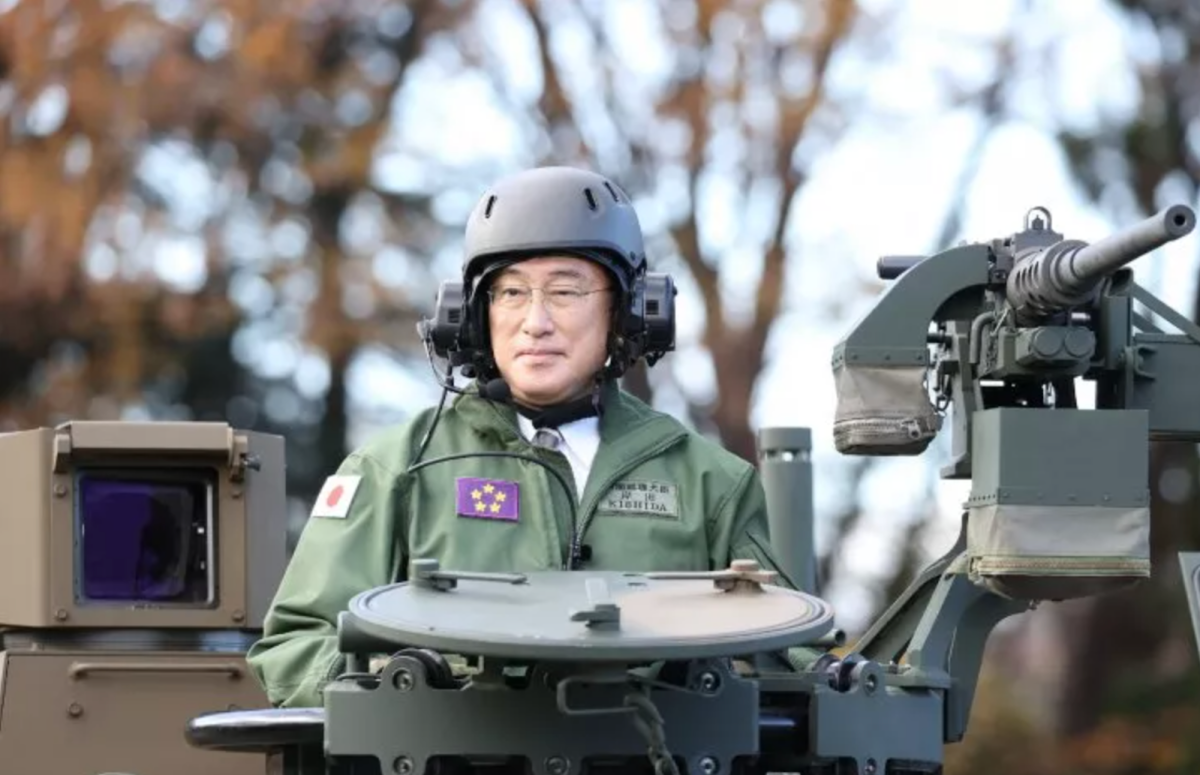
Japanese Prime Minister Fumio Kishida rides on a Japan Ground Self-Defense Force Type 10 tank during a review at JGSDF Camp Asaka in Tokyo on November 27, 2021. Photo: JiJi Richard Javad Heydarian February 5th, 2023 Prime Minister Kishida goes on a diplomatic offensive in the West as Tokyo cranks up defense spending to counter China Originally posted on Asia Time on January 23, 2023 here MANILA – Japanese Prime Minister Fumio Kishida kicked off the new year with a series of high-profile visits across key Western allied nations, including the United States. In Washington, he held “very productive” talks with US President Joe Biden on strengthening bilateral cooperation in critical industries, particularly semiconductors, as the West contemplates decoupling from its decades-long dependence on China.  Earlier, the Japanese leader also met counterparts in Europe where he signed new defense agreements to augment military interoperability and joint exercises in the Indo-Pacific. Together with the United...
johangaltung
“View” meaning not only a glimpse from above, but a position taken on the world on which the US electorate is now dumping Donald Trump. That world is today basically multi-polar, maybe with 8 poles: 1) Anglo-America, 2) Latin America-Caribbean, 3) African Unity, 4) Islam-OIC from Casablanca to Mindanao, 5) European Union, 6) Russia more region than state, 7) SAARC from Nepal to Sri Lanka, 8. ASEAN, Australia-New Zealand. [See list of abbreviations with links to the mentioned organisations under the article] And thre is the multi-regional Shanghai Cooperation Organization, SCO, with China and Russia, Islamic countries, India and Pakistan. There is a waning state reality, smaller states being increasingly absorbed into regions. There is a waxing region reality with the above eight; adding West Asian, Central Asian and Northeast Asian regions, maybe eleven. There is a global reality based on IGOs, inter-governmental organizations, with the United Nations on top;...

johangaltung
Dear Reader: This editorial 444 – the number calls for attention – is dedicated to a global overview, the world “right now”, so unstable with imbalances everywhere that what we are living is fluxes and jumps. Let us start with two major relations: Nature-human, the US-the Rest. Look at the human-nature relations. We are used to being on top, killing and taming animals, protected against many of nature’s hazards including micro-organisms. But nature comes up with ever smaller viri, and larger, or more, tsunamis and earthquakes, and an erratic climate. We oscillate between blaming ourselves, including military scheming, and the anthropomorphic “Mother Nature is angry” (Evo Morales). If nature is angry, she has good reasons for a good riddance of us. And we are slow at a deeper human-nature relations respecting and enhancing both. Nature is on top and our natural sciences are simply not good enough, taken by surprise...
jonathanpower2
The announcement was made yesterday – August 15 – by Japan’s Finance Ministry: In the last quarter of the year the Japanese economy grew at an annualised rate of 0.2%. “One wonders if the economy will remain at a standstill for the rest of the year”, the Financial Times asks. But then Japan’s economy has been becalmed for 30 years. Even though the government has poured billions of dollars into the economy it has had only a small effect in boosting demand. One wonders when the government will give up and what happens then – another decade of minimal growth? If that is what happens how much does it matter? To the Japanese themselves it seems not that much. By and large they are contented with their lot. The rest of the word may be worried as a powerful country is importing less and less. It does not contribute to...
johangaltung
The background is the two major communist parties in the world. Russia Communist Party-Bolshevik made the November 1917 revolution; from 1922 the Communist Party of the Soviet Union, CPSU(b). CPC, the Communist Party of China, now celebrating its 95th anniversary, made the 1 October 1949 revolution. World-shaking events; in the world’s biggest state in area and in the world’s biggest state in population. The revolutions cut into the modernity contradictions in the State-Capital-People triangle by conquering State-military and police. Two lasting achievements of CPSU(b): State Planning of the economy – maybe five years at the time, pjatiletka – now found in most countries; and lifting some bottom up to meet basic needs, surprisingly quickly. But CPSU(b) exercised gross structural violence in the countryside. And CPC, imitating CPSU(b), made the same mistake to start with. Then they became different. Russia got stuck with the Party on top of the State, for...
johangaltung
Except for a dark shadow, all is normal in the land of Japan. The local levels function very well with diligent Japanese working together to lift them up. Except for those with nuclear power plants, particularly one of them, on the coast, hit by a tsunami. Except too for rural communities laid waste, people aging, leaving, empty villages, hit by having to import rice instead of cultivating it. Ride the trains, walk the streets with the Japanese; as brisk and busy as ever. A little older, more canes, fewer bicycles, more cars, better streets and roads, cars run faster. In addition, a little fatter, sharing aging and putting on weight with developed societies all over. Missing are older ladies on bikes navigating the narrow streets with elegance, skirting pedestrians by a centimeter or two–bikes ride on sidewalks in Japan not on the streets–heads high, unperturbed. Not missing are school classes...
johangaltung
Marinaleda, Spain On a periphery road 108 Km east of Sevilla: one white Andalucian village after the other, traditional, poor; and suddenly this super-modern concrete reality, a utopia in many people’s minds! The basic concept is well known: authorities expropriated land lying fallow in the midst of unemployed starving land labor, and it was transformed into a communal cooperative with very inexpensive housing, kindergarten, schools, clinics. Behind that was the vision, knowledge, skill, will of the mayor for over 30 years, Juan Grillo. With the mind, a reality, and the will to transform that reality. We are dealing with more than economy and have to look beyond economics to capture what went and goes on. The old distinctions between public and private, and between owning and using, certainly enter. With comments, such as these. Generally public vs private is seen in terms of state vs capital, the state using plan...
silk-road-Yiwu-madrid
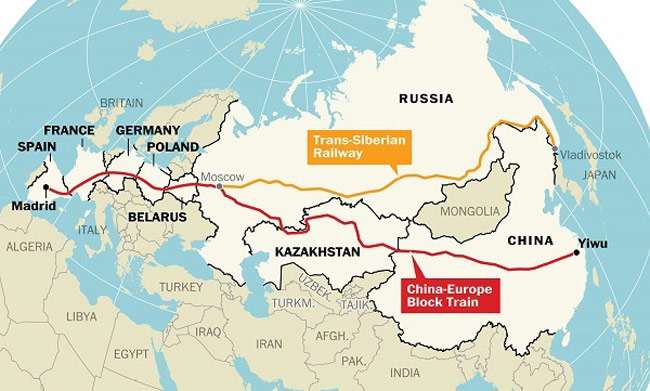
China is changing world geography, or at least trying to do so. Not in the sense of land and water like the Netherlands, but in the sense of weaving new infrastructures on land, on water, in the air, and on the web. It is not surprising that a country with some Marxist orientation would focus politics on infrastructure–but as means of transportation-communication, not as means of production. Nor is it surprising that a country with a Daoist worldview focuses politics on totalities, on holons and dialectics, forces and counter-forces, trying to tilt balances in China’s favor. How this will work depends on the background, and its implications. Two recent books, Valerie Hansen, Silk Road: A New History (Oxford University Press, 2012) and Peter Frankopan, The Silk Roads: A New History of the World (Knopf, 2015) see them as arteries connecting the world, globalization, before that term became a la mode....
johangaltung
From very high up three major countries-states stand out clearly: China, the most populous; Russia, the largest; USA, the most military. With three leaders, Xi, Putin, Obama, with much power on their hands. And here is the key hypothesis, presumably more right than wrong: China-Xi: positive peace; Russia-Putin: negative peace; USA-Obama: war. We have in mind China – also a region – building relations for reasonably mutual and equal benefit with China all over the world, spinning Asia-Europe-Africa together in a road-rail-ship-air Silk network available to all (with major mistakes in the South China Sea). We have in mind Russia – itself also a region – calling to Russia leaders in violent conflict from all over the world, seeking cease-fires and accommodation (making itself a major mistake in Syria). And we have in mind USA – more than a state, less than a region – since WWII ended killing more...
johangaltung
Do you remember the Axis of Evil – Iraq-Iran-North Korea? George W. Bush, or his speechwriter rather, concocted that axis in 2002 as focus for a global war on terror. The key term is “evil”–not “enemy”, “hostile”–the connotation being “possessed by Satan”. The proof is opposition to a USA chosen by God, as God’s Own People, as “In God we trust”. To exorcise Satan only violence works. In 1953 North Korea under Kim Il Sung did not capitulate to the USA, only cease-fire, the first US non-victory since 1812. Very evil. In 1978-79, Iran, by the Khomeini Islamic revolution, decolonized Iran from US dominance and evicted the shah, who had been installed by a US-UK (CIA-MI6) coup in 1953; in fact undoing 1953. Very, very evil. On 17 May 1987 Saddam Hussein, used by the USA to fight Iran with no gains for Iraq, fired on a US vessel (USS...
jonathanpower2
By Jonathan Power So Putin on Monday met Obama. They are going to cooperate against ISIS, the world’s worst problem. President Vladimir Putin says we should not be surprised to see Russian jets working cooperatively – even coordinating – with the US on missile attacks. Even with both powers working in tandem it will be uphill work. ISIS has attracted over 30,000 foreign fighters, according to a UN Security Council report. At least 2,000 from Russia and ex-Soviet territories are in their number. (In contrast to Russia the US is more threatened by domestic, non-Muslim, terrorists than Muslim extremists.) Will rapprochement over Syria and ISIS wind the clock back to the benign US-Russia relationship that was begun with President Barack Obama’s early “re-set” which led to, among other things, a significant agreement on reducing nuclear arms?