Following Gandhi's Path - Part 10 - If the West Is Like Pop, India Is Like Bach

My journey in India is coming to an end. I have met Buddhist youth from Tibet and visited historical places and ashrams connected with Gandhi. I have visited Varanasi or Benares, the holiest Hindu town where people seek salvation in the Ganges River’s waters which are crawling with colon bacilli. I have seen the old and sick waiting to die so that their corpses can be burnt in a great fire and the ashes spread over and taken away by the river.
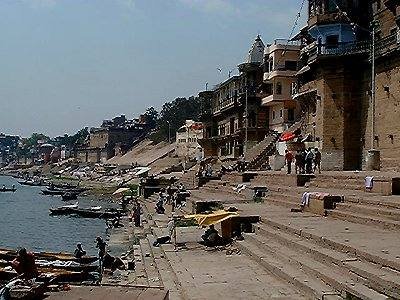
The Ganges River, Varanasi – Photo Jan Öberg, © TFF 2001

I have also visited places of central importance to Buddhism – Bodghaya, where the young Gautama was enlightened under the pipal tree, and Sarnath, where he first spoke to his disciples.
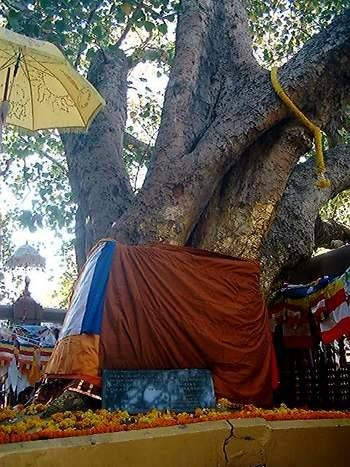
The pipal or bodhi tree in Bodghaya – where Buddha experienced enlightenment– Photo Jan Öberg, © TFF 2001

I made a trip to Rajgai where Buddha lived for 12 years and I admired the peculiar rock formation, Gridhakuta, where he is said to have given his most important lectures.
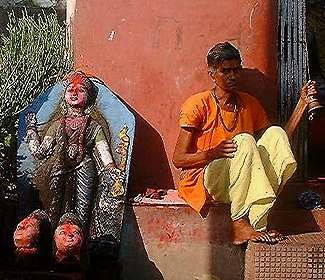
Entrance to the public bath in Rajgai – Photo Jan Öberg, © TFF 2001

I have also seen the giant and magnificent Peace Pagoda, built by the Japanese Nichiren Buddhist monk, Nichidatsu Sufujii Gurujin, in the Rajgiri Hills. Whilst thinking about him, I am reminded of Gandhi. Gurujin was born in 1885 and came to India in 1931 where he met Gandhi. They became friends and Gandhi included, from that year onwards, Buddhist mantras like “nam-myo-ho-renge-kyo” in his ecumenical prayers. Gurujin built more than 70 peace pagodas all over the world and died at the age of 101.

About Guruji who built 70 peace pagodas and became Gandhi’s friend, Rajgai – Photo Jan Öberg, © TFF 2001

I have always thought there are many similarities between Gandhi’s and Buddha’s thoughts and actions. Perhaps I have found one of many keys to these similarities in Rajgai? I add this to the already long list of questions that I must investigate more closely when I describe my journey in a book. India is very bewildering. But I don’t feel any need to know all the details or make academic analyses.

I came to India in order to experience the country and to reflect on my own life, the West and the rest of the world. Now, I feel enriched and content.
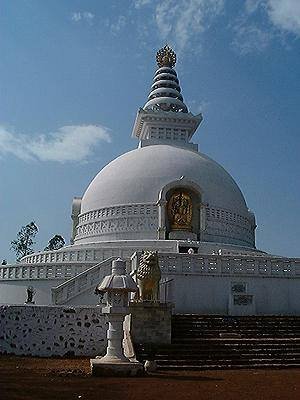
Peace pagoda on the top o a mountain outside Rajgai – Photo Jan Öberg, © TFF 2001

In the first of my ten articles, I wrote that India shouldn’t actually be possible. Now, I must admit that this is especially valid for people who come here with a typically Western-programmed mind-set. To them India must be – – and is – – incomprehensible. I have spent two months, living simply, near the people and their everyday life. Yet, I have only seen a fraction of the country; I haven’t been south of Bombay or east of Gandhi’s ashram in Sevagram. Yet, I have learnt the most important lesson: one must empty one’s mind and thoughts of as many prejudices as possible in order to meet this equally fascinating and frustrating country with an open mind.

There are no simple truths. One might comment about something that “this is just the way it is”, only to find the next minute that “this is the way it also is.” Or better perhaps: “what I just said is only one part of the truth, because it might as well be quite the opposite”.

This infinite reality, this simplicity in complexity and complexity in simplicity, this genuine Indian “unity in diversity” made me feel very humble. During the course of two months it made me look upon my own Western world, the Occident, as somewhat banal, or like a pseudo or pop culture with quick rhythms, a lot of glitter with shallow truths which we all keep pounding into our own and our fellow westerners’ minds. If the West is like a pop hit, India is like the music of Johan Sebastian Bach!
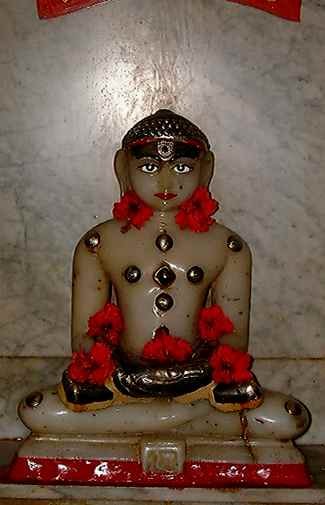
God in a Jaintemple in Bombay (Mumbai) – Photo Jan Öberg, © TFF 2001

I am struck by a dizzying thought: can all that we have built up in the West possibly last for as long as this strangely weak, crisis-ridden, yet majestically strong India? Maybe the strength of India lies in the fact that she does not develop the way we would expect? That India rather is, exists and breathes slowly, saving its civilisational energy for future use?

In his day, Karl Marx made some very condescending remarks about India. Yet even today, we can ponder whether religion serves as a sort of opium for the people. People are born into a caste; it is an extremely individualistic and atomised social order, with only a tiny elite having great mobility, and only slightly more than half of the inhabitants of India can read and write. If they, moreover, happen to live in the slums and/or are women then they don’t have a chance. Life and hope lie, necessarily, beyond the present and material reality.

I can still feel the strong sense of deadlock, of a hard society where everyone sees each other as competitors. I have seen too many taxi drivers beating each other up over the penny they would have earned from me. Loyalties are almost always vertical, with one’s superiors, with those who have power – including various gods – and hardly ever horizontal with those who share the same position or fate. There will be no collective revolution here, for sure! There is far too much cringing, false politeness and genuine subservience. There is a lot of psychological violence connected to the built-in violence of the social structures.

This is the hard side of India. To it belong the political cynicism, the corruption, the grotesque class distinctions, the nuclear weapons, the environmental pollution, and, last but certainly not least, the oppression of women.
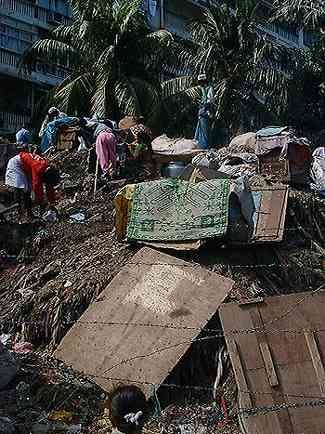
Slum area in Mumbai, just a few hundred metres from…-Photo Jan Öberg, © TFF 2001

Yet, it is enormously impressive how India has managed to maintain her soul, her spirit – – not Western and not Eastern, but simply Indian. In this soft India exists the spiritual, the consciousness that life is more than just material matter, the philosophy, the literature, the Gandhianism, the mixture and co-existence of all the religions. This is here we can find the India that has given so much to the rest of the world, but also taught the British empire a lesson without any hate. The rhythm of life in this soft India is very slow. Centuries of invasions from all parts of the world have not been able to subdue India.
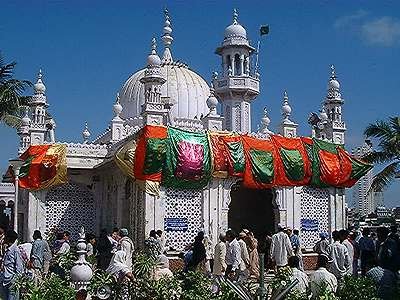
…the magnificent mosque of Mumbai. – Photo Jan Öberg, © TFF 2001

Both sides of India seem to be summed up in Gandhi: both the country’s Father and Mother, a strong individualist working on behalf of the collective, extremely self-conscious, and humbly experimenting with life itself. He was a Hindu, a Christian, a Muslim and a Buddhist, yet with a special, eclectic life-philosophy of his own, according to which “Truth is God and God is Truth”.

And, yet, when one has said that, one must retract it. Gandhi was actually also the opposite of what India is. I think he would feel deeply depressed if he suddenly woke up in today’s India. He would be the Number One enemy of the government, spending most of his time behind bars.

I did not fall in love with India, so I certainly cannot be disappointed next time we meet. And that we certainly will. I will feel more and more challenged by the visits.

Jan Øberg

Translated by Alice Moncada

Translation edited by Sara E. Ellis
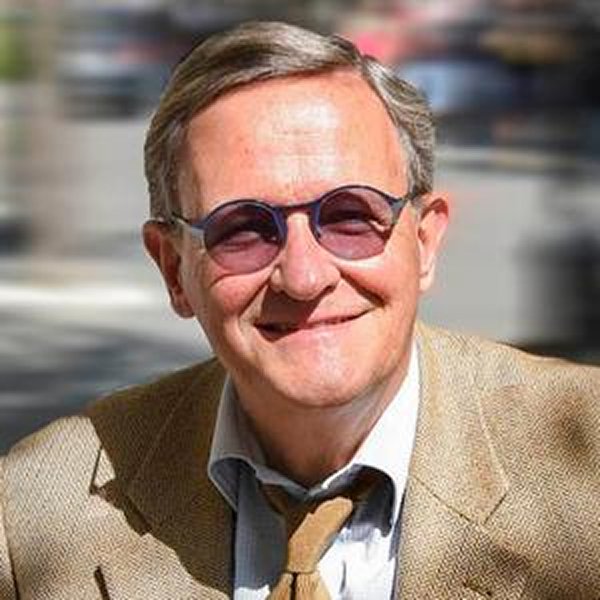
Peace & future researcher + ‌Art Photographer

Share

Leave a Reply

Your email address will not be published. Required fields are marked *

Related Posts

Af Svenska Irakkommittén mot de Ekonomiska Sanktionerna (SIES) 13 september 2002 FN:s ekonomiska sanktioner mot Irak har nu pågått i tolv år och drabbat det irakiska folket med svåra lidanden. Enligt FN:s egna siffror har mer än 1,5 miljoner människor, varav ca 600 000 barn, dött som en direkt följd av sanktionerna. Dessutom har ett lågintensivt bombkrig mot landet pågått under dessa år. Av all denna förödelse- orsakad huvudsakligen av amerikansk och brittisk politik- har Saddam Husseins brutala och diktatoriska regim snarast stärkts än försvagats. Nu förbereder USA under president Bushs ledning ett storskaligt bombkrig mot Irak som kommer att innebära ett ännu större lidande för civilbefolkningen. Ett sådant krig kommer dessutom att ytterligare undergräva freden och säkerheten i världen. Att upprätta en demokratisk regim i Irak är det irakiska folkets angelägenhet och får enligt folkrätten inte ske med krigshandlingar utifrån. Folkrätten och FN:s stadgar måste respekteras. Vi vädjar till...
LONDON – So far so good, at least on the wider level. While internally Iraq seems on the edge of chaos, the much heralded clash of civilizations between the Muslim and Judaeo-Christian worlds has yet to become apparent. We have anger and despair aplenty in the Arab and Muslim worlds. But very little rushing to the standard and there was no great pilgrimage of warriors to join the fight, as happened when the Soviet Union invaded Afghanistan twenty years ago, and then, having driven the Red Army out, were left to ferment in that mountainous redoubt. With the armaments supplied by the CIA the mujahidin were transformed into Al Qaeda that became, for a relatively brief moment as these things go, ‘the greatest threat to the homeland that America has ever known.’ Nevertheless a ‘Cold War’ between much of the Muslim world and the West is certainly in full swing. Winston...

Recent Articles

Af Svenska Irakkommittén mot de Ekonomiska Sanktionerna (SIES) 13 september 2002 FN:s ekonomiska sanktioner mot Irak har nu pågått i tolv år och drabbat det irakiska folket med svåra lidanden. Enligt FN:s egna siffror har mer än 1,5 miljoner människor, varav ca 600 000 barn, dött som en direkt följd av sanktionerna. Dessutom har ett lågintensivt bombkrig mot landet pågått under dessa år. Av all denna förödelse- orsakad huvudsakligen av amerikansk och brittisk politik- har Saddam Husseins brutala och diktatoriska regim snarast stärkts än försvagats. Nu förbereder USA under president Bushs ledning ett storskaligt bombkrig mot Irak som kommer att innebära ett ännu större lidande för civilbefolkningen. Ett sådant krig kommer dessutom att ytterligare undergräva freden och säkerheten i världen. Att upprätta en demokratisk regim i Irak är det irakiska folkets angelägenhet och får enligt folkrätten inte ske med krigshandlingar utifrån. Folkrätten och FN:s stadgar måste respekteras. Vi vädjar till...
Peace will not result from any “peace” plan circulated to date. Neither will it emerge from warfare – as the elites of NATO, EU, Russia, and Ukraine seem to finally recognise after avoidable, unspeakable losses of people, trust and physical, socio-economic destruction. And horse-trading based on military ‘security’ guarantees reveals only peace and conflict illiteracy. TFF is critical of the widespread and severe misuse of the word peace – as if it did not require any knowledge. But we do not engage in geopolitical-military commentarism or dismissive criticism of present-day Realpolitik and its militarist mindset. Indeed, we do not believe that mainstream political and media elites are aware that they know woefully little about peace and peace-making or see it as a professional field. Thus, we do not expect they would acquaint themselves with a portfolio like this. TFF concentrates on constructive, visionary thinking grounded in the science and art of peace and in our 40 years...

TFF on Substack

Discover more from TFF Transnational Foundation & Jan Oberg.

Most Popular

Af Svenska Irakkommittén mot de Ekonomiska Sanktionerna (SIES) 13 september 2002 FN:s ekonomiska sanktioner mot Irak har nu pågått i tolv år och drabbat det irakiska folket med svåra lidanden. Enligt FN:s egna siffror har mer än 1,5 miljoner människor, varav ca 600 000 barn, dött som en direkt följd av sanktionerna. Dessutom har ett lågintensivt bombkrig mot landet pågått under dessa år. Av all denna förödelse- orsakad huvudsakligen av amerikansk och brittisk politik- har Saddam Husseins brutala och diktatoriska regim snarast stärkts än försvagats. Nu förbereder USA under president Bushs ledning ett storskaligt bombkrig mot Irak som kommer att innebära ett ännu större lidande för civilbefolkningen. Ett sådant krig kommer dessutom att ytterligare undergräva freden och säkerheten i världen. Att upprätta en demokratisk regim i Irak är det irakiska folkets angelägenhet och får enligt folkrätten inte ske med krigshandlingar utifrån. Folkrätten och FN:s stadgar måste respekteras. Vi vädjar till...
Peace will not result from any “peace” plan circulated to date. Neither will it emerge from warfare – as the elites of NATO, EU, Russia, and Ukraine seem to finally recognise after avoidable, unspeakable losses of people, trust and physical, socio-economic destruction. And horse-trading based on military ‘security’ guarantees reveals only peace and conflict illiteracy. TFF is critical of the widespread and severe misuse of the word peace – as if it did not require any knowledge. But we do not engage in geopolitical-military commentarism or dismissive criticism of present-day Realpolitik and its militarist mindset. Indeed, we do not believe that mainstream political and media elites are aware that they know woefully little about peace and peace-making or see it as a professional field. Thus, we do not expect they would acquaint themselves with a portfolio like this. TFF concentrates on constructive, visionary thinking grounded in the science and art of peace and in our 40 years...
Read More
Imagen-thumbnail-The-Transnational-1
Af Svenska Irakkommittén mot de Ekonomiska Sanktionerna (SIES) 13 september 2002 FN:s ekonomiska sanktioner mot Irak har nu pågått i tolv år och drabbat det irakiska folket med svåra lidanden. Enligt FN:s egna siffror har mer än 1,5 miljoner människor, varav ca 600 000 barn, dött som en direkt följd av sanktionerna. Dessutom har ett lågintensivt bombkrig mot landet pågått under dessa år. Av all denna förödelse- orsakad huvudsakligen av amerikansk och brittisk politik- har Saddam Husseins brutala och diktatoriska regim snarast stärkts än försvagats. Nu förbereder USA under president Bushs ledning ett storskaligt bombkrig mot Irak som kommer att innebära ett ännu större lidande för civilbefolkningen. Ett sådant krig kommer dessutom att ytterligare undergräva freden och säkerheten i världen. Att upprätta en demokratisk regim i Irak är det irakiska folkets angelägenhet och får enligt folkrätten inte ske med krigshandlingar utifrån. Folkrätten och FN:s stadgar måste respekteras. Vi vädjar till...
TFFPortfolioVign
Peace will not result from any “peace” plan circulated to date. Neither will it emerge from warfare – as the elites of NATO, EU, Russia, and Ukraine seem to finally recognise after avoidable, unspeakable losses of people, trust and physical, socio-economic destruction. And horse-trading based on military ‘security’ guarantees reveals only peace and conflict illiteracy. TFF is critical of the widespread and severe misuse of the word peace – as if it did not require any knowledge. But we do not engage in geopolitical-military commentarism or dismissive criticism of present-day Realpolitik and its militarist mindset. Indeed, we do not believe that mainstream political and media elites are aware that they know woefully little about peace and peace-making or see it as a professional field. Thus, we do not expect they would acquaint themselves with a portfolio like this. TFF concentrates on constructive, visionary thinking grounded in the science and art of peace and in our 40 years...
BlackNobel
OK, Trump did not get it. But he got a full endorsement of a possible future US regime change in Venezuela. And that is what Ms Machado has advocated. On October 10, 2025, the Norwegian Nobel Committee awarded its Peace Prize to Venezuelan opposition figure María Corina Machado. The citation praised her “tireless work promoting democratic rights.” But Ms Machado has openly called for U.S. military intervention in Venezuela, stating on CBS: “The only way to stop the suppression is by force—U.S. force.” She or her party has received funding from the National Endowment for Democracy (NED), a U.S. government-backed body known as a CIA front organisation and for supporting regime-change operations worldwide. And in 2018, she sent a letter to Israeli Prime Minister Benjamin Netanyahu, asking him to use “force and influence” to help dismantle Venezuela’s government—citing alleged ties to terrorism, Iran and narcotrafficking. This year’s NATO Norwegian prize...
Screenshot-2025-10-08-163458
PRESS RELEASE – 6 OCTOBER 2025 LAY DOWN YOUR ARMSPEACE PRIZE FOR 2025 is awarded Francesca Albanese The United Nations Special Rapporteur on the occupied Palestinian territories – as the person who, in accordance with Alfred Nobel’s will, has “done the most or the best work for fraternity between nations and for the abolition or reduction of standing armies as well as for the holding and promotion of peace congresses.” Francesca Albanese has forcefully and unwaveringly worked against Israel’s full-scale war on the occupied Palestinian territories, in particular Israel´s ongoing genocide against the Palestinian people. She has confronted Israel’s systematic war crimes and crimes against humanity in a truly global outreach. Further, she has brought governments, international organisations and people’s groups together to underline the responsibility of the world at large to act and to stop arming, enabling, and profiting from Israel’s ongoing criminal actions. But first of all, Albanese...
Copilot_20251003_003414
Officially, the drones were not identified. By simply thinking critically – which journalists and selected experts no longer do – there may be a good reason for that. And this article will never be mentioned in Denmark… Drones over Denmark. No damage. No trace. No answers. Yet the headlines scream “Russian threat,” and Prime Minister Mette Frederiksen speaks with a certainty that defies logic: “We don’t know they were Russian—but we know Russia is the biggest threat to Europe.” It could be nobody else – unless you make an interest analysis which I did two days ago. This is not security policy. It’s theatre. And the audience is being played. Let’s rewind. These drones—unphotographed, untracked, unclaimed—appear and vanish like ghosts. Airports shut down. Panic spreads. Military budgets swell. And the narrative hardens: Russia is behind it. But what if that’s not just wrong but deliberately misleading? Here’s a hypothesis for...