
The (Im)Possibility of Peace

Professor and director of the Global Changes Centre in Skopje, Macedonia and TFF Board member

The intelligence services have probably noted this meticulously, but let me publicly share my experience of attending, for the first time, the annual conference of the renowned Valdai Discussion Club in Russia. For 20 years now, it has convened near Sochi, nestled among the stunning mountain peaks of the Russian Caucasus.

Personally, this year stands out for many reasons. My first visits to China, and now to Russia, are undoubtedly among the most significant. Due to the format of the conference, I can’t describe Russia to you in the same way I recounted my experience in China. Over four days, around 130 participants (professors, analysts, strategists, diplomats, former generals, journalists—mostly from foreign countries, with fewer from Russia) representing over 50 nations engaged in discussions during panels that ran from 9:30 AM to 9:30 PM.

The topics, though seemingly diverse, were interconnected and fascinating, which kept the hall consistently full. Discussions ranged from artificial intelligence to ecology, the financial system, and, of course, war and peace. A few attendees I knew from previous encounters, who are regular guests at Valdai, told me that since the inaugural conference 20 years ago, the biggest change has been in the composition of the participants. Back then, the stars of Western academia and public life dominated, reflecting Russia’s efforts and hopes at the time of being accepted as a partner in the European security community.

How naive that belief now seems—that the West had overcome its Russophobia, let alone its racial prejudice against anything non-Western! In today’s altered circumstances, the guests came from all corners of the world. Valdai, like the world itself, has become multipolar.

If you’re curious about the presence of representatives from “our allies,” even though everyone participates in a personal, not official, capacity, alongside me (coming from a NATO country), there were also colleagues from Canada, the United Kingdom, Norway, Greece, Italy, Germany, and Switzerland.

Although this was my first invitation to the Valdai Club, I was honoured to be given the role of a speaker on one of the most “heated” panels: the war and peace in Ukraine. The session was the very last one, held after dinner. For a moment, I even wondered if there would be any audience left after such a long and demanding day. But I was wrong—not only was the room packed to the last seat, but the session also lasted far longer than others due to the overwhelming number of questions.

My co-panellists included colleagues from Turkey, China, Russia, Ireland, and Moldova. It might sound immodest, but I believe part of the lively debate stemmed from my peace-oriented approach and my firm belief that violence begets violence and that the UN is fundamentally rooted in the principle of achieving “peace through peaceful means.” Closest to my perspective was the brilliant Professor Weng Wen, who presented his views through the lens of China’s state philosophy on peace.

At the hosts’ request, I had prepared a written speech, but inspired by the day-long discussions, I decided to speak freely, as I usually do—without reading and focusing on a few key points I had jotted down while listening to others. In short, I entered into dialogue with those who believed that a military solution was the only viable option and that a ceasefire would only strengthen the opposing side.

I clearly elaborated my position that the conflict in Ukraine was not “unprovoked” (as the Western narrative claims). Instead, it was driven by imperialist Western ambitions disguised as NATO enlargement. Furthermore, it did not begin in 2022 but much earlier—even before the 2014 “coloured revolution” orchestrated by Victoria Nuland. I argued that the Ukrainian conflict has been operating on three levels: an internal conflict, a clash between two neighbouring states, and, most significantly and dangerously, a proxy war by the West against Russia (with China in the background).

If you think these are heretical ideas through the lens of the West, let me tell you that some of them weren’t warmly received by the hosts either. The well-known Karaganov responded to me quite firmly and angrily, leaving the room before hearing my reply. My response was in the spirit of anti-war protests from the Vietnam era: If war is the answer, then it’s a f**king stupid question!

Late into the evening, it seemed that only my Chinese colleague and I stood firmly on the side that it is urgently necessary to stop the bloodshed, to find a way to stop fueling the fire threatening to consume the world, and that any military victory would be Pyrrhic for all, and that such a peace would only lead to new wars. Naturally, we expected third (neutral) countries to emerge as mediators, creating conditions for talks to end this war that has already claimed hundreds of thousands of lives.

As I spoke and glanced around the room, a thought crossed my mind: “Well, Biljana, this wouldn’t be the first time—you get invited once, but never again!” I waited to see what the morning would bring, curious about the participants’ reactions. And then, something remarkable happened: from that moment until the end of the conference, people from all over the world approached me with congratulations. They praised my courage, honesty, humanity, and principled defence of peace.

An Indian diplomat reassured me: “We are not here to please anyone; we are here to speak what we believe.” The hosts demonstrated a level of democracy and openness to differing opinions that are hard to find in today’s West, which has already “cancelled” me (put me on a blacklist).

An older Greek participant never missed the chance to greet me warmly and say, “You’re the only one speaking about Gaza—respect to you for that.” Even during discussions about cooperation among civilizations, I couldn’t help but think that as long as the blood of Palestinian children is being spilled, we don’t deserve to call ourselves a human civilization.
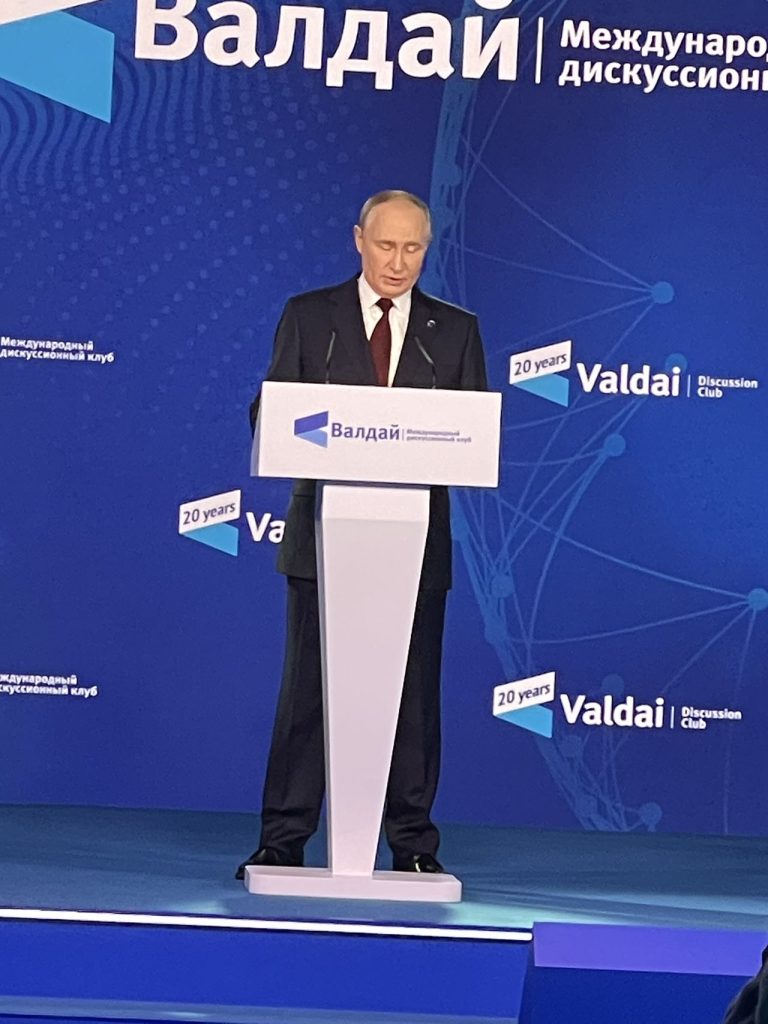
I’d probably need an entire column to describe the most media-attractive moment: President Putin’s address (after we had already been intellectually captivated by Lavrov and Zakharova!). Just as “Pinki saw Tito,” I had the chance to see and listen to Putin for a full four hours. Without a hint of fatigue, loss of focus, or hesitation, he not only delivered a speech that is now being analyzed by all major global think tanks, but also demonstrated extraordinary intelligence, eloquence, and thoughtfulness in how he responded to audience questions.

This event took place just a day after we analyzed the results of the U.S. elections. During a break, I managed to catch Trump’s victory speech on YouTube. Comparing it to Putin’s performance, all I could think was, “Oh my goodness, what a contrast!” Who, then, is Putin supposed to negotiate with? Zelensky is seen as a puppet—nothing more than an actor and a façade for Ukraine’s statehood.

Even Ursula von der Leyen and the EU are not considered real partners in potential negotiations. (Maria Zakharova humorously remarked, at Scholz’s expense, that she had forgotten the German Chancellor’s name just after he lost his authority.) In his speech, Putin openly stated that his experts tell him Brussels lacks intellectual capacity, implying “empty heads” in leadership.

And then you listen to Trump, speaking like a 15-year-old, with simplistic and clumsy sentences. He’s clearly not the one steering the country. The caricature about the dominance of the Israeli lobby (and the military-industrial complex) across all U.S. states turns out to be not an exaggeration but an accurate reflection of reality.

At the Valdai Club, the focus of the analysis leaned more toward understanding the factors behind Trump and his MAGA movement’s decisive (rather than narrow) victory, rather than debating whether he could deliver on his promise to end the war in Ukraine in a single day. Most participants likely dismissed that as nonsense, though a faint hope lingered—a hope no one wanted to abandon entirely—that perhaps his presidency might lead to the re-establishment of diplomatic communication between Washington and Moscow.

Putin, for his part, was measured in his remarks on the topic, offering what could be seen as a polite, albeit implicit, congratulation to his American counterpart. Radhika Desai delivered a stark truth: Trump is not good news for anyone, even as many might celebrate Biden’s departure.

I’ve already expressed my view on this false choice between Trump and Harris. It’s a choice between two evils, and in such a critical moment for humanity’s future, evil is still evil, regardless of whether one is deemed lesser than the other. The United States remains an empire of chaos, clinging to the dreams of omnipotence granted by the god of war, Mars—or perhaps relying on the strategy of intimidating everyone else.

While it may be too soon to fully judge Trump’s policies (and I personally doubt his capacity to craft anything beyond profit-driven, ego-centric decisions), his cabinet nominations already speak volumes.

The hawks remain dominant; there are no doves of peace in sight. Before long, American citizens—much like Macedonian voters—may find themselves lamenting how they allowed themselves to be deceived yet again or clinging to the fragile notion that hope is the last thing to die.

I must admit that I view what lies ahead with an even greater dose of pessimism. Putin is right when he says he would consider a peace plan, but there’s no one to negotiate with. Some participants asked me what Russia’s motivation would be to accept a ceasefire now, especially since it seems to be gaining momentum on the battlefield. My answer was BRICS—a cooperative, multipolar system founded on economic and technological collaboration and development, for which war is an obstacle.

If there was a unifying thread among Valdai participants, it was the emphasis on the fact that the new multipolar (or, as Putin called it, polyphonic rather than polycentric) order is not anti-Western but rather non-Western.

The most accurate description would be an anti-hegemonic system, one where the U.S. is expected to behave as a normal country—just one among many. Achieving this requires confronting the reality that the world has entered a post-American era. It’s not the same world Trump left behind four years ago.

Yet the so-called “new” Trump administration resembles a house out of a horror film. As names of key political figures emerge and their biographies are scrutinized, it becomes clear that Trump is as much a candidate for peace as Zelensky was. Moscow doesn’t trust the clowns, nor does Beijing—or anyone reasonable in the world.

The key to peace in Ukraine, Gaza, Sudan, the Congo, and beyond ultimately rests with the U.S. (i.e. the key belligerent factor in the world who is addicted to war), though not in the conventional sense. It requires a profound transformation within its own borders—a shift in perspective and priorities that moves away from perpetuating conflicts. Meanwhile, the global majority must not only observe these developments but also actively pursue a progressive agenda that champions peace and cooperation.

The international peace movement faces an immense responsibility: to renew and adapt itself to these complex and rapidly changing circumstances. In a multipolar world, the lines between opposing forces can blur, and the temptation to choose sides is real. Yet, the true moral and political foundation we must uphold is unwavering: the UN Charter norm of making peace by peaceful means.

This mission demands a collective effort—grassroots activism that speaks truth to power, regardless of the capital in question. It calls for a revival of peace advocacy in all its forms: media engagement that informs and inspires, education that instils the values of dialogue and understanding, and journalism that sheds light on the human cost of conflict.

These efforts are driven by the belief that in humanity’s darkest hours, it is our responsibility to act and to ensure that we do not falter when the future of peace and humanity itself depends on our courage and resolve.

The official Valdai Discussion Club’s Annual Meeting homepage.
Ph.D. Political Science, Department of Political Studies, Faculty of Law, University of Skopje, 1992 MA Political Science, Department for Political Studies, Faculty of Law, University of Skopje, 1988 BA Law, Department of Political and Administrative Studies, Faculty of Law, University of Skopje, 1982

Share

Leave a Reply

Your email address will not be published. Required fields are marked *

Related Posts

Officially, the drones were not identified. By simply thinking critically – which journalists and selected experts no longer do – there may be a good reason for that. And this article will never be mentioned in Denmark… Drones over Denmark. No damage. No trace. No answers. Yet the headlines scream “Russian threat,” and Prime Minister Mette Frederiksen speaks with a certainty that defies logic: “We don’t know they were Russian—but we know Russia is the biggest threat to Europe.” It could be nobody else – unless you make an interest analysis which I did two days ago. This is not security policy. It’s theatre. And the audience is being played. Let’s rewind. These drones—unphotographed, untracked, unclaimed—appear and vanish like ghosts. Airports shut down. Panic spreads. Military budgets swell. And the narrative hardens: Russia is behind it. But what if that’s not just wrong but deliberately misleading? Here’s a hypothesis for...
And why the world, especially the EU, must now declare itself independent of the United States. UN’s 80th anniversary This year, the United Nations celebrates the 80th anniversary of its founding. The UN was formed after the scourge of the Second World War, in which 70 to 85 million people were killed and many countries were destroyed. That war came on the heels of the First World War, which also killed between 15 and 22 million people. After the Second World War, especially after the use of nuclear weapons by the United States, which marked a turning point in the history of warfare that could result in the end of civilisation as we know it, humanity decided to move away from the era of empires and big power politics and usher in a new era of peace, freedom and cooperation. These were the principles enshrined in the UN Charter. The United States...
Drones over Nordic airports. No damage. No trace. No answers. Most assume Russia—but what if that’s not so? Why is there so much we are not told? This article explores the strategic ambiguity behind recent drone incursions and asks: Who else might benefit from sending drones into NATO airspace? From Ukraine’s surprising drone supremacy to Russia’s possible signalling, the silence itself may be the loudest message. These are the kinds of questions decent, intelligent investigative journalists and commentators could easily research. Why don’t they? Did you, dear reader, know or think of this? That the most powerful weapon in today’s conflicts might be the one that leaves no trace – and no answers. Just enough fear to justify the next move? Recently, drones have repeatedly appeared over Nordic airports and near some military facilities. They cause no damage – for which reason the designation “hybrid attack” is misleading but serves a purpose. These...

Recent Articles

Gandhi, Arun. Lord Richard Attenborough. Kasturba: a lifeNew Delhi: Penguin Books Ltd., 2000.315 pp, 295 Indian Rs, US $22.51 January 29, 2002 Arun Gandhi, grandson to Mohandas and Kasturba, has written a thorough account of Kasturba’s life. Arun begins with a description of Kasturba’s childhood in Porbandar in the late1800s, before she met Mohandas. By having chosen to embark on difficult research into his grandmother’s life, including her first years which are not well-documented, Arun ensures that the reader receives an intimate and life-long portrait of this amazing woman. Kasturba is presented as a lively woman &endash; obedient, yet with a mind of her own. As the relationship between Kasturba and Mohandas developed, Arun maintains that Kasturba’s influence over Mohandas in her own quiet way also grew, to which some of Mohandas’ writings also attest.  Arun paints a vivid picture of the beginnings of Mohandas’ non-violence movement in South Africa, a...
In response to an urgent Appeal from all the living Nobel Peace Prize Laureates, the General Assembly of the United Nations, on November 1998, unanimously declared the first decade of the twenty-first century to be The Decade for a Culture of Peace and Nonviolence. While people are naturally concerned about the amount of violence in our world and how it threatens our future, the Nobel Laureates are right to remind us of the potential of nonviolence and our calling to build a culture of peace and nonviolence.  The twentieth century is instructive in the way that the philosophy and practice of nonviolence have begun to flourish and in the way that nonviolent movements have had an exponential growth across the world. Mohandas Gandhi and Martin Luther King, Jr. are the most famous nonviolent leaders but many have built upon the paths they charted as in country after country, tyrannies and...
We know that medical personnel have failed to report to higher authorities wounds that were clearly caused by torture and that they have neglected to take steps to interrupt this torture. In addition, they have turned over prisoners’ medical records to interrogators who could use them to exploit the prisoners’ weaknesses or vulnerabilities. We have not yet learned the extent of medical involvement in delaying and possibly falsifying the death certificates of prisoners who have been killed by torturers. A May 22 article on Abu Ghraib in the New York Times states that “much of the evidence of abuse at the prison came from medical documents” and that records and statements “showed doctors and medics reporting to the area of the prison where the abuse occurred several times to stitch wounds, tend to collapsed prisoners or see patients with bruised or reddened genitals.” http://www.truthout.org/docs_04/080604J.shtml#16 According to the article, two doctors who...

TFF on Substack

Discover more from TFF Transnational Foundation & Jan Oberg.

Most Popular

Gandhi, Arun. Lord Richard Attenborough. Kasturba: a lifeNew Delhi: Penguin Books Ltd., 2000.315 pp, 295 Indian Rs, US $22.51 January 29, 2002 Arun Gandhi, grandson to Mohandas and Kasturba, has written a thorough account of Kasturba’s life. Arun begins with a description of Kasturba’s childhood in Porbandar in the late1800s, before she met Mohandas. By having chosen to embark on difficult research into his grandmother’s life, including her first years which are not well-documented, Arun ensures that the reader receives an intimate and life-long portrait of this amazing woman. Kasturba is presented as a lively woman &endash; obedient, yet with a mind of her own. As the relationship between Kasturba and Mohandas developed, Arun maintains that Kasturba’s influence over Mohandas in her own quiet way also grew, to which some of Mohandas’ writings also attest.  Arun paints a vivid picture of the beginnings of Mohandas’ non-violence movement in South Africa, a...
In response to an urgent Appeal from all the living Nobel Peace Prize Laureates, the General Assembly of the United Nations, on November 1998, unanimously declared the first decade of the twenty-first century to be The Decade for a Culture of Peace and Nonviolence. While people are naturally concerned about the amount of violence in our world and how it threatens our future, the Nobel Laureates are right to remind us of the potential of nonviolence and our calling to build a culture of peace and nonviolence.  The twentieth century is instructive in the way that the philosophy and practice of nonviolence have begun to flourish and in the way that nonviolent movements have had an exponential growth across the world. Mohandas Gandhi and Martin Luther King, Jr. are the most famous nonviolent leaders but many have built upon the paths they charted as in country after country, tyrannies and...
We know that medical personnel have failed to report to higher authorities wounds that were clearly caused by torture and that they have neglected to take steps to interrupt this torture. In addition, they have turned over prisoners’ medical records to interrogators who could use them to exploit the prisoners’ weaknesses or vulnerabilities. We have not yet learned the extent of medical involvement in delaying and possibly falsifying the death certificates of prisoners who have been killed by torturers. A May 22 article on Abu Ghraib in the New York Times states that “much of the evidence of abuse at the prison came from medical documents” and that records and statements “showed doctors and medics reporting to the area of the prison where the abuse occurred several times to stitch wounds, tend to collapsed prisoners or see patients with bruised or reddened genitals.” http://www.truthout.org/docs_04/080604J.shtml#16 According to the article, two doctors who...
Read More
Imagen-thumbnail-The-Transnational-1
Gandhi, Arun. Lord Richard Attenborough. Kasturba: a lifeNew Delhi: Penguin Books Ltd., 2000.315 pp, 295 Indian Rs, US $22.51 January 29, 2002 Arun Gandhi, grandson to Mohandas and Kasturba, has written a thorough account of Kasturba’s life. Arun begins with a description of Kasturba’s childhood in Porbandar in the late1800s, before she met Mohandas. By having chosen to embark on difficult research into his grandmother’s life, including her first years which are not well-documented, Arun ensures that the reader receives an intimate and life-long portrait of this amazing woman. Kasturba is presented as a lively woman &endash; obedient, yet with a mind of her own. As the relationship between Kasturba and Mohandas developed, Arun maintains that Kasturba’s influence over Mohandas in her own quiet way also grew, to which some of Mohandas’ writings also attest.  Arun paints a vivid picture of the beginnings of Mohandas’ non-violence movement in South Africa, a...
Imagen-thumbnail-The-Transnational-1
In response to an urgent Appeal from all the living Nobel Peace Prize Laureates, the General Assembly of the United Nations, on November 1998, unanimously declared the first decade of the twenty-first century to be The Decade for a Culture of Peace and Nonviolence. While people are naturally concerned about the amount of violence in our world and how it threatens our future, the Nobel Laureates are right to remind us of the potential of nonviolence and our calling to build a culture of peace and nonviolence.  The twentieth century is instructive in the way that the philosophy and practice of nonviolence have begun to flourish and in the way that nonviolent movements have had an exponential growth across the world. Mohandas Gandhi and Martin Luther King, Jr. are the most famous nonviolent leaders but many have built upon the paths they charted as in country after country, tyrannies and...
Imagen-thumbnail-The-Transnational-1
We know that medical personnel have failed to report to higher authorities wounds that were clearly caused by torture and that they have neglected to take steps to interrupt this torture. In addition, they have turned over prisoners’ medical records to interrogators who could use them to exploit the prisoners’ weaknesses or vulnerabilities. We have not yet learned the extent of medical involvement in delaying and possibly falsifying the death certificates of prisoners who have been killed by torturers. A May 22 article on Abu Ghraib in the New York Times states that “much of the evidence of abuse at the prison came from medical documents” and that records and statements “showed doctors and medics reporting to the area of the prison where the abuse occurred several times to stitch wounds, tend to collapsed prisoners or see patients with bruised or reddened genitals.” http://www.truthout.org/docs_04/080604J.shtml#16 According to the article, two doctors who...
Imagen-thumbnail-The-Transnational-1
Jan Øberg behandler i artiklen en lang række faktorer, som ligger til grund for den måde vores samfund er organiseret på – og derfor også for konflikter. Artiklen introducerer således sammenhængen mellem familien, foreninger, regeringer, NGO’ er, nation, stat, nationalstat og alliancer for på denne måde bedre at kunne forstå konflikter og i sidste ende blive klogere mht. at løse disse. Øberg, der er fortaler for global bevidsthed, hvilket skal ses i lyset af den øgede globalisering, skelner mellem kulturkamp og kulturdialog. Endelig behandles begrebet magt og magtesløshed: giver magt ret til at udøve magt – fordi man mener at have ret? Litteraturliste og arbejdsspørgsmål efter artiklen. Ordene vi bruger om verden I satellitperspektiv kan man godt tale om den menneskelige familie eller menneskeheden. Udtrykket understreger, at der eksisterer – eller burde eksistere – et fællesskab fordi vi alle er mennesker og sammen bebor denne klode og ingen anden. Og...
Imagen-thumbnail-The-Transnational-1
Kapitel 2: Forskellige sider af Europa og USA…fortsat 2.5 Militære relationer I forbifarten har vi allerede sagt nogle ting om USA’s militære situation. Kig lige en gang til på afsnit 2.3. Nu skal vi uddybe det militære forhold mellem USA og EU. Der er en række ligheder mellem visse europæiske landes og USA’s militær. Næsten alle er med på en eller anden måde i NATO, direkte som medlem – selv Island, der ikke har et forsvar – eller indirekte i Partnerskab for Fred. USA og Canada er med i OSCE (på dansk OSSE), Organisationen for Sikkerhed og Samarbejde i Europa, der tæller over 50 lande. USA samt England og Frankrig er kernevåbenstater og de har styrker til intervention langt borte fra hjemlandet, om end USA’s er tifold større. Alle har også en omfattende våbeneksport og bruger den som et middel til at tjene penge og få loyale venner på, det...
Imagen-thumbnail-The-Transnational-1
Background Christian Harleman and Jan Oberg conducted a fact-finding mission to Burundi between November 26 and December 6, 2003. (See websites about the country here). The first TFF mission took place in March 1999. Unfortunately, since then it has not been practically possible to implement the co-operation with Burundi’s Ministry of Education and Burundian NGOs that was planned at the time. The 2003 mission had three purposes. First, to do fact-finding in general about the situation and, in particular, the progress under the Arusha Peace Process. Second, to explore the possibilities for co-operation between the government and relevant NGOs on the one hand and TFF on the other, in order to develop and deepen the existing competence in fields such as conflict-understanding, reconciliation and peace-building. Finally, third, to find out whether it would be possible, in co-operation with the Swedish Rescue Services Agency (Statens Räddningsverk), to establish a health care unit that...


