Dedication
To all the brave people who refuse to participate in war, in Ukraine, Russia and everywhere else.
“War is a crime against humanity. I am therefore determined not to support any kind of war, and to strive for the removal of all causes of war”
The pacifist declaration of War Resisters’ International.
Back cover text
“How can you be a pacifist in times like these?” THE SCEPTIC asks, the Russian invasion of Ukraine fresh in mind. Majken Jul Sørensen’s first response is to counter with the opposite question: “How can you not be a pacifist in times like these? With all that we know about the consequences of modern warfare, why are all the alternatives to war not on the table?”
In “Pacifism Today”, Majken illustrates with numerous examples her understanding of pacifism and her commitment to nonviolent action and unarmed resistance to war. In this personal reflection on why she became a pacifist, she explains how her dedication to pacifism has grown deeper with increasing knowledge about people’s ability to engage in conflict by nonviolent means.
Challenged by THE SCEPTIC, Majken outlines how people can refuse all social and economic cooperation with an occupying force, for instance by boycotting schools and rigged elections. In her responses to THE SCEPTICS’ doubt, Majken uncovers the unique dynamic of nonviolent struggle. She points out how militarism in the long run is doing more harm than good, and explores under what circumstances the Russian people might be able to bring Putin down from power.
You may also read this booklet as a downloadable PDF.
Or buy it from Irene Publishing/Lulu (71 pages, € 9.82)
More about Irene Publishing here.
(The three abstract images in Ukrainian and Russian colours in this article are from Freepik)
Foreword

In my academic life as a social scientist, I have been researching and writing about nonviolent resistance and the dynamics of conflict. However, I am also a pacifist, refusing to participate in or prepare for any kind of war. I started writing this dialogue a year after the 2022 full-scale Russian invasion of Ukraine as a debate with myself about whether I could really continue to be a pacifist. When the answer turned into a profound yes, I decided to publish the dialogue and make it a bit more dramatic to answer some of the questions which are standard in conversations about pacifism and alternatives to war.
THE SCEPTIC who asks the questions in this essay is not a real person, but a “stand in” representing everyone who has questioned my pacifist position, either in person or in writing.
All views expressed here are my own. I do not claim to represent all pacifists, and not all the scholars whose research I refer to are pacifists. My hope is that those of you who have a gut feeling that war is wrong and believe there must be other solutions might find the arguments you have been looking for in this dialogue.
A text is always a collaborative process, even if I am the sole author of this publication. Thus, I am deeply grateful to everyone who has discussed pacifism and nonviolence with me over the years, helping me sharpen my arguments. This particular booklet would not have come into existence without my childhood friend Malene Raben Jørgensen. She convinced me to write down my arguments and share them with others. Craig S. Brown, Henrik Frykberg, Jørgen Johansen, Dorte Lykke Holm, Brian Martin, Yurii Sheliazhenko, Shahira Tarrash and Jan Øberg read various drafts of the text and all gave valuable comments on what to focus on or develop further. Tom Vilmer Paamand was one of the first pacifists I met when I was a teenager, helping me navigate this new world of peace activism. Tom has commented extensively on the whole text of this dialogue and especially helped me bring THE SCEPTIC to life. Thanks to all of you, this became a much better booklet. Any remaining shortcomings in the text, despite your efforts, are, of course, my responsibility.
Majken Jul Sørensen
February 16th, 2024.
Introduction
THE SCEPTIC: You call yourself a pacifist. As far as I understand the term, it means that you are against all wars and preparations for war, including the current defensive war Ukraine is waging against the Russian attack. How can you be a pacifist in times like these?
Majken: I ask myself the opposite question. How can you not be a pacifist in times like these? With all that we know about the consequences of modern warfare, why are all the alternatives to war not on the table?
The answer to why I am a pacifist can be divided into three parts. First of all, I think it is wrong to kill other people, and in war people die, soldiers as well as civilians. Second, the price people pay for fighting a war is simply too high. Infrastructure gets destroyed, and in times of war, it is more difficult to uphold the values one strives to protect, such as respect for human rights. If war was the answer, we would have had world peace by now, taking into consideration all the wars that have been fought during the past centuries with the stated intention to create peace. However, most important is the third part of my answer: today, we know a great deal about fighting with nonviolent means, and it is irrational to ignore this knowledge. We can come back to what ignited my personal interest in nonviolence and pacifism later, but I think we should start by talking about some of the alternatives I know about.
THE SCEPTIC: I absolutely agree that war is terrible and we should do everything to avoid it, but when I look at what happened in Ukraine in 2022, I don’t see any other option than armed defence to fight the Russian invasion. How can there be any alternatives?
Majken: The Russian invasion was a horrible act of aggression. Of course, I understand that the Ukrainians want to fight this invasion, but there are other ways to fight than with weapons. In the long run, unarmed methods are more likely to be effective in defending human rights and democracy and saving human lives. Unarmed struggle is also likely to make it easier to have peaceful relations in the future. For every day the war continues, every bullet fired, rocket launched, house destroyed and human life lost, the reconstruction and reconciliation will take longer. This is why I am a pacifist and see war as a crime against humanity.
THE SCEPTIC: When you say unarmed struggle, what do you have in mind? I think the time for peaceful demonstrations is over.
Majken: If you mean large gatherings of people, I agree that now is not the time for demonstrations, at least not in the parts of Ukraine that are occupied. Demonstrating in large crowds under such circumstances often creates unnecessary risk, with little chance of gaining much. This said, there are exceptions. In the early days of the Russian invasion, the citizens of the small town of Slavutich demonstrated publicly and managed to secure the release of their mayor (Note 1). Nevertheless, as the war unfolded, such actions have become increasingly risky since the occupier has started to rely on police trained in crowd control to handle these situations. (2)
If people want to express protest publicly, they can participate in small symbolic actions, like wearing a certain colour combination as a show of national unity against an occupier. Ukrainians today carry on this form of symbolic protest when they sing the national anthem, raise the Ukrainian flag or wear blue and yellow (3). In Tibet, which has been occupied by China since 1951, the symbol of resistance is the Dalai Lama. Showing his picture is forbidden, so when street vendors are selling pictures of the various Lamas which are not forbidden, they also have empty frames on display (4). Everyone knows that this is where the Dalai Lama should have been, and Tibetans place these empty frames on the walls at home. People are aware that they are representations of resistance, yet the Chinese occupier cannot forbid the selling of empty frames without making itself look ridiculous.
THE SCEPTIC: Okay, I understand that creativity in relation to symbolism can play a role in creating solidarity, but nobody in their right mind can believe this would be enough to get rid of an occupier?
Majken: You are right, it is not. That will require more daring actions, although it does not necessarily have to involve gathering of large crowds. In the occupied areas of Ukraine, strikes and boycotts and other forms of non-cooperation with the occupier are probably a better option. The Russian occupation administration, like all other occupiers, desires to operate undisturbed and uphold some image of legitimacy. If they want to hold a local election to present a façade of legitimacy, voters should boycott that election. If they want to introduce a Russian influenced curriculum in school, the parents and teachers could organise a parallel education system following the old Ukrainian curriculum. This is a type of action that involves many people and disturbs the administration of an occupation so it cannot uphold a façade of “business as usual”. There have been some small examples of this in Ukraine during the first months of the war (5), but to organise boycotts on a more widespread scale is different from spontaneous initiatives by small groups. Ideally, preparations for this nonviolent struggle should have started long ago, for instance with the Russian occupation of the Donbas and Crimea in 2014, instead of waiting until a full-scale Russian invasion. Now the Ukrainians would need to improvise an unarmed resistance, and organising during an ongoing occupation is, of course, much more challenging than if one has started to prepare in advance.
THE SCEPTIC: Everything is easier with more preparation, we can come back to that question later. But the situation is as it is, so what else could the Ukrainians do here and now?
Majken: All right, let us talk about that as a start.
The logic of unarmed struggle
THE SCEPTIC: Can you give me at least one example of an election or school boycott that actually worked out as planned?
Majken: First of all, I do not claim to have any definite answers regarding Ukraine, and I am not an area specialist on Ukraine or Russia. What I can do is point towards what we do know today about unarmed struggle, and hint at how it could potentially be relevant to the people of Ukraine. I will try to explain what I think could happen in the very unlikely case that Ukrainians decided to end the armed struggle and instead switch to fighting exclusively with unarmed resistance. Although the scenario for Ukraine is, of course, speculative, the examples I am basing my arguments on really have taken place. Let us start with an example that has some similarities with Ukraine, even if it is more than 80 years old, that you might find it inspiring.
During WWII, Norway was occupied by Nazi Germany. In 1942, Vidkun Quisling, from the small Norwegian Nazi party NS, became Minister-President of Norway. He was only supported by a small minority of Norwegians, in fact his name has since become synonymous with traitor. Quisling had big plans to spread the Nazi ideology in Norway and aimed to start with the Nazification of the Church and the schools. He also introduced an obligatory youth organisation for children between 10 and 18, modelled after the Hitlerjugend in Germany. However, the clergy’s, teachers’ and parents’ resistance was so coordinated and in unison that none of this ever materialised in practice.
THE SCEPTIC: That sounds unbelievable, how did they manage that?
Majken: Let us start with the Church, since they were first (6). At the time, Norway had a Lutheran state church, where the clergy were employed as civil servants in the state, although they also had their own independent decision-making structures. When the Nazis started to interfere in church affairs, the bishops and the priests resigned from their posts as civil servants, yet continued carrying out their obligations towards their congregations. In spite of the risk, the decision to resign was almost taken in unison—645 bishops and priests stepped back from their civil servant positions, out of a total of 699. Although the Ministry of Church and Education responded that it was not possible to resign from only part of the duties, this became the reality. Although they, of course, lost their salaries, the large majority of the priests continued working in their churches as they usually did, surviving on alternative economic arrangements and support from their congregations.
THE SCEPTIC: But why didn’t the Nazis just send all priests and bishops to prison camps or simply kill them?
Majken: I would be surprised if they did not consider the possibility. But here we have to remember that an occupier wants calm, and an appearance of being in control. If they had killed all 645, that would have caused an uproar. Sending them all to camps would have left the churches almost without priests, and that would be the opposite of normalcy. Besides, who would have been able to take their positions with just a tiny bit of legitimacy? There were not 645 other Norwegian Nazi-friendly educated priests waiting around in the corridors. In addition, the situation with the teachers was developing in parallel, probably causing so much concern that the Nazis did not want to escalate the situation with the Church.
In the case of the teachers, there had been an indication of the teachers’ anti-Nazi stance already in 1941, when the Norwegian Nazi party tried to take control of their professional organisation (7). The teachers withdrew their membership of the organisation, and instead started to organise underground, disseminating clear guidelines to all teachers: any attempt to force the teachers to become members of the Nazi party, introduce Nazi propaganda in school or contribute to organising the Nazi youth organisation were to be refused. In that way, the teachers were somewhat prepared in advance. In 1942, the Nazis wanted to force all the teachers into a new Nazi organisation called Norges Lærersamband (NL). The underground teacher organisation discussed with other underground organisations what would be the best response. They ended up deciding that all teachers should send individual declarations to the Ministry of Church and Education, explaining that they did not consider themselves members of the NL because it was against their conscience to educate the youth according to the new guidelines.
THE SCEPTIC: That sounds very risky. I do not think most of the teachers would really dare to do this?
Majken: They did. Maybe as many as 90 % of Norway’s 14,000 teachers participated (8). This was something the teachers considered so important that they were willing to run the risk, even if they did not know exactly what the risk would be. Those who were organising the signing of the declarations were prepared that some teachers might be executed; although the repression was harsh, it did not go that far. One reason might have been that the organisers had thought about how to reduce the risk as much as possible. They understood that those who signed first would be most vulnerable and that severe punishment of them might deter others from signing. Thus, the instructions to the teachers was that everyone should post their declaration on the same day, February 20th.
THE SCEPTIC: OK, but the Nazis must have reacted very strongly to such an uproar?
Majken: The first answer from the Ministry of Church and Education was that everyone who did not withdraw their declaration would be fired, and to show that they meant it, they withheld the salaries on February 25th. However, the teachers calmly continued their work as if nothing had happened. Again, it is obvious that the unity of the teachers made it much harder for the ministry to figure out how to respond, similar to the situation with the priests. If they fired so many teachers, who would educate the children? Instead, they decided to close the schools, the official excuse being a shortage of firewood to heat the classrooms.
So far, it was the Norwegian Nazi administration that had been handling the situation, but after a month of stalemate and closed schools, the German occupation administration interfered. They instructed the police to arrest 1100 male teachers, which was done across the country. Here one can speculate about why most of the Norwegian police were so obedient, and what would have happened if they had also refused to cooperate with the Nazis and neglected to arrest the teachers? But that would have been a different story. 1100 teachers did get arrested, and eventually, about half of them were sent to hard labour in the north of Norway. Along the way, they were exposed to torture and given inadequate food and shelter. Some teachers withdrew their declarations under these circumstances, although most of them did not give in. Eventually, the Nazis had to accept that they had been defeated and reopened the schools. On paper, the teachers were members of NL, however, they were not required to become members of the Nazi party, and no teacher had to fulfil any new duties because of the membership.
What we can learn from this example is that an occupying power is completely dependent on cooperation from the local population in order to uphold an image of functionality and control. In the 1950s, the US scholar Gene Sharp interviewed some of the Norwegian teachers who had participated in the strike. Sharp went on to become one of the most influential writers on unarmed struggle and the theory of nonviolence with his book “The Politics of Nonviolent Action”. Here, he writes about how the exercise of power is always dependent on cooperation and how this insight is crucial to understanding the dynamics of nonviolent action (9).
THE SCEPTIC: Okay, I get the picture, although your example is very old. If this had been Ukraine today, the Russians would simply bring in Russian teachers with their own curriculum.
Majken: What you suggest sounds very likely, which is why every situation has to be analysed and evaluated on its own terms. Local people know their own situation best, although even if each situation is unique, you can still learn and be inspired by what others have done. In your scenario with Russian teachers, the next move I could envisage would be to organise the parents so they did not send their children to these schools. In fact, there is a very interesting example from Kosovo in the 1990s, where the Albanian population in Kosovo set up a parallel education system so their children would not be indoctrinated by a Serbian curriculum. Hundreds of thousands of children participated in that (10). I could talk about that as well, however, I think that we should perhaps move on from education to another example?
THE SCEPTIC: Let us do that. What about the other idea you mentioned, to boycott local elections?
Majken: As I said, an occupying power needs to uphold some façade of legitimacy, so they are often likely to try to hold elections with a limited range of candidates, rather than simply just install someone. Although Russia is dictatorial, it still wants to uphold the image that it is a democracy. A relatively safe form of non-cooperation is to boycott events, to simply stay away and refuse to participate.
THE SCEPTIC: But that would mean that the Ukrainians would have no control over who wins. Is it not better that they elect the least bad candidate?
Majken: I would say no. There is relatively little to gain by having the least bad candidate, compared to the strong signal a united population refusing to participate would send. It would be a signal to themselves, as well as to other observers. Although the Russians would probably try to fake a higher election rate, it would still be difficult for them to achieve any legitimacy.
THE SCEPTIC: Okay, so you talk about boycotts as a form of non-cooperation that is relatively safe. You also talked about strikes as non-cooperation?
Majken: All forms of resistance to occupation involve risks, so whether a strike is safe depends on how it is carried out, and what the striking people do. The traditional form of strike was developed by workers who refused to continue working until the employer met their demands, such as higher salaries or better working conditions. However, strikes have also been used in many political conflicts, and they can be developed in creative ways to be less risky. In Poland during communist rule, workers had a long history of striking by walking out in large demonstrations. On several occasions, it ended with bloody clashes with security forces, and workers getting killed. However, in 1980 when the independent union Solidarity was formed, the workers decided on a different tactic. Instead of walking out, they occupied their factories and barricaded themselves inside, which meant that they became less vulnerable to attacks from the security forces. It also provided them with the opportunity to organise their union and develop their demands without having to deal with the authorities every minute, making it a good example of constructive resistance (11).
An occupation situation where strikes were vital to developing the resistance was the Nazi occupation of Denmark during WWII. On a number of occasions, strikes were spreading around the country from one industry to the next, although what I want to highlight here is the idea of two-minute strikes which the resistance movement experimented with as a show of strength towards the end of the war. Several times, the resistance movement announced a two-minute strike, and for a moment, Denmark came to an almost complete standstill. Since the time span was so short, this was a relatively safe form of resistance, and it was easy for almost everyone who supported the resistance to take part. At the same time, it meant that the resistance movement conveyed a sentiment to the Nazis: “See how many Danes listen to what we say; what might they be willing to do next time we ask?”. After the war, German officers also expressed that it was unproblematic to deal with the violent resistance, yet they were bewildered and unsure about how to respond to the nonviolent resistance. (12)
THE SCEPTIC: Now you have talked about different forms of non-cooperation, how about using nonviolence but being much more confrontational?
Majken: In the theory of nonviolence, we talk about actions of dispersion and actions of concentration. Demonstrations are the classic form of a tactic of concentration, where you gather many people in one place, for instance by occupying a central square or marching in large crowds. Maybe you recall the impressive images from Tahrir Square in Egypt in 2011, where the people occupied the square for weeks. Together with strikes, these demonstrations played an essential role in bringing President Mubarak from power after 30 years. That is, of course, a formidable show of strength if you are many, yet it also makes you vulnerable to direct attacks, as with the workers in Poland. When those workers occupied the factories, it was still a tactic of concentration, but they gave it a twist to make themselves less vulnerable. However, if the military had been ordered to storm the occupied factories, with all the workers gathered in one place the whole movement would have been destroyed. In contrast, when you use methods of dispersion, you spread out and can show that the movement has many supporters, albeit with much less risk.
In countries with large Muslim populations, people have stood on their rooftops and shouted “Allahu Akbar” (God is great) as a protest against dictatorial regimes. This is a tactic of dispersion and it is difficult for the clergy in a Muslim country to find a reason to forbid people from showing their religious devotion. In Latin America, it is a tradition to go on the balconies and loudly bang on pots and pans as a sign of protest. These protests, carried out within the relative safety of the home, cannot in themselves threaten an occupying power. Nevertheless, they signal to people themselves that those involved in protest are many, and that might be a factor in motivating some to engage in more daring acts.
Nonviolent movements that rely on many different methods, including both protest/persuasion as well as non-cooperation, direct action, and intervention, have a greater possibility of succeeding in reaching their goals. It is also important that they take place in different places and spaces, and involve different parts of the population (13). Movements that rely primarily on one part of the population, say students, and gather them in one place, are much more vulnerable than a movement which is diverse and engages in many different types of nonviolent resistance.
THE SCEPTIC: That sounds like guerrilla tactics. Armed and unarmed struggle must have a lot to learn from each other?
Majken: Yes, in all forms of struggle, no matter if the means used are violent or nonviolent, people need to plan, strategize and train in advance. They also need to read the political game and understand the perspective of the other side. What does the opponent want, what are they willing to sacrifice in order to get it, and where might it be easier to make them give in? Another aspect is understanding how to use your own resources smartly and strategically. At the start of the Russian invasion of Ukraine, Russia had the upper hand by being the one to take the initiative, and by having the most soldiers and weapons. However, the Ukrainian army has also been innovative and able to surprise the Russians, for instance by using small drones in unexpected ways. This ability to “read the game” and improvise is just as necessary when it comes to unarmed struggle.
THE SCEPTIC: If there are so many similarities, they should just be using unarmed methods in parallel to the armed struggle.
Majken: Absolutely not. Unarmed and armed means are not compatible because they depend on a different logic. The military logic is to take control through physical force. In contrast, unarmed struggle against an occupation is about making it politically impossible for an occupying army to continue, by refusing to cooperate. While the military struggle might benefit from being accompanied by strikes and other forms of non-cooperation, a struggle which is primarily nonviolent is usually not likely to benefit from a little violence. On the contrary, any violence is going to be counterproductive, because even a single violent episode can be used as an excuse to brutally repress all resistance. In the theory of nonviolence, we talk about the importance of upholding “nonviolent discipline”. I am aware that common sense tells many people that violent resistance is the most effective, but in this case common sense is actually completely wrong. Research which has compared violent and nonviolent struggles clearly indicate that nonviolence is more effective than violence. Erica Chenoweth and Maria Stephan carried out this research, which was published in the book “Why civil resistance works” in 2011 (14).
THE SCEPTIC: Yes, I had heard about this, but it still sounds completely unbelievable that nonviolence could be the most effective method.
Majken: It also surprised the scientists behind it. I met Erica Chenoweth shortly after the study was published, and she explained how they had actually expected to show that the scholars who were claiming that nonviolence was effective were wrong. However, Chenoweth and Stephan’s ground-breaking study showed that statistically, struggles which are primarily nonviolent are almost twice as likely to succeed as violent ones. This does not mean that nonviolent campaigns always succeed or that violent struggles always fail, but it is a very clear trend that they could document. Prior to their study, research on nonviolence and civilian-based defence had mainly been based on case studies of individual countries, something which was difficult to generalise. However, Chenoweth and Stephan could show beyond doubt that people who engage in primarily nonviolent campaigns have a good chance of reaching their goals, much better than those who decide to opt for armed struggle.
THE SCEPTIC: But that must be because they include studies of nonviolent campaigns in democracies, where repression is not comparable to what is going on in Russia or Ukraine today?
Majken: No, they do not include those kinds of campaigns in democracies. Well-known cases like the US civil rights movement in the 1960s, which made Martin Luther King and Rosa Parks famous, are not part of the study. Chenoweth and Stephan decided to base their study on the cases where they thought it would be least likely that nonviolence would succeed, something they refer to as the “maximalist goals” of the campaigns. Chenoweth and Stephan collected all the campaigns where movements have tried to overthrow a dictatorship, achieve secession and fight an occupying power between 1900 and 2006. Altogether, this was 323 cases, violent as well as nonviolent. Then they investigated how many of these cases failed, partly succeeded, or succeeded in reaching their own stated goals. Thus, if the goal of a campaign was to overthrow a dictator, the criteria for success was that the dictator was actually removed from power. If the goal was to end an occupation, the criteria was that the occupation ended.
THE SCEPTIC: This sounds really interesting. Tell me more about the cases of occupation.
Majken: Chenoweth and Stephan have classified 78 of the campaigns as “anti-occupation”. This includes nonviolent anti-occupation campaign successes, such as East Timor’s liberation from Indonesia in the 1990s, and the German Ruhr district’s nonviolent struggle against the French occupation in 1923. However, it also includes failures, like in Hungary in 1956 and Czechoslovakia in 1968, where these two countries were occupied by the Soviet Union, and the spontaneous nonviolent resistance was not enough to prevent the occupations. Regarding occupations, Chenoweth and Stephan’s findings show that the success rate for violence and nonviolence is about the same, 36% and 35% respectively. However, when it comes to partial successes, such as autonomy or power sharing, nonviolence has a much higher success rate than armed struggle.
THE SCEPTIC: But if the success rate for violence and nonviolence is about the same when it comes to occupations, why are you so certain that a nonviolent strategy is better for Ukraine than armed defence?
Majken: For two reasons. Firstly, we must also look at the consequences of fighting a war. To my mind, the price people pay in terms of lost lives is simply too high. Add to this the result of destroyed infrastructure, which leads to humanitarian disasters, and the prospect of violent conflict continuing for decades. Secondly, we do not have to rely only on the lessons learned from nonviolent resistance to occupations. There are so many parallels between situations of occupation and regime change that resistance movements can find inspiration from previous regime change campaigns. In a dictatorship, the people are “occupied” by their own government, which is why there are so many parallels. (15)
Regarding anti-regime campaigns, the success rate for primarily nonviolent struggles is much higher than for anti-occupation campaigns, 59% for nonviolence and only 27% for violence. These are the statistics in Chenoweth and Stephan’s original study. In a more recent article, Chenoweth shows how the success rate of the primarily nonviolent campaigns waged between 2010 and 2020 decreased, compared to those in the previous decades. However, the likelihood of violent campaigns succeeding decreased even more, so the ratio is now 1:4 in favour of nonviolence. (16)
THE SCEPTIC: Why is that?
Majken: Chenoweth provides some explanations, although before we talk about them, I would like to comment on the criticism that Chenoweth and Stephan’s study has received.
THE SCEPTIC: Go ahead.
Majken: A study like this, which is so widely known, will always be exposed to criticism, for instance, from researchers who are familiar with the details in some of the cases and think they have been misclassified. The most systematic critique has come from Alexei Anisin, who has done his own study of the same cases as Chenoweth and Stephan, plus additional cases. He raises two important issues. First of all, he wants to add additional cases, so he goes back to 1800, rather than start at 1900 where Chenoweth and Stephan did. In this century, he identifies no nonviolent campaigns but adds a number of campaigns which involved some form of violence, and the majority of those were successful.
This, of course, means that statistically, the likelihood of success increases for violent campaigns. Anisin also argues it is too simple with just the two categories “violent” and “nonviolent”. Thus, he adds two additional categories, which he calls “unarmed violent” and “reactive violent”. In the “unarmed violent” category he includes rioting, stone throwing, the use of Molotov cocktails and burning of cars and buildings. When he talks about reactive unarmed violence it includes the same methods, but used as a response to violence from the other side (17). To my knowledge, Chenoweth and Stephan have not commented on Anisin’s criticism, although three other researchers have. Monika Onken, Dalilah Shemia-Goeke and Brian Martin have written a detailed response where they point out some problems with Anisin’s critique. They also take some of the criticism much further than Anisin, for instance when it comes to categorisations of different campaigns. (18)
THE SCEPTIC: I think this critique is very reasonable. Unarmed people can engage in violence as well, and this violence cannot be ignored!
Majken: I absolutely agree. In order to understand unarmed resistance better, I think it is extremely relevant to analyse the effect of sabotage, rioting and other forms of unarmed violence in campaigns that are predominantly nonviolent. However, then we also need to investigate what role the unarmed violence played in the struggle; it is not enough to identify if it was present or not. You see, in the statistical studies done by both Chenoweth and Stephan, and Anisin, there is a correlation between violence/nonviolence and success/failure, but correlation does not tell us anything about cause and effect. In other words, even if unarmed violence is present, it does not necessarily mean that it contributed to the success of a primarily nonviolent campaign. Maybe the presence of unarmed violence was actually counterproductive and meant that the struggle took longer than it would have done without the unarmed violence?
To answer a question like this, we also need qualitative studies where we look into the details of each case. Such a detailed study might conclude that the unarmed violence was an integrated part of the struggle and it was essential for the success. However, in other cases, the analysis might show that the rioting was the excuse for a regime to be even more heavy-handed. Such kinds of studies can also give us explanations for what effect the violence has. We have already discussed that in the theory of nonviolence, there is a strong argument for maintaining nonviolent discipline. It is backed up by the logical explanation that the presence of even small acts of violence can be counterproductive because they can easily be used as an excuse for cracking down hard on all resisters. I do not think Anisin provides a good explanation for how a struggle might benefit from unarmed violence in a way that outweighs the risk of regime brutality.
THE SCEPTIC: Even if this critical writer does not write about it himself, there are many arguments in favour of using sabotage and riots.
Majken: Absolutely, let us talk about the potential benefit of sabotage and riots, but also remember the risk they involve. In my own academic writings, I have criticised the literature on nonviolence for glorifying and simplifying the nonviolent Danish resistance to Nazi occupation. In their eagerness to show how nonviolence might be effective and inspire others, some of the authors writing about Denmark tend to simplify a very complex situation. They gloss over internal splits both among the Danes and the Germans, ignoring how the conditions of the occupation changed considerably during the war. Changes occurred both because of internal Danish politics, and due to Germany’s increasing military losses during the war.
Some authors also neglect to discuss how the resistance movement’s sabotage against the railway and factories producing goods necessary for the German war effort was intertwined with nonviolent forms of resistance. Danes paid a high price when the Nazis executed random civilians as revenge for the sabotage, although people within the resistance movement nevertheless continued because they thought it was a price worth paying. It was a widespread belief both during and after the war that the sabotage of the railways had a profound impact on the German ability to wage war by delaying troops and goods. This myth about the effect of railway sabotage ought to have been crushed in 1971, when a Danish historian documented that it had very little practical consequences for the German army, and that the maximum delay caused by the sabotage was two days (19). However, during the war, people in Denmark did not know that. It seems reasonable to assume that the sabotage actions could have had an important effect on people’s morale, although the historian did not investigate this aspect of the railway sabotage.
Sabotage and riots might also play a role when they prevent the occupier from having the calm that they long for. It means that more personnel and other resources are tied up in maintaining the occupation, and cannot be used to fight a war on the frontline. I think we need to discuss such aspects much more among scholars of nonviolence. This requires an openminded evaluation of the role of sabotage and riots, considering both how they might support nonviolent actions, as well as what the price of sabotage and riots might be. Maybe the less-risky adoption of nonviolent methods without sabotage and riots can be sufficient to disturb the calm and keep the fighting spirit high. I have already mentioned some options in relation to Ukraine, and this is something that could be studied more in historic cases.
In Denmark during WWII, the Freedom Council, which was coordinating the resistance movement, wrote in an internal report that strikes were causing more damage to the German war effort than riots and sabotage. This insight was written after an event in 1944 known as “the people’s strike”, when the resistance movement had been conducting sabotage for years (20). However, this knowledge is almost unknown in Denmark, where the dominant narrative about the heroic sabotage still prevails. (21)
THE SCEPTIC: Okay, it was interesting to hear about Denmark as well and learn some nuances about the role of sabotage. But there are so many problems with your favourite study, and you have still not answered my question about why you think nonviolence will be the best way forward for the Ukrainians.
Majken: For the record, Chenoweth and Stephan’s study is not my favourite, and what I find interesting is not the exact numbers, but the general trend it shows. To me there is no doubt that since 1900, nonviolence has shown itself to be more effective than violence in overthrowing dictators and occupations. Chenoweth also has an interesting discussion about what the reasons for the recent decline in the success rate for nonviolent campaigns might be. One of the factors she points out is that authoritarian regimes and occupiers also learn and observe. (22)
Dictators in the past might not have felt threatened by nonviolent organising, because they were also victims of the popular myth that only violence will lead to real change. Today, they have seen regime after regime crumble following nonviolent uprisings. This means current dictators are terrified of nonviolent organising, and initiate their repression earlier and more forcefully than previous dictatorships would have done. The Russian authorities are a good example of this, which I hope we can talk more about later.
That dictators learn is outside the control of opposition movements, however, Chenoweth also points towards other possible explanations for the falling success rate which movements themselves can influence. First of all, she explains that although we witnessed impressive gatherings of a large number of protesters between 2010 and 2020, an overall trend is that these movements have been smaller at their peak compared with the nonviolent movements of the previous decades. This is a major change since Chenoweth and Stephan’s first study showed that one factor in the success of nonviolent movements is their ability to mobilise a large part of the population from all walks of life.
Chenoweth also draws attention to the fact that recent movements have relied too much on mass demonstrations, which makes them much more vulnerable to repression than movements which include a broader repertoire of nonviolent methods, as we already talked about. Adding non-cooperation to the action repertoire also has a much larger potential to do economic harm to a regime or an occupier. A third factor Chenoweth points out is that recent movements have relied on digital organising, which makes them vulnerable to surveillance.
Zeynep Tufekci is another researcher who has written about this particular aspect of organising, demonstrating how the possibility of quickly gathering large crowds of people comes at a price. In the pre-internet age, movements were forced to create an infrastructure to gather people, which created long-term resilient movements. Such resilience has to be constructed in a different way today, meaning that movements need to be aware that it is not enough just to gather people together to create political pressure. (23)
The final factor that Chenoweth points out in her article is that more movements today include radical flanks which engage in violence, thus undermining nonviolent discipline and giving regimes excuses for harsh repression. Some of this violence is orchestrated by government infiltrators because it provides regimes with excuses to crack down on all resistance. However, all this is something future movements, including in Ukraine, can learn from and address when they organise, strategise and train. Thus, future movement participants can potentially be well aware of the unique logic of nonviolence, which differs completely from a military logic.
THE SCEPTIC: What do you mean by that?
Majken: Unarmed struggle is based on the logic that an armed side, in this case, an occupying power, and an unarmed side operate in very different ways. Gene Sharp, who I mentioned previously, talks about “political jiu-jitsu”. As you probably know, in jiu-jitsu and some other Asian martial arts you use your opponent’s own strength against himself. If he comes at you with full force, you turn all that force into your counter-move, so he loses his balance and falls. That is also the logic of unarmed struggle. When the Russian occupation power attacks unarmed resisters with all its force by repressing and killing them, you have to turn that force around so it backfires.
Another scholar of nonviolence, Brian Martin, has further developed Sharp’s theory and looked into the dynamics of how you make an attack backfire (24). For instance, it is about exposing what happens so that those who care about what the Russian authorities are doing will be concerned. Now, people in the West are already concerned, so they are not the ones you want to address. You want to communicate with civilians inside Russia who might currently be indifferent to or support Putin’s regime, as well as with countries which are not currently very critical of the Russian government. Currently, that would be states like Brazil, China, Indonesia and South Africa.
THE SCEPTIC: That sounds interesting, I want to hear more about that in a minute. But first, I would like to return to the topic of risk, which I do not think we have talked enough about yet.
Unarmed struggle as a risky experiment
THE SCEPTIC: We already talked a bit about risks and how people can organise with methods of dispersion to be less vulnerable to attack. But your whole argument is based on people being brave and ordinary civilians daring to resist. What if the civilian population in Ukraine is too scared to do all this? The Russian regime is going to repress all leaders of such resistance harshly, including killing them.
Majken: Unarmed resistance will take courage and require sacrifices, just like the current war requires sacrifices. At the moment many people are cheering on all the young men willing to sacrifice their lives for Ukraine as soldiers. I do not really see the difference between these two types of sacrifices. In both cases, you are willing to take risks for something you believe is more important than your own life, but you hope to get out of it alive yourself. However, although unarmed resistance requires sacrifices, the likelihood is that it will cost less human life than to fight a war.
We should also remember that there are many actions those of us who are not Ukrainians can take to support unarmed struggle in Ukraine. One of the most interesting developments in peace work in the last decades are various experiments with international accompaniment or “unarmed bodyguards”, which is already occurring near the frontlines in Ukraine. International accompaniment has not been tried on a large scale in relation to an occupation. Nevertheless, I think there is tremendous potential and that Putin’s government is very vulnerable to this kind of exposure, if it comes from the right people.
THE SCEPTIC: It sounds extremely naïve to claim you can protect anybody if you are not willing to use weapons and harm an attacker. I sincerely doubt your “unarmed bodyguards” can make any difference.
Majken: I think all women who have ever felt unsafe on the streets at night will understand this logic. If you are scared, there is safety in being together, and you do not walk alone, you bring a friend.
During an unarmed struggle, there will be leaders and groups at a number of different levels, such as the unions to organise the strikes we already talked about, youth organisations, community organisations, religious communities and so forth. If some of them are targeted by repression, it can create a little more room to manoeuvre if there are international observers present. The observers cannot in themselves prevent anything terrible from happening, however, they are a guarantee the repression cannot go unnoticed. They report and document any attack, abuse, disappearance or killing of those who are engaged in unarmed struggle. Such documentation can play a role in later court cases, although it also has an immediate effect. It means the Russian occupation administration knows someone is watching, which is likely to cause them to restrain themselves on many occasions. This in turn gives the unarmed resisters a little more leeway to organise their struggle.
THE SCEPTIC: But why would Russian occupants restrain themselves? We have plenty of documentation of Russia committing war crimes and massacres of civilians, brutal killings and massive crackdowns on independent organising, both in Russia and in the occupied areas.
Majken: We do. Even so, these massacres have primarily occurred during war, when the soldiers thought no one would ever find out or be able to hold them accountable. Now we are talking about an occupation, which is a quite different situation where the occupiers need to uphold some form of legitimacy. In such circumstances it is usually possible to have a little more transparency than during an ongoing war, while also being much more difficult to commit massacres of civilians. Even if the Russian regime is using massive surveillance of any kind of organising, there is a limit to the level of repression it can carry out without raising concern among people at home or among their supporters abroad.
THE SCEPTIC: It sounds impossible, but I am listening. Who would be willing to do such a dangerous job?
Majken: Remember what we talked about in relation to the unique dynamics of nonviolence, that you need to put pressure on those who are currently supporting Russia, or at least not speaking out against Russia, such as South Africa, Brazil and Indonesia? Their citizens would be in an ideal position to take the lead in being observers and international accompaniment in occupied Ukraine. Now, that would be an experiment since, so far, international accompaniment has primarily been used in a very different context. I’ll give you some examples from Latin America where people who were accompanied have explicitly said that without the accompaniment, they would have been dead today. (25)
A case that really made a difference as a “discovery” of unarmed accompaniment was when the organisation Witness for Peace sent US citizens to Nicaragua during the war between the Sandinistas and the Contras in the 1980s. The Contras, who were fighting the democratically elected socialist government, were being backed by the US government, who sent weapons and provided training for the Contras. Thus, the US civilians were in Nicaragua to bear witness to the consequences of a war their own government was involved in. When they were present, the Contras had to restrain themselves, since they were worried about what would happen if they killed US citizens who were in Nicaragua to live among the civilian population. In the scenario I am suggesting in Ukraine, the Russians would have to worry about what would happen if they killed Brazilian, Indonesian or South African civilians who had come to Ukraine as observers.
Around the same time, Witness for Peace sent US citizens to Nicaragua, an organisation called Peace Brigades International deployed its first volunteers to Guatemala, which was ruled by a military dictatorship supported by the US. The government in Guatemala harassed and killed human rights activists, yet at the same time it was eager to appear “civilised”. This meant that international volunteers from western countries were able to provide some protection, sometimes they were accompanying individuals at risk 24/7. The reason the volunteers were able to offer some safety was not because they could physically fight off an attacker but because their presence represented international concern. If they witnessed attacks and harassment, they would immediately raise the alarm with their network and the western embassies.
Witness for Peace and Peace Brigades International depended on knowing the unique dynamic in these particular places, although since the 1980s, the concept has been developed considerably, with many more organisations providing accompaniment now existing. An organisation like Nonviolent Peaceforce has become very professional with paid employees in the field instead of volunteers. This organisation is already operating in the part of Ukraine controlled by the Ukrainians, in unsafe areas near the frontline and in areas where the Russian armed forces have been forced to withdraw. Here, the internationals support local volunteer networks, for instance, in evacuating families at risk. In the scenario I am talking about with international accompaniment in occupied Ukraine, the situation is, of course, very different. Even so, there is enormous potential to further develop the practice of international accompaniment.
THE SCEPTIC: But Putin’s regime would never let any such observers into the occupied parts of Ukraine, why should they?
Majken: I think the question is, rather, under what circumstances would Putin’s government be forced to let observers into a country it has occupied? The answer is that it depends on who is asking. If it is a demand made by a country or group of countries Russia depends on, say Brazil or South Africa, then it can become difficult for the Russian regime to refuse. Since they are democracies and are also eager to uphold good relations with the West, these countries might have an interest in making such a demand in order to show that they are putting pressure on Russia. However, as I said, something like this has never been tried before during an occupation and there are no guarantees that it will work like it did in Nicaragua or Guatemala. Nevertheless, I think it would be worth a try.
THE SCEPTIC: Okay, so this is your answer to the situation in occupied areas. But what about the areas where the Ukrainian military is currently fighting with military means to avoid occupation? Should they just surrender and lay down their arms?
Majken: I think they should lay down their arms, but definitely not surrender. Using all the methods of unarmed resistance we have already talked about means that you do not give up the struggle, but continue fighting with other means. I understand it might sound counter-intuitive to many people, but this is what the knowledge we have today about the consequences of war and the possibilities to fight an occupation with unarmed means is telling us. In the long run, this would be in the best interests of the Ukrainian civilian population. As we have already seen, the Russian occupation is brutal, and people are far from safe. Nevertheless, fewer people are likely to get killed fighting an occupation with unarmed means than in a war.
Personally, I would prefer to be alive under an occupation that I can continue to fight rather than to be dead. I would also rather see my loved ones alive, albeit occupied, than having them killed in a war. Of course, I am perfectly aware that this is all speculation, since the Ukrainian army is not suddenly going to stop fighting with military means. I am trying to explain the logics of a pacifist position based on active nonviolent resistance.
THE SCEPTIC: But you have no right to tell others how they should fight!
Majken: I completely agree, this is of course a decision that has to be made by the people of Ukraine. However, you asked me what I think, and I am basing my answers on what social science tells us about modern warfare and unarmed struggle.
THE SCEPTIC: I guess this is your very naive answer not just to the Ukrainians but to every country that feels threatened by Putin’s regime. Dissolve the military and jump into an unarmed struggle against an invasion?
Majken: Exactly, that is the pacifist position.
THE SCEPTIC: So everyone should just let themselves get overrun by Putin?
Majken: Again, I never said anything about letting yourself get overrun. Everyone should be prepared to fight against an occupying power, no matter who the occupier might be. Let’s just imagine for a second that this really was the case: a country like Russia is armed to the teeth, surrounded by neighbouring countries without any military. How long do you think the population in Russia will accept a leader who spends billions arming against countries that cannot possibly be considered a threat? Even if Russia continued to be heavily armed and saw this as an opportunity to invade all its neighbours, how many resources do you think it would take to uphold an occupation of all of Europe against determined, well-prepared and completely unruly populations?
THE SCEPTIC: I do not know, this is your game. But the civilian death toll would be sky-high.
Majken: I consider unarmed struggle an ongoing experiment, where we as human beings learn from trial and error. As societies, we have experimented with war for centuries, and all these wars have not led to prosperity and happiness for the majority of people on earth. Thus, I am suggesting to give unarmed struggle against war and injustice a chance for a couple of centuries, then we can make an evaluation and see what creates the best result in the long run.
I consider every life lost a tragedy, no matter if it is soldiers or civilians. However, many people seem to be more concerned with civilian deaths, and we need to remember, that in most modern wars, civilians die in much higher numbers than soldiers on the battlefield. Although there are indications that the war in Ukraine might be an exception to this, the consequences of the war are devastating for Ukrainian society. In my eyes, the cure currently used to fight the Russian invasion seems to have so many side effects that the cost outweighs anything you gain from it. Even if the number of civilians dying in Ukraine has so far been low compared to other modern wars, respect for human life decreases, human rights are violated and corruption related to the war has severe consequences for Ukraine (26). Just to take one example, the Ukrainian state represses all attempts at conscientious objection to military service, making pacifists and draft evaders extremely vulnerable in Ukraine today just for talking about the issue. Thus, I think it is time you also ask questions about the consequences of militarism. (27)
Pacifism, militarism and arms export
THE SCEPTIC: You keep talking about militarism as a problem and argue for unarmed struggle. But either the Ukrainians do not know about this, or if they do know, they think it is too late. Right now, we must help the Ukrainians survive by giving them the weapons they demand!
Majken: I disagree, we should not send any arms, because it does not help the Ukrainians survive. I think we are obliged to back efforts to create peace and support every voice raised for democracy, human rights, justice and respect for human life, no matter if they are Ukrainian, Russian or from somewhere else. To me, it does not make sense to send arms when we know it is only going to prolong the suffering and make any prospect of peaceful co-existence more difficult. I cannot support sending arms when I think it is a dangerous path to pursue.
THE SCEPTIC: I think you sound very paternalistic now, don’t you?
Majken: I can live with you thinking I am paternalistic because this demand for arms is a result of militarism. You can think of militarism as an infectious disease creating a pandemic. When everyone around you seems to believe that a military response is the only option, it is hard to stand up and say “War is never going to solve this situation”. If all you have in your toolbox is a hammer, the world might easily look like a nail. Militarism prevails completely in almost all societies which exist today. Militarists romanticise violence and armed struggle, in movies, literature and political speeches. In such societies, there is almost no space for pacifist or anti-militarist voices.
In my part of the world, which promotes itself as tolerant, liberal and democratic, even media which have traditionally been anti-militarist or at least sceptical to wars are shouting “Send more weapons to Ukraine”. When you listen to the mainstream media and all you hear is “send more weapons”, and your neighbour says, “Of course, they have a right to defend themselves with military means”, it takes a lot of courage to go against the stream.
However, if you have more than one tool in your toolbox, or at least are aware that other tools exist, then it also becomes easier to imagine that a hammer might not be the most appropriate tool if you want to cut a piece of wood in two. Then a saw might be more efficient. Likewise, if you are worried your country might be invaded by a heavily armed neighbouring country, the best way to prepare to defend yourself might not be to fight back with the same means but to plan to use tools such as strikes and boycotts and have them at the top of your toolbox.
THE SCEPTIC: I would not even consider what you talk about to be “tools”. There is a good reason why wars are so prevalent. Superior military power is the best tool for ending conflicts.
Majken: I am not surprised by your comment, because in modern societies, nationalism and militarism go hand-in-hand, and militarism dominates completely. We have a huge arms industry, where the shareholders profit by unbelievable sums of money from war and war preparation. Militarism dominates completely in accounts of history, in the media and so on. For some reason which is a mystery to me, so many people buy into the narrative that war is the best way to create peace. Take the current situation in Israel and Palestine as an example: I understand that people in Israel were shocked and terrified by Hamas’ attack on Israeli civilians on October 7th, 2023. I completely condemn what Hamas did, from what I have said so far it should be obvious that I will always condemn all violence, no matter who is behind it. I feel compassion for the victims and their families who suffered this tragic loss.
Hamas’ attack sparked a revenge war against Gaza which is completely out of proportion with what Hamas did, killing thousands of Palestinian men, women and children in Gaza, and I feel just as much compassion for these victims and their families. Earlier, we talked about how the number of civilians who have died in Ukraine appears to be unusually low for modern wars. In Gaza they are extremely high. Israeli politicians stated that the intention for the war was to “wipe out” Hamas, but it is beyond my comprehension why so many people believe this revenge war is just and necessary. I find it even more bewildering that they actually seem to believe it will bring them any closer to peace in the future. The Palestinians who have been bombed are not going to sit passively and accept their fate. Every bomb that Israel is dropping will fuel more hatred and counter-revenge. Even if the Israeli army could eliminate Hamas, new Palestinian resistance organisations will eventually emerge.
Israel has been conducting an occupation of Gaza and the West Bank since 1967, which is strongly condemned by the UN. Hamas’ attack was a result of this ongoing, illegal occupation. Interestingly, this occupation has not led to international sanctions and isolation of Israel, which is what happens to most other countries which occupy a neighbour, as we have seen against Russia. The reason Israel has been treated differently is of course the Holocaust against the Jews during WWII, which was the direct reason for the creation of the state of Israel in 1948. Because of the circumstances which led to the establishment of Israel, this country is an extremely militarised state. Most Israeli citizens believe a strong military is their best protection, but this is where I fail to understand their reasoning. If a state upholds an occupation for decades, the occupied people are going to hate the occupier. Just like in Ukraine, they will use whatever means are available to fight that occupation.
Over the years, Palestinians have tried nonviolent as well as armed struggle, neither with much success. However, the failures so far will not prevent the Palestinians from continuing to resist. If the Israelis are lucky, the Palestinians will realise that their strongest weapon is going to be nonviolent resistance, although I’m afraid this is not what will happen first.
THE SCEPTIC: So this is another example of your nonviolence not working…
Majken: I will be happy to talk with you in more detail about Israel/Palestine another time, and discuss the possibilities for conducting a nonviolent struggle, but this is not the place. The point I wanted to make now is that occupied people fight back, and they continue to fight back. One cannot eliminate the fighting spirit without eliminating everyone in a genocide. Thus, if the Israelis want peace, they need to find a way to live with their neighbours with mutual respect, otherwise the cycles of violence will just continue. There is a whole field to learn from within peace studies dealing with reconciliation and peaceful co-existence (28). Inside Israel, there are a few brave voices who talk about this, yet they are a tiny and ridiculed minority. Where militarism prevails, pacifist voices have always existed expressing critique of militarism and war, although they are extremely rare and struggle to get heard. To present a pacifist view is a sure way to be called “naïve” and sometimes also a “traitor”, in Israel as well as in all other militarised societies.
THE SCEPTIC: So why do you and others do it anyway?
Majken: I can only speak for myself and do not claim to speak for all pacifists. In my opinion, humanity deserves to live in a world where conflicts are handled without violence, and where we strive to transform ourselves and our societies towards living as peacefully together as we can. I am completely aware that I will not see a pacifist position prevailing in my lifetime, yet someone has to keep these ideas alive, particularly in times when militarism is increasingly dominating. One way to make sure alternatives to war are not forgotten when militarism is rising is to keep talking and writing publicly about them. Even if I belong to a minority and it feels like I keep hitting a wall, I consider it my obligation to highlight different options and scenarios, even if they remain speculative and are based on “what ifs”.
The most common mistake when it comes to pacifism is to associate it with passivity, whereas I hope I have managed to convince you that nonviolence is about actively engaging in a conflict. That people begin to imagine that the world can actually be different is an essential first step for any change to happen. To be ridiculed by cynics for being naïve is a very small price to pay, especially in comparison with all those who suffer tremendously as a consequence of war.
THE SCEPTIC: As a pacifist, you must really hate the soldiers who fight with military means?
Majken: I have the greatest respect for anyone who fights for what they believe in, especially if their struggle is about protecting human rights, democracy and respect for minorities. If I had lived in Ukraine and saw military means as the only way to protect such values, I hope I would have been fighting with weapons as well. However, now that I know it is not the only way, I could never imagine joining an armed struggle. I always try to remember that soldiers are also victims of war and militarism. Many soldiers return from war with traumas because of the brutalities they have witnessed or committed, often causing mental health problems like PTSD and suicides. As a pacifist, my commitment is to try to reduce hate in the world, not increase it.
THE SCEPTIC: Have you always been a pacifist?
Majken: I found the term for what I was thinking when I was around 13 or 14. I did not know anyone who was a pacifist or anti-militarist, and I actually do not know where the ideas first came from. I was reading a lot, and I had a profound feeling that war was wrong and meaningless and there had to be other ways. In 1989, I was 12 years old, and I was following the Chinese students’ occupation of Tiananmen Square in my dad’s newspaper. The Chinese students and workers were directly confronting an authoritarian regime and demanding democracy. Later in the year the Berlin Wall fell, ending the Cold War and providing a sense of hope and optimism. On Tiananmen Square it ended tragically when students and workers were killed by the Chinese regime. Nevertheless, it gave me a sense of the power that so-called ordinary people possess. If they stand together, people can seriously challenge even the most brutal dictatorship.
By coincidence, I came across a pacifist magazine at the local library, and I started to read more about pacifism and nonviolence, and it made perfect sense to me. Then I became involved in a local peace group and found like-minded people. Later in life, when studying the theory of nonviolent action, I found the words to express my gut feeling, and the more I learned, the more convinced I became as a pacifist.
THE SCEPTIC: It sounds as if you have just been looking for research that supported your view, and ignored all the rest.
Majken: Then I would have been a very bad social scientist, and I do not think my academic career would have lasted very long. Taking a personal stand and being open about it just means that I need to sharpen my arguments. Researchers who support war and armed struggle also have an opinion, yet they are seldom accused of being biased as long as they express what “everyone” knows is true. This is also a result of the prevailing militarism in our societies.
THE SCEPTIC: When the invasion of Ukraine happened, did it not make you doubt your belief that war is wrong?
Majken: Of course, it made me consider if something had changed in my arguments, and that is why we are having this conversation now. But the more I think about what is going on, the more convinced I become that war is not a solution.
THE SCEPTIC: But others who were critical of war have changed their mind and now support the war and arms exports?
Majken: I know. Acts of aggression like the Russian invasion can make pacifists change their minds. The Spanish Civil War in the 1930s made many pacifists doubt their beliefs, and they started to support armed struggle against the fascists in Spain because they saw no other option. Likewise, the Nazi invasion of a number of European countries in the late 1930s and 1940s made it hard to argue for pacifism.
THE SCEPTIC: So, you are just being stubborn, while they were more open-minded?
Majken: I think earlier pacifism was, to a large degree, founded on individual moral beliefs that “I do not want to take a life”. When people realised something that was dear to them was under attack, they also wanted to contribute to the struggle, and they did not know any other means to fight with. Although I completely share the belief that waging war is morally wrong, my arguments for pacifism are not only individual. My main concern is not that I avoid killing others, rather it is what we know as a society about violence and conflict.
So far you and I have hardly talked about morality but about the efficiency of nonviolence and the devastating consequences of waging war. This means that you can go all in for nonviolent struggle and bring attention to the problematic sides of military struggle, even if you are not sure if you want to call yourself a pacifist or anti-militarist. Today we have a comprehensive knowledge about unarmed struggle that did not exist previously, some authors refer to this as “pragmatic pacifism”.
By “pragmatic pacifism” they mean a principled commitment to nonviolence which is not rooted in moral arguments but in a realist understanding of politics, which takes into account the current knowledge about nonviolence. These authors argue that it is not the pacifists who are naïve and misguided but the militarists who believe that war will lead to peace. They are the ones who have unrealistic expectations about what can be achieved with violence. (29)
THE SCEPTIC: Does this mean you are optimistic about the future of pacifism?
Majken: As I said, the moral argument for pacifism is not as important as it used to be, so maybe it is becoming increasingly irrelevant if you are a pacifist or not. I still call myself a pacifist because the moral component is vital to me, and the nonviolent discipline is central to nonviolent struggle. In my opinion, it will be easier for a movement to uphold nonviolent discipline if the refusal to harm comes from a moral belief, and is not just a calculation of efficiency. The people you are fighting are probably also more likely to believe that you are sincere if they see your commitment to nonviolence as deep, rather than a tactical choice of the moment.
Sometimes, principled and strategic approaches to nonviolence are positioned against each other, as if you have to choose between principles and good strategies. However, leaders of nonviolent struggles like Gandhi and Martin Luther King, who had very principled commitments to nonviolence, were also great strategists. Their insights demonstrate how the binary between principles and strategy is completely artificial.
THE SCEPTIC: Okay, we will come back to how nonviolent actions are perceived by the other side later, but you did not answer my question about the future of pacifism. Are you optimistic?
Majken: Regarding the future, it depends on how far ahead you mean. If we are talking about the coming decade as “the future”, unfortunately, I am not optimistic. I do not see any near end to the wars and occupations of Ukraine, Gaza and the West Bank, and these wars are going to have a considerable impact on world politics for the foreseeable future. However, in the long run, I am optimistic about the future of pacifism and nonviolent struggle. One should always be careful with predictions, but I believe a growing number of people will realise in the next decade that these wars are not going to result in peaceful co-existence. As a result, they will look for other solutions and be inspired by nonviolent struggle and pacifism.
THE SCEPTIC: All right, now I want to change the topic and address the question I find most troublesome with pacifism. What would you do if you or someone you love were physically attacked on the street? Would you just turn the other cheek and let yourself get raped and those you love get killed?
Majken: None of us know how we react in situations like these until we are facing them. Many victims of rape are unable to fight back, and I do not think we should ever blame victims for freezing when they are terrified. I have friends who have managed to calm down attackers who were armed with knives, but I do not know if I would be brave enough to try that. If I was attacked, I certainly hope I would try to run away as fast as I could, and if that was not enough, try to defend myself. If I had the opportunity, I would probably also use some physical force to stop and restrain the attacker. I would be grateful to anyone who came to my rescue. With this answer, I divert from those pacifists who think that all violence is wrong, also in personal self-defence. They might even say that I am not a real pacifist. However, in my view, there is quite a long way from hitting someone with your bare hands or trying to scratch their eyes out, to killing them.
THE SCEPTIC: Does this mean you think it is all right to use some violence in self-defence?
Majken: When discussing violence between individuals, a proportionate amount of physical force to restrain an attacker might be necessary. However, I base my safety on living in a peaceful community where most people are not attacked during their lifetime and where gun violence is relatively rare. If I believed that my safety was based on my ability for physical self-defence, I should have trained in martial arts or argued for the right to carry guns.
However, I think armed self-defence is counterproductive since it means that there are many more guns in circulation in society, and the risk of people getting killed by accident increases enormously. It is also a parallel to the risks of militarism that we talked about earlier, and how militarism is like a pandemic. If all you hear is that guns are the solution, then you forget about all these other ways that safety is created through the social relations you are part of and how important it is to be able to communicate with and respect your neighbours. Even if you have disagreements, it is crucial to try to understand the situation from their perspective to understand better why they act the way they do.
THE SCEPTIC: But your example of using physical force to restrain an attacker is exactly what is happening in Ukraine. A small country being attacked by a big bully!
Majken: When we are talking about war, it is a completely different scale, and the consequences are so much more difficult to predict. If I am attacked and I use a nearby stone to defend myself, I know exactly that I will hit my attacker and no one else. In a war, you can never be sure where your bombs and missiles will land, and who is going to suffer as a consequence of your actions. The potential side effects are so catastrophic in a war that the situations are incomparable.
Your question also leads us to a topic we have not discussed yet: you likened Russia to a big bully that attacked small Ukraine, yet with this comparison, you ignore the bigger picture.
The bigger picture: NATO
THE SCEPTIC: You just said that I forget the bigger picture when I compare Russia to a big bully. I assume that by “bigger picture,” you mean it is relevant to talk about NATO as well.
Majken: Exactly. In any war, there is always a complex history to take into consideration and, in this case, we need to think back to the collapse of the Soviet Union as a minimum. In 1989, the Cold War between the East and the West, which had dominated international relations since the final days of WWII, ended.
That was a result of people power movements in Eastern European countries like Poland, Czechoslovakia, Hungary and East Germany, where unarmed masses forced regime change that no observer of these countries had predicted. An important factor in these changes was the policy of openness initiated by the leader of the Soviet Union, Mikhail Gorbachev. This means that it was a Soviet leader who was responsible for de-escalation, not someone from the West. This moment in history, the fall of the Berlin Wall and the dissolution of the Soviet Union, was an unprecedented opportunity for de-escalation.
During the Cold War, the Eastern bloc had its own equivalent to NATO, called the Warsaw Pact, which was also dissolved in 1991. This would have been the time to dissolve NATO as well. However, rather than doing that, the Western powers looked for new ways to justify NATO’s existence, for the first time involving itself in “out of area” wars, first against Serbia in 1999, and later with “missions” in countries like Iraq, Afghanistan and Libya, all with disastrous consequences. While Russia was at its weakest, NATO countries did not de-escalate tensions, instead the US became the only superpower, strongly supported by its NATO allies.
NATO also started to expand, with many new member states from the former Warsaw Pact countries, what Russia had seen as its “sphere of influence”. This expansion was an unnecessary provocation, and an important factor in the war in Ukraine today. It does not in any way justify Russia’s attack, but it is a part of the explanation we cannot ignore.
THE SCEPTIC: But Russia’s attack on Ukraine proves exactly the opposite, that NATO is needed more than ever, to defend western countries from Russia!
Majken: Russia has a long history of behaving aggressively in Eastern Europe. I completely acknowledge that, and I understand that countries bordering Russia are concerned and want to consider how best to defend themselves. I think their best option is civilian-based defence, where they are preparing for unarmed struggle. This could very well be something they could do in an alliance with other European countries. However, I do not think it is reasonable to talk about the current situation without discussing how NATO might have contributed to creating this condition.
THE SCEPTIC: I have trouble following your logic here, Russia was not attacked, Ukraine was!
Majken: Absolutely. We completely agree that this brutal act of aggression was initiated by Russia, in violation of international law. But that does not exclude that the Russian government felt threatened and provoked by decades of NATO expansion, which was now right at Russia’s doorstep, with Ukraine wanting to join NATO. If one wants to understand the situation and find ways forward for de-escalation of violence, it is necessary to acknowledge how the situation is perceived by others, even if their reactions appear irrational or paranoid to oneself.
THE SCEPTIC: But is it not reasonable that all states have the right to join any alliance or union that they want?
Majken: It might be a reasonable principle, but that does not mean that it is wise to do it. In this case, you had a former world power, Russia, on its knees in the early 1990s and with its pride severely wounded. Russia has been aggressive towards many of its neighbours, although the country also has a long history of experiencing threats from the West. This goes back to Sweden’s attack in 1708, Napoleon’s attempt to invade in 1812, and Germany’s invasion during WWII. (30)
Thus, it is not impossible to comprehend why Russian leaders feel threatened by the idea of Ukraine joining NATO. If we look at how the war is waged today, NATO is heavily involved in it. Even if Ukrainian troops are fighting on the ground, they are utterly dependent on the weapon supplies they receive from NATO members.
THE SCEPTIC: Okay, you have a point there. However, if you reject NATO’s involvement, support with weapons as well as Ukrainian armed resistance, how is this ever going to end? Even if the Ukrainians were to follow your idea of relying only on unarmed resistance, they might be facing decades of occupation with harsh repression?
Majken: You are right, they might. There is no guarantee of anything. I am just telling you what the research shows, and trying to explain my pacifist position, which follows directly from this knowledge. However, I could ask you the same question: how is this ever going to end? Are we not facing decades of war? Even if Ukraine, with NATO support, were to press Russian forces out of Ukraine, tensions would be high for the foreseeable future. Low intensity warfare would be likely to continue in the border regions, just like before Russia’s full-scale invasion. When would Ukrainians ever feel safe?
I think we need to think about who is most likely to remove Putin from power and change the Russian population’s attitude to what is happening in Ukraine. At the moment, authoritarian forces in Russia are being strengthened, and the longer the war continues, the more hostility there will be between Russia and Ukraine in the decades to come.
How to bring down Putin
THE SCEPTIC: You just finished by raising the very interesting question about who are most likely to bring down Putin. Who do you think could do that?
Majken: In my opinion, the most likely candidate in bringing down Putin and his regime is the Russian people. Putin is terrified of his own population, and he also saw what the so-called colour revolutions did in Serbia, Georgia and Ukraine in the early 2000s (31). Just like with the fall of the Berlin Wall, people power movements overthrew authoritarian regimes and secured democratic elections. In Serbia, NATO failed to bomb Slobodan Milosevic from power in 1999, yet a year later, the Serbian population brought him down in an unarmed revolution. Putin’s regime has worked hard to try to prevent something similar from happening in both Russia and Belarus.
When Russia invaded Ukraine, the political opposition in Russia and practically all politicised parts of Russian civil society had been dismantled or forced into exile. Russia has never had a strong civil society, and Putin and his supporters have been extremely skilful at outmanoeuvring any threats to their power. An especially powerful tool has been legislation which registers nongovernmental organisations, media and individuals as “foreign agents”, thereby crushing critique and opposition from organisations working on protecting human rights. The term was first introduced in 2012 and has since been gradually expanded to include a growing number of people and organisations, leading one observer to describe Russian civil society as a “civil desert”. (32) It means that organised work for human rights and democracy is almost completely wiped out.
THE SCEPTIC: That does not sound very promising. How would the Russian people ever be able to bring down Putin without any organised civil society? Is it not more likely that if Putin falls, it will be through a military coup?
Majken: That might very well happen, and a Russian people power movement needs to be aware of this risk and also take into consideration how it would respond to a military coup. Although it might seem like a relief to get rid of Putin no matter how, military coups easily turn into military dictatorships. Even if a military rids a country of an authoritarian leader, it is still a military and always governed by the logic of militarism and violence. There might also be other authoritarian forces waiting behind the scenes in Russia, eager to gain control.
THE SCEPTIC: Well, let us move on and hear your thoughts when it comes to people power in Russia, although I must say I am sceptical.
Majken: I also have my doubts, and I think it will take a long time to build a truly democratic movement. Much internal work needs to take place to foster a spirit of tolerance for differences and respect for human rights, including those of minorities. However, Russian people power is the only viable option I see, and it would of course be easier for Russians to do this work if the struggle in Ukraine was waged with nonviolent means. As we already talked about when it comes to nonviolence, it is a question of long-term strategy, understanding what kind of power game is going on and realising who is willing to listen to who.
At the moment, Putin is quite popular among a large number of ordinary Russian people. They consider him a strong leader upholding important conservative values, and they think he will bring Russia back to its former glory. They buy his propaganda about Russia’s attack on Ukraine being a “limited military operation” to get rid of Nazis and that Russia is under threat.
In my opinion, ordinary Russian citizens are most likely to turn against Putin if their economic interests are threatened, if prices on ordinary consumer goods get too high to uphold their current standard of living on their average pensions and salaries. People in Russia are no different from the rest of us; they are concerned with being able to pay the rent, put food on the table, crash in front of the telly in the evening and do something relaxing or enjoyable in the weekend. Who will they trust to tell them true stories about what is going on in Ukraine?
Ordinary Russians have no faith in opposition leaders who are fans of the EU, or the provocative opposition groups we love in the West, such as Pussy Riot. People in Russia might listen to their local priest or school teacher or to the son of their neighbour whom they have known since he was a little boy. There is a good chance they will be affected by the stories these sons tell them after returning home from the war in Ukraine. For this reason, the way the struggle is waged in Ukraine is decisive for what can happen inside Russia.
In the scenario I am trying to illustrate, we have an unarmed struggle against an occupation going on in Ukraine, and the only bullets fired are Russian. If the Ukrainians would manage to uphold their nonviolent discipline, it would be hard for the ordinary Russian soldier involved in enforcing an occupation to feel personally threatened. The soldiers would encounter peaceful protests, with lots of non-cooperation in the form of strikes, parents refusing to send their children to schools with Russian curriculums and so on. At least a part of the ordinary Russian population is likely to become troubled if they hear about the killing of peaceful protesters in Ukraine from people they trust.

THE SCEPTIC: But the Russian regime will try to cover up such events with censorship!
Majken: Of course, but no regime has ever managed to uphold complete and total censorship, in spite of many attempts. Stories will get out on social media, and soldiers who have participated in the occupation will eventually return home and tell their families what they have witnessed. Then it is important to think about what stories they will tell. Have they met Ukrainian soldiers firing at them with weapons given by NATO countries, or will they tell stories of an unruly society organising protest and non-cooperation?
THE SCEPTIC: But what about fake news?
Majken: Propaganda has always existed in wars. Remember the example of the Norwegian teacher strike that we started out with? When the teachers sent in their individual declarations, stating that they did not consider themselves members of the new Nazi teacher organisation because it was against their conscience, do you recall that? One of the first responses from the Ministry of Church and Education was to try to mislead the Norwegian population about what the teachers had done, by claiming they had wanted to resign, which was never the case. With strict censorship, the Nazis seemed to be in control of communication. However, the illegal underground papers that were published and distributed secretly could give a correct account of what the teachers had done. Communication and propaganda have taken a new turn with so-called deep fakes that are so well done that it is impossible to detect if they are fake or not. Of course, the Russian military is likely to produce fake news, and what will they produce fake news about in order to undermine a Ukrainian unarmed struggle?
THE SCEPTIC: Maybe about armed attacks on Russian military troops?
Majken: Exactly. And that also confirms my point about why nonviolent discipline is so important. Any violent attack, even fake news about one, can be used as an excuse to justify violence against all nonviolent resistance in Ukraine.
THE SCEPTIC: But that would mean that it will be doomed to try a nonviolent strategy!
Majken: As I said, propaganda has always been parts of war and occupation, it is nothing new that the reliability of news is about who you trust to give you correct information. Deep fakes might mean that in the future, people are likely to have less faith in photo and film documentation. Potentially it means that eyewitnesses become more important, then we need to consider who the Russian population is likely to trust.
In relation to nonviolent discipline, it means that leaders will have to be very explicit about how the movement must be completely nonviolent. Anyone who suggests changing the nonviolence strategy towards violence should be considered an agent provocateur planted by the Russian authorities. By extension, any film or audio recording showing anyone from the movement advocating violence would necessarily be a fake.
THE SCEPTIC: But how will ordinary Russians get access to this kind of information when there is so much censorship? We already talked about the miserable state of Russia’s independent civil society and the lack of independent media. Who will dare to spread it when any opposition encounters such harsh repression and stigmatisation as “foreign agents”?
Majken: Even if the politicised part of a civil society has either left or been forced into silence, Russia still has a legacy of creative oppositional culture that the Russians do remember. It has well educated academics and teachers, and although civil society is not openly working on anything that resembles politics, people do meet each other. Some of these meeting places for ordinary Russians can potentially turn into information networks for a revitalised opposition. I think that the moment Ukrainian resistance turned to rely exclusively on nonviolent means, it would relatively soon turn opinions around among ordinary Russians. Some of the independent voices that are silent at the moment will speak up again, or new ones will emerge. If the Ukrainian people were to defend themselves exclusively with nonviolent means, the Russian opposition’s job in advocating against Russian aggression and occupation would be a lot easier than what it is now.
Much of what they will do in such a scenario will be similar to what civilians in Ukraine are doing: documenting Russian soldiers’ abuse and violence against Ukrainian civilians, spreading alternative information, upholding underground communication with Ukraine, and organising strikes and boycotts inside Russia protesting the war. Additionally, using their existing networks in civil society organisations, among parents, unions, churches and neighbours, to communicate what is not part of mainstream news in Russia.
I would not be surprised if Russian women were to take a strong lead in organising against the war in Ukraine, as there are already small signs that they are organising to bring their husbands, sons and brothers home (33). During the war in Chechnya in the 1990s, when the Russian military was committing horrible atrocities, the mothers of soldiers organised themselves in protesting the war. Some of them even travelled to Chechnya to try to find their sons, and managed to bring them home. The mothers became known internationally for their commitment to creating peace, respect for human rights and educating the Russians about their rights in relation to the military. They have also been victims of Putin’s harassment of civil society, thus they do not currently have the status they had in the 1990s. Nevertheless, this is the kind of organisation which could potentially see a strong revival if the Ukrainian resistance was only relying on unarmed methods. (34)
To understand the potential for opposition, it is necessary to understand the complexity of Russian society, which is not just a submissive population of Putin’s puppets. To see Putin removed from power, Ukrainians and us in the West who support their cause need to carefully consider how we can best support democratic forces in Russia. Boycotting everything Russian is about the most stupid thing we can do. Rather, we need to uphold and expand our relations with the other Russia and ask them how we can be of service. Maybe they do not want us to interfere at all, because Putin’s regime will use any kind of financial assistance or moral support to frame them as foreign agents. As I said when we discussed the possibility of unarmed bodyguards from abroad, this time we in the West are not in a position to play a role we can play in other cases.
Preparing for unarmed struggle
THE SCEPTIC: Earlier on in our conversation you wanted to talk about the need to prepare for unarmed struggle, but I didn’t let you get to that topic because I was eager to hear about options in the present situation in Ukraine. However, now I am curious to know how societies can prepare for unarmed struggle
Majken: I am really pleased you remembered this theme since I think it is a bit unfair to ask us, pacifists, what we think should be done after the war is a fact. Our worldview is based on avoiding war and handling conflicts through nonviolent struggle and preventive action before violence breaks out.
THE SCEPTIC: Then it sounds as if most of that pacifistic reasoning and arguments are based on a dream scenario that does not exist, and most likely never will.
Majken: Many of the scenarios I have talked about are speculative and it will take a long time before we know for certain whether I am right in my assumptions. The forms of nonviolent actions I have advocated in relation to Ukraine would probably have been more likely to succeed and much quicker to work if they had been planned in advance. However, many examples I have provided are from historic cases where people had not planned well in advance, but developed these responses during ongoing war and occupations.
Thus, pacifism and nonviolence are not only about a dream scenario that does not exist. Pacifists make their decisions according to their beliefs here and now, in a world that is far from their ideals. However, you are right in the sense that the more speculative parts of what I have suggested are a coherent set of ideas where it does not make much sense to just take one aspect and leave out the others. For instance, what I have said about the Russian people being likely to overthrow Putin is based on Ukrainians giving up military struggle.
THE SCEPTIC: Okay, let’s get back to your ideas about planning in advance.
Majken: When it comes to military means, everyone is aware that training and preparation is necessary to become a good soldier or plan military strategy. In many places, basic military training is around one year. During this time, the soldiers learn to operate the guns and tanks and all the other equipment, but the military also works hard on building comradeship and bonding in the units so the soldiers trust each other. The same goes for preparing for unarmed struggle. Of course, there are no weapons to learn to use, but people in a nonviolence team also need to know and trust one another in order to work efficiently.
Unarmed resistance to occupations will be more likely to succeed if everyone understands the logic of unarmed struggle and what is involved when we talk about non-cooperation, backfire and political jiu-jitsu. Like I said earlier, it is a question of understanding how to plan and prepare, and how to strategize and use available resources in a particular context. Some aspects one can learn in advance, like the theory I have talked about. Another skill is to be able to read the political game. One can never plan in detail in advance, although the more we experiment with different scenarios, the better our capacity to think creatively and strategically becomes.
THE SCEPTIC: How do you think one can try out scenarios?
Majken: One can have computer simulations or games where you are a nonviolent group struggling against repression and occupation. There are already a few of these available, but here there is a huge potential to develop them further (35). To me, it seems essential that knowledge about theory, strategy and tactics is decentralised since these are not just skills required by a few leaders who make the decisions.
During nonviolent struggle in a situation of occupation, many actions have to be taken by small independent groups who might not be able to have much contact and discussions with others for security reasons. If everyone knows that other people who participate in the struggle are well-informed about the principles of nonviolence, it is reasonable to assume the likelihood of success will increase. A component here is that everyone understands why it is essential to maintain nonviolent discipline.
Additionally, it is a question of having an infrastructure in place for what to do in case of an invasion.
THE SCEPTIC: What do you mean by “infrastructure”?
Majken: I imagine that all existing organisations have thought about what their role could be in case of an invasion, from whoever you are afraid of. Civil servants working with passports and other ID documents ought to prepare secret places where they can issue documents to those who need a new ID. The teacher’s union ought to have a plan for non-cooperation, and sports clubs, churches, and unions have considered how they can spread information. All of civil society should have planned how they are going to make decisions or elect a new leadership in case the leaders are arrested, or if they have to communicate underground. Religious communities can consider what they can do to strengthen morale by initiating symbolic actions of unity, and how they can support families of prisoners. This way, those who are willing to take risks do not need to worry about who will take care of their families.
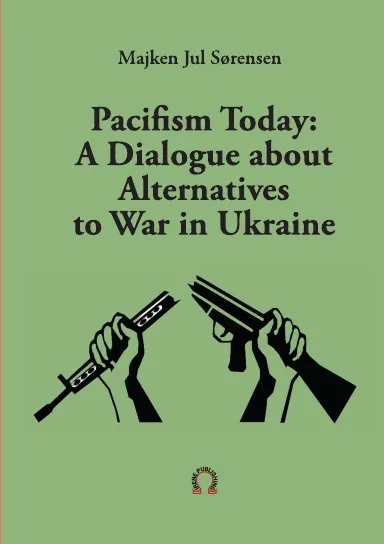
THE SCEPTIC: But it would be impossible to keep such plans secret, and then your whole scenario of planning goes down the drain!
Majken: An important aspect of planning is to do a lot of it publicly, so that it will be a deterrent for a potential attacker. Anyone considering an invasion will know in advance that this is going to be an unruly population, that a military occupation is going to require a lot of manpower, and that there will be little to gain from it.
THE SCEPTIC: How come so few states have shown an interest in how to defend themselves without arms? Is it because they are afraid that people who understand nonviolent direct action might use it against their own governments?
Majken: I think your last comment is spot on. Some states have shown interest in civilian-based defence and there is a body of literature on hybrid defence which tries to combine military and unarmed means. Nevertheless, in my opinion, the state as an institution is not really compatible with nonviolent struggle. What is needed to carry out social defence and nonviolent struggle is much more aligned with self-organising at the community level rather than top-down government instructions. I sincerely doubt any government is ever going to take the initiative in truly preparing the population for social defence by providing the necessary training. That is why we, so-called ordinary citizens, have to lead the way in preparing for unarmed resistance. What I suggest is very different from what we know today regarding social, political and economic structures in society. In the future, we can hopefully have a conversation about what that could look like.
THE SCEPTIC: Some of your wild ideas do make some sense to me now. You mentioned earlier that the knowledge about nonviolent defence is not really new. Where can I find more information?
Majken: Ideas about how to replace the military with nonviolent defence have been around for a century, often under the label “civilian-based defence”. Some authors have imagined civilian-based defence as a replacement for the military, which would serve the same purpose: defending a specific territory from invasion (36). Considerable effort in the area has been concerned with trying to convince governments to include these aspects in their defence plans. I would say that, at best, the interest has been lukewarm in a few places. One exception is Lithuania, where the defence minister said “I would rather have this book than the atomic bomb” after reading Gene Sharp’s “Civilian-based Defence” (37). In Lithuania, there has also been some effort to disseminate information about nonviolent responses to invasion to the wider public. (38)
Other authors have used a different term in this context, referring to “nonviolent defence” or “social defence” (39). They usually also focus less on the territory and more on how one can defend communities, values and ways of life, hence the term “social”. A recent book published on this is Jørgen Johansen and Brian Martin’s “Social Defence”, which discusses a grassroots approach to how social movements can work with promoting and preparing social defence. The book was published a few years before the invasion of Ukraine, so it is very timely and also includes considerations about the potential impact of recent technological development, such as social media.
To answer your last question, below you will find a short list of books which are a good start for learning more about unarmed resistance as well as nonviolent action and theory.
Further reading. A short, annotated bibliography
Peter Ackerman and Christopher Kruegler, “Strategic Nonviolent Conflict: The Dynamics of People Power in the Twentieth Century”, 1994.
This book is now 30 years old but still going strong. Although several more recent compilations of case studies with newer examples of nonviolent struggles are available, this book provides the most systematic comparisons for readers interested in analysing the strategic aspects of nonviolent resistance.
Erica Chenoweth and Maria Stephan, “Why Civil Resistance Works”, 2011.
In the dialogue above, I have extensively referenced this book by Chenoweth and Stephan. The study was ground-breaking in popularising the understanding of nonviolence and expanding academic interest. It documents how nonviolence is more likely to succeed than violence, and also explains why.
Erica Chenoweth, “Civil Resistance: What Everyone Needs to Know”, 2021.
This book is more accessible than the 2011 study Chenoweth wrote together with Maria Stephan. It is a very good introduction to understanding civil resistance, with many examples and explanations of the dynamics of nonviolence.
Jørgen Johansen and Brian Martin, “Social Defence”, 2019
In this short book about social defence, Jørgen Johansen and Brian Martin address the problems with military defence and discuss how societies can best defend themselves against invasions and military coups in our time. The authors explain the differences between civilian-based defence and social defence in an accessible style. They also provide many historical examples which I did not find room for in the dialogue above, which are highly relevant in relation to Ukraine today.
Liam Mahony and Luis Enrique Eguren, “Unarmed bodyguards: International Accompaniment for the Protection of Human Rights”, 1997.
For readers interested in unarmed international accompaniment, this book about Peace Brigade International’s early years is a good start. The authors give a detailed account of the peace movement’s early experiments and the cooperation with local organisations in Guatemala. It covers both the successes and problems that led to a greater understanding of the unique dynamic of international accompaniment.
Gene Sharp, “The Politics of Nonviolent Action”, 1973.
This book is sometimes called “the bible of nonviolence” because of Gene Sharp’s influence on theorising nonviolence. It was published more than 50 years ago, so the cases do not include any references to later events. When I read this book in my early 20s, it completely turned my world upside down. Sharp’s consent theory of power is still essential reading for anyone who wants to study nonviolence further, as well as his idea about political jiu-jitsu and why it is important to uphold nonviolent discipline.
However, readers with a theoretical interest in nonviolence should continue with reading Stellan Vinthagen’s book “A Theory of Nonviolent Action: How Civil Resistance Works”.
Majken Jul Sørensen, Stellan Vinthagen and Jørgen Johansen, “Constructive Resistance: Resisting Injustice by Creating Solutions”, 2023.
In the dialogue above, I mention the concept of “constructive resistance” briefly and in one of the last answers to THE SCEPTIC I hint at the possibilities of direct democracy and self-organising at the community level. In “Constructive Resistance”, my co-authors and I explain in detail how attempts to create the society one desires can simultaneously be a way of resisting the status quo. It is an accessible book with many historical and contemporary cases of people organising independently of and in opposition to power to create change. We argue that people who creatively combine resistance and construction in their struggles are more likely to succeed and have a greater chance of seeing the changes become more durable.
Stellan Vinthagen, “A Theory of Nonviolent Action: How Civil Resistance Works”, 2015
This book is essential reading when it comes to understanding the dynamics of nonviolence theoretically and gaining a deeper understanding of the topics I have touched upon briefly above. Vinthagen has inspired my thinking about nonviolence deeply, although he is not referenced in the dialogue. Vinthagen explains Sharp’s consent theory of power, but also problematises it and develops it much further. In order to do this, Vinthagen draws on insights from Gandhi, feminism and a number of sociological thinkers which he brings together in a highly creative and innovative theory of nonviolent action.
Bibliography
Amundsen, Sverre S., ed. Kirkenesferda 1942 [The Journey to Kirkenes 1942]. Oslo: Cappelen, 1946.
Anisin, Alexei. “Debunking the Myths Behind Nonviolent Civil Resistance.” Critical Sociology 46, no. 7-8 (2020): 1121-39.
Austad, Torleiv. Kirkelig motstad: Dokumenter fra den norske kirkekamp under okkupasjonen 1940-45 med Innledninger og kommentarer. [Church Resistance: Documents from the Norwegian Church Struggle during the Occupation 1940-45 with Introductions and Comments]. Kristiansand, Norway: Høyskoleforlaget, 2005.
Bergfeldt, Lennart. “Experiences of Civilian Resistance: The Case of Denmark 1940-1945.” PhD, Uppsala University, 1993.
Boulding, Elise. Cultures of Peace: The Hidden Side of History. Syracuse Studies on Peace and Conflict Resolution. Syracuse, N.Y.: Syracuse University Press, 2000.
Bundgård Christensen, Claus; Joachim Lund; Niels Wium Olesen, and Jakob Sørensen. Danmark besat: Krig og hverdag 1940-45. 3rd revised edition. København: Information, 2009.
Burrowes, Robert J. The Strategy of Nonviolent Defense: A Gandhian Approach. Albany: State University of New York Press, 1996.
Chayes, Antonia Handler, and Martha Minow. Imagine Coexistence: Restoring Humanity After Violent Ethnic Conflict. San Francisco: Jossey-Bass, 2003.
Chenoweth, Erica. “The Future of Nonviolent Resistance.” Journal of Democracy 31, no. 3 (2020): 69-84.
Chenoweth, Erica, and Maria J. Stephan. Why Civil Resistance Works: The Strategic Logic of Nonviolent Conflict. Columbia Studies in Terrorism and Irregular Warfare. New York: Columbia University Press, 2011.
Clark, Howard. Civil Resistance in Kosovo. London: Pluto Press, 2000.
Dobson, William J. The Dictator’s Learning Curve: Inside the Global Battle for Democracy. New York: Doubleday, 2012.
East, George. “Ready for Russia: Lithuanians Taught How to Resist Invasion.” The Guardian, 5th December 2016. Accessed 29th January 2024.
Finkel, Evgeny, and Yitzhak M. Brudny, eds. Coloured Revolutions and Authoritarian Reactions. Oxon: Routledge, 2013.
Gretskiy, Igor. “Is There Life in the Desert? Russian Civil Society after the Full-Scale Invasion of Ukraine.” Tallinn, Estonia: International Centre for Defence and Security, May 2023.
Hill, Alexander. “Deep-Rooted Russian Fear of the West Has Fuelled Putin’s Invasion of Ukraine.” The Conversation, Accessed 22nd December 2023.
Howes, Dustin Ells. “The Failure of Pacifism and the Success of Nonviolence.” Perspectives on Politics 11, no. 02 (2013): 427-46.
Johansen, Jørgen, and Brian Martin. Social Defence. Sparsnäs, Sweden: Irene Publishing, 2019.
Karcher, Nicola, Kampen om skolen: Nazifisering og lærernes motstand i det okkuperte Norge [The Struggle for the School: Nazification and the Teachers’ Resistance in Occupied Norway], Oslo: Dreyers Forlag, 2018.
Lederach, John Paul. Building Peace: Sustainable Reconciliation in Divided Societies. Washington, D.C.: United States Institute of Peace Press, 1997.
Mahony, Liam, and Luis Enrique Eguren. Unarmed Bodyguards: International Accompaniment for the Protection of Human Rights. West Hartford, Conn: Kumarian Press, 1997.
Martin, Brian. Justice Ignited: The Dynamics of Backfire. Lanham: Rowman & Littlefield, 2007.
Onken, Monika; Dalilah Shemia-Goeke, and Brian Martin. “Learning from Criticisms of Civil Resistance.” Critical Sociology 47, no. 7-8 (June 2021): 1191-203.
Ram, Senthil. “The Tibet Issue, 1987-1997: Internationalization and Media Mobilization.” Jawaharlal Nehru University, 2001.
Rigby, Andrew. Justice and Reconciliation: After the Violence. Boulder, Colo.: L. Rienner, 2001.
Sauer, Pjotr. “‘We’re Tired of Being Good Girls’: Russia’s Military Wives and Mothers Protest against Putin.” The Guardian, 25th December 2023. Accessed 26th January 2024.
Schock, Kurt. Unarmed Insurrections: People Power Movements in Nondemocracies. Social Movements, Protest, and Contention Vol. 22, Minneapolis: University of Minnesota Press, 2005.
Semelin, Jacques. Unarmed against Hitler: Civilian Resistance in Europe, 1939-1943. Westport, CT: Praeger, 1993.
Sharp, Gene. The Politics of Nonviolent Action. Boston: P. Sargent Publisher, 1973.
———. Tyranny Could Not Quell Them. London: Publications Committee of Peace News, 1958.
Sierra, Felip Daza. “Ukrainian Nonviolent Civil Resistance in the Face of War. Analysis of Trends, Impacts and Challenges of Nonviolent Action in Ukraine between February and June 2022.” International Catalan Institute for Peace (ICIP), International Institute for Nonviolent Action (Novact), German Friedrich-Schiller-University Jena and German peacebuilding NGO Corridors – Dialogue through Cooperation, 2022.
Sørensen, Majken Jul. “Glorications and Simplications in Case Studies of Danish WWII Nonviolent Resistance.” Journal of Resistance Studies 3, no. 1 (2017): 99-137.
Sørensen, Majken Jul; Stellan Vinthagen, and Jørgen Johansen. Constructive Resistance: Resisting Injustice by Creating Solutions. London: Rowman & Littlefield, 2023.
Tufekci, Zeynep. Twitter and Tear Gas: The Power and Fragility of Networked Protest. New Haven: Yale University Press, 2017.
Ukrainian Pacifist Movement. “Peace Agenda for Ukraine and the World.” International Peace Bureau, Accessed 26th January 2024.
———. “Ukrainian Pacifists: War Is a Crime against Humanity.” War Resisters´ International, Accessed 26th January 2024.
Vitkine, Benoît. “The Committee of Soldiers’ Mothers of Russia Resumes Its Fight.” Le Monde, 1st October 2022. Accessed 28th December 28th 2023.
Walker, Shaun. “‘Ukrainians Understand Corruption Can Kill’: Kyiv Takes on an Old Enemy.” The Guardian, 19th September 2023. Accessed 26th January 2024.
Wilson, Andrew. Ukraine’s Orange Revolution. New Haven: Yale University Press, 2005.
1. Felip Daza Sierra, “Ukrainian Nonviolent Civil Resistance in the Face of War. Analysis of Trends, Impacts and Challenges of Nonviolent Action in Ukraine between February and June 2022,” (International Catalan Institute for Peace (ICIP), International Institute for Nonviolent Action (Novact), German Friedrich-Schiller-University Jena and German peacebuilding NGO Corridors – Dialogue through Cooperation, 2022).
2. Ibid.
3. Ibid.
4. Senthil Ram, “The Tibet Issue, 1987-1997: Internationalization and Media Mobilization” (Jawaharlal Nehru University, 2001).
5. Sierra, “Ukrainian Nonviolent Civil Resistance in the Face of War. Analysis of Trends, Impacts and Challenges of Nonviolent Action in Ukraine between February and June 2022.”
6. The story about the clergy is based on Torleiv Austad, Kirkelig motstad: Dokumenter fra den norske kirkekamp under okkupasjonen 1940-45 med innledninger og kommentarer [Church Resistance: Documents from the Norwegian Church Struggle during the Occupation 1940-45 with Introductions and Comments] (Kristiansand, Norway: Høyskoleforlaget, 2005).
7. The story about the teachers is based on these sources: Nicola Karcher, Kampen om skolen: Nazifisering og lærernes motstand i det okkuperte Norge [The Struggle for the School: Nazification and the Teachers’ Resistance in Occupied Norway] (Oslo: Dreyers Forlag, 2018); Sverre S. Amundsen, ed. Kirkenesferda 1942 (Oslo: Cappelen, 1946); Gene Sharp, Tyranny Could Not Quell Them (London: Publications Committee of Peace News, 1958).
8 Numbers very considerably depending on the source. For a detailed overview of different numbers and sources see Karcher, Kampen om skolen: Nazifisering og lærernes motstand i det okkuperte Norge.
9 Gene Sharp, The Politics of Nonviolent Action (Boston: P. Sargent Publisher, 1973).
10 Howard Clark, Civil Resistance in Kosovo (London: Pluto Press, 2000).
11 Majken Jul Sørensen, Stellan Vinthagen, and Jørgen Johansen, Constructive Resistance: Resisting Injustice by Creating Solutions (London: Rowman & Littlefield, 2023).
12 Jacques Semelin, Unarmed against Hitler: Civilian Resistance in Europe, 1939-1943 (Westport, CT: Praeger, 1993).
13 Kurt Schock, Unarmed Insurrections: People Power Movements in Nondemocracies, vol. 22, Social Movements, Protest, and Contention (Minneapolis: University of Minnesota Press, 2005).
14 Erica Chenoweth and Maria J. Stephan, Why Civil Resistance Works: The Strategic Logic of Nonviolent Conflict, Columbia Studies in Terrorism and Irregular Warfare (New York: Columbia University Press, 2011).
15 Thanks to Jørgen Johansen for providing me with this way of explaining the parallels.
16 Erica Chenoweth, “The Future of Nonviolent Resistance,” Journal of democracy 31, no. 3 (2020).
17 Alexei Anisin, “Debunking the Myths Behind Nonviolent Civil Resistance,” Critical sociology 46, no. 7-8 (2020).
18 Monika Onken, Dalilah Shemia-Goeke, and Brian Martin, “Learning from Criticisms of Civil Resistance,” Critical Sociology 47, no. 7-8 (2021).
19 Claus Bundgård Christensen et al., Danmark Besat: Krig Og Hverdag 1940-45, 3. reviderede udgave ed. (København: Information, 2009).
20 Lennart Bergfeldt, “Experiences of Civilian Resistance: The Case of Denmark 1940-1945” (PhD, Uppsala University, 1993).
21 Majken Jul Sørensen, “Glorications and Simplications in Case Studies of Danish Wwii Nonviolent Resistance,” Journal of Resistance Studies 3, no. 1 (2017).
22 See also William J. Dobson, The Dictator’s Learning Curve: Inside the Global Battle for Democracy, First ed. (New York: Doubleday, 2012).
23 Zeynep Tufekci, Twitter and Tear Gas: The Power and Fragility of Networked Protest (New Haven: Yale University Press, 2017).
24 Brian Martin, Justice Ignited: The Dynamics of Backfire (Lanham: Rowman & Littlefield, 2007).
25 Liam Mahony and Luis Enrique Eguren, Unarmed Bodyguards: International Accompaniment for the Protection of Human Rights (West Hartford, Conn: Kumarian Press, 1997).
26 It is always difficult to get reliable numbers when it comes to victims of wars. Regarding the war in Ukraine, Wikipedia keeps a page with the estimates given by various sources, both regarding casualties on the battlefield and among civilians. When it comes to corruption in Ukraine, see, for instance, this news story from The Guardian, Shaun Walker, “‘Ukrainians Understand Corruption Can Kill’: Kyiv Takes on an Old Enemy,” The Guardian, September 19 2023.
27 Ukrainian Pacifist Movement, “Peace Agenda for Ukraine and the World,” International Peace Bureau, “Ukrainian Pacifists: War Is a Crime against Humanity,” War Resisters´ International.
28 See for instance these classics: John Paul Lederach, Building Peace: Sustainable Reconciliation in Divided Societies (Washington, D.C.: United States Institute of Peace Press, 1997); Andrew Rigby, Justice and Reconciliation: After the Violence (Boulder, Colo.: L. Rienner, 2001); Antonia Handler Chayes and Martha Minow, Imagine Coexistence: Restoring Humanity after Violent Ethnic Conflict, 1st ed. (San Francisco: Jossey-Bass, 2003).
29 Dustin Ells Howes, “The Failure of Pacifism and the Success of Nonviolence,” Perspectives on Politics 11, no. 02 (2013).
30 Alexander Hill, “Deep-Rooted Russian Fear of the West Has Fuelled Putin’s Invasion of Ukraine,” The Conversation.
31 Evgeny Finkel and Yitzhak M. Brudny, eds., Coloured Revolutions and Authoritarian Reactions (Oxon: Routledge, 2013); Andrew Wilson, Ukraine’s Orange Revolution (New Haven: Yale University Press, 2005).
32 Igor Gretskiy, “Is There Life in the Desert? Russian Civil Society after the Full-Scale Invasion of Ukraine,” (Tallinn, Estonia: International Centre for Defence and Security, May 2023).
33 See for instance Pjotr Sauer, “‘We’re Tired of Being Good Girls’: Russia’s Military Wives and Mothers Protest against Putin,” The Guardian, December 25 2023.
34 Benoît Vitkine, “The Committee of Soldiers’ Mothers of Russia Resumes Its Fight,” Le Monde, October 1st, 2022 2022.
35 See for instance the “Beautiful Trouble Strategy Cards” or “People Power: The Civil Resistance Game.”
36 Jørgen Johansen and Brian Martin, Social Defence – Sparsnäs, Sweden: Irene Publishing, 2019.
37 Ibid.
38 George East, “Ready for Russia: Lithuanians Taught How to Resist Invasion,” The Guardian, December 5 2016.
39 Johansen and Martin, Social Defence; Robert J. Burrowes, The Strategy of Nonviolent Defense: A Gandhian Approach (Albany: State University of New York Press, 1996).
The author
Majken Jul Sørensen is an associate professor of social science at Østfold University College and Karlstad University. She has written a number of books and academic articles about humour, political activism, nonviolent action and constructive resistance at the intersection between sociology and peace studies. Previously she was active in the international pacifist organisation War Resisters’ International and its affiliates Aldrig Mere Krig and Ofog. At the moment her contribution to the peace movement is to write and keep dreams alive. She is also a TFF Associate.
You may also read this booklet as a downloadable PDF.
Or buy it from Irene Publishing/Lulu (71 pages, € 9.82)
More about Irene Publishing here.