
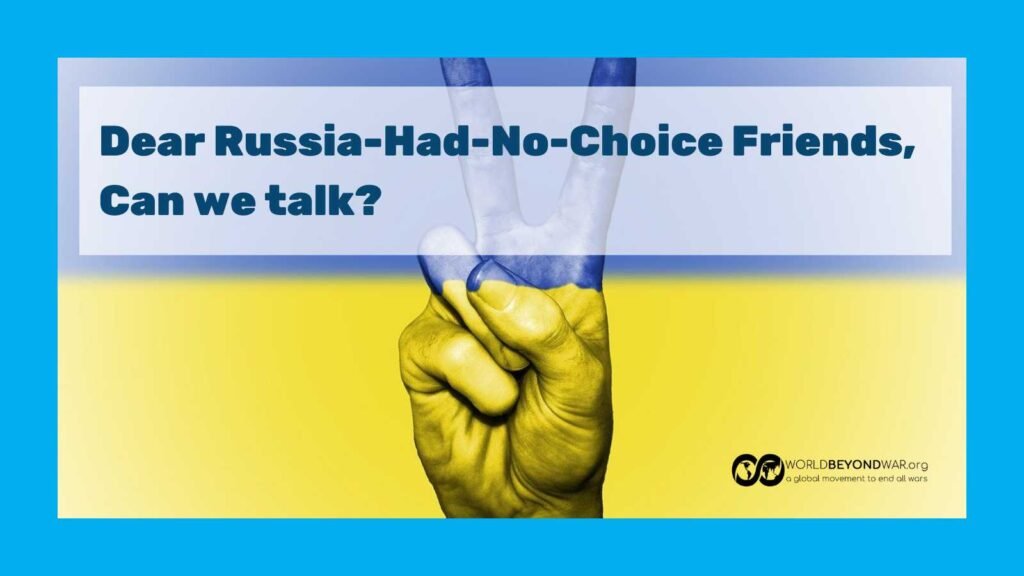
Dear "Russia-Had-No-Choice" Friends

TFF Associate

Here’s a terrible “syllogism” from a wonderful person, Ray McGovern, longtime CIA employee, then longtime peace activist, and now year-long contender, that Russia had no choice but to attack Ukraine.

“The Russians had other options to invading Ukraine.
They attacked Ukraine in a ‘war of choice’; also threaten NATO.
Ergo, the West must arm Ukraine to the teeth, risking wider war.”

This is supposedly an explanation of the thinking of we believers that Russia had some choice other than to invade Ukraine. In reality, it illustrates a very sad and enormous distance between the thinking of people who once agreed that war was immoral, but who have now spent over a year utterly failing to persuade each other of anything.

Of course the quote above is not a syllogism at all. This is a syllogism:

A threat of war requires war.
Russia is threatened with war.
Russia requires war.

(Or write the same thing substituting Ukraine for Russia.)

But so is this:

A threat of war does not require war.
Russia is threatened with war.
Russia does not require war.

(Or write the same thing substituting Ukraine for Russia.)

The disagreement is over the major premise. The syllogism is not actually a very useful tool for thinking; merely for a primitive sort of thinking about thinking. The world is actually complex, and someone could build a case for this one, too: “A threat of war sometimes requires war, depending.” (They’d be wrong.)

That the threat or war, and even actual war, in many cases has not required war in response but been defeated by other means is a matter of record. So the question is whether this time was different from all of those times.

Here’s another disagreement. Which of these is true?

“Opposing one side of a war requires defending the other side.”

or

“Opposing one side of a war could conceivably be part and parcel of opposing all sides of all wars.”

This is a factual question, too, a matter of record. Those of us who have spent all these many months denouncing every war act by both sides of the war in Ukraine can show each side all the accusations we’ve received of supporting both their side and the other side — and all the evidence that they are all mistaken.

But maybe it doesn’t matter whether someone fantasizes that I’m cheering for NATO and secretly in the pay of Lockheed Martin. They simply want an answer to the staggeringly slam-dunk drop-the-mic win-the-whole-internet brilliant inquiry of “Well what the eff then could Russia have possibly, possibly done?”

Before I describe what Russia could have done, both in the moment of maximum crisis and in the previous months and years and decades, it’s worth digging up some ancient Greeks one more time:

Russia had to defend against NATO.
Attacking Ukraine was guaranteed to provide the biggest boost NATO had seen in a lifetime.
Therefore Russia had to attack Ukraine.

Maybe the syllogism can be helpful after all? The two premises are perfectly true. Can anyone spot the illogic? It seems not, at least not in the first year and a quarter. The U.S. set the trap and Russia simply had no choice but to take the bait? Really? How insulting to Russia!

Over a year ago, I wrote an article called “30 Nonviolent Things Russia Could Have Done and 30 Nonviolent Things Ukraine Could Do.” Here’s the Russian list:

Russia could have:

  1. Continued mocking the daily predictions of an invasion and created worldwide hilarity, rather than invading and making the predictions simply off by a matter of days.
  2. Continued evacuating people from Eastern Ukraine who felt threatened by the Ukrainian government, military, and Nazi thugs.
  3. Offered evacuees more than $29 to survive on; offered them in fact houses, jobs, and guaranteed income. (Remember, we’re talking about alternatives to militarism, so money is no object and no extravagant expense will ever be more than a drop in the bucket of war spending.)
  4. Made a motion for a vote in the UN Security Council to democratize the body and abolish the veto.
  5. Asked the UN to oversee a new vote in Crimea on whether to rejoin Russia.
  6. Joined the International Criminal Court.
  7. Asked the ICC to investigate crimes in Donbas.
  8. Sent into Donbas many thousands of unarmed civilian protectors.
  9. Sent into Donbas the world’s best trainers in nonviolent civil resistance.
  10. Funded educational programs across the world on the value of cultural diversity in friendships and communities, and the abysmal failures of racism, nationalism, and Nazism.
  11. Removed the most fascist members from the Russian military.
  12. Offered as gifts to Ukraine the world’s leading solar, wind, and water energy production facilities.
  13. Shut down the gas pipeline through Ukraine and committed to never building one north of there.
  14. Announced a commitment to leaving Russian fossil fuels in the ground for the sake of the Earth.
  15. Offered as a gift to Ukraine electric infrastructure.
  16. Offered as a gift of friendship to Ukraine railway infrastructure.
  17. Declared support for the public diplomacy that Woodrow Wilson pretended to support.
  18. Announced again the eight demands it began making in December, and requested public responses to each from the U.S. government.
  19. Asked Russian-Americans to celebrate Russian-American friendship at the teardrop monument given to the United States by Russia off New York Harbor.
  20. Joined the major human rights treaties it has yet to ratify, and asked that others do the same.
  21. Announced its commitment to unilaterally uphold disarmament treaties shredded by the United States, and encouraged reciprocation.
  22. Announced a no-first-use nuclear policy, and encouraged the same.
  23. Announced a policy of disarming nuclear missiles and keeping them off alert status to allow more than mere minutes before launching an apocalypse, and encouraged the same.
  24. Proposed a ban on international weapons sales.
  25. Proposed negotiations by all nuclear-armed governments, including those with U.S. nuclear weapons in their countries, to reduce and eliminate nuclear weapons.
  26. Committed to not maintaining weapons or troops within 100, 200, 300, 400 km of any borders, and requested the same of its neighbors.
  27. Organized a nonviolent unarmed army to walk to and protest any weapons or troops near borders.
  28. Put out a call to the world for volunteers to join the walk and protest.
  29. Celebrated the diversity of the global community of activists and organized cultural events as part of the protest.
  30. Asked the Baltic states that have planned nonviolent responses to Russian invasion to help train Russians and other Europeans in the same.

I discussed this on this radio show.

I’m sure it’s in vain, but please make a real effort to remember that this was in an article about what each side could do instead of the insanity of organized mass-murder, risking nuclear apocalypse, starving the globe, impeding climate collaboration, and ruining a country. Please make a real effort to remember that we all have always been painfully aware of all the U.S. aggression toward Russia. So, the answer to “How dare I suggest that Russia behave better than the horrible worst-government-on-Earth of the country where I myself live, the United States?” is the usual one: I spend most of my time demanding that the United States behave better, but if the rest of the world can find it within itself to behave so well that life on Earth is preserved despite every effort of Washington, I’m going to be grateful for that — and I’m certainly not going to discourage it.

Maybe the Russian peace activists so bravely opposing their nation’s warmaking, as we all must oppose our own, are deeply misguided, but I don’t think they are.

So, why is it so impossible to even make each other understand where we’re coming from, you Russia-Had-No-Choicers and I? You suspect that either Ray’s old outfit is slipping me cash or that I’m scared of getting called a “Putin Lover” — as if I haven’t had plenty of death threats for opposing a war on Iraq that I would have traded in a heartbeat to simply be called an “Iraq Lover.”

My suspicions of you may be as wildly off as yours of me, but I don’t think they are, and I mean them with total respect.

I suspect that you think if one side of a war is wrong, the other is probably right — and right in every detail. I suspect you opposed the U.S. side of the war on Iraq but not the Iraqi side. I suspect you oppose the U.S. side of the war in Ukraine, and that you think it simply follows that whatever the Russian side does is admirable. I imagine the two of us going back to an age of dueling. I’d be screaming “Stop this idiotic barbarism, you two!” and you’d be hurriedly asking around to determine which idiot was the good one and which the evil one. Or would you?

I suspect that you don’t want to give any thought to the years that the two sides spent failing to prepare unarmed defenses, and that you think that no matter what Russia did to appeal to the morality and fairness of the world, the world would have spat at Russia and grabbed some popcorn to watch the U.S./NATO buildup. Yet, even with Russia committing hideous murderous acts, we’ve nonetheless seen much of the world — and many of the world’s governments! — refuse to side with NATO, despite enormous pressure, and despite the horrible embarrassment of having to seem to defend, or being accused of defending, Russia’s warmaking. We’ll never know how the world would have responded had Russia used massive and creative nonviolent action, had Russia joined international bodies of law, had Russia signed onto human rights treaties, had Russia sought to democratize world institutions, had Russia appealed to the world to reject U.S. imperialism in favor of a world run by the entire world.

Maybe the Russian government doesn’t want to fall under the rule of law any more than the U.S. government does. Maybe it wants a balance of power, not a balance of justice. Or maybe it thinks like most people in Western society — even many who have acted as peace activists for years — that war is the only answer in the end. And maybe nonviolent action would have failed. But there are two weaknesses in that thought that I think are indisputable.

One is that we are now closer than ever to nuclear apocalypse, and when we’re gone we won’t really get to argue who was more in the right than whom.

The other is that the U.S./NATO build-up was over decades and years and months. Russia could have waited another day or 10 or 200, and in that time it could have begun to try something else. Nobody picked the timing of Russia’s escalation other than Russia. And when you pick the timing of something, you had a choice to give something else a try first.

Even more importantly, unless both sides admit some wrong and agree to some compromise, the war will not end and life on Earth might. It would be a real shame if we couldn’t agree on that much.

Notes

Ray McGovern also has this entry with text and video on his homepage to how Professor Mearsheimer perceives the question of whether or not Russia had alternatives to the invasion of Ukraine.

The editor of The Transnational here, Jan Oberg, likewise argued, on February 25, 2022, that Russia had some alternatives – “There were alternatives: Why Russia should not have bombed Ukraine.” He offers 8 reasons to be against the invasion and 5 alternative actions at the time.

We find this debate very useful and have the highest respect for both – Ray as a friend since the 1980s and David as a friend and TFF Associates for many years too. And we all adhere to the idea that explaining something does not mean an automatic, uncritical endorsement of the act and its consequences.


Share

Leave a Reply

Your email address will not be published. Required fields are marked *

Related Posts

Officially, the drones were not identified. By simply thinking critically – which journalists and selected experts no longer do – there may be a good reason for that. And this article will never be mentioned in Denmark… Drones over Denmark. No damage. No trace. No answers. Yet the headlines scream “Russian threat,” and Prime Minister Mette Frederiksen speaks with a certainty that defies logic: “We don’t know they were Russian—but we know Russia is the biggest threat to Europe.” It could be nobody else – unless you make an interest analysis which I did two days ago. This is not security policy. It’s theatre. And the audience is being played. Let’s rewind. These drones—unphotographed, untracked, unclaimed—appear and vanish like ghosts. Airports shut down. Panic spreads. Military budgets swell. And the narrative hardens: Russia is behind it. But what if that’s not just wrong but deliberately misleading? Here’s a hypothesis for...
And why the world, especially the EU, must now declare itself independent of the United States. UN’s 80th anniversary This year, the United Nations celebrates the 80th anniversary of its founding. The UN was formed after the scourge of the Second World War, in which 70 to 85 million people were killed and many countries were destroyed. That war came on the heels of the First World War, which also killed between 15 and 22 million people. After the Second World War, especially after the use of nuclear weapons by the United States, which marked a turning point in the history of warfare that could result in the end of civilisation as we know it, humanity decided to move away from the era of empires and big power politics and usher in a new era of peace, freedom and cooperation. These were the principles enshrined in the UN Charter. The United States...
Drones over Nordic airports. No damage. No trace. No answers. Most assume Russia—but what if that’s not so? Why is there so much we are not told? This article explores the strategic ambiguity behind recent drone incursions and asks: Who else might benefit from sending drones into NATO airspace? From Ukraine’s surprising drone supremacy to Russia’s possible signalling, the silence itself may be the loudest message. These are the kinds of questions decent, intelligent investigative journalists and commentators could easily research. Why don’t they? Did you, dear reader, know or think of this? That the most powerful weapon in today’s conflicts might be the one that leaves no trace – and no answers. Just enough fear to justify the next move? Recently, drones have repeatedly appeared over Nordic airports and near some military facilities. They cause no damage – for which reason the designation “hybrid attack” is misleading but serves a purpose. These...

Recent Articles

PressInfo # 141, December 21, 2001It’s time to prepare reconciliation between Albanians and Serbs PressInfo # 140, December 14, 2001Ibrahim Rugova’s decade-long leadership in Kosovo/a PressInfo # 139, 11. december, 2001En god nyhet: Jugoslaviens Sannings- och försoningskommission PressInfo # 139, 11. december, 2001Gode nyheder: Jugoslaviens Sandheds- og Forsoningskommission PressInfo # 139, December 11, 2001Good news: Yugoslavia’s Truth and Reconciliation Commission PressInfo # 138, November 8, 2001TFF co-founder PhD with thesis about young people with roots in other cultures PressInfo # 138, November 8, 2001TFF:s medstiftare doktor på avhandling om unga med ursprung i andra kulturer PressInfo # 137, October 17, 2001A new Marshall Plan: Advancing human security and controlling terrorism PressInfo # 136, October 15, 2001The UN and Annan really deserve it PressInfo # 135, October 10, 2001Preventing a terrorist mushroom cloud PressInfo # 134, 17 oktober, 2001Sverige og 11. september PressInfo # 134, October 9, 2001Sweden and September 11...
Peace is promoted by constructive proposals and dialogue Four preceding PressInfos have expressed concern over — and criticised — the ongoing, militarisation of the EU. Some will say: but there are no alternatives. We believe that there are always alternatives, that democracies are characterised by alternatives and choice, and that openly discussed alternatives will improve the quality and legitimacy of society’s decision–making. In addition, it is an intellectual and moral challenge to not only criticise but also be constructive. If we only tell people that we think they are wrong, they are not likely to listen. However, if we say: what are your views on this set of ideas and steps? — we may sometimes engage them in dialogue and sow a seed. Most people in power circles live their daily lives in in a time frame and a social space where certain ideas, viewpoints and concepts are just not...
Photos © TFF 2000 Read PressInfo 90 “Lift the Sanctions and Bring More Aid to Yugoslavia” See Pictures from Belgrade © TFF 2000 Please reprint, copy, archive, quote or re-post this item, but please retain the source.

TFF on Substack

Discover more from TFF Transnational Foundation & Jan Oberg.

Most Popular

PressInfo # 141, December 21, 2001It’s time to prepare reconciliation between Albanians and Serbs PressInfo # 140, December 14, 2001Ibrahim Rugova’s decade-long leadership in Kosovo/a PressInfo # 139, 11. december, 2001En god nyhet: Jugoslaviens Sannings- och försoningskommission PressInfo # 139, 11. december, 2001Gode nyheder: Jugoslaviens Sandheds- og Forsoningskommission PressInfo # 139, December 11, 2001Good news: Yugoslavia’s Truth and Reconciliation Commission PressInfo # 138, November 8, 2001TFF co-founder PhD with thesis about young people with roots in other cultures PressInfo # 138, November 8, 2001TFF:s medstiftare doktor på avhandling om unga med ursprung i andra kulturer PressInfo # 137, October 17, 2001A new Marshall Plan: Advancing human security and controlling terrorism PressInfo # 136, October 15, 2001The UN and Annan really deserve it PressInfo # 135, October 10, 2001Preventing a terrorist mushroom cloud PressInfo # 134, 17 oktober, 2001Sverige og 11. september PressInfo # 134, October 9, 2001Sweden and September 11...
Peace is promoted by constructive proposals and dialogue Four preceding PressInfos have expressed concern over — and criticised — the ongoing, militarisation of the EU. Some will say: but there are no alternatives. We believe that there are always alternatives, that democracies are characterised by alternatives and choice, and that openly discussed alternatives will improve the quality and legitimacy of society’s decision–making. In addition, it is an intellectual and moral challenge to not only criticise but also be constructive. If we only tell people that we think they are wrong, they are not likely to listen. However, if we say: what are your views on this set of ideas and steps? — we may sometimes engage them in dialogue and sow a seed. Most people in power circles live their daily lives in in a time frame and a social space where certain ideas, viewpoints and concepts are just not...
Photos © TFF 2000 Read PressInfo 90 “Lift the Sanctions and Bring More Aid to Yugoslavia” See Pictures from Belgrade © TFF 2000 Please reprint, copy, archive, quote or re-post this item, but please retain the source.
Read More
Imagen-thumbnail-The-Transnational-1
PressInfo # 141, December 21, 2001It’s time to prepare reconciliation between Albanians and Serbs PressInfo # 140, December 14, 2001Ibrahim Rugova’s decade-long leadership in Kosovo/a PressInfo # 139, 11. december, 2001En god nyhet: Jugoslaviens Sannings- och försoningskommission PressInfo # 139, 11. december, 2001Gode nyheder: Jugoslaviens Sandheds- og Forsoningskommission PressInfo # 139, December 11, 2001Good news: Yugoslavia’s Truth and Reconciliation Commission PressInfo # 138, November 8, 2001TFF co-founder PhD with thesis about young people with roots in other cultures PressInfo # 138, November 8, 2001TFF:s medstiftare doktor på avhandling om unga med ursprung i andra kulturer PressInfo # 137, October 17, 2001A new Marshall Plan: Advancing human security and controlling terrorism PressInfo # 136, October 15, 2001The UN and Annan really deserve it PressInfo # 135, October 10, 2001Preventing a terrorist mushroom cloud PressInfo # 134, 17 oktober, 2001Sverige og 11. september PressInfo # 134, October 9, 2001Sweden and September 11...
Imagen-thumbnail-The-Transnational-1
Peace is promoted by constructive proposals and dialogue Four preceding PressInfos have expressed concern over — and criticised — the ongoing, militarisation of the EU. Some will say: but there are no alternatives. We believe that there are always alternatives, that democracies are characterised by alternatives and choice, and that openly discussed alternatives will improve the quality and legitimacy of society’s decision–making. In addition, it is an intellectual and moral challenge to not only criticise but also be constructive. If we only tell people that we think they are wrong, they are not likely to listen. However, if we say: what are your views on this set of ideas and steps? — we may sometimes engage them in dialogue and sow a seed. Most people in power circles live their daily lives in in a time frame and a social space where certain ideas, viewpoints and concepts are just not...
Imagen-thumbnail-The-Transnational-1
Photos © TFF 2000 Read PressInfo 90 “Lift the Sanctions and Bring More Aid to Yugoslavia” See Pictures from Belgrade © TFF 2000 Please reprint, copy, archive, quote or re-post this item, but please retain the source.
Imagen-thumbnail-The-Transnational-1
Av FRANK SØHOLM GREVIL 16 augusti 2004  Vi er nu nået til tredje akt i det absurde teaterstykke, der i analogi med de store skueprocesser i Moskva 1936-38 er blevet døbt ‘Grevil-sagen’. Første akt bestod i min anonyme fremlæggelse af egenhændigt nedklassificerede rapporter i Berlingske Tidende i februar og marts. Andet akt udgjordes af min fremtræden med navn og billede i Information i april samt den efterfølgende mediestorm, som uden min direkte medvirken kostede en forsvarsminister taburetten samt en sigtelse for brud på tavshedspligten. Tredje akt bliver en retssag, hvor jeg står tiltalt for at have overtrådt straffelovens bestemmelser om uberettiget videregivelse eller udnyttelse af fortrolige oplysninger. Statsanklageren har ovenikøbet valgt at påberåbe sig særligt skærpende omstændigheder. Da jeg aldrig har modtaget betaling for at stille rapporterne til rådighed eller lade mig interviewe, må det skærpende bestå i, at “videregivelsen eller udnyttelsen er sket under sådanne omstændigheder, at det påfører...
Imagen-thumbnail-The-Transnational-1
Af Svenska Irakkommittén mot de Ekonomiska Sanktionerna (SIES) 13 september 2002 FN:s ekonomiska sanktioner mot Irak har nu pågått i tolv år och drabbat det irakiska folket med svåra lidanden. Enligt FN:s egna siffror har mer än 1,5 miljoner människor, varav ca 600 000 barn, dött som en direkt följd av sanktionerna. Dessutom har ett lågintensivt bombkrig mot landet pågått under dessa år. Av all denna förödelse- orsakad huvudsakligen av amerikansk och brittisk politik- har Saddam Husseins brutala och diktatoriska regim snarast stärkts än försvagats. Nu förbereder USA under president Bushs ledning ett storskaligt bombkrig mot Irak som kommer att innebära ett ännu större lidande för civilbefolkningen. Ett sådant krig kommer dessutom att ytterligare undergräva freden och säkerheten i världen. Att upprätta en demokratisk regim i Irak är det irakiska folkets angelägenhet och får enligt folkrätten inte ske med krigshandlingar utifrån. Folkrätten och FN:s stadgar måste respekteras. Vi vädjar till...

