
Gordon M Hahn: The NATO-Russian Ukraine War’s New, Most Dangerous Phase

Gordon M Hahn

February 14, 2023

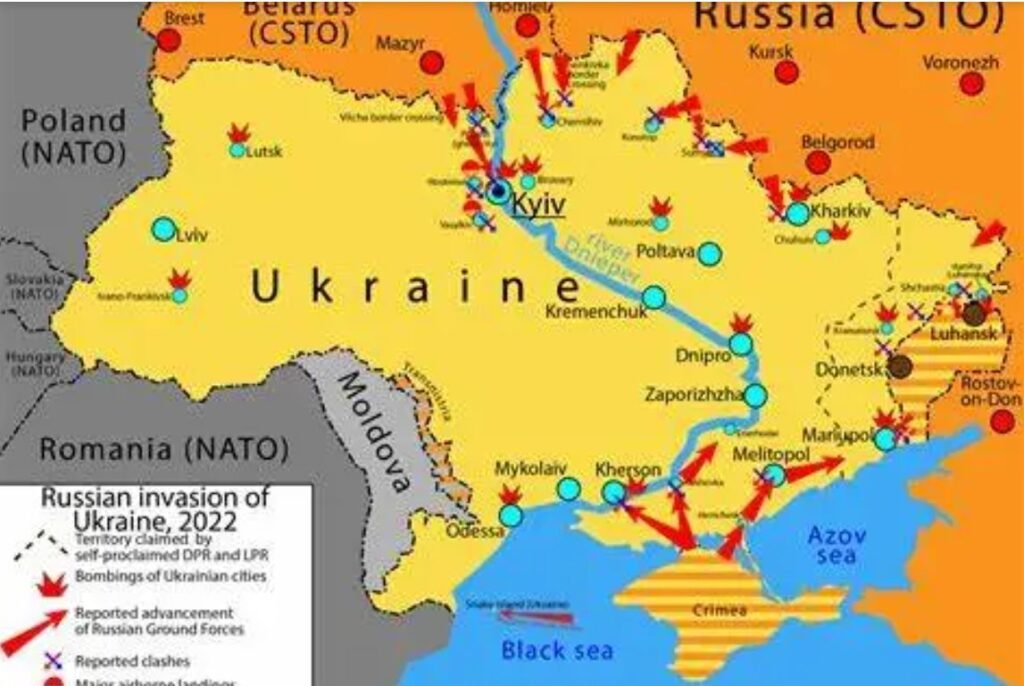
We are entering the most dangerous phase of the NATO-Russian Ukraine war up till now. The West is undertaking a major escalation in the war by increasing the lethality of weapons it is supplying Ukraine to include tanks and the largest tranche of military equipment supplied to Kiev so far. Meanwhile, Russia is on the verge of an offensive on the background of slow but steady gains in the east, taking Soledar, moving into Vugledar (Ugledar) and the outskirts of Bakhmut (Atemevsk), threatening Ukrainian forces with operational encirclements in several areas.

Russia now has available in and around Ukraine 5-600,000 regular troops, almost none of which have been used so far, with Moscow having been relying on the DPR and LNR forces, the Wagner troops, Chechens, and massive attacks from the air by artillery, rockets, drones and such in previous phases of the war.

Originally published at Gordon Hahn on January 30, 2023

The false myth that Russia is losing the war is being exposed for the propaganda lie it has always been, risking the loss of public support in the West. That exposure is leaving the ‘king even more naked’ as the Russian offensive gradually gains steam over the next two months. Russia was not militarily defeated in Kharkiv and Kherson when it retreated from those places.

In the latter case, there seems to have been a tacit agreement between Moscow and Kiev that Russian troops would withdraw behind the Dnepr, and Kiev’s forces would not harass them much at all and the agreement appears to have held. In both cases, Moscow decided to withdraw forces because it was badly outnumbered and sought to avoid a fight and high casualties. Russian forces have been making steady progress over the last few weeks, recently taking Soledar. They are in the process of establishing operational encirclement around Bakhmut as well as Avdiivka and have moved deeply into Mariinka and Vugledar (Ugledar); all of which could trap 10,000s of Ukrainian troops.

More importantly, the offensive that is slowly ramping up will consist of larger combined force operations that is most likely to more resemble actual all-out total war than the hitherto ‘special military operation,’ though I expect some considerable continuing restraint to preserve civilian and Russian military lives as much as is possible. Whether the offensive will include a ground and/or air assault on Kiev and an attempt to encircle and/or in intensive bombing campaign targeting Zelenskiy and the government infrastructure – thus far left to be – is impossible to know for sure, but is likely.

NATO is now openly at war with Russia and intensively escalating that war. This is not Russian propaganda; it has been a poorly held secret for months. NATO and the US provide: all of the kinds of lethal weapons; strategic, operational, and tactical intelligence; means of communications; and strategic and operational planning as well as tactical and weapons training. Polish and perhaps Rumanian and other state’s soldiers have been fighting out of uniform in Ukraine against Russia. NATO has also organized Belarusian and Russian opposition units that are fighting Russia and allied forces in Ukraine.

The ‘NATOization’ of the Ukraine war and the effort to organize opposition military forces against Moscow and Minsk is making it more likely that Russia will pressure Belarusian President Aleksandr Lukashenka to bring Belarusian forces into the war along with Russia’s own units deployed there, if only as part of the Russian-Belarusian ‘joint Union force’. Lukashenka could put up little resistance, especially if it appears that Russia’s efforts are failing or, more obviously, if Ukrainian or Polish elements were to undertake some sort of operation on Belarus’s territory. Clearly, Lukashenka’s prospects for retaining his hold on power decline sharply should Russia lose this war, given the likely repercussions for Putin’s rule in the event.

Moscow may soon decide that since NATO countries are legally definable as combatants it has the right to respond in some way. Responses could include financing terrorist attacks, sabotage, destroying non-Russian oil and gas pipelines, rejecting all international copyright law, targeting staging sites in Poland or Rumania from which supplies and newly Western-trained troops are transported to Ukraine—who knows, maybe all of the above. That could provoke open NATO-Russian warfare on European and Russian territory, which is already being hit by the Ukrainians using US missiles.

If the escalation stops with the new wave perhaps there will not be any such Russian responses, but Western ‘appeasement’ is unlikely. War is in the air from Washington to Warsaw to Moscow.

The always insightful Colonel Douglas McGregor is wrong when he says that in Washington they do not understand that Russia is a country that can and if need be will mobilize its entire population if its leadership perceives a threat sufficient to warrant it.

They understand this full well in DC and hope to force Putin to engage such a mobilization and trap Putin in a quagmire – regardless of the costs to Ukraine — with everything else that will entail for Russia’s economic efficiency, residual freedoms, and political stability in the long-term. In other words, they hope to saddle Putin with a war that will ultimately destabilize the political system and lead to his downfall.

The time frame in such thinking is probably connected with the next Russian presidential election scheduled for 2024. Elections are focal points that often spark ‘color revolutions’ such as Ukraine in 2004, Georgia in 2005, and the failed 2012 white ribbon protests in Russia. This is the idea driving the West’s foolhardy strategic escalation of the war and complete lack of interest in cultivating peace talks. The foundational drive is that any taks will fail if Washington and Brussels do not agree to end NATO expansion at least in the case of Ukraine; something the West is unwilling to do. This is why I have been calling the ‘special military operation’ or ‘Russia’s war in Ukraine’ the NATO-Russian Ukraine war.

The West now also is risking the great danger that what remains of the Ukrainian state will be destroyed for the goal of removing Putin from power. But any fall of Putin from power will change neither Russian resistance to NATO expansion and Western color revolutionism (regime change policies or ‘democracy promotion’) nor the startegies and tactics Moscow uses to carry out that resistance.

Washington has a dearth of knowledge about or willingness to acknowledge and incorporate into policy Russia’s long history of being targeted by Western powers for political interference and manipulation and military intervention and invasion and the resulting centrality of security vigilance in relation to the West in Russia’s political and security culture. And destruction of the Ukrainian state will eliminate the prospect of stabilization through the transformation of Ukraine into a neutral buffer zone between NATO and Russia, a prospect that should be acceptable to all sides, including Kiev, after this terrible war.

The absence of American statesmanship – really, the presence of American anti-leadership, even international subversion – is bringing catastrophe. Washington should be pressing both sides to negotiate not just be sending more, more and still more lethal weapons to Kiev. This is a criminal abandonment of leadership that risks us all with World War III and nuclear conflagration. It is perhaps more and surely deeply disturbing – and certainly must be raising red flags in Moscow – that there is a senile, arrogant, corrupt American president threatened by congressional investigations and perhaps impeachment for crimes he and his son committed, who is deciding how far the West’s involvement in the NATO-Russian war in Ukraine should go. The possibility that Joe Biden is not in charge or is being profoundly manipulated by a coalition of Washington Democrat Party-state and globalist radicals is no more comforting.

Overall, the script is one that seems to have been written in Hollywood if not in Hell itself. Can Humankind or Heaven amend a happy ending? I am having my doubts.

How will 2023 play out? Aside from all that has been said above for the moment, 2023 is unlikely to see an end to the war. Russia’s offensive will be methodical and likely slowly grind down the Ukrainian army. The influx of large quantities of Western weapons — tanks, armored fighting vehicles, armored personnel carriers, and much more, including it seems also jet fighters — could stall that offensive but is not likely to prevent a Russian military victory on the ground.

However, the costs to Russia (not to mention Ukraine!) in blood and treasure will be far greater than previously. This combination of Russia’s attainment of a position of strength on the battlefield and rising human, financial, and political costs could create a willingness in Moscow to more earnestly pursue ceasefire or a more general peace settlement at the year’s end.

2024 might see a settlement might involving Moscow’s core demands: no NATO expansion to Ukraine, recognition of Crimea, Donetsk, Luhansk, and at least part of Zaporizhe and Kherson Oblasts as Russian territories, and de-nazification of Ukraine. But Ukraine and the West would need a face-saving compensation.

If Moscow’s forces drive to the Dnepr, then confining Russia’s territorial gains to the already annexed territories would constitute one Russian compromise. Kiev could receive Western security guarantees (imbedded in a new overall European security architecture) and war reparations in some form. But all this seems unlikely at the moment, and one sense it is more likely there will be escalation up to and including NATO’s direct involvement.

After all, it is already a NATO-Russian war.

Originally published at Gordon Hahn on January 30, 2023

About the Author

All about Gordon M. Hahn, Ph.D., on his homepage here.

Please help TFF remain truly independent by contributing if you benefited from this article

[paypal-donation]

No data was found

Share

Leave a Reply

Your email address will not be published. Required fields are marked *

Related Posts

Officially, the drones were not identified. By simply thinking critically – which journalists and selected experts no longer do – there may be a good reason for that. And this article will never be mentioned in Denmark… Drones over Denmark. No damage. No trace. No answers. Yet the headlines scream “Russian threat,” and Prime Minister Mette Frederiksen speaks with a certainty that defies logic: “We don’t know they were Russian—but we know Russia is the biggest threat to Europe.” It could be nobody else – unless you make an interest analysis which I did two days ago. This is not security policy. It’s theatre. And the audience is being played. Let’s rewind. These drones—unphotographed, untracked, unclaimed—appear and vanish like ghosts. Airports shut down. Panic spreads. Military budgets swell. And the narrative hardens: Russia is behind it. But what if that’s not just wrong but deliberately misleading? Here’s a hypothesis for...
And why the world, especially the EU, must now declare itself independent of the United States. UN’s 80th anniversary This year, the United Nations celebrates the 80th anniversary of its founding. The UN was formed after the scourge of the Second World War, in which 70 to 85 million people were killed and many countries were destroyed. That war came on the heels of the First World War, which also killed between 15 and 22 million people. After the Second World War, especially after the use of nuclear weapons by the United States, which marked a turning point in the history of warfare that could result in the end of civilisation as we know it, humanity decided to move away from the era of empires and big power politics and usher in a new era of peace, freedom and cooperation. These were the principles enshrined in the UN Charter. The United States...
Drones over Nordic airports. No damage. No trace. No answers. Most assume Russia—but what if that’s not so? Why is there so much we are not told? This article explores the strategic ambiguity behind recent drone incursions and asks: Who else might benefit from sending drones into NATO airspace? From Ukraine’s surprising drone supremacy to Russia’s possible signalling, the silence itself may be the loudest message. These are the kinds of questions decent, intelligent investigative journalists and commentators could easily research. Why don’t they? Did you, dear reader, know or think of this? That the most powerful weapon in today’s conflicts might be the one that leaves no trace – and no answers. Just enough fear to justify the next move? Recently, drones have repeatedly appeared over Nordic airports and near some military facilities. They cause no damage – for which reason the designation “hybrid attack” is misleading but serves a purpose. These...

Recent Articles

In response to an urgent Appeal from all the living Nobel Peace Prize Laureates, the General Assembly of the United Nations, on November 1998, unanimously declared the first decade of the twenty-first century to be The Decade for a Culture of Peace and Nonviolence. While people are naturally concerned about the amount of violence in our world and how it threatens our future, the Nobel Laureates are right to remind us of the potential of nonviolence and our calling to build a culture of peace and nonviolence.  The twentieth century is instructive in the way that the philosophy and practice of nonviolence have begun to flourish and in the way that nonviolent movements have had an exponential growth across the world. Mohandas Gandhi and Martin Luther King, Jr. are the most famous nonviolent leaders but many have built upon the paths they charted as in country after country, tyrannies and...
We know that medical personnel have failed to report to higher authorities wounds that were clearly caused by torture and that they have neglected to take steps to interrupt this torture. In addition, they have turned over prisoners’ medical records to interrogators who could use them to exploit the prisoners’ weaknesses or vulnerabilities. We have not yet learned the extent of medical involvement in delaying and possibly falsifying the death certificates of prisoners who have been killed by torturers. A May 22 article on Abu Ghraib in the New York Times states that “much of the evidence of abuse at the prison came from medical documents” and that records and statements “showed doctors and medics reporting to the area of the prison where the abuse occurred several times to stitch wounds, tend to collapsed prisoners or see patients with bruised or reddened genitals.” http://www.truthout.org/docs_04/080604J.shtml#16 According to the article, two doctors who...
Jan Øberg behandler i artiklen en lang række faktorer, som ligger til grund for den måde vores samfund er organiseret på – og derfor også for konflikter. Artiklen introducerer således sammenhængen mellem familien, foreninger, regeringer, NGO’ er, nation, stat, nationalstat og alliancer for på denne måde bedre at kunne forstå konflikter og i sidste ende blive klogere mht. at løse disse. Øberg, der er fortaler for global bevidsthed, hvilket skal ses i lyset af den øgede globalisering, skelner mellem kulturkamp og kulturdialog. Endelig behandles begrebet magt og magtesløshed: giver magt ret til at udøve magt – fordi man mener at have ret? Litteraturliste og arbejdsspørgsmål efter artiklen. Ordene vi bruger om verden I satellitperspektiv kan man godt tale om den menneskelige familie eller menneskeheden. Udtrykket understreger, at der eksisterer – eller burde eksistere – et fællesskab fordi vi alle er mennesker og sammen bebor denne klode og ingen anden. Og...

TFF on Substack

Discover more from TFF Transnational Foundation & Jan Oberg.

Most Popular

In response to an urgent Appeal from all the living Nobel Peace Prize Laureates, the General Assembly of the United Nations, on November 1998, unanimously declared the first decade of the twenty-first century to be The Decade for a Culture of Peace and Nonviolence. While people are naturally concerned about the amount of violence in our world and how it threatens our future, the Nobel Laureates are right to remind us of the potential of nonviolence and our calling to build a culture of peace and nonviolence.  The twentieth century is instructive in the way that the philosophy and practice of nonviolence have begun to flourish and in the way that nonviolent movements have had an exponential growth across the world. Mohandas Gandhi and Martin Luther King, Jr. are the most famous nonviolent leaders but many have built upon the paths they charted as in country after country, tyrannies and...
We know that medical personnel have failed to report to higher authorities wounds that were clearly caused by torture and that they have neglected to take steps to interrupt this torture. In addition, they have turned over prisoners’ medical records to interrogators who could use them to exploit the prisoners’ weaknesses or vulnerabilities. We have not yet learned the extent of medical involvement in delaying and possibly falsifying the death certificates of prisoners who have been killed by torturers. A May 22 article on Abu Ghraib in the New York Times states that “much of the evidence of abuse at the prison came from medical documents” and that records and statements “showed doctors and medics reporting to the area of the prison where the abuse occurred several times to stitch wounds, tend to collapsed prisoners or see patients with bruised or reddened genitals.” http://www.truthout.org/docs_04/080604J.shtml#16 According to the article, two doctors who...
Jan Øberg behandler i artiklen en lang række faktorer, som ligger til grund for den måde vores samfund er organiseret på – og derfor også for konflikter. Artiklen introducerer således sammenhængen mellem familien, foreninger, regeringer, NGO’ er, nation, stat, nationalstat og alliancer for på denne måde bedre at kunne forstå konflikter og i sidste ende blive klogere mht. at løse disse. Øberg, der er fortaler for global bevidsthed, hvilket skal ses i lyset af den øgede globalisering, skelner mellem kulturkamp og kulturdialog. Endelig behandles begrebet magt og magtesløshed: giver magt ret til at udøve magt – fordi man mener at have ret? Litteraturliste og arbejdsspørgsmål efter artiklen. Ordene vi bruger om verden I satellitperspektiv kan man godt tale om den menneskelige familie eller menneskeheden. Udtrykket understreger, at der eksisterer – eller burde eksistere – et fællesskab fordi vi alle er mennesker og sammen bebor denne klode og ingen anden. Og...
Read More
Imagen-thumbnail-The-Transnational-1
In response to an urgent Appeal from all the living Nobel Peace Prize Laureates, the General Assembly of the United Nations, on November 1998, unanimously declared the first decade of the twenty-first century to be The Decade for a Culture of Peace and Nonviolence. While people are naturally concerned about the amount of violence in our world and how it threatens our future, the Nobel Laureates are right to remind us of the potential of nonviolence and our calling to build a culture of peace and nonviolence.  The twentieth century is instructive in the way that the philosophy and practice of nonviolence have begun to flourish and in the way that nonviolent movements have had an exponential growth across the world. Mohandas Gandhi and Martin Luther King, Jr. are the most famous nonviolent leaders but many have built upon the paths they charted as in country after country, tyrannies and...
Imagen-thumbnail-The-Transnational-1
We know that medical personnel have failed to report to higher authorities wounds that were clearly caused by torture and that they have neglected to take steps to interrupt this torture. In addition, they have turned over prisoners’ medical records to interrogators who could use them to exploit the prisoners’ weaknesses or vulnerabilities. We have not yet learned the extent of medical involvement in delaying and possibly falsifying the death certificates of prisoners who have been killed by torturers. A May 22 article on Abu Ghraib in the New York Times states that “much of the evidence of abuse at the prison came from medical documents” and that records and statements “showed doctors and medics reporting to the area of the prison where the abuse occurred several times to stitch wounds, tend to collapsed prisoners or see patients with bruised or reddened genitals.” http://www.truthout.org/docs_04/080604J.shtml#16 According to the article, two doctors who...
Imagen-thumbnail-The-Transnational-1
Jan Øberg behandler i artiklen en lang række faktorer, som ligger til grund for den måde vores samfund er organiseret på – og derfor også for konflikter. Artiklen introducerer således sammenhængen mellem familien, foreninger, regeringer, NGO’ er, nation, stat, nationalstat og alliancer for på denne måde bedre at kunne forstå konflikter og i sidste ende blive klogere mht. at løse disse. Øberg, der er fortaler for global bevidsthed, hvilket skal ses i lyset af den øgede globalisering, skelner mellem kulturkamp og kulturdialog. Endelig behandles begrebet magt og magtesløshed: giver magt ret til at udøve magt – fordi man mener at have ret? Litteraturliste og arbejdsspørgsmål efter artiklen. Ordene vi bruger om verden I satellitperspektiv kan man godt tale om den menneskelige familie eller menneskeheden. Udtrykket understreger, at der eksisterer – eller burde eksistere – et fællesskab fordi vi alle er mennesker og sammen bebor denne klode og ingen anden. Og...
Imagen-thumbnail-The-Transnational-1
Kapitel 2: Forskellige sider af Europa og USA…fortsat 2.5 Militære relationer I forbifarten har vi allerede sagt nogle ting om USA’s militære situation. Kig lige en gang til på afsnit 2.3. Nu skal vi uddybe det militære forhold mellem USA og EU. Der er en række ligheder mellem visse europæiske landes og USA’s militær. Næsten alle er med på en eller anden måde i NATO, direkte som medlem – selv Island, der ikke har et forsvar – eller indirekte i Partnerskab for Fred. USA og Canada er med i OSCE (på dansk OSSE), Organisationen for Sikkerhed og Samarbejde i Europa, der tæller over 50 lande. USA samt England og Frankrig er kernevåbenstater og de har styrker til intervention langt borte fra hjemlandet, om end USA’s er tifold større. Alle har også en omfattende våbeneksport og bruger den som et middel til at tjene penge og få loyale venner på, det...
Imagen-thumbnail-The-Transnational-1
Background Christian Harleman and Jan Oberg conducted a fact-finding mission to Burundi between November 26 and December 6, 2003. (See websites about the country here). The first TFF mission took place in March 1999. Unfortunately, since then it has not been practically possible to implement the co-operation with Burundi’s Ministry of Education and Burundian NGOs that was planned at the time. The 2003 mission had three purposes. First, to do fact-finding in general about the situation and, in particular, the progress under the Arusha Peace Process. Second, to explore the possibilities for co-operation between the government and relevant NGOs on the one hand and TFF on the other, in order to develop and deepen the existing competence in fields such as conflict-understanding, reconciliation and peace-building. Finally, third, to find out whether it would be possible, in co-operation with the Swedish Rescue Services Agency (Statens Räddningsverk), to establish a health care unit that...
Imagen-thumbnail-The-Transnational-1
Former UN Under-Secretary-General with special responsibility for peacekeeping operations TFF associate August 20, 2003 YRINGHAM, Mass.- Ralph Bunche was born in Detroit 100 years ago today (August 7, 2003). His passionate determination to get results did not extend to seeking credit for them, so his work is better remembered than he is. Of all his many accomplishments – civil rights pioneer, Nobel Peace Prize laureate, chief drafter of two chapters of the United Nations charter, negotiator of the armistices that ended the first Arab-Israeli war – Bunche said he was proudest of developing what came to be known as peacekeeping. Setting up the United Nations Truce Supervision Organization in Palestine in 1948, Bunche formulated the principles that have governed peacekeeping operations ever since. In the 1956 Suez crisis, working with Secretary General Dag Hammarskjold and Lester Pearson of Canada, he organized the first peacekeeping force, the United Nations Emergency Force...

