
Selling a war: Report exposes how German media stirs up militancy in society and works to prevent negotiations with Russia

An academic shock study exposes how the press is pushing for confrontation with Moscow in the EU’s most powerful state

Felix Livshitz

December 22, 2022

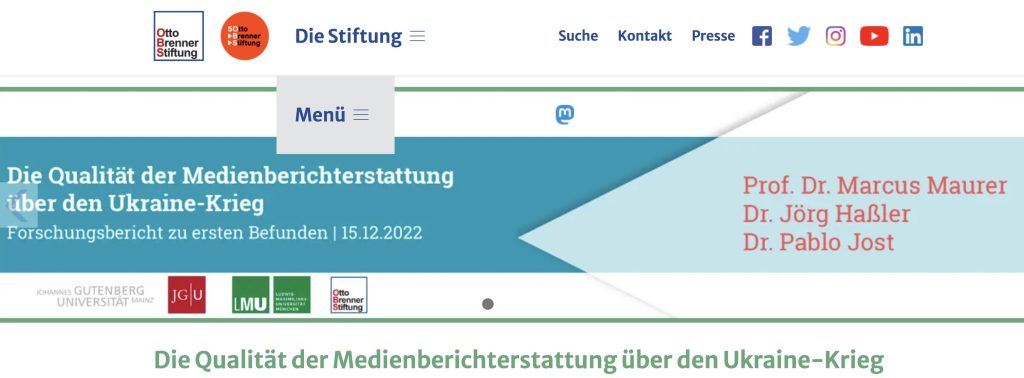
Last week, the University of Mainz published a study of German news coverage of events in Ukraine, and Berlin’s official response to the crisis. The conclusions confirm that since February 24, the media has played a major role in keeping the conflict going, and making a negotiated settlement less likely, due to almost universally biased, pro-war, anti-Russia content being published at all stages.

Researchers at the university analyzed German-language reporting on the Ukraine conflict between February 24 and May 31, assessing the content of around 4,300 separate articles published by the country’s eight leading newspapers and TV stations: FAZ, Suddeutsche Zeitung, Bild, Spiegel, Zeit, ARD Tagesschau, ZDF Today, and RTL Aktuell.

Originally published on RT, December 22, 2023

During this time, Ukraine was portrayed positively in 64% of all coverage, and President Vladimir Zelensky in 67%. By contrast, Russia was portrayed “almost exclusively negatively” 88% of the time, and President Vladimir Putin in 96% of cases. Almost all reports – 93% in total – attributed sole blame for the war to Putin and/or Russia. The West was named as “jointly responsible” in only 4% of instances, Ukraine even less so at 2%.

The perspectives of Russia on the conflict were only considered or mentioned in 10% of news reports, less than the viewpoint of any other country, including Moscow’s neighbors. Alternative for Germany and the Left Party, which both oppose arming Ukraine and prolonging the fighting, “had practically no media presence in reporting on the war.”

Government messaging and statements from ministers were completely dominant, being the focus in 80% of news coverage, more than four times above the figure for opposition parties.

In media discussions of “measures most likely to end the war,” economic sanctions against Russia were “by far the most frequently reported,” and approved of in 66% of cases. Diplomatic measures were mentioned “much less frequently,” while “humanitarian measures” were even less regularly featured.

In all, 74% of the reports surveyed portrayed military support to Ukraine “extremely positively.” Delivery of heavy weapons was endorsed “a little less clearly, but still considered to be largely sensible,” with 66% “overwhelmingly in favor.” Less than half – 43% – gave the impression that diplomatic negotiations would be useful, and this was largely due to Der Spiegel’s reporting that clearly marked diplomacy as the most sensible option for Berlin “by far.”

Der Spiegel was the only media examined to rate diplomatic negotiations more positively than the delivery of heavy weapons,” the academics conclude.

The report did identify one area where media coverage was “certainly not pro-government.” On certain rare occasions, Chancellor Olaf Scholz and his coalition were strongly criticized “for hesitating to flood Ukraine with heavy weapons” by all outlets apart from Der Spiegel.

The report adds that “not all members of the government were equally affected by the criticism.” While those who escaped censure aren’t listed, it’s a fair bet they are representatives of government coalition parties such as the Greens, who have been demanding that Berlin flood Kiev with arms from day one.

Overall, though, the study offers a disturbing view into how Germany’s entire media lined up behind the cause of war and a dangerous escalation against Russia. Meanwhile, consideration of alternative policies, such as supporting a diplomatic settlement or urging Ukraine to engage in productive negotiations to end the fighting as early as possible was almost completely absent – or indeed completely withheld – from any news reporting or analysis.

It also shows how journalists are among the most aggressive and effective lobbyists for war. Germany is just one country, and a similar investigation of media coverage of the conflict in any Western state would inevitably reach similar conclusions. In many cases, the findings could possibly be even more drastic, in terms of the one-sided, pro-war picture presented to average citizens by the press, and the lack of opposing, pro-diplomacy viewpoints.

This would surely be the case in the UK and US, the two countries most eagerly pushing proxy war with Russia. It has been confirmed that Kiev and Moscow reached a negotiated interim settlement in early April, whereby Russia would withdraw to its pre-February 24 position, and Ukraine would promise not to seek NATO membership in return for security guarantees from a number of countries.

However, at the very last minute, then-UK Prime Minister Boris Johnson reportedly flew to Kiev and demanded that Zelensky step away from talks. This shocking fact has barely been mentioned in English-language news, but this should not surprise us.

These organizations and the journalists who work for them seem to have a forever war to sell. For that to happen, the Western public apparently cannot be allowed to know it’s possible to achieve peace by alternative means to death and destruction. It is also necessary, it appears, to mislead Europeans about the consequences of the conflict for their own economies and personal lives, as the University of Mainz study proves.

Between February 24 and May 31, the proportion of reports that mentioned or were about the “influence of the war on Germany,” such as energy shortages and price inflation, never rose above 15% in total per week. It is only lately the country’s media has begun to recognize this damage, and explored what it means for the average citizen. A majority of the public may not see the huge recession coming, or have any idea that it is self-inflicted.
Please support TFF’s work for peace through research and public education. We are all-volunteer, people-financed and do not accept money from governments or corporations. In other words, one of the very last free research think tanks in this world – and for a noble purpose: Peace by peaceful – intelligent – means. It is fast, easy and secure. Click here. Thanks!

[paypal-donation]

No data was found

Share

Leave a Reply

Your email address will not be published. Required fields are marked *

Related Posts

Drones over Nordic airports. No damage. No trace. No answers. Most assume Russia—but what if that’s not so? Why is there so much we are not told? This article explores the strategic ambiguity behind recent drone incursions and asks: Who else might benefit from sending drones into NATO airspace? From Ukraine’s surprising drone supremacy to Russia’s possible signalling, the silence itself may be the loudest message. These are the kinds of questions decent, intelligent investigative journalists and commentators could easily research. Why don’t they? Did you, dear reader, know or think of this? That the most powerful weapon in today’s conflicts might be the one that leaves no trace – and no answers. Just enough fear to justify the next move? Recently, drones have repeatedly appeared over Nordic airports and near some military facilities. They cause no damage – for which reason the designation “hybrid attack” is misleading but serves a purpose. These...
Below are TFF-related media mentions, comments, videos and social media posts published elsewhere but not on this homepage. We happen to catch and list only a fraction. Regarding video comments and debates, we recommend that you go to the TFF Video Channel on Substack where many of them are reproduced. Jan Oberg is a contributor to China Daily – 52 million daily clicks – and Global Times, CGTN and CCTV (the national television), China Investment, Xinhua News Agency and several others. Articles and videos on these media very often multiply into countless Chinese (and Western media) that re-post them from these main media. Thanks to The China Academy, his analyses, interviews and comments are frequently posted on YouTube channels such as Thinkers Forum and Wave Media. These videos are often re-posted on Bilibili (China’s YouTube), the China Content Center on TikTok, and on the Chinese edition of TikTok, Douyin.com. This means reaching hundreds of millions of viewers worldwide over a year. While there are too many to catch on all these...
A slightly modified version of a text published on Sept. 1, 2025 in TMS. On August 25 Thomas Friedman, always a weathervane for political and economic establishment thinking in the West, wrote a notable column in the NY Times that was pragmatic in tone, misleading in substance, and regressive in intention. Yet it reflects a growing ambivalence toward Israel’s prolonged genocide even among longtime supporters of Israel that now highlights starvation, famine, and a gross distortion of the delivery of humanitarian aid under emergency conditions. But expressed dangerously without hiding the hope that Israel could even now restore its legitimacy without being held accountable for crimes in Gaza and despite all, still expecting to be rewarded by excluding Hamas from any further governance role in Gaza and continuing to move toward the annexation of the West Bank by formal action or through further settlement expansion. It is notable that the headline of...

Recent Articles

Gandhi, Arun. Lord Richard Attenborough. Kasturba: a lifeNew Delhi: Penguin Books Ltd., 2000.315 pp, 295 Indian Rs, US $22.51 January 29, 2002 Arun Gandhi, grandson to Mohandas and Kasturba, has written a thorough account of Kasturba’s life. Arun begins with a description of Kasturba’s childhood in Porbandar in the late1800s, before she met Mohandas. By having chosen to embark on difficult research into his grandmother’s life, including her first years which are not well-documented, Arun ensures that the reader receives an intimate and life-long portrait of this amazing woman. Kasturba is presented as a lively woman &endash; obedient, yet with a mind of her own. As the relationship between Kasturba and Mohandas developed, Arun maintains that Kasturba’s influence over Mohandas in her own quiet way also grew, to which some of Mohandas’ writings also attest.  Arun paints a vivid picture of the beginnings of Mohandas’ non-violence movement in South Africa, a...
In response to an urgent Appeal from all the living Nobel Peace Prize Laureates, the General Assembly of the United Nations, on November 1998, unanimously declared the first decade of the twenty-first century to be The Decade for a Culture of Peace and Nonviolence. While people are naturally concerned about the amount of violence in our world and how it threatens our future, the Nobel Laureates are right to remind us of the potential of nonviolence and our calling to build a culture of peace and nonviolence.  The twentieth century is instructive in the way that the philosophy and practice of nonviolence have begun to flourish and in the way that nonviolent movements have had an exponential growth across the world. Mohandas Gandhi and Martin Luther King, Jr. are the most famous nonviolent leaders but many have built upon the paths they charted as in country after country, tyrannies and...
We know that medical personnel have failed to report to higher authorities wounds that were clearly caused by torture and that they have neglected to take steps to interrupt this torture. In addition, they have turned over prisoners’ medical records to interrogators who could use them to exploit the prisoners’ weaknesses or vulnerabilities. We have not yet learned the extent of medical involvement in delaying and possibly falsifying the death certificates of prisoners who have been killed by torturers. A May 22 article on Abu Ghraib in the New York Times states that “much of the evidence of abuse at the prison came from medical documents” and that records and statements “showed doctors and medics reporting to the area of the prison where the abuse occurred several times to stitch wounds, tend to collapsed prisoners or see patients with bruised or reddened genitals.” http://www.truthout.org/docs_04/080604J.shtml#16 According to the article, two doctors who...

TFF on Substack

Discover more from TFF Transnational Foundation & Jan Oberg.

Most Popular

Gandhi, Arun. Lord Richard Attenborough. Kasturba: a lifeNew Delhi: Penguin Books Ltd., 2000.315 pp, 295 Indian Rs, US $22.51 January 29, 2002 Arun Gandhi, grandson to Mohandas and Kasturba, has written a thorough account of Kasturba’s life. Arun begins with a description of Kasturba’s childhood in Porbandar in the late1800s, before she met Mohandas. By having chosen to embark on difficult research into his grandmother’s life, including her first years which are not well-documented, Arun ensures that the reader receives an intimate and life-long portrait of this amazing woman. Kasturba is presented as a lively woman &endash; obedient, yet with a mind of her own. As the relationship between Kasturba and Mohandas developed, Arun maintains that Kasturba’s influence over Mohandas in her own quiet way also grew, to which some of Mohandas’ writings also attest.  Arun paints a vivid picture of the beginnings of Mohandas’ non-violence movement in South Africa, a...
In response to an urgent Appeal from all the living Nobel Peace Prize Laureates, the General Assembly of the United Nations, on November 1998, unanimously declared the first decade of the twenty-first century to be The Decade for a Culture of Peace and Nonviolence. While people are naturally concerned about the amount of violence in our world and how it threatens our future, the Nobel Laureates are right to remind us of the potential of nonviolence and our calling to build a culture of peace and nonviolence.  The twentieth century is instructive in the way that the philosophy and practice of nonviolence have begun to flourish and in the way that nonviolent movements have had an exponential growth across the world. Mohandas Gandhi and Martin Luther King, Jr. are the most famous nonviolent leaders but many have built upon the paths they charted as in country after country, tyrannies and...
We know that medical personnel have failed to report to higher authorities wounds that were clearly caused by torture and that they have neglected to take steps to interrupt this torture. In addition, they have turned over prisoners’ medical records to interrogators who could use them to exploit the prisoners’ weaknesses or vulnerabilities. We have not yet learned the extent of medical involvement in delaying and possibly falsifying the death certificates of prisoners who have been killed by torturers. A May 22 article on Abu Ghraib in the New York Times states that “much of the evidence of abuse at the prison came from medical documents” and that records and statements “showed doctors and medics reporting to the area of the prison where the abuse occurred several times to stitch wounds, tend to collapsed prisoners or see patients with bruised or reddened genitals.” http://www.truthout.org/docs_04/080604J.shtml#16 According to the article, two doctors who...
Read More
Imagen-thumbnail-The-Transnational-1
Gandhi, Arun. Lord Richard Attenborough. Kasturba: a lifeNew Delhi: Penguin Books Ltd., 2000.315 pp, 295 Indian Rs, US $22.51 January 29, 2002 Arun Gandhi, grandson to Mohandas and Kasturba, has written a thorough account of Kasturba’s life. Arun begins with a description of Kasturba’s childhood in Porbandar in the late1800s, before she met Mohandas. By having chosen to embark on difficult research into his grandmother’s life, including her first years which are not well-documented, Arun ensures that the reader receives an intimate and life-long portrait of this amazing woman. Kasturba is presented as a lively woman &endash; obedient, yet with a mind of her own. As the relationship between Kasturba and Mohandas developed, Arun maintains that Kasturba’s influence over Mohandas in her own quiet way also grew, to which some of Mohandas’ writings also attest.  Arun paints a vivid picture of the beginnings of Mohandas’ non-violence movement in South Africa, a...
Imagen-thumbnail-The-Transnational-1
In response to an urgent Appeal from all the living Nobel Peace Prize Laureates, the General Assembly of the United Nations, on November 1998, unanimously declared the first decade of the twenty-first century to be The Decade for a Culture of Peace and Nonviolence. While people are naturally concerned about the amount of violence in our world and how it threatens our future, the Nobel Laureates are right to remind us of the potential of nonviolence and our calling to build a culture of peace and nonviolence.  The twentieth century is instructive in the way that the philosophy and practice of nonviolence have begun to flourish and in the way that nonviolent movements have had an exponential growth across the world. Mohandas Gandhi and Martin Luther King, Jr. are the most famous nonviolent leaders but many have built upon the paths they charted as in country after country, tyrannies and...
Imagen-thumbnail-The-Transnational-1
We know that medical personnel have failed to report to higher authorities wounds that were clearly caused by torture and that they have neglected to take steps to interrupt this torture. In addition, they have turned over prisoners’ medical records to interrogators who could use them to exploit the prisoners’ weaknesses or vulnerabilities. We have not yet learned the extent of medical involvement in delaying and possibly falsifying the death certificates of prisoners who have been killed by torturers. A May 22 article on Abu Ghraib in the New York Times states that “much of the evidence of abuse at the prison came from medical documents” and that records and statements “showed doctors and medics reporting to the area of the prison where the abuse occurred several times to stitch wounds, tend to collapsed prisoners or see patients with bruised or reddened genitals.” http://www.truthout.org/docs_04/080604J.shtml#16 According to the article, two doctors who...
Imagen-thumbnail-The-Transnational-1
Jan Øberg behandler i artiklen en lang række faktorer, som ligger til grund for den måde vores samfund er organiseret på – og derfor også for konflikter. Artiklen introducerer således sammenhængen mellem familien, foreninger, regeringer, NGO’ er, nation, stat, nationalstat og alliancer for på denne måde bedre at kunne forstå konflikter og i sidste ende blive klogere mht. at løse disse. Øberg, der er fortaler for global bevidsthed, hvilket skal ses i lyset af den øgede globalisering, skelner mellem kulturkamp og kulturdialog. Endelig behandles begrebet magt og magtesløshed: giver magt ret til at udøve magt – fordi man mener at have ret? Litteraturliste og arbejdsspørgsmål efter artiklen. Ordene vi bruger om verden I satellitperspektiv kan man godt tale om den menneskelige familie eller menneskeheden. Udtrykket understreger, at der eksisterer – eller burde eksistere – et fællesskab fordi vi alle er mennesker og sammen bebor denne klode og ingen anden. Og...
Imagen-thumbnail-The-Transnational-1
Kapitel 2: Forskellige sider af Europa og USA…fortsat 2.5 Militære relationer I forbifarten har vi allerede sagt nogle ting om USA’s militære situation. Kig lige en gang til på afsnit 2.3. Nu skal vi uddybe det militære forhold mellem USA og EU. Der er en række ligheder mellem visse europæiske landes og USA’s militær. Næsten alle er med på en eller anden måde i NATO, direkte som medlem – selv Island, der ikke har et forsvar – eller indirekte i Partnerskab for Fred. USA og Canada er med i OSCE (på dansk OSSE), Organisationen for Sikkerhed og Samarbejde i Europa, der tæller over 50 lande. USA samt England og Frankrig er kernevåbenstater og de har styrker til intervention langt borte fra hjemlandet, om end USA’s er tifold større. Alle har også en omfattende våbeneksport og bruger den som et middel til at tjene penge og få loyale venner på, det...
Imagen-thumbnail-The-Transnational-1
Background Christian Harleman and Jan Oberg conducted a fact-finding mission to Burundi between November 26 and December 6, 2003. (See websites about the country here). The first TFF mission took place in March 1999. Unfortunately, since then it has not been practically possible to implement the co-operation with Burundi’s Ministry of Education and Burundian NGOs that was planned at the time. The 2003 mission had three purposes. First, to do fact-finding in general about the situation and, in particular, the progress under the Arusha Peace Process. Second, to explore the possibilities for co-operation between the government and relevant NGOs on the one hand and TFF on the other, in order to develop and deepen the existing competence in fields such as conflict-understanding, reconciliation and peace-building. Finally, third, to find out whether it would be possible, in co-operation with the Swedish Rescue Services Agency (Statens Räddningsverk), to establish a health care unit that...

