Omri Walach: Which countries have the most nuclear weapons?

Omri Walach

October 21, 2021

Originally posted on Visual Capitalist’s homepage on September 30, 2021

Which Countries Have the Most Nuclear Weapons?

In theory, nuclear weapon stockpiles are closely held national secrets. The leading countries have rough estimates that aren’t regularly updated, newly nuclear countries keep their capabilities vague and unclear, and Israel has never officially confirmed a nuclear weapons program.

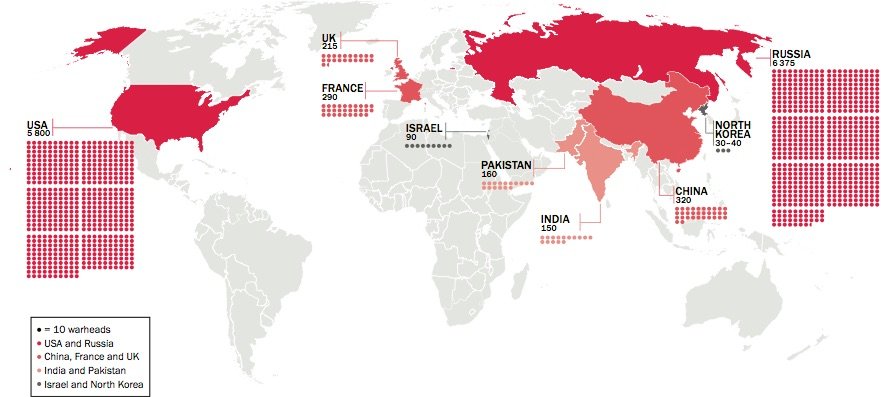
But thanks to limited disclosures, records, and leaks, we can visualize the full extent* of the world’s nuclear arsenal. This graphic uses estimated nuclear warhead inventories from the Federation of American Scientists as of August 2021.

Based on these estimates, there are just nine countries with nuclear weapons in the world.

Editor’s note: Exact numbers of nuclear warheads possessed by countries are closely guarded state secrets, with the FAS estimate being the closest, most-used, and most-trusted international approximation available.

Nuclear Weapons, by Country

The nuclear arms race has always centered around the U.S. and Russia.

After the end of World War II and well into the Cold War, the world’s two superpowers raced to build more nuclear weapons (and more capable nuclear weapons) than the other.

Even while international organizations lobbied for the end of nuclear proliferation, the world’s nuclear weapon stockpile grew to a peak of 70,300 total warheads in 1986.

As arms agreements and non-proliferation treaties started to gain greater momentum, the U.S. and Russia cut back on stockpiles while new countries with nuclear weapons started to pop up.
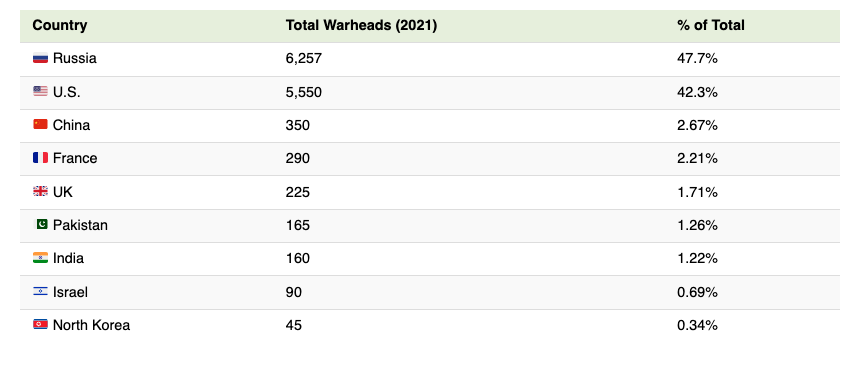
Despite reducing their stockpiles significantly since the end of the Cold War, Russia and the U.S. still own around 90% of all nuclear warheads in the world.

Far behind them are China and France, which started testing nuclear weapons in 1964 and 1960 respectively. The UK has the fifth-most nuclear weapons today, though it was the third country in the world to develop them after the U.S. and Russia in 1952.

The countries with fewer than 200 nuclear weapons are regional rivals India and Pakistan, which first tested nuclear weapons in the 1970s, and North Korea, which began to operate uranium fabrication plants and conduct explosive tests in the 1980s.

Israel is also estimated to have fewer than 200 nuclear weapons, and reports have its weapons program dating back to the 1960s. However, the country has never confirmed or announced its nuclear capabilities.

Countries With Nuclear Weapons, by Warhead Status

Though the world has 13,132 nuclear weapons, that doesn’t mean they’re all ready to fire.

Weapons (or “warheads”) are delivered by missile, and countries don’t keep all of their nuclear warheads primed for use. The estimation of nuclear stockpiles also clarifies whether warheads are considered deployed, reserved, or retired:

  • Deployed warheads are deployed on intercontinental missiles, at heavy bomber bases, and on bases with operational short-range delivery systems.
  • Reserve warheads are in storage and not deployed on launchers.
  • Retired warheads are still intact but in queue for dismantlement.
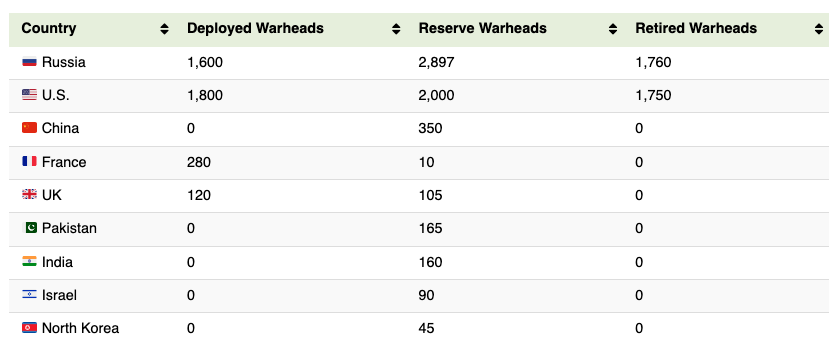
Only four countries have officially deployed warheads, while the majority of the world’s nuclear stockpile is in reserve. This is partially due to estimates ranging from relatively transparent in the case of the U.S. to opaque and uncertain for countries like China and North Korea.

But some countries are expected to further bolster their stockpiles. The UK government announced it would increase its stockpile to no more than 260 warheads, and U.S. intelligence expects China, India, and Pakistan to increase their stockpiles.

Though the world’s nuclear stockpile will likely continue dwindling on account of U.S. and Russia retirements, the 2021 landscape of countries with nuclear weapons shows that proliferation is still underway.

Please think of supporting TFF so we can bring you more genuine materials – like the above – on problems and on peace as well as remain 100% people-financed and therefore independent and politically non-correct…
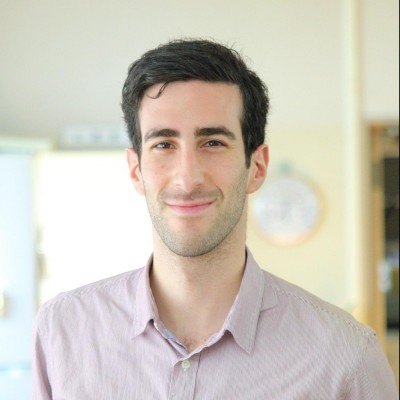
Omri Wallach is a writer focused on tech, business trends, and everything current. He got his Master of Journalism at the University of British Columbia and still lives in sometimes-sunny Vancouver.
No data was found

Share

Leave a Reply

Your email address will not be published. Required fields are marked *

Related Posts

Officially, the drones were not identified. By simply thinking critically – which journalists and selected experts no longer do – there may be a good reason for that. And this article will never be mentioned in Denmark… Drones over Denmark. No damage. No trace. No answers. Yet the headlines scream “Russian threat,” and Prime Minister Mette Frederiksen speaks with a certainty that defies logic: “We don’t know they were Russian—but we know Russia is the biggest threat to Europe.” It could be nobody else – unless you make an interest analysis which I did two days ago. This is not security policy. It’s theatre. And the audience is being played. Let’s rewind. These drones—unphotographed, untracked, unclaimed—appear and vanish like ghosts. Airports shut down. Panic spreads. Military budgets swell. And the narrative hardens: Russia is behind it. But what if that’s not just wrong but deliberately misleading? Here’s a hypothesis for...
Drones over Nordic airports. No damage. No trace. No answers. Most assume Russia—but what if that’s not so? Why is there so much we are not told? This article explores the strategic ambiguity behind recent drone incursions and asks: Who else might benefit from sending drones into NATO airspace? From Ukraine’s surprising drone supremacy to Russia’s possible signalling, the silence itself may be the loudest message. These are the kinds of questions decent, intelligent investigative journalists and commentators could easily research. Why don’t they? Did you, dear reader, know or think of this? That the most powerful weapon in today’s conflicts might be the one that leaves no trace – and no answers. Just enough fear to justify the next move? Recently, drones have repeatedly appeared over Nordic airports and near some military facilities. They cause no damage – for which reason the designation “hybrid attack” is misleading but serves a purpose. These...
Launched on November 17, 2024Updated with new materials regularly TFF Board members Thore Vest. Everywhere, the delegation was met with a sincere wish to develop knowledge, dialogue, cooperative projects, and initiatives based on citizens’ diplomacy – in general, but with the West in particular. For more, see “Report from the Nordic delegation to China’s Xinjiang Province, September 7-15, 2024.” While the delegation was in Xinjiang, various ideas were already being discussed from the local to the top level, i.e., with the governor and party leaders of Xinjiang. The two TFF Associates suggested that TFF set up a special section – in addition to its “China and Silk” – where various quality materials about Xinjiang would regularly be published to promote public education about Xinjiang, particularly its contemporary development – worldwide but in the West in particular. This is now a reality – as can be seen below – but it...

Recent Articles

Former UN Under-Secretary-General with special responsibility for peacekeeping operations TFF associate August 20, 2003 YRINGHAM, Mass.- Ralph Bunche was born in Detroit 100 years ago today (August 7, 2003). His passionate determination to get results did not extend to seeking credit for them, so his work is better remembered than he is. Of all his many accomplishments – civil rights pioneer, Nobel Peace Prize laureate, chief drafter of two chapters of the United Nations charter, negotiator of the armistices that ended the first Arab-Israeli war – Bunche said he was proudest of developing what came to be known as peacekeeping. Setting up the United Nations Truce Supervision Organization in Palestine in 1948, Bunche formulated the principles that have governed peacekeeping operations ever since. In the 1956 Suez crisis, working with Secretary General Dag Hammarskjold and Lester Pearson of Canada, he organized the first peacekeeping force, the United Nations Emergency Force...
– nästan 11 månader Till Sofia nästan 11 månader # 1  Till Sofias huvudsida Till alla Privata Foto-Serier
Till Sofias huvudsida

TFF on Substack

Discover more from TFF Transnational Foundation & Jan Oberg.

Most Popular

Former UN Under-Secretary-General with special responsibility for peacekeeping operations TFF associate August 20, 2003 YRINGHAM, Mass.- Ralph Bunche was born in Detroit 100 years ago today (August 7, 2003). His passionate determination to get results did not extend to seeking credit for them, so his work is better remembered than he is. Of all his many accomplishments – civil rights pioneer, Nobel Peace Prize laureate, chief drafter of two chapters of the United Nations charter, negotiator of the armistices that ended the first Arab-Israeli war – Bunche said he was proudest of developing what came to be known as peacekeeping. Setting up the United Nations Truce Supervision Organization in Palestine in 1948, Bunche formulated the principles that have governed peacekeeping operations ever since. In the 1956 Suez crisis, working with Secretary General Dag Hammarskjold and Lester Pearson of Canada, he organized the first peacekeeping force, the United Nations Emergency Force...
– nästan 11 månader Till Sofia nästan 11 månader # 1  Till Sofias huvudsida Till alla Privata Foto-Serier
Till Sofias huvudsida
Read More
Imagen-thumbnail-The-Transnational-1
Former UN Under-Secretary-General with special responsibility for peacekeeping operations TFF associate August 20, 2003 YRINGHAM, Mass.- Ralph Bunche was born in Detroit 100 years ago today (August 7, 2003). His passionate determination to get results did not extend to seeking credit for them, so his work is better remembered than he is. Of all his many accomplishments – civil rights pioneer, Nobel Peace Prize laureate, chief drafter of two chapters of the United Nations charter, negotiator of the armistices that ended the first Arab-Israeli war – Bunche said he was proudest of developing what came to be known as peacekeeping. Setting up the United Nations Truce Supervision Organization in Palestine in 1948, Bunche formulated the principles that have governed peacekeeping operations ever since. In the 1956 Suez crisis, working with Secretary General Dag Hammarskjold and Lester Pearson of Canada, he organized the first peacekeeping force, the United Nations Emergency Force...
– nästan 11 månader Till Sofia nästan 11 månader # 1  Till Sofias huvudsida Till alla Privata Foto-Serier
Till Sofias huvudsida
BlackNobel
OK, Trump did not get it. But he got a full endorsement of a possible future US regime change in Venezuela. And that is what Ms Machado has advocated. On October 10, 2025, the Norwegian Nobel Committee awarded its Peace Prize to Venezuelan opposition figure María Corina Machado. The citation praised her “tireless work promoting democratic rights.” But Ms Machado has openly called for U.S. military intervention in Venezuela, stating on CBS: “The only way to stop the suppression is by force—U.S. force.” She or her party has received funding from the National Endowment for Democracy (NED), a U.S. government-backed body known as a CIA front organisation and for supporting regime-change operations worldwide. And in 2018, she sent a letter to Israeli Prime Minister Benjamin Netanyahu, asking him to use “force and influence” to help dismantle Venezuela’s government—citing alleged ties to terrorism, Iran and narcotrafficking. This year’s NATO Norwegian prize...
Screenshot-2025-10-08-163458
PRESS RELEASE – 6 OCTOBER 2025 LAY DOWN YOUR ARMSPEACE PRIZE FOR 2025 is awarded Francesca Albanese The United Nations Special Rapporteur on the occupied Palestinian territories – as the person who, in accordance with Alfred Nobel’s will, has “done the most or the best work for fraternity between nations and for the abolition or reduction of standing armies as well as for the holding and promotion of peace congresses.” Francesca Albanese has forcefully and unwaveringly worked against Israel’s full-scale war on the occupied Palestinian territories, in particular Israel´s ongoing genocide against the Palestinian people. She has confronted Israel’s systematic war crimes and crimes against humanity in a truly global outreach. Further, she has brought governments, international organisations and people’s groups together to underline the responsibility of the world at large to act and to stop arming, enabling, and profiting from Israel’s ongoing criminal actions. But first of all, Albanese...
Copilot_20251003_003414
Officially, the drones were not identified. By simply thinking critically – which journalists and selected experts no longer do – there may be a good reason for that. And this article will never be mentioned in Denmark… Drones over Denmark. No damage. No trace. No answers. Yet the headlines scream “Russian threat,” and Prime Minister Mette Frederiksen speaks with a certainty that defies logic: “We don’t know they were Russian—but we know Russia is the biggest threat to Europe.” It could be nobody else – unless you make an interest analysis which I did two days ago. This is not security policy. It’s theatre. And the audience is being played. Let’s rewind. These drones—unphotographed, untracked, unclaimed—appear and vanish like ghosts. Airports shut down. Panic spreads. Military budgets swell. And the narrative hardens: Russia is behind it. But what if that’s not just wrong but deliberately misleading? Here’s a hypothesis for...