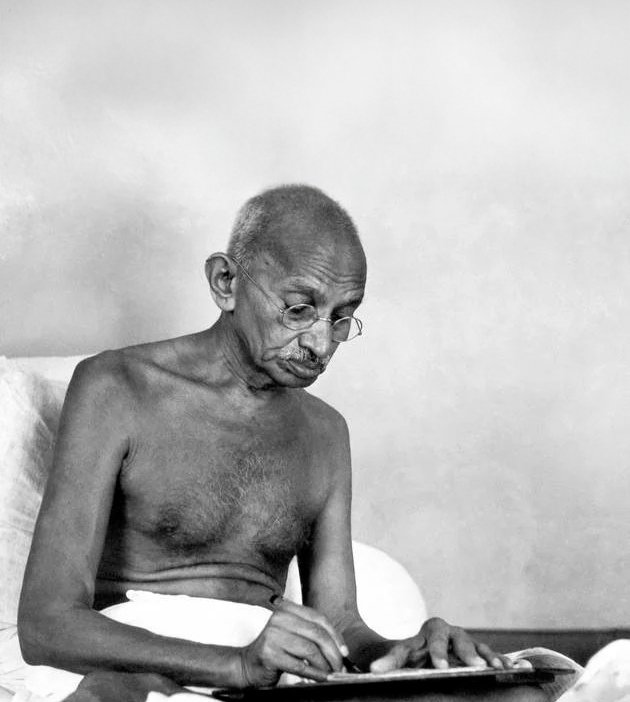
Gandhi - the first peace journalist

May 18, 2020

Steven Youngblood

When asked to describe Mahatma Gandhi, most would say he was an Indian independence leader, human rights defender, and spiritual guide. However, “People don’t think of him as a journalist” even though “he was a journalist from an early age, and died as a journalist.”

Originally posted on The Peace Journalist magazine, published by the Center for Global Peace Journalism on February 6, 2020, here

This is according to professor, historian, and author Rajmohan Gandhi, the grandson of Mahatma Gandhi. Professor Gandhi was the featured speaker at a program titled “Gandhi: The First Peace Journalist,” held at Park University on Aug. 26.

The evening began with a presentation by Gandhi documentarian, Cynthia Lukas, about Gandhi’s background as a journalist. Gandhi was a prolific journalist and editor who was well-known in India for his articles stressing social justice in such publications as Indian Opinion, Young India, and Navajivan (A New Life). Lukas said his writing avoided inflammatory, “poisonous journalism” (as Gandhi termed it). Instead, Mahatma Gandhi emphasized civility and politeness in his articles, striving always to “step into the shoes of our opponents.”

Professor Gandhi agreed, adding that it is “certainly correct to describe Gandhi as a journalist.” His grandson said Gandhi was a staunch defender of the free press who nonetheless understood the need to avoid inflammatory rhetoric, to “put a curb on his own pen.”
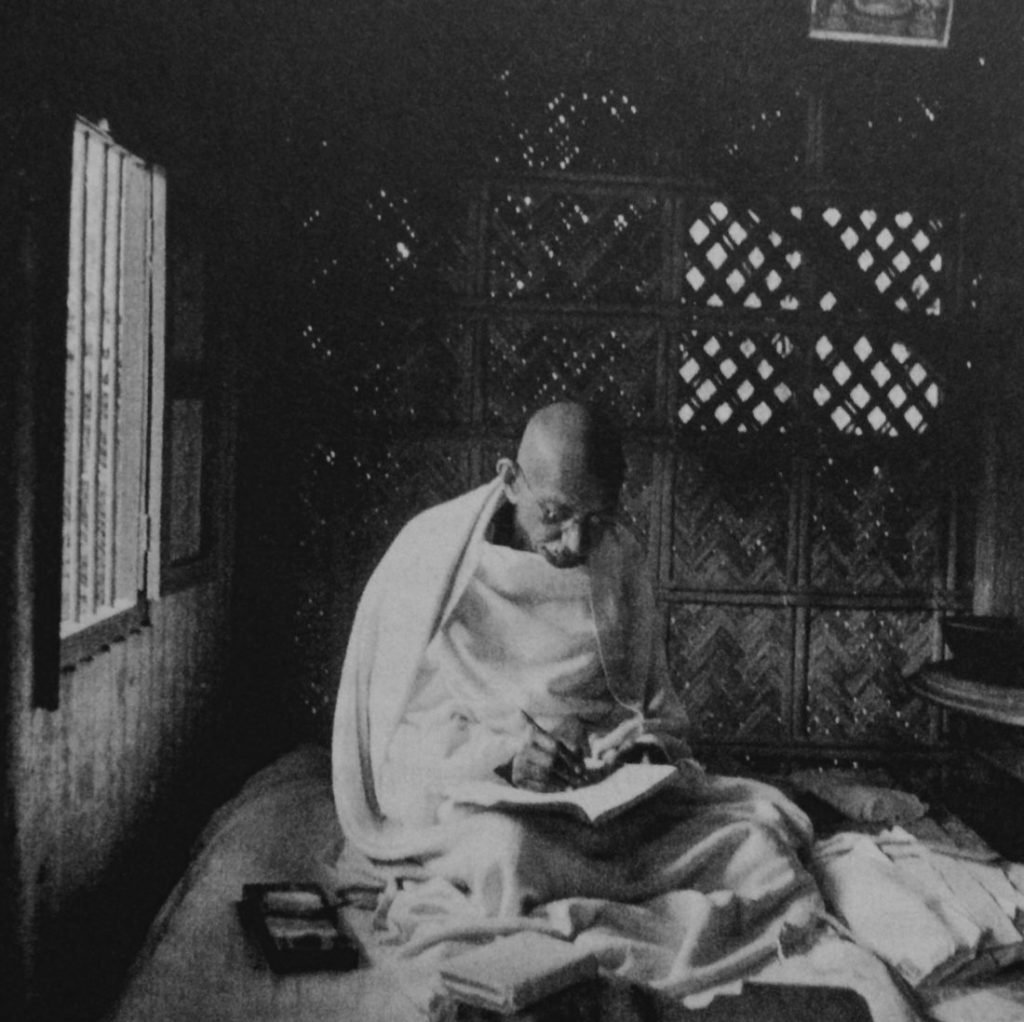
My presentation followed, and supported the premise that Gandhi was indeed a peace journalist. I listed several characteristics shared by Gandhian and peace journalism. These include rejecting “us vs. them” narratives; journalism as public service; media as a tool to de-escalate conflicts; using journalism as a means to foster reconciliation; carefully choosing one’s words to avoid sensationalism; giving a voice to the voiceless; and emphasizing facts and truth.

Regarding language, I shared a quote with the audience. Writing about the “Indian Opinion” journal, Gandhi said, “I cannot recall a word in those articles set down without thought or deliberation, or a word of conscious exaggeration, or anything merely to please…”

The truth, and facts, had no more strident champion than Gandhi. I presented this telling quote from 1926: “The way to peace is the way of truth. Truthfulness is even more important than peacefulness. Indeed, lying is the mother of violence. The truth of a few will count; the untruth of millions will vanish even like chaff before a whiff of wind.”

Professor Gandhi agreed with my assessment that Mahatma Gandhi was indeed a peace journalist. He cited an incident where the Mahatma called out those who had labeled an opponent a snake. “To liken someone to a snake…is a degrading performance,” the professor quoted his grandfather.

The final speaker was Park professor Abhijit Mazumdar, who discussed inflammatory and often hate-filled speech in South Asian media. He cited examples from social media, including hash tags like #HatePakLovers, as well as inflammatory name-calling on Indian TV like “shrieking raccoon” and venomous snake.” In addition, he noted many examples of false news that have been reported by Indian television. Professor Gandhi added that Indian media often spread “toxicity.”

“The way to peace is the way of truth. Truthfulness is even more important than peacefulness. Indeed, lying is the mother of violence. The truth of a few will count; the untruth of millions will vanish even like chaff before a whiff of wind.”

The event was sponsored by Park University’s Center for Global Peace Journalism, which also arranged Prof. Gandhi’s appearances in several Park University classes.

The students were thrilled. “A once in a lifetime opportunity…A class I’ll never forget…Inspiring…” were among the avalanche of positive comments from Park University students who met and were inspired by Prof. Gandhi.

In the peace journalism class, Prof. Gandhi addressed the shortcomings of media, but left the students hopeful that media can become more responsible. He said he was impressed by the work that many U.S. journalists do, and the “commitment and quality of social journalists.”

Prof. Gandhi said he was depressed because of a “lack of substance,” media bias, and the media’s desire to “keep viewers glued to the screen” through sensationalism.

He was critical of Fox News’ “unfortunate bias” that supports the “curious notion” of white supremacy that suggests that only whites are the rightful owners of the U.S. “The way to confront them (white nationalists) is with the real American ideal” upon which the country was founded. “The U.S. has stood for justice and equality. We have to remind America of this,” he said.

The discussion about nationalism in the U.S. and elsewhere continued in Intro to Peace Studies class. Gandhi said that nationalism in the U.S. means ”reclaiming” of the country for whites; and in India, “reclaiming” the country for Hindus, despite Mahatma Gandhi’s lifelong struggle trying to build bridges between Hindus and other religions.

Prof. Gandhi also answered a question about the viability of non-violent approaches to peace. While he acknowledged that these tactics haven’t always worked, he said it is an unassailable fact that “violence hasn’t brought peace.” Gandhi further defended non-violence with the logic that violence begets violence, leaving non-violence as the only viable option.

In both of his classroom stops at Park, Prof. Gandhi discussed the current crisis in Kashmir, where 2,000 people have been arrested, the internet and phone service shut off, and over 400,000 Indian troops are deployed.

He mentioned – repeatedly – that the recent Indian government decision to strip Kashmir of its special limited sovereignty status was made “without consulting even one Kashmiri.” He firmly believes in the right of self-determination for Kashmiris, a right he said has been trampled by the current Indian government.

Park University students were thrilled to meet and be inspired by Prof. Gandhi. “I was impressed by the transmission of calmness and knowledge when he talks,” said Marcelo Aquino. International student from India Aadarash Chandan noted, “His views about the events are realistic, practical, and yet polite. His audacity is unmatched.” Destiny Webb spoke for many students when she commented, “He gave good advice and a better outlook on a non-violent society. His words were extremely wise.”

Finally, Nathan Moore said, “His views and thoughts on peace were very informative and got me to thinking about peace in my community.”

I know I speak for my students when I say we were truly honored by his presence and his wisdom.

If you enjoyed your visit on this website, please consider donating a dollar or five…

[paypal-donation]

Steven Youngblood is the founding director of the Center for Global Peace Journalism at Park University in Parkville, Missouri USA, where he is a communications professor. He has organized and taught peace journalism seminars and workshops in 27 countries/regions.
Youngblood is the author of Peace Journalism: Principles and Practices and Professor Komagum (2013). He edits The Peace Journalist magazine, and writes and produces the Peace Journalism Insights blog. He has been recognized for his contributions to world peace by the U.S. State Department, Rotary International, and the UN Association of Kansas City.

Recommended further reading
Mahatma Gandhi and mass media

The Journalism Notebook – on Gandhi

Gandhi Sevagram Ashram

M. K. Gandhi as author

Gandhi – Journalist and editor

Share

Leave a Reply

Your email address will not be published. Required fields are marked *

Related Posts

PRESS RELEASE – 6 OCTOBER 2025 LAY DOWN YOUR ARMSPEACE PRIZE FOR 2025 is awarded Francesca Albanese The United Nations Special Rapporteur on the occupied Palestinian territories – as the person who, in accordance with Alfred Nobel’s will, has “done the most or the best work for fraternity between nations and for the abolition or reduction of standing armies as well as for the holding and promotion of peace congresses.” Francesca Albanese has forcefully and unwaveringly worked against Israel’s full-scale war on the occupied Palestinian territories, in particular Israel´s ongoing genocide against the Palestinian people. She has confronted Israel’s systematic war crimes and crimes against humanity in a truly global outreach. Further, she has brought governments, international organisations and people’s groups together to underline the responsibility of the world at large to act and to stop arming, enabling, and profiting from Israel’s ongoing criminal actions. But first of all, Albanese...
Officially, the drones were not identified. By simply thinking critically – which journalists and selected experts no longer do – there may be a good reason for that. And this article will never be mentioned in Denmark… Drones over Denmark. No damage. No trace. No answers. Yet the headlines scream “Russian threat,” and Prime Minister Mette Frederiksen speaks with a certainty that defies logic: “We don’t know they were Russian—but we know Russia is the biggest threat to Europe.” It could be nobody else – unless you make an interest analysis which I did two days ago. This is not security policy. It’s theatre. And the audience is being played. Let’s rewind. These drones—unphotographed, untracked, unclaimed—appear and vanish like ghosts. Airports shut down. Panic spreads. Military budgets swell. And the narrative hardens: Russia is behind it. But what if that’s not just wrong but deliberately misleading? Here’s a hypothesis for...
Drones over Nordic airports. No damage. No trace. No answers. Most assume Russia—but what if that’s not so? Why is there so much we are not told? This article explores the strategic ambiguity behind recent drone incursions and asks: Who else might benefit from sending drones into NATO airspace? From Ukraine’s surprising drone supremacy to Russia’s possible signalling, the silence itself may be the loudest message. These are the kinds of questions decent, intelligent investigative journalists and commentators could easily research. Why don’t they? Did you, dear reader, know or think of this? That the most powerful weapon in today’s conflicts might be the one that leaves no trace – and no answers. Just enough fear to justify the next move? Recently, drones have repeatedly appeared over Nordic airports and near some military facilities. They cause no damage – for which reason the designation “hybrid attack” is misleading but serves a purpose. These...

Recent Articles

PressInfo # 141, December 21, 2001It’s time to prepare reconciliation between Albanians and Serbs PressInfo # 140, December 14, 2001Ibrahim Rugova’s decade-long leadership in Kosovo/a PressInfo # 139, 11. december, 2001En god nyhet: Jugoslaviens Sannings- och försoningskommission PressInfo # 139, 11. december, 2001Gode nyheder: Jugoslaviens Sandheds- og Forsoningskommission PressInfo # 139, December 11, 2001Good news: Yugoslavia’s Truth and Reconciliation Commission PressInfo # 138, November 8, 2001TFF co-founder PhD with thesis about young people with roots in other cultures PressInfo # 138, November 8, 2001TFF:s medstiftare doktor på avhandling om unga med ursprung i andra kulturer PressInfo # 137, October 17, 2001A new Marshall Plan: Advancing human security and controlling terrorism PressInfo # 136, October 15, 2001The UN and Annan really deserve it PressInfo # 135, October 10, 2001Preventing a terrorist mushroom cloud PressInfo # 134, 17 oktober, 2001Sverige og 11. september PressInfo # 134, October 9, 2001Sweden and September 11...
Peace is promoted by constructive proposals and dialogue Four preceding PressInfos have expressed concern over — and criticised — the ongoing, militarisation of the EU. Some will say: but there are no alternatives. We believe that there are always alternatives, that democracies are characterised by alternatives and choice, and that openly discussed alternatives will improve the quality and legitimacy of society’s decision–making. In addition, it is an intellectual and moral challenge to not only criticise but also be constructive. If we only tell people that we think they are wrong, they are not likely to listen. However, if we say: what are your views on this set of ideas and steps? — we may sometimes engage them in dialogue and sow a seed. Most people in power circles live their daily lives in in a time frame and a social space where certain ideas, viewpoints and concepts are just not...
Photos © TFF 2000 Read PressInfo 90 “Lift the Sanctions and Bring More Aid to Yugoslavia” See Pictures from Belgrade © TFF 2000 Please reprint, copy, archive, quote or re-post this item, but please retain the source.

TFF on Substack

Discover more from TFF Transnational Foundation & Jan Oberg.

Most Popular

PressInfo # 141, December 21, 2001It’s time to prepare reconciliation between Albanians and Serbs PressInfo # 140, December 14, 2001Ibrahim Rugova’s decade-long leadership in Kosovo/a PressInfo # 139, 11. december, 2001En god nyhet: Jugoslaviens Sannings- och försoningskommission PressInfo # 139, 11. december, 2001Gode nyheder: Jugoslaviens Sandheds- og Forsoningskommission PressInfo # 139, December 11, 2001Good news: Yugoslavia’s Truth and Reconciliation Commission PressInfo # 138, November 8, 2001TFF co-founder PhD with thesis about young people with roots in other cultures PressInfo # 138, November 8, 2001TFF:s medstiftare doktor på avhandling om unga med ursprung i andra kulturer PressInfo # 137, October 17, 2001A new Marshall Plan: Advancing human security and controlling terrorism PressInfo # 136, October 15, 2001The UN and Annan really deserve it PressInfo # 135, October 10, 2001Preventing a terrorist mushroom cloud PressInfo # 134, 17 oktober, 2001Sverige og 11. september PressInfo # 134, October 9, 2001Sweden and September 11...
Peace is promoted by constructive proposals and dialogue Four preceding PressInfos have expressed concern over — and criticised — the ongoing, militarisation of the EU. Some will say: but there are no alternatives. We believe that there are always alternatives, that democracies are characterised by alternatives and choice, and that openly discussed alternatives will improve the quality and legitimacy of society’s decision–making. In addition, it is an intellectual and moral challenge to not only criticise but also be constructive. If we only tell people that we think they are wrong, they are not likely to listen. However, if we say: what are your views on this set of ideas and steps? — we may sometimes engage them in dialogue and sow a seed. Most people in power circles live their daily lives in in a time frame and a social space where certain ideas, viewpoints and concepts are just not...
Photos © TFF 2000 Read PressInfo 90 “Lift the Sanctions and Bring More Aid to Yugoslavia” See Pictures from Belgrade © TFF 2000 Please reprint, copy, archive, quote or re-post this item, but please retain the source.
Read More
Imagen-thumbnail-The-Transnational-1
PressInfo # 141, December 21, 2001It’s time to prepare reconciliation between Albanians and Serbs PressInfo # 140, December 14, 2001Ibrahim Rugova’s decade-long leadership in Kosovo/a PressInfo # 139, 11. december, 2001En god nyhet: Jugoslaviens Sannings- och försoningskommission PressInfo # 139, 11. december, 2001Gode nyheder: Jugoslaviens Sandheds- og Forsoningskommission PressInfo # 139, December 11, 2001Good news: Yugoslavia’s Truth and Reconciliation Commission PressInfo # 138, November 8, 2001TFF co-founder PhD with thesis about young people with roots in other cultures PressInfo # 138, November 8, 2001TFF:s medstiftare doktor på avhandling om unga med ursprung i andra kulturer PressInfo # 137, October 17, 2001A new Marshall Plan: Advancing human security and controlling terrorism PressInfo # 136, October 15, 2001The UN and Annan really deserve it PressInfo # 135, October 10, 2001Preventing a terrorist mushroom cloud PressInfo # 134, 17 oktober, 2001Sverige og 11. september PressInfo # 134, October 9, 2001Sweden and September 11...
Imagen-thumbnail-The-Transnational-1
Peace is promoted by constructive proposals and dialogue Four preceding PressInfos have expressed concern over — and criticised — the ongoing, militarisation of the EU. Some will say: but there are no alternatives. We believe that there are always alternatives, that democracies are characterised by alternatives and choice, and that openly discussed alternatives will improve the quality and legitimacy of society’s decision–making. In addition, it is an intellectual and moral challenge to not only criticise but also be constructive. If we only tell people that we think they are wrong, they are not likely to listen. However, if we say: what are your views on this set of ideas and steps? — we may sometimes engage them in dialogue and sow a seed. Most people in power circles live their daily lives in in a time frame and a social space where certain ideas, viewpoints and concepts are just not...
Imagen-thumbnail-The-Transnational-1
Photos © TFF 2000 Read PressInfo 90 “Lift the Sanctions and Bring More Aid to Yugoslavia” See Pictures from Belgrade © TFF 2000 Please reprint, copy, archive, quote or re-post this item, but please retain the source.
Imagen-thumbnail-The-Transnational-1
Av FRANK SØHOLM GREVIL 16 augusti 2004  Vi er nu nået til tredje akt i det absurde teaterstykke, der i analogi med de store skueprocesser i Moskva 1936-38 er blevet døbt ‘Grevil-sagen’. Første akt bestod i min anonyme fremlæggelse af egenhændigt nedklassificerede rapporter i Berlingske Tidende i februar og marts. Andet akt udgjordes af min fremtræden med navn og billede i Information i april samt den efterfølgende mediestorm, som uden min direkte medvirken kostede en forsvarsminister taburetten samt en sigtelse for brud på tavshedspligten. Tredje akt bliver en retssag, hvor jeg står tiltalt for at have overtrådt straffelovens bestemmelser om uberettiget videregivelse eller udnyttelse af fortrolige oplysninger. Statsanklageren har ovenikøbet valgt at påberåbe sig særligt skærpende omstændigheder. Da jeg aldrig har modtaget betaling for at stille rapporterne til rådighed eller lade mig interviewe, må det skærpende bestå i, at “videregivelsen eller udnyttelsen er sket under sådanne omstændigheder, at det påfører...
Imagen-thumbnail-The-Transnational-1
Af Svenska Irakkommittén mot de Ekonomiska Sanktionerna (SIES) 13 september 2002 FN:s ekonomiska sanktioner mot Irak har nu pågått i tolv år och drabbat det irakiska folket med svåra lidanden. Enligt FN:s egna siffror har mer än 1,5 miljoner människor, varav ca 600 000 barn, dött som en direkt följd av sanktionerna. Dessutom har ett lågintensivt bombkrig mot landet pågått under dessa år. Av all denna förödelse- orsakad huvudsakligen av amerikansk och brittisk politik- har Saddam Husseins brutala och diktatoriska regim snarast stärkts än försvagats. Nu förbereder USA under president Bushs ledning ett storskaligt bombkrig mot Irak som kommer att innebära ett ännu större lidande för civilbefolkningen. Ett sådant krig kommer dessutom att ytterligare undergräva freden och säkerheten i världen. Att upprätta en demokratisk regim i Irak är det irakiska folkets angelägenhet och får enligt folkrätten inte ske med krigshandlingar utifrån. Folkrätten och FN:s stadgar måste respekteras. Vi vädjar till...