
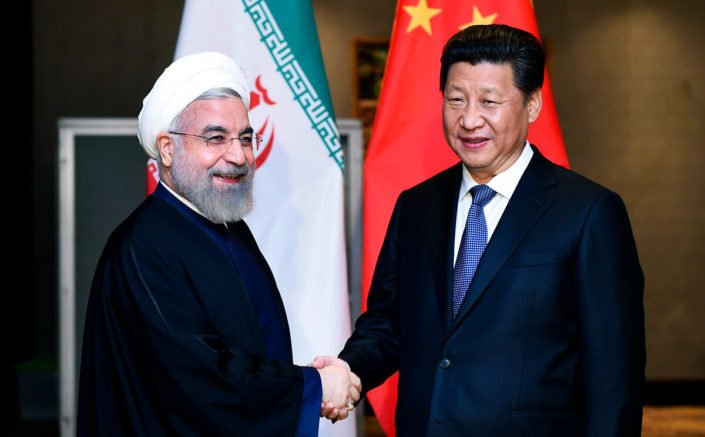
Iran reinforces partnership with China for economic relief

By Sabena Siddiqui

September 20, 2019

Facing an economic crisis in large part due to US sanctions, Iran soon may be aligning its policies toward China’s. Having recently updated the terms of a 25-year strategic partnership signed with Beijing in 2016, it looks like Tehran is indeed returning to its Look East foreign policy.

Originally posted on Al-Monitor’s website
September 17, 2019 here

Considered an important player in Chinese President Xi Jinping’s Belt and Road Initiative (BRI) megaproject, introduced in 2013, Iran has been pursued by Beijing for its energy resources and strategic location. But when economic sanctions on Iran were lifted under the Joint Comprehensive Plan of Action (JCPOA) nuclear deal in 2015, Iran preferred to do business on a global basis.

Instead of committing to an eastward-looking foreign policy at that time, Tehran tried to maintain a balance. However, since the United States withdrew from the nuclear deal in May 2018, Europe is having difficulty negotiating an arrangement acceptable to Iran.

So last month, Iranian Foreign Minister Mohammad Javad Zarif met with Chinese Foreign Minister Wang Yi to upgrade the comprehensive 25-year deal.

All details of this partnership are not known and may not be released to the public, as China hasn’t fully revealed the terms of its BRI agreements with other countries. But according to news reports, the first investments will take place in the initial five years, with $280 billion being pumped into the Iranian petrochemicals sectors and $120 billion into revamping transportation and manufacturing infrastructure.

China is to increase its imports of Iranian oil, which will be available at discounted rates, and it will also help to develop Iran’s Chabahar port.

Planning bilateral trade to the tune of $600 billion over a 10-year period, Beijing will increase investments in key economic sectors like energy and transportation in Iran.

China already has a significant presence in Iran, having provided $10 billion worth of loans to Chinese companies for projects, including rail infrastructure, dams and power generators; several of those projects are completed or underway. Engaged in developing three key energy projects, China had already taken the place of Western energy firms that left Iran.

Buying oil and gas at discounted rates using other soft currencies as well as the renminbi, China will also be granted the right to delay payments for up to two years, according to the new terms. Considering the exchange rates, China can get as much as a 32% discount on its purchases. Chinese companies will get first preference in all petrochemical projects in the country, whether it is to provide technology, systems or personnel.

Most significantly, “This will include up to 5,000 Chinese security personnel on the ground in Iran to protect Chinese projects, and there will be additional personnel and material available to protect the eventual transit of oil, gas and pet-chems supply from Iran to China, where necessary, including through the Persian Gulf,” an Iranian source told Petroleum Economist.

According to BRI requirements, the city of Tabriz would become a key node in the supply routes and connect Urumqi in China’s Xinjiang territory in the northwest to Tehran.

Pros and cons

Putting things in perspective, there are pros and cons of these terms.

One of the deal’s main benefits is that Iran expects to have two out of five United Nations Security Council (UNSC) votes in its corner to help bypass US sanctions, as Russia and China are both permanent members and Moscow backs Beijing in this strategic partnership.

Second, Iran could speed up oil and gas production from three of its main fields and create ripples in the hydrocarbon market. Reaping immediate benefits, Iran could reenter the hydrocarbon market with a bang.

Third, China would increase its imports of Iranian oil and help bring Tehran out of its economic crisis. However, Beijing might not be able to completely fill the economic void created by the departure of Western companies from Iran since the economic sanctions kicked in, as some Chinese oil companies like Sinopec and China National Petroleum Co. are already there.

There are several possible complications, though.

First, both the Arab states and Iran would have China as their biggest energy customer. This would be a major development for the Middle Eastern energy industry, as Saudi Arabia and other Arab states have also swung toward the East lately.

China and other Asian economies would still be dependent on hydrocarbon supplies, while the United States has its own reserves and the EU has implemented massive decarbonization policies.

Not only that, trade between China and the Arab states amounted to $244.3 billion in 2018, while Chinese companies signed construction contracts in Arab countries worth $35.6 billion and made direct investments of around $1.2 billion.

Therefore, after this 25-year partnership ends, Iran and its rivals will have to co-exist, as both will be firmly in the Chinese zone of influence.

Second, China might delay Iran’s entry into the Shanghai Cooperation Organization (SCO) until sanctions are lifted, as Beijing is also committed to the JCPOA. Also, after accepting Iran into the SCO, China would also have to accept Saudi Arabia and the United Arab Emirates at a time when the rivalry of new members India and Pakistan is already difficult for the forum to manage.

Finally, consolidating ties with China might close negotiation doors with the West, forcing Iran to comply with China’s long-term interests.

Committing to China completely could limit Iran’s business options in the long run. Meanwhile, even though Beijing has long been Tehran’s largest trading partner, China has annual trade worth $650 billion with just the United States, while the European Union is China’s biggest trading partner.

Disregarding US sanctions, China has continued its oil trade with Iran, but the volume is much less than last year. Thus, while Tehran would have to follow Beijing, the latter wouldn’t be bound to Iran to the same extent.

Therefore, looking East isn’t as easy as it might appear for Iran.

Being dependent on any single country for economic and security support would weaken Tehran, even though it could solve immediate problems, provide trade and stabilize Iran’s economy. Before implementing the 25-year strategic partnership, Tehran needs to give it more thought.

Sabena Siddiqui is a foreign affairs journalist and geopolitical analyst with a special focus on the Belt and Road Initiative, the Middle East and South Asia. On Twitter: @sabena_siddiqi

No data was found

Share

Leave a Reply

Your email address will not be published. Required fields are marked *

Related Posts

OK, Trump did not get it. But he got a full endorsement of a possible future US regime change in Venezuela. And that is what Ms Machado has advocated. On October 10, 2025, the Norwegian Nobel Committee awarded its Peace Prize to Venezuelan opposition figure María Corina Machado. The citation praised her “tireless work promoting democratic rights.” But Ms Machado has openly called for U.S. military intervention in Venezuela, stating on CBS: “The only way to stop the suppression is by force—U.S. force.” She or her party has received funding from the National Endowment for Democracy (NED), a U.S. government-backed body known as a CIA front organisation and for supporting regime-change operations worldwide. And in 2018, she sent a letter to Israeli Prime Minister Benjamin Netanyahu, asking him to use “force and influence” to help dismantle Venezuela’s government—citing alleged ties to terrorism, Iran and narcotrafficking. This year’s NATO Norwegian prize...
PRESS RELEASE – 6 OCTOBER 2025 LAY DOWN YOUR ARMSPEACE PRIZE FOR 2025 is awarded Francesca Albanese The United Nations Special Rapporteur on the occupied Palestinian territories – as the person who, in accordance with Alfred Nobel’s will, has “done the most or the best work for fraternity between nations and for the abolition or reduction of standing armies as well as for the holding and promotion of peace congresses.” Francesca Albanese has forcefully and unwaveringly worked against Israel’s full-scale war on the occupied Palestinian territories, in particular Israel´s ongoing genocide against the Palestinian people. She has confronted Israel’s systematic war crimes and crimes against humanity in a truly global outreach. Further, she has brought governments, international organisations and people’s groups together to underline the responsibility of the world at large to act and to stop arming, enabling, and profiting from Israel’s ongoing criminal actions. But first of all, Albanese...
Officially, the drones were not identified. By simply thinking critically – which journalists and selected experts no longer do – there may be a good reason for that. And this article will never be mentioned in Denmark… Drones over Denmark. No damage. No trace. No answers. Yet the headlines scream “Russian threat,” and Prime Minister Mette Frederiksen speaks with a certainty that defies logic: “We don’t know they were Russian—but we know Russia is the biggest threat to Europe.” It could be nobody else – unless you make an interest analysis which I did two days ago. This is not security policy. It’s theatre. And the audience is being played. Let’s rewind. These drones—unphotographed, untracked, unclaimed—appear and vanish like ghosts. Airports shut down. Panic spreads. Military budgets swell. And the narrative hardens: Russia is behind it. But what if that’s not just wrong but deliberately misleading? Here’s a hypothesis for...

Recent Articles

Gandhi, Arun. Lord Richard Attenborough. Kasturba: a lifeNew Delhi: Penguin Books Ltd., 2000.315 pp, 295 Indian Rs, US $22.51 January 29, 2002 Arun Gandhi, grandson to Mohandas and Kasturba, has written a thorough account of Kasturba’s life. Arun begins with a description of Kasturba’s childhood in Porbandar in the late1800s, before she met Mohandas. By having chosen to embark on difficult research into his grandmother’s life, including her first years which are not well-documented, Arun ensures that the reader receives an intimate and life-long portrait of this amazing woman. Kasturba is presented as a lively woman &endash; obedient, yet with a mind of her own. As the relationship between Kasturba and Mohandas developed, Arun maintains that Kasturba’s influence over Mohandas in her own quiet way also grew, to which some of Mohandas’ writings also attest.  Arun paints a vivid picture of the beginnings of Mohandas’ non-violence movement in South Africa, a...
In response to an urgent Appeal from all the living Nobel Peace Prize Laureates, the General Assembly of the United Nations, on November 1998, unanimously declared the first decade of the twenty-first century to be The Decade for a Culture of Peace and Nonviolence. While people are naturally concerned about the amount of violence in our world and how it threatens our future, the Nobel Laureates are right to remind us of the potential of nonviolence and our calling to build a culture of peace and nonviolence.  The twentieth century is instructive in the way that the philosophy and practice of nonviolence have begun to flourish and in the way that nonviolent movements have had an exponential growth across the world. Mohandas Gandhi and Martin Luther King, Jr. are the most famous nonviolent leaders but many have built upon the paths they charted as in country after country, tyrannies and...
We know that medical personnel have failed to report to higher authorities wounds that were clearly caused by torture and that they have neglected to take steps to interrupt this torture. In addition, they have turned over prisoners’ medical records to interrogators who could use them to exploit the prisoners’ weaknesses or vulnerabilities. We have not yet learned the extent of medical involvement in delaying and possibly falsifying the death certificates of prisoners who have been killed by torturers. A May 22 article on Abu Ghraib in the New York Times states that “much of the evidence of abuse at the prison came from medical documents” and that records and statements “showed doctors and medics reporting to the area of the prison where the abuse occurred several times to stitch wounds, tend to collapsed prisoners or see patients with bruised or reddened genitals.” http://www.truthout.org/docs_04/080604J.shtml#16 According to the article, two doctors who...

TFF on Substack

Discover more from TFF Transnational Foundation & Jan Oberg.

Most Popular

Gandhi, Arun. Lord Richard Attenborough. Kasturba: a lifeNew Delhi: Penguin Books Ltd., 2000.315 pp, 295 Indian Rs, US $22.51 January 29, 2002 Arun Gandhi, grandson to Mohandas and Kasturba, has written a thorough account of Kasturba’s life. Arun begins with a description of Kasturba’s childhood in Porbandar in the late1800s, before she met Mohandas. By having chosen to embark on difficult research into his grandmother’s life, including her first years which are not well-documented, Arun ensures that the reader receives an intimate and life-long portrait of this amazing woman. Kasturba is presented as a lively woman &endash; obedient, yet with a mind of her own. As the relationship between Kasturba and Mohandas developed, Arun maintains that Kasturba’s influence over Mohandas in her own quiet way also grew, to which some of Mohandas’ writings also attest.  Arun paints a vivid picture of the beginnings of Mohandas’ non-violence movement in South Africa, a...
In response to an urgent Appeal from all the living Nobel Peace Prize Laureates, the General Assembly of the United Nations, on November 1998, unanimously declared the first decade of the twenty-first century to be The Decade for a Culture of Peace and Nonviolence. While people are naturally concerned about the amount of violence in our world and how it threatens our future, the Nobel Laureates are right to remind us of the potential of nonviolence and our calling to build a culture of peace and nonviolence.  The twentieth century is instructive in the way that the philosophy and practice of nonviolence have begun to flourish and in the way that nonviolent movements have had an exponential growth across the world. Mohandas Gandhi and Martin Luther King, Jr. are the most famous nonviolent leaders but many have built upon the paths they charted as in country after country, tyrannies and...
We know that medical personnel have failed to report to higher authorities wounds that were clearly caused by torture and that they have neglected to take steps to interrupt this torture. In addition, they have turned over prisoners’ medical records to interrogators who could use them to exploit the prisoners’ weaknesses or vulnerabilities. We have not yet learned the extent of medical involvement in delaying and possibly falsifying the death certificates of prisoners who have been killed by torturers. A May 22 article on Abu Ghraib in the New York Times states that “much of the evidence of abuse at the prison came from medical documents” and that records and statements “showed doctors and medics reporting to the area of the prison where the abuse occurred several times to stitch wounds, tend to collapsed prisoners or see patients with bruised or reddened genitals.” http://www.truthout.org/docs_04/080604J.shtml#16 According to the article, two doctors who...
Read More
Imagen-thumbnail-The-Transnational-1
Gandhi, Arun. Lord Richard Attenborough. Kasturba: a lifeNew Delhi: Penguin Books Ltd., 2000.315 pp, 295 Indian Rs, US $22.51 January 29, 2002 Arun Gandhi, grandson to Mohandas and Kasturba, has written a thorough account of Kasturba’s life. Arun begins with a description of Kasturba’s childhood in Porbandar in the late1800s, before she met Mohandas. By having chosen to embark on difficult research into his grandmother’s life, including her first years which are not well-documented, Arun ensures that the reader receives an intimate and life-long portrait of this amazing woman. Kasturba is presented as a lively woman &endash; obedient, yet with a mind of her own. As the relationship between Kasturba and Mohandas developed, Arun maintains that Kasturba’s influence over Mohandas in her own quiet way also grew, to which some of Mohandas’ writings also attest.  Arun paints a vivid picture of the beginnings of Mohandas’ non-violence movement in South Africa, a...
Imagen-thumbnail-The-Transnational-1
In response to an urgent Appeal from all the living Nobel Peace Prize Laureates, the General Assembly of the United Nations, on November 1998, unanimously declared the first decade of the twenty-first century to be The Decade for a Culture of Peace and Nonviolence. While people are naturally concerned about the amount of violence in our world and how it threatens our future, the Nobel Laureates are right to remind us of the potential of nonviolence and our calling to build a culture of peace and nonviolence.  The twentieth century is instructive in the way that the philosophy and practice of nonviolence have begun to flourish and in the way that nonviolent movements have had an exponential growth across the world. Mohandas Gandhi and Martin Luther King, Jr. are the most famous nonviolent leaders but many have built upon the paths they charted as in country after country, tyrannies and...
Imagen-thumbnail-The-Transnational-1
We know that medical personnel have failed to report to higher authorities wounds that were clearly caused by torture and that they have neglected to take steps to interrupt this torture. In addition, they have turned over prisoners’ medical records to interrogators who could use them to exploit the prisoners’ weaknesses or vulnerabilities. We have not yet learned the extent of medical involvement in delaying and possibly falsifying the death certificates of prisoners who have been killed by torturers. A May 22 article on Abu Ghraib in the New York Times states that “much of the evidence of abuse at the prison came from medical documents” and that records and statements “showed doctors and medics reporting to the area of the prison where the abuse occurred several times to stitch wounds, tend to collapsed prisoners or see patients with bruised or reddened genitals.” http://www.truthout.org/docs_04/080604J.shtml#16 According to the article, two doctors who...
Imagen-thumbnail-The-Transnational-1
Jan Øberg behandler i artiklen en lang række faktorer, som ligger til grund for den måde vores samfund er organiseret på – og derfor også for konflikter. Artiklen introducerer således sammenhængen mellem familien, foreninger, regeringer, NGO’ er, nation, stat, nationalstat og alliancer for på denne måde bedre at kunne forstå konflikter og i sidste ende blive klogere mht. at løse disse. Øberg, der er fortaler for global bevidsthed, hvilket skal ses i lyset af den øgede globalisering, skelner mellem kulturkamp og kulturdialog. Endelig behandles begrebet magt og magtesløshed: giver magt ret til at udøve magt – fordi man mener at have ret? Litteraturliste og arbejdsspørgsmål efter artiklen. Ordene vi bruger om verden I satellitperspektiv kan man godt tale om den menneskelige familie eller menneskeheden. Udtrykket understreger, at der eksisterer – eller burde eksistere – et fællesskab fordi vi alle er mennesker og sammen bebor denne klode og ingen anden. Og...
Imagen-thumbnail-The-Transnational-1
Kapitel 2: Forskellige sider af Europa og USA…fortsat 2.5 Militære relationer I forbifarten har vi allerede sagt nogle ting om USA’s militære situation. Kig lige en gang til på afsnit 2.3. Nu skal vi uddybe det militære forhold mellem USA og EU. Der er en række ligheder mellem visse europæiske landes og USA’s militær. Næsten alle er med på en eller anden måde i NATO, direkte som medlem – selv Island, der ikke har et forsvar – eller indirekte i Partnerskab for Fred. USA og Canada er med i OSCE (på dansk OSSE), Organisationen for Sikkerhed og Samarbejde i Europa, der tæller over 50 lande. USA samt England og Frankrig er kernevåbenstater og de har styrker til intervention langt borte fra hjemlandet, om end USA’s er tifold større. Alle har også en omfattende våbeneksport og bruger den som et middel til at tjene penge og få loyale venner på, det...
Imagen-thumbnail-The-Transnational-1
Background Christian Harleman and Jan Oberg conducted a fact-finding mission to Burundi between November 26 and December 6, 2003. (See websites about the country here). The first TFF mission took place in March 1999. Unfortunately, since then it has not been practically possible to implement the co-operation with Burundi’s Ministry of Education and Burundian NGOs that was planned at the time. The 2003 mission had three purposes. First, to do fact-finding in general about the situation and, in particular, the progress under the Arusha Peace Process. Second, to explore the possibilities for co-operation between the government and relevant NGOs on the one hand and TFF on the other, in order to develop and deepen the existing competence in fields such as conflict-understanding, reconciliation and peace-building. Finally, third, to find out whether it would be possible, in co-operation with the Swedish Rescue Services Agency (Statens Räddningsverk), to establish a health care unit that...

