China’s Belt and Road Initiative: Towards a Just World?

By Chandra Muzaffar

May 16th, 2019

The Belt Road Initiative (BRI) also known as the One Belt One Road (OBOR) project could well emerge as the obor (the flame in Indonesian or Malay) that will blaze the trail in the evolution of a new epoch in history.

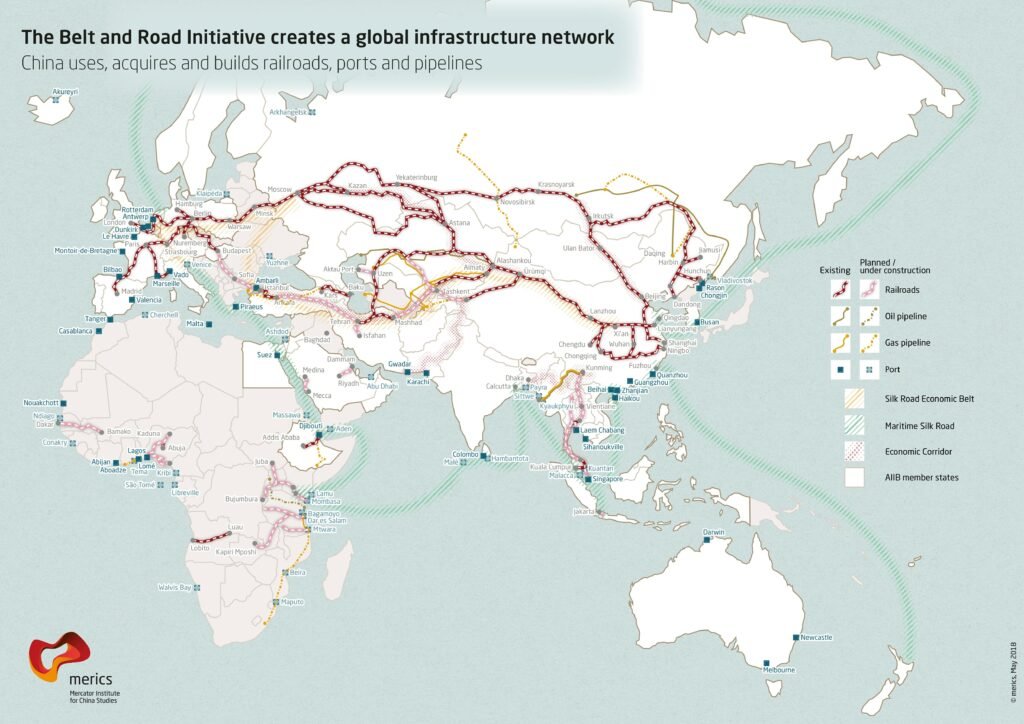
Chinese President Xi Jinping must have sensed its historical significance when he announced OBOR in 2013. Essentially an infrastructure development endeavor it seeks to initiate and support the construction of roads, railways, ports and bridges in at least 65 other countries spanning four continents. With a commitment of over 900 billion US dollars, OBOR is the biggest infrastructure development project ever undertaken in the history of our planet.

Originally posted on Transcend Media Service on May 1st, 2019 here

It is more than infrastructure in the conventional sense. The China-Pakistan Economic Corridor  (CPEC) for instance which connects China’s Xinjiang province with Gwadar port in Pakistan’s Balochistan province will strengthen Pakistan’s energy sector, contribute to economic growth and reduce its severe trade deficit. The CPEC will also enhance cooperation between the two countries in agriculture.  There are other projects in other countries that will impact positively upon education and health care.

There is no doubt at all that OBOR will also facilitate the interaction of cultures and communities across national boundaries. This may lead to better understanding and appreciation of cultural and religious diversity. Greater respect for the differences and similarities that distinguish religions and cultures could help create an atmosphere that conduces towards social harmony.

If OBOR paves the way for positive interaction between different ethnicities and nationalities it would be replicating one of the outstanding achievements of the ancient Silk Route which was the inspiration for OBOR.

Ideas and beliefs flowed along the Silk Route which connected East Asia and Southeast Asia with West Asia and East Africa to Southern Europe from about 130 BC until perhaps the middle of the 15th century.  It is significant that it was through the Silk Route that Buddhism, Christianity and Islam spread at different times in history.

It was “the cauldron where language groups competed, where Indo-European, Semitic and Sino-Tibetan tongues wagged alongside those speaking Altaic, Turkic and Caucasian.”

Places of worship and libraries dotted the region “connecting Constantinople to Damascus, Isfahan, Samarkand, Kabul and Kashgar.”

First Wave of Globalization

These fabulous cities were not only centres of culture and learning but also hubs of thriving commercial enterprise. Silk was an important element in the trade that connected the sprawling network of links which was why a German geologist in the 19th century gave it the name the “Silk Roads”.  Precious stones and metals, paper and artwork, leather and hides, grains and spices, fruits and vegetables were all part of the trade and commerce that brought China and India close to Persia and Rome and vice versa.  

The variety of goods and commodities available and the lands and nations that produced them endowed the Silk Route with an unprecedented global character. It was truly humankind’s first wave of globalization.

Second Wave of Globalization

A variety of factors brought the wave to an end, among them Christopher Columbus’s expedition to the Americas and Vasco da Gama’s journey around the southern tip of Africa and on to India at the end of the 15th century, both of which opened up new sea routes for Europe’s ascending maritime powers.

Columbus in relation to the Americas and da Gama in relation to India and Asia heralded the rise of European colonialism which over the next four centuries embarked upon the conquest of land, the subjugation of people and the usurpation of natural resources that ushered in a pattern of power, control and dominance centering around Europe and later, the United States of America.

Indeed, western colonialism as it expressed itself in almost every sphere of life laid the basis for a new form of globalization which has perpetuated itself beyond the end of formal colonial rule. It is what one would call ‘hegemonic globalization’. 

Hegemonic globalization has resulted in the dissemination of ideas and methods in economics and finance, politics and administration, education and science which by and large emanate from the centers of power in the West.

It has shaped a world in which the interests and agendas of the dominant West supersede everything else. This is why the second wave of globalization is perceived as unjust and inimical to the well-being of the majority of the world’s citizens.

Third Wave of Globalization

As globalization’s third wave, OBOR is opposed to hegemony. The Chinese leadership sees relationships among OBOR states as a partnership. It has no intention of imposing its will upon any other state. This was put to the test in the East Coast Rail Link (ECRL) issue which saw Malaysia objecting to various terms of the agreement forged between a Chinese company and the previous Malaysian government  that were clearly detrimental to the nation’s interests. After strenuous negotiations, the agreement was revised extensively for the good of both parties.

It is not just China’s willingness to consider the interests of a partner state that facilitated a solution to the ECRL issue. The partner state should also be free of those vested interests that impede a just solution.

It is important to observe that even in other collaborative efforts in which China has played a leading role such as the Asia Infrastructure Investment Bank (AIIB), the Brazil, Russia, India, China and South Africa (BRICS) network and the Shanghai Cooperation Organization (SCO), China has adopted a collegial approach.

Given its record, China should now elevate the principle of partnership in OBOR to a higher level by establishing an international panel consisting of seven to ten OBOR states that would be given the task of monitoring and evaluating the implementation of OBOR projects and activities.  The proposed panel would of course work closely with the Chinese authorities.

It could also help ensure that OBOR is corruption-free which is the wish that Xi expressed at the recently concluded Belt and Road Forum for International Cooperation in Beijing. There will be other challenges facing OBOR in the years ahead. But the governments that are committed to the project should remain steadfast in their determination to achieve its goals.

For apart from the economic and cultural benefits that OBOR will bring to the human family which we have noted, OBOR is the best hope we have for evolving a just and equitable world which is not dominated by a few.

Only in such a world will human dignity flourish. This is perhaps the most compelling reason why the citizens of the world should strive with all their energy to keep the flame alive.
Dr. Chandra Muzaffar is a member of the TRANSCEND Network for Peace, Development and Environment, and president of the International Movement for a Just World (JUST). He is the author of the e-book ‘Whither WANA?-Reflections on the Arab Uprisings,’ which is accessible through the JUST website, www.just-international.org.

Share

Leave a Reply

Your email address will not be published. Required fields are marked *

Related Posts

Launched on November 17, 2024Updated with new materials regularly TFF Board members Thore Vest. Everywhere, the delegation was met with a sincere wish to develop knowledge, dialogue, cooperative projects, and initiatives based on citizens’ diplomacy – in general, but with the West in particular. For more, see “Report from the Nordic delegation to China’s Xinjiang Province, September 7-15, 2024.” While the delegation was in Xinjiang, various ideas were already being discussed from the local to the top level, i.e., with the governor and party leaders of Xinjiang. The two TFF Associates suggested that TFF set up a special section – in addition to its “China and Silk” – where various quality materials about Xinjiang would regularly be published to promote public education about Xinjiang, particularly its contemporary development – worldwide but in the West in particular. This is now a reality – as can be seen below – but it...
Photo Jan Oberg China has recently garnered significant attention due to its advancements in various technological fields, such as quantum physics and artificial intelligence. In media discussions and my lectures on China, it is common to encounter objections asserting that the West, particularly the United States, is certainly ahead of China. These assertions appear to be more emotional than factual. However, a more fundamental consideration is whether this question holds any significance. Cultural Perspective One aspect that Westerners often overlook is the cultural variation in understanding the relationship between abstract academic insights and practical applications of those insights. To comprehend the origin and significance of discussions on technological superiority, it is essential to acknowledge cultural and social differences between China and the West. I have explored this topic before in some of my previous articles published on the TFF website. Particularism On the cultural dimension universalist – particularist, China exhibits...
Foreword The Board of The Transnational Foundation in Sweden has decided to publish an easy-to-read, scholarly anthology that addresses one of the most important – and potentially dangerous – issues of our time: Why are the political, economic, and medialised Western images of China so consistently negative – and what can you do to understand China better? These images may be expressions of a political will to present only various shades of grey and black with the aim of building a consciousness about China as an enemy and not a partner. They may also be seen as a sort of world-dominating ethos of ignorance based upon the assumption that “we’ve-got-nothing-to-learn-from-others,’ we are the teacher. Another possibility is that the West, deep down, feels that it is getting relatively weaker from a macro-historical perspective and comforts itself with denial and accusations against “the other” of being the reason for its manifest...

Recent Articles

PressInfo # 141, December 21, 2001It’s time to prepare reconciliation between Albanians and Serbs PressInfo # 140, December 14, 2001Ibrahim Rugova’s decade-long leadership in Kosovo/a PressInfo # 139, 11. december, 2001En god nyhet: Jugoslaviens Sannings- och försoningskommission PressInfo # 139, 11. december, 2001Gode nyheder: Jugoslaviens Sandheds- og Forsoningskommission PressInfo # 139, December 11, 2001Good news: Yugoslavia’s Truth and Reconciliation Commission PressInfo # 138, November 8, 2001TFF co-founder PhD with thesis about young people with roots in other cultures PressInfo # 138, November 8, 2001TFF:s medstiftare doktor på avhandling om unga med ursprung i andra kulturer PressInfo # 137, October 17, 2001A new Marshall Plan: Advancing human security and controlling terrorism PressInfo # 136, October 15, 2001The UN and Annan really deserve it PressInfo # 135, October 10, 2001Preventing a terrorist mushroom cloud PressInfo # 134, 17 oktober, 2001Sverige og 11. september PressInfo # 134, October 9, 2001Sweden and September 11...
Peace is promoted by constructive proposals and dialogue Four preceding PressInfos have expressed concern over — and criticised — the ongoing, militarisation of the EU. Some will say: but there are no alternatives. We believe that there are always alternatives, that democracies are characterised by alternatives and choice, and that openly discussed alternatives will improve the quality and legitimacy of society’s decision–making. In addition, it is an intellectual and moral challenge to not only criticise but also be constructive. If we only tell people that we think they are wrong, they are not likely to listen. However, if we say: what are your views on this set of ideas and steps? — we may sometimes engage them in dialogue and sow a seed. Most people in power circles live their daily lives in in a time frame and a social space where certain ideas, viewpoints and concepts are just not...
Photos © TFF 2000 Read PressInfo 90 “Lift the Sanctions and Bring More Aid to Yugoslavia” See Pictures from Belgrade © TFF 2000 Please reprint, copy, archive, quote or re-post this item, but please retain the source.

TFF on Substack

Discover more from TFF Transnational Foundation & Jan Oberg.

Most Popular

PressInfo # 141, December 21, 2001It’s time to prepare reconciliation between Albanians and Serbs PressInfo # 140, December 14, 2001Ibrahim Rugova’s decade-long leadership in Kosovo/a PressInfo # 139, 11. december, 2001En god nyhet: Jugoslaviens Sannings- och försoningskommission PressInfo # 139, 11. december, 2001Gode nyheder: Jugoslaviens Sandheds- og Forsoningskommission PressInfo # 139, December 11, 2001Good news: Yugoslavia’s Truth and Reconciliation Commission PressInfo # 138, November 8, 2001TFF co-founder PhD with thesis about young people with roots in other cultures PressInfo # 138, November 8, 2001TFF:s medstiftare doktor på avhandling om unga med ursprung i andra kulturer PressInfo # 137, October 17, 2001A new Marshall Plan: Advancing human security and controlling terrorism PressInfo # 136, October 15, 2001The UN and Annan really deserve it PressInfo # 135, October 10, 2001Preventing a terrorist mushroom cloud PressInfo # 134, 17 oktober, 2001Sverige og 11. september PressInfo # 134, October 9, 2001Sweden and September 11...
Peace is promoted by constructive proposals and dialogue Four preceding PressInfos have expressed concern over — and criticised — the ongoing, militarisation of the EU. Some will say: but there are no alternatives. We believe that there are always alternatives, that democracies are characterised by alternatives and choice, and that openly discussed alternatives will improve the quality and legitimacy of society’s decision–making. In addition, it is an intellectual and moral challenge to not only criticise but also be constructive. If we only tell people that we think they are wrong, they are not likely to listen. However, if we say: what are your views on this set of ideas and steps? — we may sometimes engage them in dialogue and sow a seed. Most people in power circles live their daily lives in in a time frame and a social space where certain ideas, viewpoints and concepts are just not...
Photos © TFF 2000 Read PressInfo 90 “Lift the Sanctions and Bring More Aid to Yugoslavia” See Pictures from Belgrade © TFF 2000 Please reprint, copy, archive, quote or re-post this item, but please retain the source.
Read More
Imagen-thumbnail-The-Transnational-1
PressInfo # 141, December 21, 2001It’s time to prepare reconciliation between Albanians and Serbs PressInfo # 140, December 14, 2001Ibrahim Rugova’s decade-long leadership in Kosovo/a PressInfo # 139, 11. december, 2001En god nyhet: Jugoslaviens Sannings- och försoningskommission PressInfo # 139, 11. december, 2001Gode nyheder: Jugoslaviens Sandheds- og Forsoningskommission PressInfo # 139, December 11, 2001Good news: Yugoslavia’s Truth and Reconciliation Commission PressInfo # 138, November 8, 2001TFF co-founder PhD with thesis about young people with roots in other cultures PressInfo # 138, November 8, 2001TFF:s medstiftare doktor på avhandling om unga med ursprung i andra kulturer PressInfo # 137, October 17, 2001A new Marshall Plan: Advancing human security and controlling terrorism PressInfo # 136, October 15, 2001The UN and Annan really deserve it PressInfo # 135, October 10, 2001Preventing a terrorist mushroom cloud PressInfo # 134, 17 oktober, 2001Sverige og 11. september PressInfo # 134, October 9, 2001Sweden and September 11...
Imagen-thumbnail-The-Transnational-1
Peace is promoted by constructive proposals and dialogue Four preceding PressInfos have expressed concern over — and criticised — the ongoing, militarisation of the EU. Some will say: but there are no alternatives. We believe that there are always alternatives, that democracies are characterised by alternatives and choice, and that openly discussed alternatives will improve the quality and legitimacy of society’s decision–making. In addition, it is an intellectual and moral challenge to not only criticise but also be constructive. If we only tell people that we think they are wrong, they are not likely to listen. However, if we say: what are your views on this set of ideas and steps? — we may sometimes engage them in dialogue and sow a seed. Most people in power circles live their daily lives in in a time frame and a social space where certain ideas, viewpoints and concepts are just not...
Imagen-thumbnail-The-Transnational-1
Photos © TFF 2000 Read PressInfo 90 “Lift the Sanctions and Bring More Aid to Yugoslavia” See Pictures from Belgrade © TFF 2000 Please reprint, copy, archive, quote or re-post this item, but please retain the source.
Imagen-thumbnail-The-Transnational-1
Av FRANK SØHOLM GREVIL 16 augusti 2004  Vi er nu nået til tredje akt i det absurde teaterstykke, der i analogi med de store skueprocesser i Moskva 1936-38 er blevet døbt ‘Grevil-sagen’. Første akt bestod i min anonyme fremlæggelse af egenhændigt nedklassificerede rapporter i Berlingske Tidende i februar og marts. Andet akt udgjordes af min fremtræden med navn og billede i Information i april samt den efterfølgende mediestorm, som uden min direkte medvirken kostede en forsvarsminister taburetten samt en sigtelse for brud på tavshedspligten. Tredje akt bliver en retssag, hvor jeg står tiltalt for at have overtrådt straffelovens bestemmelser om uberettiget videregivelse eller udnyttelse af fortrolige oplysninger. Statsanklageren har ovenikøbet valgt at påberåbe sig særligt skærpende omstændigheder. Da jeg aldrig har modtaget betaling for at stille rapporterne til rådighed eller lade mig interviewe, må det skærpende bestå i, at “videregivelsen eller udnyttelsen er sket under sådanne omstændigheder, at det påfører...
Imagen-thumbnail-The-Transnational-1
Af Svenska Irakkommittén mot de Ekonomiska Sanktionerna (SIES) 13 september 2002 FN:s ekonomiska sanktioner mot Irak har nu pågått i tolv år och drabbat det irakiska folket med svåra lidanden. Enligt FN:s egna siffror har mer än 1,5 miljoner människor, varav ca 600 000 barn, dött som en direkt följd av sanktionerna. Dessutom har ett lågintensivt bombkrig mot landet pågått under dessa år. Av all denna förödelse- orsakad huvudsakligen av amerikansk och brittisk politik- har Saddam Husseins brutala och diktatoriska regim snarast stärkts än försvagats. Nu förbereder USA under president Bushs ledning ett storskaligt bombkrig mot Irak som kommer att innebära ett ännu större lidande för civilbefolkningen. Ett sådant krig kommer dessutom att ytterligare undergräva freden och säkerheten i världen. Att upprätta en demokratisk regim i Irak är det irakiska folkets angelägenhet och får enligt folkrätten inte ske med krigshandlingar utifrån. Folkrätten och FN:s stadgar måste respekteras. Vi vädjar till...